Sine fine, or: Imaginations of Infinity, Unlimitedness, and Limitlessness

Jupiter, in the first book of Vergil’s Aeneid, outlines his vision for the future and develops a strategy for the Roman Empire. One of the highlights of his speech is a well-known, rather extraordinary promise (Verg. Aen. 1.278-9):

His ego nec metas rerum nec tempora pono,
imperium sine fine dedi. (…)

To them I set neither goals for their fortunes nor seasons,
I granted rule without limit. (…)

Roman affairs (res), according to this, will be free from divinely imposed (nec … pono) restrictions in space (metae) or time (tempora) – resulting in the award of an imperium that has no boundaries (sine fine).

By this, the Romans were – poetically – granted an unlimited imperium, unlimited rule, by a higher authority, for Jupiter could have interfered with their success story by means of imposing restrictions. Restrictions and limits are typically imposed by authorities and natural necessities whose power rules supreme, but here Jupiter, as a benign spiritus rector, chose not to exercise his powers, thus supporting the (imagined) sustained prosperity of the Empire through the removal of otherwise limiting features.

Sine fine, ‘without limit’, is not an uncommon motive in Latin literature – there are over sixty instances for it, many of them poetical. What stands out in Vergil’s use of it, however, is its proximity to terms that denote the deliberate, divine (lack of) imposition of fines, making Jupiter’s promised ‘infinity’ something that is unlimited, not limited by constraints, rather than something that is actually limitless.

Unlimitedness, according to this, creates certainty and ultimately also prosperity: it is a state of affairs that allows its beneficiaries to have something to rely upon and to build upon.

The same cannot be said for the concept of limitlessness, expressed by the same phrase sine fine, which in Latin literature is an inherently vague, potentially deeply unsettling, and in fact threatening state.

Lucretius, in his didactic poem De Rerum Natura (‘On the Nature of Things’), describes the infinity of the universe, imagining a void in which all atoms move. The limitlessness of this void results in the atoms’ inability to settle permanently and to build up in a constructive fashion, resulting in definitive clusters (Lucr. 2.90-4):

(…) reminiscere totius imum
nil esse in summa, neque habere ubi corpora prima
consistant, quoniam spatium sine fine modoquest
immensumque patere in cunctas undique partis
pluribus ostendi et certa ratione probatumst.

 (…) remember that overall there is no bottom of the Universe, nor is there anywhere for the atoms to settle, for space is without limit and measure, and I have shown and proven with reason and certainty that it extends itself unfathomably everywhere in every direction.

In the Vergilian passage, Jupiter is imagined as having lifted constraints, granting unlimited rule. Limitlessness, too, can be imposed – famously exemplified in the suffering of the eternal sinners of the ancient world.

The Roman fabulist Phaedrus, in the seventh poem of his Appendix, entitled Sensum aestimandum esse non uerba (‘The meaning is to be considered, not the mere words’), writes (Phaedrus, Appendix 7.1–6):

Ixion quod versari narratur rota,
Volubilem Fortunam iactari docet.
Aduersus altos Sisyphus montes agit
Saxum labore summo, quod de uertice
Sudore semper irrito reuoluitur,
Ostendit hominum sine fine esse miserias
.

‘The story of Ixion, whirling round upon the wheel, teaches us what a rolling thing is fortune. Sisyphus, with immense labour, pushing the stone up the lofty hill, which ever, his labour lost, rolls back from the top, shows that men’s miseries are endless.’

(transl. H. Th. Riley)

Imposed limitlessness in this story means endless suffering and complete absence of hope for Sisyphus to regain control over his life – it remains permanently under the control of supreme powers. It is thus the exact opposite of the unlimitedness that results from lifted restrictions that regulate one’s fate, even though the language – most notably its key phrase sine fine – is so deceptively similar.
Posted in Poetry | Tagged , , , , | Comments Off on Sine fine, or: Imaginations of Infinity, Unlimitedness, and Limitlessness

The Uses and Benefits of Multilingualism

The L’Africa Romana series is both a treasure trove and a complete nightmare. It comprises the proceedings of a series of broad international conferences, co-ordinated by the University of Sassari, dedicated to the study of Roman North Africa. They cover the widest possible range of studies related to this exciting, vibrant region of the Roman world. Many a gem tends to go unnoticed in the overwhelming stream of articles that are published in those voluminous, daunting tomes on a regular basis, unsurprisingly not seldom buried among numerous pieces of lesser significance.

In the nineteenth volume of this series, the distinguished Tunisian scholar Zeineb Benzina Ben Abdallah, in collaboration with Lotfi Naddari, in their piece ‘Omnium litterarum scientissimus …: à propos d’une famille des lettrés des environs d’Ammaedara’, report a pair of clearly related funerary inscriptions of the Caecilii family from Ammaedara (Haïdra, Tunisia).

One of the two items they discuss in this article caught my attention due to its prominent mention of multilingualism.

The text has been inscribed on an impressive hexagonal cippus of 2.37 metres’ height, and it reads as follows:

D(is) M(anibus) s(acrum). | Q(uintus) Caecilius | Vitalis uix(it) | ann(os) LXXV m(enses) II. | h(ic) s(itus) e(st). | Caecilii Vitali|anus Barba|rus et Rusticu|lus filii pa|tri optimo | omnium litte(ra)|rum scientissi|mo et in utra|q(ue) lingua tam | Graeca quam | Latina peritis|simo propa|gatori huius | surculi bono | uiro fece[ru]nt.

Sacred to the Manes. Quintus Caecilius Vitalis lived for 75 years and 2 months. He lies here. The Caecilii Vitalianus, Barbarus, and Rusticulus, his sons, had this made for their best father, most learned in all disciplines as well as most experienced in the Greek language just as much as in Latin, promoter of this sprig, a decent man.

(Afr. Rom. XIX p. 2118–20 with fig. 5–6)

This monument deploys a veritable array of superlatives. The father is described by his three sons as omnium litte(ra)|rum scientissi|mo et in utra|q(ue) lingua tam | Graeca quam | Latina peritis|simo, ‘most learned in all disciplines as well as most experienced in the Greek language just as much as in Latin’.

The phrase stresses not only the father’s bilingualism, but simultaneously volunteers an understanding of in utra|q(ue) lingua in the form of a comparison. Could there possibly have been any ambiguity over the meaning of utraque lingua, one must wonder?

Well, actually, yes, there could have been, for the linguistic landscape of Roman North Africa was anything but homogeneous, as J. N. Adams in his monograph on ‘Bilingualism and the Latin Language’ has demonstrated with meticulous care.

Since the inscription was found in Roman North Africa, it is altogether unsurprising that the father’s native language or at least his preferred ‘official’ language was Latin: this area was part of the Latin-speaking hemisphere of the Roman empire. Yet, Latin was by no means the sole language that was in use in Roman North Africa, and in that respect it was of course perfectly possible that someone buried in that area also knew a native language or regional dialect of Africa Proconsularis.

This, however, is not at all the impression the dedicants of this inscription wanted to give – in fact, they seem to have been eager to avoid it at all costs –, and thus they clarify their statement by likening his command of Greek to that of his (native? preferred?) Latin.

Why did it matter so much to them?

A reasonable response to this question would be that it mattered because reference to the utraque lingua is shorthand code for an apparent, traditional Roman aristocratic education. The father had command of two prestige languages, command to a degree that even Quintilian should have been proud of him.

Asserting (classical) learning and multilingualism is, as Ben Abdallah and Naddari have seen in their fascinating article, not an altogether uncommon motive in the sphere of the Northern African provinces.

One can add to their observations that, in addition to Rome and some Italic regions, Africa is in fact the sole area of the Roman Empire in which multilingualism seems to have made it into the canon of topoi on funerary inscriptions – it did not seem to matter anywhere near as much in the Western, Northern, and Eastern regions of the empire.

North Africa in one way was far away from Rome and main Italy. Those who assert multilingualism here, in the way in which the Caecilii did, may indeed have done so as a means of asserting their traditional, upper-class education.

This, however, is only one use of their promoted multilingualism. Roman North Africa was an area of the Roman empire that saw almost unparalleled levels of growth and prosperity, of urbanisation and cultural wealth from the first century A. D. onwards. The area sits at the crossroads of the Greek-speaking East and the Latin-speaking West, and it was an vibrant area of global trade and commerce. In such an area multilingualism, whether acquired as an object of prestige or for purely practical reasons, was an economic necessity.

A bit of this mentality – in addition to that of education for education’s sake – shines through in the above inscription as well: the Caecilius Vitalis is stylised as a propagator huius surculi, a ‘promoter of this sprig’, a driving force behind a fresh, young branch of a family that clearly is determined to grow and to prosper.

The same mindset emerges from the second inscription that is discussed in Ben Abdallah’s and Naddari’s article, an inscription that honours Vitalis’ father: the father is described as the institutor huius regionis et surculi, the one who set up this entire region as well as the family branch – the very branch that Vitalis then managed to advance even further.

The decidedly entrepreneurial spirit behind this set of texts thus makes it very unlikely that the desire to reveal classical learning was the sole driving force behind their language learning. At the same time, the veneer of a classical education clearly will have been welcome to them, too.

Posted in Education, Epigraphy, Prose | Tagged , , , | 1 Comment

Grapes and Wrath, or: Phaedrus on Things Too High

Former UK Prime Minister Sir John Major recently expressed his shock at ‘at the way in which every sphere of modern public life is dominated by a private school-educated elite and well-heeled middle class’.

‘Our education system should help children out of the circumstances in which they were born, not lock them into the circumstances in which they were born. We need them to fly as high as their luck, their ability and their sheer hard graft can actually take them. And it isn’t going to happen magically,’ Major said.

It is easy to play the blame game (and Major’s own intervention is not entirely free of that). Which one of the political parties is more to blame for the loss of social mobility (the very concept of which has recently been brought into disrepute as well)? Yet, it is an exercise in futility, as it does nothing to identify possible solutions – and as it misses an essential point. A first degree from an Higher Education institution in the UK, for home and EU students, currently comes with an annual price tag of up to £9,000 – on top of the daily cost of life.

The recent change in the tuition fees regime has sparked a massive debate as to whether some degree programmes are more useful than others, furthered by the government’s desire to introduce a ‘food labelling’ system to classify degree programmes and to measure their performance indicators. It has generated a debate as to whether a  degree is a good idea to begin with. It has generated a debate as to whether some (or any) Universities are worth such a significant investment.

All of this is dwarfed, however, by a common trend in the public perception of Higher Education in the UK – the outright despisal and contempt hurled towards Academia and its representatives as a bunch of quixotic, out-of-this-world tree-huggers and eggheads: web forums and other outlets are full of such remarks, as are opinion pieces in newspapers – a trend that no government appears to be interested in contradicting or tackling. This is, of course, remarkable in a situation in which on the one hand ‘the masses’ have effectively been priced out of Higher Education, while, on the other hand, it is perfectly obvious (as Major aptly points out) that the country is run by the recipients of the same.

Phaedrus, a slave, who became famous for his writing of Aesopian fables during the early Roman Empire, tells a well-known story (Phaedus 4.3):

De uulpe et uua

Fame coacta uulpes alta in uinea
uuam appetebat summis saliens uiribus;
quam tangere ut non potuit, discedens ait:
‘nondum matura est; nolo acerbam sumere.’
qui facere quae non possunt, uerbis eleuant,
ascribere hoc debebunt exemplum sibi.

Of the Fox and the Grapes

Driven by hunger, a fox tried to reach, high up in the vineyard, the grapes, jumping with all his strength; as he could not reach it, he walked away and said: ‘They’re not ripe yet; I don’t like to eat them sour.’

Those who scorn, with their words, what they cannot achieve, will have to fess up to this paradigm.

The fox’s frustration is understandable. Sadly, his response is neither designed to allay his hunger nor, in fact, to remove the need to eat, if he wishes to survive. Yet, it was not the fox’s instinct to try the grapes that was mistaken: it was the inadequacy of his attempts to reach it that betrayed him.

There may be a lesson in Phaedrus’ fable.

Posted in Education, Poetry | Tagged , , | Comments Off on Grapes and Wrath, or: Phaedrus on Things Too High

Imperialism, Linguistic Diversity, and Common Language

A few thoughts on occasion of Language Festival 2013.

By the mid first century AD, when the Roman author Pliny the Elder wrote his monumental Natural History, Rome had become an empire of global significance and enormous dimensions. It held territories around the Mediterranean, in Europe, Asia, and Africa, incorporating hundreds of peoples, tribes, and cultures across closer to five million square miles, who, in many cases, had little more in common than their being subjected to Roman rule.

When he describes the landscape and the peoples of the Apennine peninsula, in the third book of his Natural History, Pliny makes an interesting comment. Following a rough-and-ready account of but a few of the peoples who originally inhabited the Apennine peninsula (i. e. modern day Italy), he says that –

I am well aware that I may with justice be considered ungrateful and lazy if I describe in this casual and cursory manner a land which is at once the nursling and the mother of all other lands, chosen by the providence of the gods to make heaven itself more glorious, to unite scattered empires, to make manners gentle, to draw together in converse by community of language the jarring and uncouth tongues of so many nations, to give mankind civilisation, and in a word to become throughout the world the single fatherland of all the races. But what am I to do?

(Pliny, Natural History 3.29, transl. H. Rackham)

Pliny’s words express a remarkable pride in the achievements of the Roman Empire, originating in his native Italy: Rome is both the nursling and the mother of all other lands, and it has become the single fatherland of all the races, throughout the world. It has brought (or so Pliny chooses to think) gentle manners and unity to communities across the ancient world – the Latin text says congregaret imperia (‘to make empires flock together’) and ritusque molliret (‘to soften the conduct’). In short, it gave mankind civilisation – humanitatem homini daret, to provide humanitas, the very essence of human existence, to the humans.

And then there is that bit about the languages…

The Latin reads as follows: et tot populorum discordes ferasque linguas sermonis commercio contraheret ad colloquia – ‘and to pull together for mutual exchange such many disharmonious and unrestrained languages of peoples through the community of language.’

Rome, the parent of the ancient world, has taught her rumbustious (rather forcefully adopted) children a common language, a lingua franca, and it is by means of this tool that some of the less desirable aspects of the olden age appear to have disappeared: fruitful verbal exchange (colloquia) has replaced the disharmonious (discordes) and unrestrained (feras) linguistic landscape.

The Latin language knows a stylistic device called enallage adiectivi – the re-deployment of an adjective, to accompany  that one noun in a pairing of nouns that would not normally require such qualification. One may, of course, imagine the existence of disharmonious languages. But what would be the idea behind ‘wild, unrestrained languages’? It is thus not altogether implausible that these two adjectives, disharmonious and unrestained, should in fact be taken with tot populorum, i. e. ‘the languages of such many disharmonious and unrestrained peoples’.

The semantic shift may seem minimal. But it radically highlights the underlying issue: imposing the use of a single language on the peoples of the Roman Empire (at least as far as the Apennine peninsula is concerned – Pliny does not pretend that this applies to the entire Roman world) is an act of imperialism, suppression, and violence, disguised as the arrival of civilisation in an otherwise cruel, wild environment. And this process is a reduction – it is hardly accidental that the forceful act is described with the verb contrahere, ‘pulling together’, ‘restraining’.

What Pliny in his romanticising view of the nature of Roman imperialism does not mention is the cost of this: would the peoples, however disharmonious and unrestrained they were before they had become part of Rome’s empire, agree with the idea of Rome’s language as a bringer of civilisation and peace, or would they have felt that something worth preserving had been lost? Was Rome’s rule not but a form of linguistic and cultural hegemony, a rather unilaterally taken decision as to what would be good for everyone else?

Pliny’s narrative is simplifying (as he himself admits), romanticising, and not an accurate representation of the complex linguistic landscape of the Roman world, as research on the widespread multilingualism of the ancient world has shown. Yet, it is an intriguing testament to a thoroughly imperial mindset, and a mindset that sounds both worrying when detecting it in the past and strangely familiar with a view on our own times.

In that respect, it may be of interest to those who feel strongly about their own language(s) to consider how the story ended. The Latin language disintegrated and gave birth to a great variety of diverse new languages and cultures, drawing on the diverse substrates of older, local traditions, on the heritage of the Roman Empire, and on creative, cultural innovations and influences from elsewhere.

Is the force behind the imposition of a lingua franca ethical? What will the fate of the current lingua franca be, considering just how far and wide it is spread – will it implode, as Latin did? And should all of that imply for modern approaches to language policies? It may not be good enough to take Plinian pride in the achievements of empires, old and new. On the other hand, it may be about time to be less glossy and gloomy in one’s pessimism over the linguistic abilities of the native speakers of the current lingua franca, too – or one is likely to fall for a similarly distorted narrative as the one offered by the Elder Pliny.

Posted in Education, Prose | Tagged , , , | Comments Off on Imperialism, Linguistic Diversity, and Common Language

Latin Greeting Rituals: ‘How are you’ vs. ‘Hope you’re well’

My son's school's motto: vitae didicimus in schola, didicimus in schola vitae ('we learnt for life in school, we learnt in the school of life')

My son’s school’s motto: vitae didicimus in schola, didicimus in schola vitae (‘we learnt for life in school, we learnt in the school of life’)

My son has an excellent, inspirational Latin teacher. Two months of Latin at school, and he has already written his first little (as in: six-act) play – called Quintus et Flavia – entirely in Latin. If only I could acquire a new language (or even Latin!) with such ease!

When my son read his play to me, he had one of the characters asking the other: ‘ut uales?’, which he wanted to be the equivalent of the greeting formula ‘how are you’. This struck me as an unusual way of putting it. When asked, my son answered that this was precisely what his teacher had suggested as the appropriate phrase for this scenario.

The phrase ut uales is attested – sparingly – in the body of surviving Latin literature. It features in Plautus (7 instances) and in Terence (1 instance), and in both comic playwrights the phrase occurs close (ish) to the beginning of conversations. Does that make ut uales the Latin counterpart of the polite greeting ritual ‘how are you’, and more precisely, does it actually ask how one is?

Upon closer inspection, things turn out to be rather less than straightforward.

The question ‘how are you’, in English, can be taken in two ways: either as part of a greeting ritual (in which a detailed, or even honest, response is neither necessary nor expected), or as a sincere question: an ambiguity that not seldom is productively exploited in conversations, a joke at least as old as Plautus’ play Rudens (1304):

LABRAX. ut uales.
GRIPUS. quid tu? num medicus, quaeso, es?

LABRAX. ut uales?
GRIPUS. What are you? Are you a doctor, pray tell?

At any rate, ‘how are you’ can be either a formulaic question that triggers a more or less formulaic response (‘thanks’, ‘fine’, ‘I’m well, how are you?’ or some such), or it yields a more detailed response which seeks to answer the operative element, ‘how’. Either way, the point of the question is to inquire as regards the actual mode of the interlocutor’s state.

With that in mind, it is interesting to approach those eight instances of ut uales in Latin (which I will leave untranslated, so as not to prejudice the outcome).

A first, immediate observation to make, with regard the ancient evidence, is that no interlocutor ever responds with a phrase that would be the equivalent of ‘fine’ or ‘well’. The closest one gets to this attitude are the following two responses:

  • Mostellaria 718: non male (‘not bad’)
  • Persa 17: ut queo (‘as best I can’)

While the distinct lack of a full response in those cases may (at first glance) indeed be taken as evidence for a ritualised use of ut uales, neither one of these two responses necessarily provides an answer to the question as to whether ut uales aims to establish the mode of one’s current state (as in ‘how are you’) or in fact something else. The sarcastic ‘are you a doctor, pray tell’ response at Rudens 1304 is equally inconclusive. Finally, at Plautus, Epidicus 9 and Persa 204 as well as at Terence, Heauton Timorumenos 406 no direct response whatsoever is given with regard to the ut uales phrase.

When trying to establish the exact point of the ut uales phrase, looking at Trinummus 48–52 then comes as an initial eye-opener. Here, Callicles addresses Megaronides and the following little dialogue ensues:

CAL. O amice, salue, atque aequalis. ut uales,
Megaronides?
MEG. et tu edepol salue, Callicles.
CAL. ualen? ualuistin? MEG. ualeo, et ualui rectius.
CAL. quid tua agit uxor? ut ualet? MEG. plus quam ego uolo.
CAL. bene hercle est illam tibi ualere et uiuere.

CAL. O friend and age-mate, greetings. ut uales, Megaronides?
MEG. Greetings to you, too, by Pollux, Callicles.
CAL. Are you well? Have you been well? MEG. I am well, and I was better still.
CAL. How is your wife doing? ut ualet? MEG. More than I would like.
CAL. By Hercules, it is good for you that she is well and alive.

At first, Megaronides does not seem to respond anything to Callicles’ phrase ut ualeas: he merely repeats his greetings. Callicles resumes the ualere theme, but turns it into a verbal question, both in the present and in the past tenses: ualen, ualuistin?, which Megaronides then answers as fully as one would expect. Callicles then moves on and enquires about Megaronides’ wife. Here he gets an immediate response (‘more than I would like’). There is a marked difference in the way in which the question is asked, however, for one must note that Callicles now has phrased his own line as follows: the phrase ut ualet is preceded by the question quid tua agit uxor, ‘how is your wife doing’?

The same combination of ut uales and preceding quid (tu) agis can be found in three out of eight instances for ut uales that are attested in Plautus: Epidicus 9. Persa 204. Truculentus 577. In addition to that, at the aforementioned passage Persa 17, where the response ut queo (‘as best I can’) was given, this is immediately followed up by the question quid agitur (‘what is one doing’) and the response uiuitur (‘one is alive’).

The wording at Truculentus 577–578 provides an additional clue to the investigation of the point of the ut uales phrase. Here, Cyamus approaches Phronesium:

(CYAM.) iubeo uos saluere. PHRON. noster Cyame, quid agis? ut uales?
CYAM. ualeo, et uenio ad minus ualentem, et melius qui ualeat fero.

(CYAM.) Be greeted! PHRON. Our Cyamus, how are you doing? ut uales?
CYAM. I am well, and I come to someone less well, and I carry something so she may feel better.

Cyamus responds to Phronesium’s ut ualeas with a simple ualeo. This response, picking up the very verb ualere, is the Latin counterpart of a ‘yes’ in the English language, suggesting that ut uales is a phrase that most straightforwardly can be answered in yes/no terms (rather than with a modal expression).

This, however, would mean that ut uales is not a modal question ‘how are you’: much rather, it must be an expression tantamount to ‘[I hope] that you’re well’ – a format that can accommodate all the various surviving responses as outlined above, including ‘not bad’,  ‘as best I can’, and ‘are you a doctor, pray tell’.

My son has an excellent, inspirational Latin teacher. This week, it would seem, she has taught me that I happen to know far less about Latin than I care to admit – starting with such seemingly banal things like ‘how did the Romans say ‘how are you’?’

Posted in Education | Tagged , , , , | 3 Comments

Cicero, On Sustainable Government

Cicero’s work De Re Publica (‘On Commonwealth’) does for Classicists what Shakespeare will do for the Anglophone: it is so full of famous quotes that one begins to wonder if it is an authentic work, or just a string of famous Cicero quotes pieced together. This makes it tempting to pay little attention to those quotes. But perhaps it is worth paying more attention to them every once in a while.

Scipio, one of the main interlocutors of the first book, comes up with a famous definition of what is a res publica (Cic. rep. 1.39):

‘Est igitur,’ inquit Africanus, ‘res publica res populi, populus autem non omnis hominum coetus quoquo modo congregatus, sed coetus multitudinis iuris consensu et utilitatis communione sociatus. eius autem prima causa coeundi est non tam imbecillitas quam naturalis quaedam hominum quasi congregatio.’

Africanus said: ‘A commonwealth (res publica, lit. ‘the public matter’) is the matter of the people (res populi), and the people (populus) is not just a gathering of humans, come together in whatever way, but a gathering of a plethora (multitudo), united in their agreement on law and the sharing of usefulness. The prime cause of this gathering, however, is not so much (sc. individual) weakness, but a certain, natural sociability of humankind.’

Subsequently, Cicero makes Scipio reflect on the need for government (Cic. rep. 1.41-2):

Omnis ergo populus, qui est talis coetus multitudinis qualem exposui, omnis ciuitas, quae est constitutio populi, omnis res publica, quae ut dixi populi res est, consilio quodam regenda est, ut diuturna sit. id autem consilium primum semper ad eam causam referendum est, quae causa genuit ciuitatem. deinde aut uni tribuendum est, aut delectis quibusdam, aut suscipiendum est multitudini atque omnibus.

Consequently, the entire people (populus), who are a gathering of a plethora (multitudo) of the type that I have described, the entire state (ciuitas), which is a manifestation of the people, the entire commonwealth (res publica), which, as I said, is a matter of the people (res populi), must be steered with a certain sense of direction, for it to be of a lasting nature. This direction, however, must first and foremost always be related to the cause, which cause brought about the state (ciuitas). Subsequently, it must then be assigned to one person, or a certain selection of people, or it has to be shouldered by the plethora (multitudo), i. e. by everyone.

Ever since the 1990s, there has been a significant debate over the ‘sustainability’ of our societies, of our living conditions, and so forth. The focus of the political debate has largely been on political systems and regimes on the one hand and on economic, financial, and natural resources on the other – occasionally overshadowed by the question of the impact of disasters and global diseases.

Scipio’s words raise an interesting, in fact rather challenging, potentially even unsettling philosophical question: is the sustainability of human societies an end in itself?

Scipio’s suggestion is that, if (si) one wanted a state (ciuitas) to be of lasting nature (diuturna), then it would require a sense of direction (consilium). He defined a ciuitas as a structured manifestation (constitutio) of the people, somewhere between a mere gathering (coetus) and a res publica = res populi. First and foremost, according to Cicero’s Scipio, this sense of direction must bear in mind, at all times, the prime cause for the actual gathering of the people under one shared structure – and only after that one must talk about the best form of government.

What was the prime cause? Looking back at the earlier of the two passages, one makes an interesting observation: using the same phrase, prima causa, Scipio had explained that the prime cause for the people to unite under one structure was ‘a certain, natural sociability of humankind’ – the Latin term for ‘sociability’ being congregatio, a word related to grex, ‘flock’ -, and not an innate weakness of the constituents.

What is more, Scipio describes the motivation behind this ‘congregation’: it is the people’s being ‘united in their agreement on law and the sharing of usefulness’ (iuris consensu et utilitatis communione sociatus).

If Scipio is right, this offers an interesting perspective on sustainability of states, institutions, companies: can it be achieved with utter disregard of the motivation of those who constitute the populus, their agreement on common rules (iuris consensu) and their shared hope for usefulness (utilitatis communione)? Should it be achieved, overriding the prime cause for the people’s decision to give structure to their ‘gathering’?

Scipio suggests that responsibility for the ‘sense of direction’, the ‘plan’ (consilium) must be assigned (tribuendum est) to some decision-making body – but only secondarily so, and under the vitally important, non-negotiable condition that this consilium must always relate to the shared interest of what brought about a community in the first place.

It would seem as though any institution that fundamentally disregards this first principle does not have hope, or entitlement, to be sustainable.

Posted in Prose | Tagged , , , , | Comments Off on Cicero, On Sustainable Government

Looks right, therefore is right, or: the treacherous force of linguistic habit

An unexpected encounter

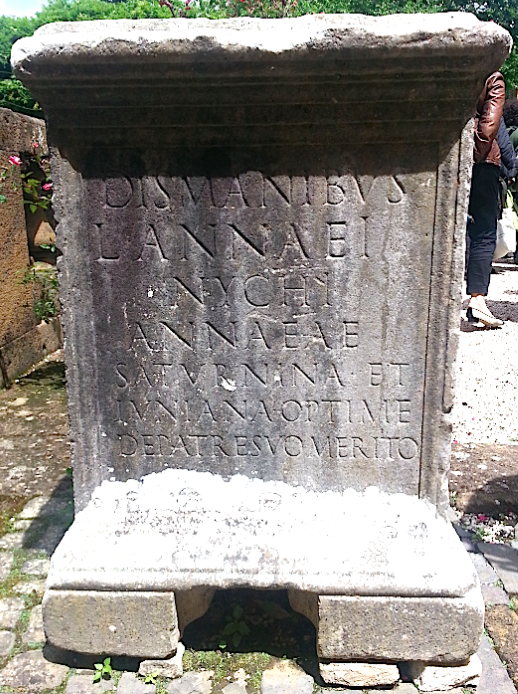
On occasion of the 17th International Colloquium on Latin Linguistics, held at the Università degli Studi di Roma 2 ‘Tor Vergata’, I had the delightful opportunity to see the Roman funerary inscription CIL VI 11677. The inscription is kept on the terrace of the grandiose Villa Mondragone, a former papal residence situated in Monte Porzio Catone (Frascati), which hosted us on 24 May 2013.

Mondragone_Inscription

CIL VI 11677. Photo: Peter Kruschwitz (2013)

The monument itself is an unspectacular funerary altar, with some decorative elements on the non-inscribed sides, made of sandstone, partly weathered and covered in lichens. Based on the rather rough and ready measurements that I was able to take on this occasion, the inscription appears to be just under 90 cm high, about 60 cm wide, and about 50 cm deep.

The inscribed field at the front is framed and countersunk, and the text is executed in clearly legible letters of a capitalis quadrata, which is centred. The height of the letters decreases from approximately 5 cm in the first line (I longa: 6.5 cm) to approximately 3 cm in the last line.

The text of the inscription unambiguously reads as follows:

Dìs Manibus
L(uci) Annaeì
Nychi
Annaeae
Saturnina et
       5
Iuniana optime
de patre suo merito (!).

In English translation:

To the Manes of Lucius Annaeus Nychus: Annaea Saturnina and Annaea Iuniana, most well deservedly (!) with regard to their father.

Wait, what?

The most remarkable aspect of the inscription is, without a doubt, the awkward syntax of the final bit. (For illustrative purposes, the English translation is designed to emulate this sensation.) The linguistic flaw, in turn, has led to a number of interpretations and proposed emendations of this text.

So what appears to be the problem then?

Everything is just fine with this inscription … until the text reaches the second word of line 6, where the syntax suddenly derails. At this point one may, of course, content oneself with sufficient levels of Schadenfreude – even the Romans could not get their Latin right! Or one may curiously ask: how come they got it wrong?

The latter approach offers a surprising microscopic interesting insight into the workings of formalised language, – the force of habit, and the struggles it may cause to keep one’s technical terms straight – whether a native speaker or not. Is it time to get Monty Python’s Roman centurion and let him impart Latin grammar in his very special ways?

http://www.youtube.com/watch?v=XbI-fDzUJXI

The most likely scenario for the introduction of the oddity (or so it would seem) is, that someone did not only know Latin, but in fact was so familiar with the formulaic nature of the standardised language of Latin inscriptions, down to the level of word order and syntactic arrangement, that he (or she?) found it difficult to tell them apart (or at least to spot the mistake until it was too late).

How come?

What they really wanted to say…

The main linguistic challenge in the above text is to offer a satisfactory explanation for the grammatical purpose of the two Latin adverbs optime (‘most well’) and merito (‘deservedly’), respectively. At least one of them cannot be right, and the particularly problematic candidate in that respect is the latter of the two, merito.

In Latin funerary inscriptions the concept of filial or parental duty, pietas, is relatively frequently referred to by a version of the phrase of endearment bene merens (‘well deserving’) in grammatical agreement with one of the names that are mentioned in the inscription.

In the present case, it is clear that the names of the daughters were intended to provide the point of reference for the phrase bene / optime merens, since the text encloses de patre suo in the syntactical bracket provided by the words optime and merito. For this to work in Latin, however, one would have had to write optime de patre suo merentes or optime de patre suo meritae: ‘of the greatest deservedness with regard to their father’.

… and how they outsmarted themselves

Finding the word merito – in that very form – at the very end of a Latin inscription is not an uncommon occurrence, quite the contrary: it happens a lot.

Yet, and this is vital, it does happen in a very different category of Latin inscriptions – not on tombstones (such as the present one), but in votive inscriptions: Roman votive inscriptions , with great frequency, contain the stock phrase libens merito, ‘with pleasure, deservedly’, typically towards the end of the text.

Could it thus be that the actual reason why the mistake has crept in (and remained undetected until the text was finalised by the stonecutter) was that the word merito at the end of an inscribed text simply did not look suspicious to anyone casting an eye over this text?

Even if there was any minimum level of doubt at any stage: the faulty merito, to anyone reading carelessly enough, could still appear to be justified due to the immediate proximity of the ablative of de patre suo, lending additional confidence in the grammaticality of the phrase, even though these two elements, from a syntactical point of view, cannot meaningfully go together.

Posted in Epigraphy | Tagged , , , , , | 1 Comment

False Worship and Filthy Lucre

Thomas Bonney of Magdalen College, Oxford, in 1728, performed a Latin poem at Reading School. The poem, like several others from similar occasions, is reported in the addenda et corrigenda of Charles Coates’s marvellous 1802 The History and Antiquities of Reading, and it has been long forgotten ever since. Yet, Bonney’s poem is of outstanding historical and intellectual interest, and it thus deserves re-examination.

The text of Bonney’s poem, consisting of twenty elegiac couplets, reads as follows:

Monasterium Readingense

Hic, quacunque Arbor supereminet atra corymbis,
Fractaque murorum culmina, serpit, amans;
Dives agris, dives nummis tellure repostis,
Dicitur hos, Abbas, incoluisse Lares.
Foemineae, fertur simul hic Dux foemina, turbae, 5
Non procul hinc aedes tum tenuisse suas.
Praefuit Hic monachis tonsa et pingui cute visis,
Solaque virgineo praefuit Illa choro.
Una at utrique fuit fallentis semita vitae,
Nunc iterando preces, nunc iterando cibos. 10
Barbarus has, Miles, simul illas diruit aedes;
Sive auri, aut suasit Relligionis amor.
Sed locus antiqui servat vestigia Moris,
Idem nos rerum priscus et ordo manet.
Hic nunc inclusam Danaen habet aenea multam 15
Turris, at aurato non adeunda Jovi.
Cerberides, ingens monstrum, stat janitor aulae;
Januaque haud facili cardine vertit iners.
Vivitur hic etiam nunc, ut Vestalibus olim,
Virginis imperiis obsequiturque cohors. 20
Quas quondam Ingenuae coluere fideliter, artes
Jam tali studio turba perita colit.
Hinc varios discit mentiri lana colores,
Telaque purpureas dissimulare rosas.
Hinc Orphei similis, Forfex quoque gnara secandi 25
Post se nunc sylvas, nunc trahit arte feras.
Mola Farina luto fitque hic imitabilis udo,
Hinc rerum species induit atque novas.
Nunc urbis referat munitae maenia; nunc fit
Vel leo, vel delphin, capra, vel ursa, lyra. 30
Quid loquar innumeras artes, cum vivit ut olim
Jam simili Monachi more modoque Puer.
Sic cerebrum tundens insulsaque carmina fundens,
Aut unguem rodit, vel caput ungue fodit.
Utimur et poenis, intorti ictuque flagelli; 35
Vapulat ut Monachus, vapulat usque Puer.
Haeccine sic fieri? num impune exerceat artes
Quisquam hic Papales? – dicere posse pudet!
Haec repsisse mala Henricus si noverit in nos,
Nonne Reformandam diceret esse Fidem? 40

In English:

Reading Abbey

Here, where a dark tree, with ivy flowers, winds itself around the the wall’s highest remains, lovingly, an abbot is said to have had his homestead, rich in land, rich in money, invested into the soil. Of a bevy of girls, it is said, the female leader once upon a time has had her home not far from here. The former was in charge of the monks, shorn to their fat skin, behold! The latter alone was in charge of the girls’ choir. But one narrow path of deceitful life they shared, repeating their prayers, repeating their repasts. The barbarian destroyed the latter, the soldier the former, too, persuaded by zeal for gold or for their religion.

Yet the place preserves the traces of the manner of old, and the same old order of things awaits us, too. A brazen tower now holds many a Danaë locked away, inaccessible even to golden Jove. An A Cerberide, a towering monster, stands guard as janitor of the hall; an artless gate hinges from its heavy goal post.

Here lives even now, and is obedient, a bevy, by the orders of the Virgin (as the Vestals used to do). Arts, once faithfully practiced by noble maids, are now taken up by a skilled crowd, with great studiousness. Whence the wool learns to affect colourful shades, and the loom to hide the purple roses. Whence, like Orpheus, the sawblade, too, skillful in cutting, draws past itself now lumbers, now, skillfully, beasts. The grain mill becomes imitative here from the liquid mire, and whence it adopts its new appearances. Now it resembles the walls of an enclosed city, now it turns into a lion, a dolphin, a goat, a bear, a lyre.

Why mention those countless crafts, while a boy lives already in similar manner and mode as the monk, once upon a time. Thus, banging his head and spilling witless songs, he bites his nail, or scratches his head with the same. We use punishments, too, as well as the lash of the curved whip: as the monk was beaten, the boy is beaten to the present day. Is this really happening? May someone practise papal arts in this place, without punishment? It is shameful to be able to say that! Had Henry known that such evils were to befall us, would he not have ordered to reform our belief?

The poem opens with a reference two of Reading’s most ancient religious structure, the Reading Nunnery and Reading Abbey – the latter of which appears to be alluded to, at least at first glance, in the poem’s title, and whose impressive ruins are referenced throughout. The nunnery was destroyed by Danish invaders, the Abbey in 1538 under Henry VIII’s dissolution of the monasteries – parallel life cycles, nicely united in Bonney’s phrase ‘The barbarian destroyed the latter, the soldier the former, too, persuaded by zeal for gold or for their religion‘.

Neither the abbey nor the nunnery are truly at the heart of this allegorical poem, however. This becomes apparent in the next move, suggesting that an ancient spirit and an overcome habit still remain – unbroken by the upheavals of previous times: they remain preserved in a new tower, resembling that of mythical Danaë, heavily protected and sealed off from the outside world. Once noble arts were conducted in this place, by a bevy of skillful girls, preparing and dying wool.

This, beyond reasonable doubt, is a reference to the Oracle workhouse, funded from the estate of the late John Kendrick in the 1620s, partly as a means to become more competitive in the wool trade business (which in the 17th and 18th centuries was one of Reading’s major economic strongholds). The heavy wooden gates of the Oracle workhouse, originally situated in Minster Street, alluded to in the poem, survive to the present day and are incorporated in the fine local history collection of Reading Museum.

The poem’s true power, however, unfolds in its final movement. The Oracle workhouse is stylised to have become Reading’s new monastery – the poem is called monasterium Readingense after all! Yet, this place, according to the author, despite its grand appearance (a brazen tower, to keep a Danaë) was no less dismal, no less exploitative, and no less a place of false worship than any of the previous manifestations of worship in Reading: girls and boys, kept under unworthy conditions, had to endure the same deeply inhumane, sordid lifestyle and treatment (including physical punishment) as the monks or nuns – an early 18th century criticism of the infamous British workhouses, at Reading and elsewhere, more than one-hundred years before Charles Dickens was to publish his novel Oliver Twist.

Calling the Oracle workhouse a monastery and referring to Henry VIII’s dissolution of the monasteries is a bold statement – not only in favour of the Anglican faith. It suggests the author’s strong feeling that the Oracle workhouse was not doing what it was supposed to do (to provide an opportunity for the poor), and it also suggests that its prime objective was to add to the wealth and power of its ‘abbot’ – as invoked at the poem’s very beginning.

It one of history’s many ironies that this monastery was subsequently replaced by a structure, still called The Oracle, which has driven the (secular) worship of the proverbially filthy lucre to new extremes, and that this structure now is at the very heart of the town of Reading.

Posted in Education, History of Reading, Poetry | Tagged , , , , , , , , , , , | 1 Comment

Tragedy, Epic, and the Real

On 3 October, 2013, a boat sank off the Italian island of Lampedusa, a small island in the Mediterranean between Tunisia and the island of Malta, south of mainland Italy. The vessel is reported to have carried up to 500 people who were hoping to escape their dismal living conditions in Eritrea and Somalia. More than one hundred people drowned, when their boat caught fire, possibly in an attempt to give a light signal to nearby vessels.

This is the youngest (reported) incident in a series of horrendous accidents, giving but a superficial idea of the unfathomable level of despair that will cause people to leave their home country, to sell everything they have, to join a forlorn hope and to risk everything, including their very lives.

We read and hear about this (and similar) stories in newspapers, on the internet, on broadcast media. Does it make us feel anything, or do we prefer to call it tragic, perhaps even do the decent thing and donate money towards the survivors’ support, and, after a moment of silence and contemplation, move on in our daily lives, feeling safe in the assumption that this does not relate to us? Or have we become numb?

When our everyday experiences exceed what we appear to be able to grasp, we tend to create narratives, to resort to images. One might thus be tempted to call the journey of those whose boat sank today an ‘Odyssey’. Except, the Odyssey is about coming home. What the trip that ended tragically today really was (and will continue to be for the survivors), is something else – a version of the trip of Aeneas, fleeing the ruins of Troy, ultimately hoping to arrive in Italy, to find a new home for himself, his family, and his men.

On their way across the Mediterranean, Aeneas and the Trojans, too, encounter many a nightmare while seaborne. In the first book of the Aeneid, for example, they have to endure a horrendous storm, raised by Aeolus, by order of Juno, a storm that will send the Trojans to Carthage, where things get a lot worse before they eventually get better:

From pole to pole it thunders, the skies lighten with frequent flashes, all forebodes the sailors instant death. Straightway Aeneas’ limbs weaken with chilling dread; he groans and, stretching his two upturned hands to heaven, thus cries aloud:

“O thrice and four times blest, whose lot it was to meet death before their fathers’ eyes beneath the lofty walls of Troy! O son of Tydeus, bravest of the Danaan race, ah! that I could not fall on the Ilian plains and gasp out this lifeblood at your hand – where, under the spear of Aeacides, fierce Hector lies prostrate, and mighty Sarpedon; where Simois seizes and sweeps beneath his waves so many shields and helms and bodies of the brave!”

As he flings forth such words, a gust, shrieking from the North, strikes full on his sail and lifts the waves to heaven. The oars snap, then the prow swings round and gives the broadside to the waves; down in a heap comes a sheer mountain of water.

(Vergil, Aeneid 1.90–105, transl. H.R. Fairclough)

This is a powerful scene of great emotional immediacy from one of the great classics of European literature, and as such it is read frequently, all over the world.

One tends to be impressed by the greatness of Vergil’s words, characters, and narratives. But one hardly ever envisions this to be a story that could be real – and right at the beginning of the Aeneid, Vergil already tells his audience to await the happy ending:

Arms and the man I sing, who first from the coasts of Troy, exiled by fate, came to Italy and Lavine shores; much buffeted on sea and land by violence from above, through cruel Juno’s unforgiving wrath, and much enduring in war also, till he should build a city and bring his gods to Latium; whence came the Latin race, the lords of Alba, and the lofty walls of Rome.

(Vergil, Aeneid 1.1–7, transl. H.R. Fairclough)

For most of the time, one tends to leave the two versions of the same story unconnected: the tragic real (as encountered today) and the epic narrative, written for entertainment. It is on occasions like today that one must ask, just how much more powerful and moving one’s experience of such disasters do become, once one starts reading the two versions against each other.

Clearly some people coming to Europe, fleeing their home countries and arriving in Italy, after a horrendous trip across the sea, where many a man dies, appear to be considerably luckier than others. One must hope that the survivors will be able to find happiness after all – skipping the stories that ensue in the Aeneid after the foreigners reach Italy. One must not forget, however, that there is a second issue: the causes in the native lands of those who decided to embark on this trip, which (very much like in the case of the Trojan war) are not altogether home-made.

Will today’s news story, like that of Aeneas and his men, eventually find its own Vergil, and even become part of a positive narrative of history? This could give some meaning to today’s tragic loss of human lives after all.

Posted in Poetry | Tagged , , , , | 1 Comment

Seneca on Higher Education in the Arts and Humanities

Originally published on the University of Reading’s Engage in Teaching and Learning blog:

Seneca the Younger (4 B.C. – A.D. 65) was a famous Roman statesman and stoic philosopher. As the young Nero’s tutor, he at some point was de facto Rome’s Emperor by all but the title. His Epistulae Morales (‘Moral Letters’) constitute a major part of his philosophical work. The 108th epistle of that collection provides remarkably relevant food for thought for the Higher Education landscape. The following text is my (reasonably faithful) translation of the opening of Seneca’s epistle, without omissions or adaptations; the subtitles, however, are my own.

Reading List Enquiries

The topic, about which you enquire, is one of those, which deal with knowledge for knowledge’s sake. Yet, because it relevant, you rush and do not wish to wait for the books which I am busy to arrange, covering the whole area of moral philosophy. I will send them in due course, but let me write this in advance, how your very desire to learn, which I see burning in you, needs structure, lest it proves to be an obstacle.

Modularisation and Progression Rules

Neither must one gather things randomly, nor should one eagerly attack everything at once: step by step one will arrive at completeness. The workload must be adapted to one’s strength, and it must not tackle more than one can handle. Do not absorb how much you like, but how much you can handle. Just have courage, and you will be able to grasp however much you wish. The more the mind takes in, the more it will become flexible to accommodate.

Ideal Student Meets Ideal Teacher

This is what Attalus taught us, I remember, when we virtually laid siege to his class, arriving first, leaving last, challenging him to some sort of discussion even when he was walking about – while he was not just ready to see the students, but made an effort to meet them half-way. He said: ‘Teacher and student need to follow the same principle: the former must want to be of use, the latter to benefit.’

An Inspirational Environment

Who attends a wise man’s class, should take home something good with him every day: may he go home either sounder, or capable of becoming sounder. But he will return: such is the power of philosophical knowledge, that it helps not only those who study it, but even those who merely get exposed to it. Who walks in the sun, even without the aim to reach it, will get tanned. Who sits in a perfumer’s shop, and even if only dwelling there for a slightly extended period of time, will carry away with him the scent of the place. And thus, too, he who attended to a wise man, must by definition take away something that is useful even to those who do not pay a lot of attention. Mark my words: to those who do not pay a lot of attention, not to those who are obstinate.

Lecture Theatre

‘What then? Do we not know those who sit for many a year with a wise man and still do not manage to let it show?’ Do I not know those? There are some particularly persevering types, zealous, too, whom I call not the wise man’s pupils, but aliens. Some of them attend to listen, not to learn, just as we are led to the theatre for the sake of acustic pleasures, through speech or song or plot. You will see that a large part of the listeners, to whom the lecture hall of a wise man is but a place to spend their leisure time. They are not concerned with addressing their weaknesses, to understand something about a principle of life, to adjust their character accordingly, but they merely enjoy the pleasure of the acoustics.

Note-Taking, Revision, and Intellectual Appropriation

Some, however, come along with their notebooks, not to write down the matter at hand, but the very words, so that they can repeat them just as much to no use to anyone else as they were first perceived by themselves. Some are excited by big words and thus eagerly proceed to mimick the speakers’ emotions in facial expression and gesture, just like those emasculated Cybele-Worshippers when they hear the sound of the flute-player and initiate their frenzy to order. The others, however, are taken by, and driven further by, the beauty of the matter itself, not the sound of empty words.

Posted in Education, Prose | Tagged , | Comments Off on Seneca on Higher Education in the Arts and Humanities