Rest and Peace: Terence on a Reading Cemetery

Towards the South-Eastern corner of Reading’s Old Cemetery at Cemetery Junction, there is an obelisk. It is the funerary monument of John Cecil Grainger, once vicar of the parish of Saint Giles. The obelisk rests on a pedestal, which is inscribed on two sides:

Above the inscription at the front of the monument, there is a metal armorial achievement mounted to the pedestal. The achievement consists of the shield, the helm, and a crest (a stag with an ear of wheat – the abundance of wheat here and in the shield may well be a reference to the family name, Grainger) -, and the motto scroll.

Grainger_armsThe shield in itself is rather complex. It is divided into a dexter and a sinister, the latter of which is subdivided further. The dexter exhibits three ears of wheat, stalked and leaved, two over one. The sinister consists of four quarters. The upper left and bottom right quarters display the same charges, namely a chevron between three pheons (a reference to the Smart of Trewhitt family, mentioned in the inscription on the back of the monument), two human shinbones in saltire in the bottom left quarter, and a demi-lion rampant in the top right quarter.

The inscription on the motto scroll reads:

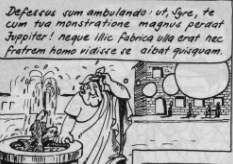
Defessus sum ambulando.

‘I am worn out from all this walking about.’

Considering the genre – a motto scroll -, the text conveys an unusual, in fact rather remarkable level of resignation (not least for a parish priest, mind). Why such a seemingly dispiriting motto then, one must wonder?

The answer is somewhat surprising: to the knowing, the motto is not actually dispiriting at all. It is a verbatim reference to the play Adelphoe (‘The Brothers’) of the Roman second-century B. C. playwright Terence, where Demea, an old(er) man and country-dweller, had been sent on a wild goose chase throughout the entire town, by the slave Syrus, when trying to find his brother Micio.

When Demea finally gives up his attempt to find Micio according to the slave’s instructions, he returns to the scene and says (Adelphoe 713-8):

Defessus sum ambulando: ut, Syre, te cum tua
monstratione magnus perdat Iuppiter!
perreptaui usque omne oppidum: ad portam, ad lacum,
quo non? neque illi ulla fabrica erat nec fratrem homo
uidisse se aibat quisquam. nunc uero domi
certum obsidere est usque donec redierit.

I am worn out from all this walking about. Syrus, may the big Jupiter himself destroy you and your directions! I crawled through the entire town: to the gate, to the lake – where didn’t I go? He did not have any workshop there, nor did anyone suggest to have seen my brother. Now I’ll wait at home, I’ve decided, until he comes back.

Demea, tired of walking about (image from H. Oberst, Terenz in Comics)

Demea, tired of walking about (image from H. Oberst, Terenz in Comics)

In keeping with the comic genre, as soon Demea gives, of course, he finally gets to see Micio, who had been in the house all along (and who enters the stage just after Demea has finished his last line).

‘Seek, and ye shall find,’ they say – but a possible lesson from the scene above is: you cannot trust the directions given to you: go to the most likely place and pause, and what you are looking for will come to you. This may be the true idea behind the motto of John Cecil Grainger’s arms, then: not resignation, but the deeper lesson that the suspension of restless activity and planless business may in fact be the better way to achieving one’s aims.

Posted in Epigraphy, History of Reading, Poetry | Tagged , , , | Comments Off on Rest and Peace: Terence on a Reading Cemetery

Sea Shells, Or: How the Deluge Reached Reading

Charles Coates’s monumental 1802 work ‘The History and Antiquities of Reading’ is a treasure house for discoveries surrounding the history of the county town of Royal Berkshire. In its discussion of the specifics of the area of Katesgrove,  the book records a short poem in 32 dactylic hexametres. They are presented as composed by ‘Mr Allen, then an assistant at the School’ (i. e. Reading School) and ‘spoken at the Triennial Visitation in 1752’.

The poem reads as follows:

Conchae prope Raedingum effossae probant diluvium
[‘Sea shells unearthed near Reading prove the deluge’]

Qua properat, Patrem ad Thamesinum brachia tendens,
Praecipitesque urget rapidus Cunetio fluctus,
Eruit attonitus rerum novitate colonus
Littus arenosum natasque sub aequore conchas:
Non leve prodigium. Quippe his distantia longe    
5
Finibus Oceanus raucos ad littora fluctus
Volvit, & has nullis agitat terroribus oras:
Undique frondosi colles atque amnibus udae
Spectantur valles, herbisque virentia prata.
At detossa jugi sub mole haec monstra fatentur,     
10
Humida Nereïdas tenuisse his sedibus antra,
Coeruleasque rotas delphine egisse jugato;
Dum circum phocae, pecus illaetabile, passim
Tonderent algam & nondum indurata coralla.
Huc ades, oh quicumque sacris sermonibus aures    
15
Impius avertens, veteris portenta Noëmi
(Qui mare, quondam uterum, tunc rerum immane sepulcrum,
Exigere humano tutus de crimine poenas
Vidit) uti nugas figmentaque anilia rides.
Huc ades; atque haec ima miracula mente revolvens    
20
Contemplare, oculisque tuis fiducia detur.
Salve, concharum feries veneranda! superstes
Rerum ex naufragio! Mundi salvete prioris
Sanctae relliquiae! Queis certa immotaque sedes,
Innumerisque quies saec’lis invicta remansit,    
25
Dum tot mille vices dominorum terra novavit,
Et sacrum quodcunque habitum, quodcunque superbum,
Regalesque arces, confisae moenibus urbes,
Et templa aevorum vix tandem extructa labore,
Turres Iliacae, Capitoli immobile saxum,    
30
Regia Pyramidum moles, & Mausolei
Omnia concussa atque annis eversa labascunt

[The following version of the text is marked ‘A Translation of the above, by the Author’ by Coates]

Where rapid Kennet rolls his headlong stream,
Eager to share with Thames a nobler name,
While lab’ring hinds for future fabric toil
In the dark bosom of the yielding soil,
Amaz’d they view of shells and sand a shore,
On which no bursting waves are heard to roar.
In distant coasts, the traveller may tell,
How raging oceans’s foaming horrors swell,
But here the swain with ravish’d eye can trace
The chearful landskip’s variegated grace;
The rising hill, embrown’d with many a grove,
And vales, where streams in bright Meanders rove.
Yet these strange reliques of the main declare
That the rough sea once drove its billows there;
That o’er the rising hill embrown’d with shade,
The stream-wash’d valley and the verdant mead,
The grazing Sea-calf trod with humid foot,
And cropp’d the budding coral’s tender shoot.
Approach, thou impious wretch, who, blind yet bold,
Presum’st to doubt what sacred lips have told,
That by divine command the rising wave,
The womb of nature once, was once her grave.
By virtue rescued, and by virtue’s God,
While earth was ravag’d by the raging flood,
While all around the heaving ocean boil’d,
A chosen few at all its terrors smil’d.
Approach – believe – and dread the wrath of heav’n,
And pray thy impious doubts may be forgiv’n.
Hail, sacred reliques of a former world,
Safe, while all nature was in ruin hurl’d!
These wondrous shells unhurt by time endure,
And for unnumber’d ages rest secure,
While what mankind as strong or great reveres,
Has sunk beneath the weight of rolling years.
Th’ environ’d citadel’s stupendous pile,
The solemn temple, rais’d by tedious toil,
The less’ning fame of Ilion’s lofty tow’r,
The wrecks of Rome, that hastes to be no more,
Mausolos’ tomb, and Egypt’s mould’ring pride,
All yield to rapid Time’s o’erwhelming tide.

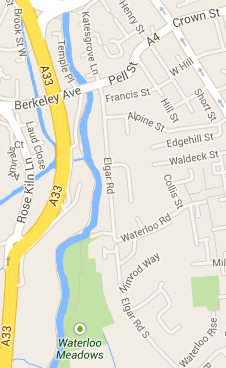
The text is of course a remarkable piece, reflecting on a time when Reading was a rather different place and the conurbation had not yet sprawled out to the South significantly beyond London Road. The ancient map, as published by Coates, indicates the position of the oyster banks in the area that is now Elgar Road, just north of the area now known as Waterloo Meadows:

The geological structure of the neighbourhood of Reading was reported, for example, by J. Rofe jun. in a contribution to the Transactions of the Geological Society of London in 1834, which can be read online in a number of formats, and the geological condition of the area led to the rise of a number of kilns and mines in the Katesgrove area, among which, for example, the ancient Katesgrove Kiln Chalk Mine, marked ‘Mr Waugh’s Brick Kiln’ in the ancient map.

More interesting still, however, is the following observation. The translation that is recorded in Coates’s volume is not altogether faithful to the Latin (which is nowhere near as horrid as the translation), and it certainly is rather more obsessed with keeping up its rhyme scheme than it should have been. What Mr Allen actually wrote in the very first few lines of his poem, rather than talking about ‘lab’ring hinds for future fabrics (…) in the dark bosom of the yielding soil’ is this:

Where torrential Kennet rushes, extending its arms towards the Themse-ian father,
And headlong pushes its floods,
The settler, astonished by the novelty of those matters,
unearths
A sandy shore and shells, born under the sea:

A veritable prodigy!

The settler, colonus, is the one first to encounter the remarkable find – a clear indication of the ways in which the Katesgrove area, adjacent to the river Kennet, became of increasing interest to the inhabitants of Reading – starting to link the site of ‘Mr Waugh’s Brick Kiln’ with the area west of Southampton Street (i. e. the area that is now Alpine Street), an area that the poem describes as an in fact rather idyllic, serene grove (an impression that a walk along the Kennet-Avon canal on occasion manages to sustain).

The poem extends the invitation to come and see the wondrous feature of nature to those  who ‘who, blind yet bold, / Presum’st to doubt what sacred lips have told’, i. e. those who – despite the proximity of the Church of St Giles  – felt less than inspired by its preachings: inspection of the miracles, seeing the sea shells with one’s own eyes, thus becomes a means to strengthen one’s faith – a miracle emphatically welcomed by the poet himself (Salve, concharum series veneranda!).

Katesgrove 2013 - did the deluge strike again?

Katesgrove 2013 – did the deluge strike again?

Yet, one cannot help but feel that this poem is not about religious edification. It ends in a dark vision about the death and decay of even the biggest, most outstanding of human achievements – invoking Classical examples: Troy, the Capitol of Rome, the Pyramids, the tomb of Mausolos. Omnia concussa atque annis eversa labascunt: ‘everything falls, shattered and eradicated by time,’ is the poet’s conclusion.

Could this mean that the poem’s actual point is a criticism of Reading’s starting expansion to the south of London Road, not least driven by commercial interests, ultimately destroying the beauty of nature that Katesgrove once must have been – idle ambition and arrogance to create something huge, with the sole prospect of being overthrown eventually? This thought presents the poem’s centre – inconspicuously hidden away in parenthesis! – in a different light (and again only a more literal translation can bring this aspect out more clearly):

He (= Noah), who saw the sea, once the womb, then the horrendous tomb of all matters,
Execute the punishment for human misdeed,
Being Safe himself.

The miracle of nature of Katesgrove, clearly sea-related, easily linked to the biblical flood in poetic imagery, thus has become a tool for the poet to remind his audience of the causes for the deluge – human wickedness and arrogance. How will the colonus respond, the colonus who dwells in the very place where ‘These wondrous shells unhurt by time endure, / And for unnumber’d ages rest secure, / While what mankind as strong or great reveres, / Has sunk beneath the weight of rolling years.’

Shield of the University of Reading

Shield of the University of Reading

An aside: sea shells, more specifically scallop shells, hold particular symbolism for Reading, as they had been a constituent of the arms of Reading Abbey, still preserved in the arms of the University of Reading. Perhaps that gives the University an additional right, every now and then, and without confessional motivation or dimension, to contemplate the bigger picture, to consider aspects of global responsibility and sustainability, and not just to pursue short-term interests that may damage and destroy more than they manage to create?

Posted in History of Reading, Poetry | Tagged , , , , | Comments Off on Sea Shells, Or: How the Deluge Reached Reading

Beer Goggles in Ancient Rome

The Ig Nobel Prizes honor achievements that first make people laugh, and then make them think. The prizes are intended to celebrate the unusual, honor the imaginative — and spur people’s interest in science, medicine, and technology.

(Source: http://www.improbable.com/ig/)

The winners of the of the 2013 Ig Nobel Prize in Psychology are ‘Laurent Bègue [FRANCE], Brad Bushman [USA, UK, the NETHERLANDS, POLAND], Oulmann Zerhouni [FRANCE], Baptiste Subra [FRANCE], and Medhi Ourabah [FRANCE], for confirming, by experiment, that people who think they are drunk also think they are attractive’ (source: http://www.improbable.com/ig/winners/#ig2013).

The phenomenon that is at the heart of this research, the so-called ‘beer goggles’, famously taken literally in The Simpsons

…is by no means a modern observation.

The ancient Roman playwright Terence (Publius Terentius Afer, 195 or 185-159 [?] B. C.), in scene IV 4 of his play Eunuchus (‘The Eunuch’) has the character Chremes enter the stage – visibly drunk. He encounters the courtesan Pythias, whom he had already met a short while ago:

CH. Attat data hercle uerba mihi sunt: uicit uinum quod bibi.
at dum accubabam quam uidebar mi esse pulchre sobrius!
postquam surrexi neque pes neque mens satis suom officium facit.
PY. Chreme. CH. quis est? ehem Pythias: uah quanto nunc formonsior    730
uidere mihi quam dudum! PY. certe tuquidem pol multo hilarior.

Chremes: Whoa, I’ve been well deceived, by Hercules. The wine I drank has won. Yet, when I was still lying down, I seemed to be pretty sober still. But once I got up, neither my foot nor my brain are functioning as they’re supposed to do.
Pythias: Chremes!
Chremes: Who is that? Oy, Pythias: ha, so much more beautiful you appear to me now than before!
Pythias: Well, you, by Pollux, are a lot funnier now, that’s for sure.

Aristotle allegedly wrote a specialist treatise On Drunkenness (Περὶ μέθης), which is now mostly lost. Yet, some of his original ideas may well be preserved in the third book of  the (presumably Pseudo-)Aristotelian treatise Problemata (‘Problems’), where the author writes at III 2:

ἔτι οἱ μὲν νήφοντες μᾶλλον ὀρθῶς κρίνουσιν, οἱ δὲ σφόδρα μεθύοντες οὐδ’ ἐγχειροῦσι κρίνειν· οἱ δὲ ἀκροθώρακες κρίνουσι μὲν διὰ τὸ μὴ σφόδρα μεθύειν, κακῶς δὲ διὰ τὸ μὴ νήφειν, καὶ ταχὺ τῶν μὲν καταφρονοῦσιν, ὑπὸ τῶν δὲ λιγωρεῖσθαι δοκοῦσιν.

‘Moreover, those who are sober are rather better at judging matters, and those who are heavily drunk do not even attempt to judge: those, however, who are tiddly do judge, as they are not heavily drunk, but do so badly due to their not being sober, and they are quick at looking down upon others, and they think that they are belittled by others in turn.’

This, according to (Pseudo-)Aristotle, is accompanied by blurred vision, seeing things moving in circles and manifold – a reasonably accurate description of the state of intoxication.

The award-winning research itself, however, was less concerned with actual drunkenness and ‘beer goggles’: instead, it was designed to show that even the illusion of drunkenness can result in similar attitudes and behaviour.

From here, it is of course but one small step to a successful application of this eminently mediasuitable research. And who would know better than Ovid, the very master of erotic edification, who suggests in his Ars Amatoria:

Ebrietas ut uera nocet, sic ficta iuuabit:
fac titubet blaeso subdola lingua sono,
ut, quicquid facias dicasue proteruius aequo,
credatur nimium causa fuisse merum.    
600

‘Just as actual drunkenness is harmful, thus a fake one will be of use: let your sneaky tongue fake a stammer, with hint of a lisp, so that, whatever you do or say, if it is a bit more daring than it ought to be, it will be believed to be the result of too much wine.’

In uino ueritas – in wine there is truth. Well, sometimes. Maybe. Just don’t rely on it too much.

Posted in Poetry | Tagged , , , , , , | 1 Comment

Can we mend broken hearts?

Originally published on the University of Reading’s The Forum blog:

The fence around the University of Reading’s Humanities and Social Science (HumSS) Building is currently decorated with images and captions illustrating Reading’s desire to be ‘asking big questions.’ One of the captions, attributed to Dr Sam Boateng from the School of Biological Sciences, asks: ‘Can we mend broken hearts?’

boateng

The caption, a playful curtsy to Reading’s leadership in cardiovascular research, reminded me of a passage attributed to the Latin poet Lygdamus, a love-poet of the first century B. C., who wrote in his Elegies 2.1-6:

Qui primus caram iuueni carumque puellae
eripuit iuuenem, ferreus ille fuit.
durus et ille fuit, qui tantum ferre dolorem,
uiuere et erepta coniuge qui potuit.
non ego firmus in hoc, non haec patientia nostro
ingenio: frangit fortia corda dolor.

‘He who first robbed a young man of his love, and a girl of her beloved, that person was made of iron. Hard, too, was he who could bear such pain, and who could live, with the partner snatched away. I am not strong in that respect, nor is there such endurance in my mind: pain makes brave hearts break.’

The image of heartbrokenness – ancient, yet familiar – begins to intrigue: how can a heart be broken, how can it get broken? Is it just the lack of resilience to emotional strain, one’s weakness, as Lygdamus suggests?

A possible answer can be found in even earlier Latin literature, in an author of the third and second centuries B. C. As far as one can tell from the fragmentary transmission of Latin literature, it may in fact have been the comic playwright Titus Maccius Plautus, who first employed it in his comedy Cistellaria (‘Casket Comedy’). In this play, Plautus has a lovesick young man called Alcesimarchus say (Cistellaria 221–2):

‘maritumis moribus mecum experitur: ita meum frangit amantem animum.’

‘He handles me the way the (stormy) sea would do: thus he breaks my lovesick heart.’

Plautus exploits the imagery of a ship exposed to the heavy sea, battered by the waves, lacking direction, and ultimately crushed to pieces by the forces of nature to describe the battles, external and internal, that Alcesimarchus has to face in his quest for fulfilled love.

From here it is only a small step to the image’s predominant use outside the realm of Latin poetry: here, animum frangere is frequently used particularly as an image denoting the ‘crushing of someone’s spirit’ (rather than heart itself – the Latin term covers both facets).

Yet, in Latin writing it does not always have to be debilitating trauma that may result in the proverbial ‘broken heart’. Quintilian, Rome’s first professor of Latin, when discussing the best way in which to design the epilogue to a courtroom speech, suggests in his Institutio Oratoria (11.3.170):

‘si misericordia commouendos, flexum uocis et flebilem suauitatem, qua praecipue franguntur animi quaeque est maxime naturalis: nam etiam orbos uiduasque uideas in ipsis funeribus canoro quodam modo proclamantis.’

‘If they (sc. the judges) are to be moved by pity, (sc. employ) an inflexion of the voice and a whiney sweetness, by which hearts are broken first and foremost, yet which is most natural: for you see parents bereft of their children, and you see widows, at the very funerals, lamenting in that peculiar song-like voice.’

Even this very small selection of Latin usages of the image of the broken heart does show: pain, worries, sorrow (and ultimately: death) are deeply connected to it – and the idea of suffering and even of death due to a broken heart (figuratively, not literally speaking) is not alien to the medical profession.

What is interesting to a linguistic scholar, of course, is how a verbal image that started its life as a poetic metaphor can be appropriated by the language of science – a language that often (albeit incorrectly) is deemed objective and descriptive.

The image of the broken heart that Dr Boateng uses in his big question is by no means an exception in that respect. Instead, it even adds another facet to it: the allusion to the image does not restore a literal facet of the phrase ‘broken heart’ that did not exist in its figurative use – hearts, unless subject to substantial physical force, do not literally break into pieces, like a clay vessel if dropped. Instead, it combines the pre-existing image with that of a broken piece of machinery (an engine, perhaps), thus expanding the metaphoric use rather than restricting it.

Dr Boateng asks a big question: ‘Can we mend broken hearts?’ – and I very much hope he can (or that he will be able to do that one day in the very near future). An even bigger question than this could be: ‘Should we mend broken hearts?’ One must not be cynical when it comes to deeply unsettling matters; yet, the answer to this question, whether for the scientific or the poetic use of the phrase, will have to remain a philosophical one.

Posted in Poetry | Tagged , , , | 1 Comment

A Readingite’s Prayer for Peace

Charles Coates, in the appendices to his monumental 1802 work ‘The History and Antiquities of Reading’, records numerous Latin and English pieces that were performed or recited at Reading School. Among these, there is a Latin ode of eighty lines, composed in 1761 by The Rev. John Spicer M. A. (d. 1784), which is translated into English for the first time here.

The ode’s twenty stanzas follow the metrical form of the so-called Alcaic Stanza, a common rhythm in Horace’s Carmina (‘Odes’). The poem is written in a rather turgid, dense style, laden with allusions to, and extensive verbatim borrowings from, the (pagan) Latin Classics; the translation – hard to believe – conveys the poem’s convoluted nature only in part.

The ode reads thus:

Votum pro pace (1761)

O! si benigno Numine Delius
Aspiret ignes, queis chitarae potens
Charusque Musis Addisonus
Marlburii cecinit trophaea;

Digne referrem, ut plus vice simplici 5
Gallorum inanes conciderint minae,
Monstrumque triplex defatiget
Herculeis Fredericus ausis:

Sed per madentes sanguine civico
Errare campos Musa perhorruit, 10
Pompam auspicari festiorem, et
Laetificos renovare plausus

Conata. Terras, Diva, Britannicas
Invise praesens! Jam niveis redi
Pax alma bigis, Gratiaeque 15
Et veteres comitentur Artes!

O quando tandem palmite sub suo
Miles recumbet vulnere plurimo
Distinctus, immistumque Chium
Diis patriis sine fraude libans, 20

Mille et peric’la et mortis imagines
Mille explicabit, Penelope pia
Haerente collo, per genasque
Attonitas oriente gutta?

Aut dulce sera colloquium trahens 25
Sub nocte, laetas concipiet vices,
Et Delphico correptus igne
Fata canet venientis aevi?

Gradive, caedis jam faturum Tibi
Ensem repono; Tum Patriae satis, 30
Tum gloriae, felix laborum
Et spoliis dedit aucta raris

Britanna pubes. Maxime Principum
Io Georgi! Te colit Africa
Donis onusta, aureasque large 35
Fundit opes latebris ab imis:

Te Barbari, quot stagna per intima
Sylvasque caecas nutrit America,
Jam caedis obliti verentur,
Nec solitas meditantur Artes: 40

Quascunque terrarum Oceanus sinu
Circumdat alto, ſulmina navium
Non vana tangunt, imperique
Sceptra tui sonat ore Ganges.

Hic erigas ritu Herculis impigri 45
Rerum columnas, quas vigil Artifex
Ter mille fraudum non refringet
Gallia, non Proceres Britanni

Turpi insolentes foedere. Jam retro
Usque appetentis Monstra Cupidinis 50
Cessere, dentes infremuntque
Compedibus rigidis revincta:

Virtus repulsam proh! nimis asperam
Experta, dignis fulget honoribus;
Et lapsa Libertas ab alto 55
Ore nitet placido per urbes.

O quanta rerum Gloria nascitur!
Quam latus Ordo! non mage dissono
Clamore, victo Caesar orbe,
Rite Pater Patriae audiebat. 60

Quam thure multo, quam prece supplici
Divos fatigat fida Britannia,
Ut propria haec praestes, novaque
Progenie facias beatam,

O Gratiarum cura decentium 65
Charlotta, O Musis nomen amabile
Atque Isidis laetas per undas
Carmine perpetuo sonandum;

Si forte sacras moribus integris
Intrabis aedes nobilis incola, 70
Henricus olim queis struebat
Vincula Francigenis futura:

Hic literato splendidus Otio
Repente flammas nutriet aemulas,
Dum pace, dum bello potentum 75
Suspiciet monimenta Regum;

Hic Ipse amicus pacificae Togae,
Intaminatos sanguine civico
Evolvet Annales Parentis,
Et placidos sine nube Soles. 80

A Prayer for Peace

Oh if the Delian, benevolent,
Inspired such fires by which the master of the lyre,
Dear to the Muses, Addison,
Sang the exploits of Marlborough;

I would dignifiedly report how more than once 5
The French’s inane threats collapsed,
The Threefold Monster is worn out
By Frederick through Herculean deeds.

But through fields, soaking with civic blood,
To err dreaded the Muse: 10
A more joyous parade to initiate, and
Cheerful applauses to repeat,

Was her attempt. British lands, Goddess,
Do visit now! Return already on your snow-white
Chariot, nourishing Peace, and may the Graces 15
and the Old Arts accompany you!

Oh when will, finally, under his vine,
The soldier recline, with many a wound
Decorated, offering blended Chian wine
To the native Gods without deceit 20

And those thousand dangers, and images of death,
another thousand, unfold, pious Penelope,
With hanging neck, over her cheeks,
Astonished, gushes a teardrop.

Or a tender conversation, extending through the late 25
Night, will hold sweet altercations,
and someone, kindled by Delphic fire,
Will sing the fate of the time to come?

Mars Gradivus, what already heralds slaughter for you,
The sword I cast off; By then for the Fatherland enough, 30
By then for Glory, too, burgeoning with hard work,
And endowed with rare spoils of war, has given

The youth of Britain. Greatest of Princes,
Io, George! Africa worships you,
Laden with gifts, and abundantly golden 35
Artworks it exhales from its deepest lairs:

The Barbarians, however many of them across its inner swamps
And dark woods America does spawn,
No longer mindful of the slaughter, they respect you,
And pursuing Arts previously unknown. 40

Whatever lands the Ocean with its bosom
Wide engulfs, the thunderbolts of ships
Ominously reach, and the Ganges
Resounds with its mouth the sceptres of your realm.

Here may you erect, in the tradition of the indefatigable Hercules, 45
The Columns of the World, which that vigilant Artist
Of three-thousand deceits may not upset,
France, nor those noble Britains,

Haughty in their hideous covenant. Aback already
The Spectres of Greedy Lust, striving perpetually, 50
Have retreated, snarling and bellowing,
Restrained in their firm bonds.

Virtue who, alas!, has experienced the Defeated in its
Utter acrimony, shines with honours worthy;
And fallen Liberty from high above
Shines with a pleasant face across the cities.

Oh what universal Glory arises!
What universal Order! No longer in dissonant
Clamour, once the world has been subjected, will Caesar
Rightly be hailed Father of the Fatherland. 60

With what amount of frankincense, with how suppliant a prayer
Does faithful Britannia tire the Gods,
For you to grant this in particular, and with a new
Offspring to make her happy,

Oh concern of the decent Graces, 65
Charlotte, oh name lovable to the Muses,
Across the waves of Isis
In eternal song to resound;

If, perchance, with blameless character the sacred
Building should enter a noble citizen, 70
Where Henry once upon a time did instruct himself
To become the Frenchmen’s Fetter:

He, in learned Peacefulness, sublime
Afresh will nourish striving flames,
While in peace, while in the war of the mighty 75
He will glimpse the monuments of Kings;

Here the friend of the peaceful toga himself
Undefiled by the blood of citizens
The Annals of the father will unfold,
And Days, placid, without a cloud.  80

Undoubtedly, better poetry has been written. Yet, on closer inspection, the ode becomes a touchingly romantic piece – in times, in which armed conflicts, civil unrest, nationalism, and dehumanised cruelty appear to mushroom across the globe.

Spicer’s epitaph in Reading’s Saint Laurence church praises this native resident’s ‘genius, learning, friendship, charity, and genuine patriotism’. So what exactly did this learned patriot from Reading (with a rather ill-concealed dislike for the French and a colonialist mindset not untypical of his times) have to say – or rather, what was he praying for?

Spicer’s first move is to take a bow to the poet Joseph Addison (1672-1719), who had written an extensive poem The Campaign, to commemorate the exploits of the Duke of Marlborough in the Battle of Ramillies. Spicer claims that, if only he had the same talent as Addison, he would glorify the Herculean deeds of Frederick (i. e. Frederick the Great, King of Prussia), who had defeated France multiple times, with France being that ‘threefold monster’ (an allusion to the threefold nature of the mythological chimera, traditionally described as a hybrid of a lion, a snake, and a goat) during the Seven Years’ War (which was still in full swing at the time the ode was written).

Yet, Spicer’s Muse dreads the war-theme. The Muse, and with her Peace, the Graces, and Old Arts, are called back to Britain. For far too long, says Spicer, British soldiers had been employed abroad: when will they be home, when will they be able to retire, when will they have time to come to terms with their wounds, their trauma, and when will they have time to be reunited with their beloved ones? When will civil life return to Britain after all? The Youth of Britain has given quite enough to their fatherland already, it has assembled enough glory and it has collected enough exotic spoils for its monarch.

The monarch in question, George III., whose reign began in 1760 and whose coronation took place in 1761, the year of the above ode, was already ‘respected’ in Africa, America, and India: now, suggests Spicer at the very middle of the poem, it is therefore time to settle, to stabilise and to secure what has been achieved, to erect the proverbial pillars of Hercules – pillars so solid that not even France, ‘that vigilant Artist of three-thousand deceits,’ or subversive elements among the British nobility could upset them.

The Monstra Cupidinis, the Spectres of Greedy Lust, are to be restrained, and time for Virtus (‘Virtue’), Libertas (‘Liberty’), Gloria (‘Glory’), and Ordo (‘Order’) to rule has come. This new order, says Spicer, has to be based on contemplation, deep learning, the study of History (ideally at Queen’s College, Oxford, as the allusion to Henry V. would imply?), to embrace a world of peacefulness and civilisation for placid days to come.

Spicer makes a firm plea for the role and value of education (and the presence of an inspired Muse) as a corrective to armed conflicts, uncertainty, and lack of civilisation. While he longs for peace, order, and liberty, he is not at all a proponent of universal pacifism. Yet he comes across as someone who has recognised that there has to be more to life than just endless, traumatising conflict, all the time and everywhere, triggered by what he calls the Spectres of Greedy Lust, the insatiable, carnal desire for more, whether there is any need for it or not: eventually, time is ripe for contemplation, study, and civilisation, with a glass of Chian wine, and to consider what has been achieved historically, and what is to come next – ideally in the realm of the learned peacefulness of a University.
Posted in Education, History of Reading, Poetry | Tagged , , , , , , , | Comments Off on A Readingite’s Prayer for Peace

Fabulous Plagiarism

Originally published on the Engage in Teaching and Learning blog:

Niccolò Perotti, the Italian humanist, preserved a collection of fables ascribed to the ancient Roman fabulist Phaedrus. This collection, commonly known as the Appendix Perottina, contains a poem called Prometheus et Dolus (‘Prometheus and Trickery’), subtitled De ueritate et mendacio (‘Of Truth and Falsehood’). It reads as follows:

Olim Prometheus saeculi figulus noui
cura subtili Veritatem fecerat,
ut iura posset inter homines reddere.
Subito accersitus nuntio magni Iouis
commendat officinam fallaci Dolo,
                                                5
in disciplinam nuper quem receperat.
Hic studio accensus, facie simulacrum pari,
una statura, simile et membris omnibus,
dum tempus habuit callida finxit manu.
Quod prope iam totum mire cum positum foret,
                            10
lutum ad faciendos illi defecit pedes.
Redit magister, quo festinanter Dolus
metu turbatus in suo sedit loco.
Mirans Prometheus tantam similitudinem
propriae uideri uoluit gloriam.       
                                                15
Igitur fornaci pariter duo signa intulit;
quibus percoctis atque infuso spiritu
modesto gressu sancta incessit Veritas,
at trunca species haesit in uestigio.
Tunc falsa imago atque operis furtiui labor
                                20
Mendacium appellatum est, quod negantibus
pedes habere facile et ipse adsentio.
Simulata interdum initio prosunt hominibus,
sed tempore ipsa tamen apparet ueritas.

‘Once upon a time Prometheus, creator of a new era, had, with meticulous care, moulded the figure of Veritas (‘Truth’), for it to be able to dispense justice among humankind. Suddenly called away by a messenger of the great Jupiter, he relinquished his workshop to devious Dolus (‘Trickery’), whom he had recently accepted as an apprentice. The latter, burning with zeal, with crafty hand, while there was time, created an effigy of the same appearance, the same stature, equal also with regard to every limb. As he had already almost finished this marvellous work, he ran out of clay, to craft the feet. The master came back, whence Dolus, struck with fear, rushed to sit down in his place. Prometheus, in admiration of such similarity, wanted the glory of his own work to be seen. Thus he put both statues in the kiln simultaneously; once they were fired and had life breathed into them, venerable Veritas walked with measured gait, but the handicapped copy was stuck in her step. Then the false image and result of stolen work was called Mendacium (‘Falsehood’) – and I readily agree myself with those who claim that Falsehood lacks feet. False copies every now and then can be to the credit of humankind, at first; but with time truth herself will appear nonetheless’.

Dolus’ plagiarism of Prometheus’ inspired work was discovered immediately, it did not even need to stand the test of time. The false copy did not do the wrong-doer any good: Prometheus revealed the ineptitude of Dolus’ work, using the kiln as plagiarism-detection device – the divine potter’s Turnitin, so to speak.

A simple story, with a simple, agreeable moral.

Or is it?

Fables supposedly teach a lesson, and an important lesson to learn is that the moral of a fable, literally its bottom-line, is not always exactly what a poet actually wanted the readers to appreciate: fables are a thoroughly and utterly subversive genre. So perhaps one should read the fable once again.

Prometheus, whose name means ‘Fore-Thought’, is more than the potter of a new age: he is presented by the poet of this piece as the inspired, inspirational creator of ueritas, truth, and he is also an educator, a magister.

Is Prometheus a good educator?

There is room for reasonable doubt.

Prometheus, thinking ahead rather less than his own name would suggest, has accepted Dolus-Trickery as his apprentice, unimpressed by the tell-tale moniker of his pupil. Prometheus seems to be keen to promote his own art over everything else, driven by a desire for glory.

Prometheus’ pupil, in turn, is gifted enough to create a spitting image of Prometheus’ sculpture. He is let down by the lack of resources at the workshop to perfect his work. Moreover, he appears to be terrified by the return of the instructor to such a degree that he is quite literally afraid to stand up for his own (replica) work.

Dolus is described as ‘burning with zeal’ (studio accensus). He is a capable craftsman, and he seems to see his time at Prometheus’ workshop as an opportunity to live up to the technical standards set by his master-educator. Dolus is not cheating, either: he merely runs out of building material, he does not make any attempt to conceal his work. Yet, the poet dismisses his work as false image and result of stolen work.

Where did Dolus go so horribly wrong, why is his Veritas nothing but Falsehood, a fake, and a lie?

The key to unlock the message of this poem is hidden in its precise middle:

Redit magister, quo festinanter Dolus
metu turbatus in suo sedit loco.

‘The master came back, whence Dolus, struck with fear, rushed to sit down in his place.’

Prometheus has let down a talented, eager pupil first by leaving him with too little resource and too little advice, and then by giving him the impression that he needs to be afraid. He has reinforced this message by the way in which he followed up on what had happened, making a mockery out of a talented student’s skillful work rather than guiding him to best practice for the future.

Worst of all, however, the educator forgot to teach his pupil an important lesson, yet a lesson that he expected him to know from the outset: it is originality that will prevail in the end, and yet this originality must be an originality that lies largely within the confines and the practices of the discipline.

To get the balance right overall, one needs practice as well as time, resource, and the opportunity to try oneself out, while obtaining firm, yet supportive advice from a teacher (who is interested in the profession, not in their own glory).

Falsehood, according to this fable, is a near-perfect truth that fails to advance. In a poetic, subversive way, we as educators are invited to consider how this could have been avoided and how we in turn may run our workshop differently.

Finally, the fable may well contain an aside remark on the impact of management meetings on the quality of one’s profession – fables are a thoroughly and utterly subversive genre – but that is a different story altogether.

Posted in Education, Poetry | Tagged , , , | Comments Off on Fabulous Plagiarism

Hope and Despair in Roman Britain

Originally published on the Classics-at-Reading blog:

The Yorkshire Museum in York houses a most impressive collection of Roman inscriptions from York and the immediate vicinity. On occasion of a trip to Yorkshire in August 2013, I was finally able to see for myself a particularly noteworthy item of their collection, an item that has fascinated me for quite some time: the tombstone of a girl named Corellia Optata.

Inscription of Corellia Optata

Inscription for Corellia Optata

The stone, arguably dating to the second half of the first century A. D., more plausibly somewhat later in date, is heavily damaged. At the top, a sculpture is lost altogether (as is a letter ‘D’ on the left-hand side, which would have corresponded with the letter ‘M’ on the right). In its present state, the lower part of a (presumably female) figure’s legs survives, standing in the middle, resting on the frame that contains the actual inscription.

The Latin text, full of abbreviations, ligatures, and spelling oddities, reads as follows:

[D(is)] M(anibus).
Corellia Optata an(norum) XIII.
Secreti Manes, qui regna
Acherusia Ditis incoli-
tis, quos parua petunt post
            5
lumina uite exiguus cinis
et simulacrum, corpo<r>is um-
bra: insontis gnate geni-
tor spe captus iniqua
supremum hunc nate
                        10
miserandus defleo finem.
Q(uintus)
Core(llius) Fortis pat(er) f(aciendum) c(urauit).

(Carmina Latina Epigraphica 395)

 In translation:

To the divine Manes.
Corellia Optata, aged 13.
You reclusive Manes, who inhabit the Acherusian realm of Hades, whom the little pile of ashes and the spirit do seek after but a short span of life, the body’s shade: I, the begetter of an innocent daughter, trapped by wrongful hope, wretched, wail this, my daughter’s ultimate destiny.
Quintus Corellius Fortis, the father, had this made.

The central part of this inscription (lines 2–11 in the Latin) forms a poem comprising five dactylic hexametres:

Secreti Manes, qui regna Acherusia Ditis
incolitis, quos parua petunt post lumina uite
exiguus cinis et simulacrum, corpo<r>is umbra:
insontis gnate genitor spe captus iniqua
supremum hunc nate
miserandus defleo finem.            5

Inscribed poems, very common in other parts of the Roman world, appear to have been exceptionally rare in Roman Britain: a mere two dozen or so have survived to the present day. In that respect, a poem of five perfectly preserved lines is rather spectacular.

The poem, dedicated to the secreti Manes, those reclusive, hard-to-grasp spirits of the Roman underworld, seems topical at first: a girl dies young, and a parent expresses his grief, complaining about the injustice of the premature death. Yet this father, Q. Corellius Fortis, at least superficially familiar with the literary classics of his day and age, went beyond that: and the way in which he did this is precisely what makes this poem so remarkable.

Corellius was a brave man, certainly by name: Fortis is not only the father’s name, but also a Latin adjective denoting the quality of ‘brave’. Perhaps he earned this nickname in a military career? He and the (altogether nameless, absent) mother of the child clearly desired a child, for they gave the daughter the name Optata, ‘Desired’, ‘Hoped-For’.

The brave man was fooled, however, a soldier trapped (captus) by spes iniqua, a hope that brought undeserved disappointment: the verbal allusion of spes (‘hope’) to the name of the daughter, Optata, could hardly be more obvious. A similarly inspired word play can be seen in the placement of the word finis (‘destiny’, more literally: ‘end’) at what is indeed the very end of the poem.

Corellius may have been fortis, but he was not ashamed to express his sorrow, his lament, and, in fact, his bitter disappointment, and to record it for eternity. Following the expressive alliteration parua petunt post – the ‘spitting’ Ps barely conceal the author’s contempt –, Corellius stresses the daughter’s innocence, using the loaded term insons. This not only implies the absence of guilt, but also utter harmlessness. This increases the contrast between the innocent victim of premature death – the daughter – and those who now, undeservedly, get to enjoy the presence of Optata’s physical and immaterial remains: the Manes in their reclusive abode, the dark realm of Hades.

Yet, the poem also leaves little doubt over who is the real victim: Corellius Fortis, the genitor (‘begetter’), a wretch (miserandus) first trapped by deceitful hope, then robbed by the untimely demise.

Funerary inscriptions, whether prose or poetry, deal with commonplaces, necessitated by the events and the need to offer consolation for those left behind, and many a time they resort to truisms, banalities, and ideology. Corellius Fortis was forced to face the same fate as many parents in the ancient world, the loss of his child at a relatively early age. His poetic attempt to come to terms with this stands out not only because of the (relative) rarity of inscribed poems in the environment of Roman Britain: it stands out because of the amount of skill and thought that have gone into this highly individual, personal, and touching little poem, expressing hope, despair, and grief with a gripping immediacy.

Posted in Carmina Epigraphica, Epigraphy, Poetry | Tagged , , , , , | 1 Comment

The (Corrupting) Appeal of Latin

Originally published on the Classics at Reading blog:

Reading’s Phoenix College, situated on Christchurch Road, recently put up a new sign at their entrance which drew my attention to their Latin motto:

Motto of Phoenix College, Reading. Photo: Peter Kruschwitz.

Motto of Phoenix College, Reading. Photo: Peter Kruschwitz.

Ad astra per aspira.

At first, it seemed to me as though this was a mere mistake, a corruption of the well-known Latin motto Per aspera ad astra, ‘through hardship to the stars’ (or its alternative version per ardua ad astra, as used by the Royal Air Force).

RAF headstone, Reading Old Cemetery. Photo: Peter Kruschwitz.

RAF headstone, Reading Old Cemetery. Photo: Peter Kruschwitz.

Some further investigation into this rather curious motto, however, took me to the college’s webpages, where one finds the following statement:

“Ad Astra Per Aspira” in Latin means to aspire for the stars. Our school endeavours to help students reach up to their potential.

In other words, the college has adopted (and created?) the motto on purpose.

Now, there cannot be much dispute over the question as to whether or not the motto is in correct Latin: it is not. It is also rather obvious how this mistake will have occurred: the Latin for ‘hardship’ (lit. ‘hard things’), aspera, in its English pronunciation sounds just about close enough to aspira – so why not go all the way and change the spelling altogether, to produce the aspirational (if ungrammatical) claim?

Why then, one must ask, use a Latin motto, if one is not actually competent in that language? The answer is simple: Latin in a modern setting is a prestige language: ‘to aspire for the stars’ is a perfectly good motto, but stating the same thing in Latin lends the motto a whiff of dated venerability that can only come from a language that the majority of readers do not really understand. Moreover, it puts the school on par with other local schools that have Latin motti, such as the nearby Abbey School:

Motto of the Abbey School, Reading. Photo: Peter Kruschwitz.

In aedificationem corporis Christi.

‘For the edifying of the body of Christ.’

Phoenix College, however, is not the only place that displays a faulty Latin inscription in Reading. There are at least two more examples, both rather prominent. First, the statue of Lord Rufus Isaacs at Eldon Square. It displays the honorand’s coat of arms on its pedestal:

Statue of Sir Rufus Isaacs, Eldon Square, Reading. Photo: Peter Kruschwitz.

The motto scroll reads as follows:

Motto of Sir Rufus Isaacs. Photo: Peter Kruschwitz.

Motto of Sir Rufus Isaacs. Photo: Peter Kruschwitz.

Aut nunquam tentes aut persicei.

This meaningless text is a corruption of the Latin motto aut nunquam tentes aut perfice (‘either do not attempt at all, or complete it to perfection’), and one can be reasonably certain that the sculptor, when the statue was produced some eighty years ago, misread the phrase perfice! in an early 20th century handwriting and replaced the f with an s and the exclamation mark with an –i.

Secondly, equally venerable, there is a beautiful stained glass window in the Lady Chapel of Reading Minster of St Mary the Virgin. The arms on display here are those of the Yates family, who is also otherwise represented in this church. The motto reads:

Arms of the Yates Family, Reading Minster. Photo: Peter Kruschwitz.

Arms of the Yates Family, Reading Minster. Photo: Peter Kruschwitz.

Per rege et patria.

This is an obvious corruption of the Latin for ‘For King and Country’, which should of course read pro rege et patria.

It may not be much of a consolation to any of the concerned, but mistakes in Latin inscriptions have a long tradition: the hundreds of thousands inscriptions that survive from Roman antiquity, written at a time when Latin was still in active, everyday use, are in fact full of mistakes, many of which deserving of the famous treatment that Brian receives from the centurion in Monty Python’s Life of Brian. One may smirk at the fact that even the Romans could not get their own language right in writing. But these ‘mistakes’ now help scholars of the Latin language to develop a rather better understanding of variation and change in Latin, trends that eventually led to the emergence of Romance languages.

It is always easy and tempting to mock those who make mistakes. But in actual fact, even the mistakes – such as that in the motto of Phoenix College – may be indicative of something, and in this particular case, of the desire to express something beautiful.

Posted in Epigraphy, History of Reading | Comments Off on The (Corrupting) Appeal of Latin

‘Experiencing’ university: A Polemic

Originally published on the University of Reading’s Engage in Teaching and Learning blog:

Avant-Propos

The University of Reading, like any other Higher Education Institution, is a diverse place, with many stakeholders, but – at least in theory – one mutual mission: ‘our mission is to educate talented people well, to conduct outstanding research, and to promote the responsible application of new knowledge.’

Unsurprisingly, the various stakeholders have diverse, sometimes downright conflicting ideas as to how to achieve the objectives outlined in the mission statement. In between Senior Management, the Centre for the Development of Teaching and Learning, the Admissions and Student Recruitment teams, and – last, but certainly not least – the academics in the teaching units at Reading, it will be difficult to find much common ground, as these groups’ respective agendas will shape their views.

As an academic it appears to be increasingly difficult to voice one’s concerns in this context (or so it seems, anyway), as financial considerations (fair enough!) and ‘wider developments in the HE sector’ (it would be nice to hear of those in advance occasionally, rather than only whenever convenient in response to perfectly reasonable considerations!) may be hurled one’s way at any one time.

The Normative Force of Verbal Imagery

Promotional material is designed to send out messages to an audience that has an interest in one’s offerings, highlighting those aspects that the advertising business regards as particularly relevant to their potential clients’ interests. Our University webpage is nothing but admirably clear about what is good about us and about what should make potential applicants consider coming to Reading as their University of choice: there are many reasons, but first and foremost it is the ‘great student experience’. Academic excellence comes fifth, the relevance and the rigorous standard of our degree programmes does not feature on the menu at all:

Screenshot from http://www.reading.ac.uk/Study/study-why.aspx (12 December 2012)

This observation gives me an opportunity to combine my research interests in the interdependence of language, text, and power with my professional interests as an University educator, and to reflect on what it is that we actually tell our potential applicants.

Human language is a sign system. It enables exchange of information between those who, implicitly or explicitly, agreed on the set of signs as well as its underlying sets of principles and rules. Furthermore, it enables its users to express their views and ideas. This use of language that, at first glance, seems to suggest that one is somehow in control of one’s words as well as one’s thoughts, and that one is able to think and express whatever one pleases however one chooses to do so.

This optimistic view is wishful thinking at best, however. Partly due to its pre-agreed nature, partly due to the all too human reluctance to challenge traditions and practices, language exercises considerable normative force over the mindset and attitudes of those who agreed to abide by the rules of this system. The extent to which language regulates, restricts, and positively reduces our imagination becomes obvious when it comes to the use of metaphors and verbal imagery.

Recent years have seen an excessive use of the phrase ‘student experience’ in the Higher Education sector. This phrase, although objectively neutral (an experience can be good, bad, or inconclusive), has a deceptively positive ring to it: ‘experience’ is a decidedly sensual term, seemingly taking into account as to how one feels about what one encounters in a certain environment. It also seems to imply a certain sense of adventure, of controlled exposure, and of unrestricted subjectivity. In other words, it is a term designed to encourage a consumerist attitude. Those who use this term for advertising purposes are fully aware of this aspect:

Screenshot from http://www.reading.ac.uk/Study/study-why.aspx (12 December 2012)

In turn, however, it is reasonable to assert that those who choose to use the term ‘student experience’ will deservedly encounter an attitude that tends to be self-centred and devoid of responsibility on the side of those who find themselves at the receiving end of such an ‘experience’. This must not come as a surprise, since this is exactly what the term ‘experience’ implies. Advertisers may not care about that, but those who are responsible for the delivery of the ‘experience’ must know this: for it is the normative, thought-structuring force of the metaphor that haunts those who cherish the term’s positive connotations in advertising jargon, but in actual fact rather dislike the expectations of the ‘customers’ who came for what has been promised.

The view of a University education as an ‘experience’ is a paradigm that, with its quasi-mystic and holistic subjectivism, can safely be assigned to the intellectual world of the New Age movement. It has largely replaced harder, more challenging synonyms, including ‘study’ and (now heavily dated) ‘read’, with an implicit assumption that the threatening, industrial implication of hard work may put off those fearful souls who go to University with the aim ‘to get a degree’, ideally with little effort, and certainly with very little actual regard for the world of knowledge and learning that they choose to join for their personal benefit.

Expectations, Aims, and Attitudes

If one puts the ‘student experience’ at the heart of one’s advertising campaigns, as Reading does, one should not be surprised if those who choose to take up one’s offer are passive and consumerist in their attitude. Furthermore, the connotation of an experience, with its rootedness in New Age thinking, is also reminiscent of the Human Potential Movement: the ubiquity of references to a ‘supportive, nurturing environment’, to ‘feedback’ and ‘feed-forward’, and to ‘sharing of good practice’ are the most obvious indications of this.

This attitude, however one may feel about this, does come at a significant cost. There is an increasing political and economic necessity to demonstrate that our alumni are highly skilled, independent, and capable of making a positive contribution to our society, appropriate to their level of training. One may be even more aspirational and say: our alumni should not only be able to contribute to the well-being of our world today, but they should be capable of leading and designing the world of tomorrow. Which begs an obvious question: considering that those who join us are attracted by an ideology that encourages feel-good complacency, passive consumerism, and the expectation of entertainment, how does one then manage to turn them into alumni that fit the model description of an ideal Readingite? Can this be achieved without missing out on talented, yet potentially rather less confident applicants?

Ad Fontes! (‘To the sources!’)

The answer to this question may, interestingly enough, already exist at Reading, if perhaps largely unbeknownst to most of us. As part of my professional interest in both the history of the Latin language and in inscribed text, I have recently started to collect the Latin inscriptions of Reading. One of the most remarkable examples of a Latin inscription at Reading can be found on the premises of our very own University, in the quadrangle of Wantage Hall. The North wall of the large quad, facing the dining hall, holds a large inscription, commemorating the dedication of Wantage Hall by Baroness Wantage in honour of her husband, as a gift to University College Reading in 1908:

Dedicatory inscription, Wantage Hall, Reading (7 August 2012)

The inscription reads as follows –

Aulam hanc
coniugis sui dignissimi
Collegii Universitatis apud Radingam olim praesidis
nomini semper servando
d(onum) d(edit)
Baronissa de Wantage
MCMVIII
in usum iuventutis
studiis ibi liberalibus operaturae
ut communi ardore alacri sermone
in beatam litterarum ac scientiae sodalitatem
feliciter congregentur.

‘This hall, to preserve the name of her most worthy husband, former president of University College, Reading, was given as gift by Baroness Wantage in 1908, for the use of the youth, to engage in liberal study there, so they, in common ardour and eager speech, may fruitfully assemble for the blessed community of letters and science.’

The inscription is a powerful reminder of a time when reading for a degree at University, at least in romanticising, abstract thought, primarily was about education, not about an experience prior to one’s joining the workforce. The very term education implies liberation, aiming at freedom from authorities that assume the right to determine one’s behaviour in word and deed – this ambiguous potential is precisely what makes education so powerful and threatening at the same time.

The idea of an education at Reading as something that liberates the hopefuls of our society (the inscription explicitly talks about the studia liberalia, the studies worthy of a free spirit) is eminently appealing to me. The inscription urges us to achieve this through the provision of a sheltered space for our studentship in conjunction with an environment that encourages intellectual ardour and heated debate between them, in the presence of the academics of our University.

Embracing this legacy of the earliest days of our University, adapting it to the needs of a globalised world with a pace that is radically different from what it was more than one hundred years ago, is indeed something that must appeal to a studentship that is active, engaged, and willing to be bold and to make a difference after their time at University. We can decide: do we want to offer our students a feel-good experience, a quick trip on the conveyor belt of the skills supply industry, or a space for contemplation, fundamental and thorough learning, and an education worthy of its name?

Postscriptum (Instead of a Conclusion)

There is a well-known rivalry between Wantage Hall and St. Patrick’s Hall at Reading. St. Patrick’s, too, has a Latin inscription on display in its quadrangle, and it would be a shame to omit it from the present context:

Motto of St. Patrick’s Hall, Reading (7 August 2012)

The inscription, underneath a basket of flames surrounded by a circle formed of two snakes biting their tails, reads thus:

Facta non forma.

‘Deeds, not image.’

After the previous considerations, it is tempting to offer an alternative interpretation to this text: how about ‘(excellent) education, not (just a mere feel-good) experience’?

Posted in Education, Epigraphy, History of Reading | Tagged , , , , , , | Comments Off on ‘Experiencing’ university: A Polemic

The fading voices from Reading’s past

Originally published on the University of Reading’s The Forum blog:

The Latin term monumentum, from which the English ‘monument’ is derived, is related to the verb monere, ‘to remind’. Monuments are thus tangible, visible manifestations of human memory. Often monuments are inscribed, to aid the memory of those who want to remember, and that of future generations, as to why a certain monument was erected – be it specific to a person, an event, or gnomic, i. e. in the form of some general wisdom. Monuments and inscriptions form a unit that cannot be dissolved, and it is the conjunction of the two that makes for a particularly powerful tool. But what if the language of the inscription cannot be understood by (most or at least some) of the public that it addresses? What happens if neglect allows the monument itself to decay? One could argue that in those cases memory will fade with the monument itself, and neglect will turn into ignorance. The Latin inscriptions from Reading, whether ancient, mediaeval, or modern, provide numerous telling examples for this view.

Times are a-changin’

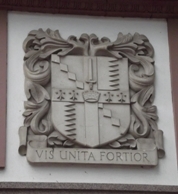
Inscription on HSBC building

Vis unita fortior.

Meaning:

“A force united is stronger.”

Why exactly is this on display in Reading’s Broad Street? Older residents of Reading may remember that the building was not always that of HSBC, but was once the location of the Midland Bank. This bank was acquired by HSBC in 1992, and it was rebranded in 1999. The arms with their Latin motto were that of the Midland Bank, originally founded in 1836.

It is beautifully ironic in a way that the Latin inscription and the crest alone survive, with a Latin motto that in hindsight seems to suggest that, even for banks, only joining forces is hope for survival.

Voices muffled and vanishing

After just twenty years, it has become difficult to understand the relationship between the Midland Bank motto and its current location. It may also be difficult or in fact impossible for many passers-by to grasp the meaning of the text, even though Latin mottos are, in fact, still frequent in Britain.

Inscription for Edward Dalby

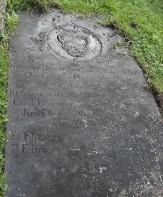
But what if the inscription is closer to 300 years old, substantially longer, yet exclusively written in Latin, and it is not even on display in a prominent spot? The answer should be obvious, and it is depressingly easy to illustrate the point with an example. The following stone now lies in the graveyard of Saint Laurence, just north of the church building. This is the monument of Edward Dalby, once upon a time the Recorder of Reading. It reads thus:

Spe resurgendi
Hic prope depositi sunt cineres Edwardi Dalby,
ar(miger) qui obiit 30 Martii, Anno D(omi)ni 1672,
aetatis 56.
Et Franciscae uxoris ejus, filiae superstitis et her(e)dis
Caroli Holloway, ar(miger), servientis ad legem:
Haec obiit 17 Augusti, anno D(omi)ni 1717,
aetatis 90.
Et Elizabethae, filiae eorundem, quae obiit
8 Februarii, anno D(omi)ni 1686, aetatis 23.

“In the hope of resurrection, here are deposited the ashes of Edward Dalby, armiger, who died 30th of March, A.D. 1672, aged 56. Also of Frances, his wife, surviving daughter and heir of Charles Holloway, serjeant-at-law: she died on 17th of August, A.D. 1717, aged 90. Also of Elizabeth, their daughter, who died on 8th of February, A.D. 1686, aged 23.”

The stone, embellished with a significant coat of arms at its top, now exposed to weather, filth, and vegetation, records the life of one of Reading’s foremost dignitaries at the time as well as those of his family: Edward Dalby of the Inner Temple. Henry Hyde, Earl of Clarendon, described him as a man ‘of eminent loyalty and as wise a man as I have known of his rank’. He married Frances, daughter of Charles Holloway, also a lawyer. Dalby became Recorder (or High Steward) of Reading in 1669, replacing Daniel Blagrave, who had to flee the country for his involvement in regicide (as one of the signatories of King Charles I’s death warrant). Their daughter died young. Their son John, not mentioned in this text, continued the legacy of the Dalby family after his father’s death. Only a small street, Dalby Close in Hurst, Wokingham, still preserves the family’s name today.

A small step towards regaining collective memory?

There are well over 100 Latin inscriptions, from ancient to modern, in Reading – some of them well-known to everyone (like the one on the pedestal of the statue of Queen Victoria on Blagrave Street), others rather more cryptic and hidden away. Many of them have fascinating stories to tell, and they all add to the jigsaw puzzle that is the history of Reading. For the Latinist, they are also invaluable documents to understand the spread, role, and legacy of Latin in modern times. It is high time to collect these texts and to make them available to the public, in translation and with appropriate amounts of documentation, so that fading memory, in conjunction with a language barrier, will not soon turn into complete and utter oblivion.

Posted in Epigraphy, History of Reading | Tagged , , , | Comments Off on The fading voices from Reading’s past