Operation Mos Maiorum, Or: Ve Hav Vays … (Of Our Ancestors, That Is)

On Monday, 13 October, an EU-wide joint police operation will commence. It will last for two weeks, and its purpose is to target undocumented immigrants to the EU, to investigate their routes into the EU, and to crack down on human trafficking. The operation will be lead by the Italian ministry of the interior (with Italy currently holding the EU presidency), in conjunction with Frontex, Europol, and police forces of the EU member states.

Operations like this have somewhat of a tradition.

The most recent one came under the operational code name of Perkunas (autumn 2013, under the Lithuanian presidency). Earlier instalments of the same exercise were named Hermes, Mitras, Demeter, Balder, and Aphrodite – names that sound like a somewhat unimaginative job-creation measure for Classicists (including Nordic Studies).

Was it this tradition that led the Italian authorities to name the new operation ‘Mos Maiorum’, ‘Ways of the Ancestors‘?

Whatever the case may be, the most recent code name, Mos Maiorum, reminded me of one of the earliest instances of the phrase mos maiorum in Latin literature, preserved in the Trinummus, a comedy written by the 3rd/2nd century B. C. Roman playwright Titus Maccius Plautus.

At the beginning of the second scene of the second act, Philto – a father figure who sees the world in a constant state of decline – laments (Plaut. Trin. 280–300):

Feceris par tuis ceteris factis,
patrem tuom si percoles per pietatem.
nolo ego cum improbis te viris, gnate mi,
neque in via, neque in foro necullum sermonem exsequi
novi ego hoc saeculum moribus quibus siet:
malus bonum malum esse volt, ut sit sui similis;
turbant, miscent mores mali: rapax avarus invidus
sacrum profanum, publicum privatum habent, hiulca gens.
haec ego doleo, haec sunt quae me excruciant, haec dies
noctesque tibi canto ut caveas.
quod manu non queunt tangere tantum fas habent quo manus abstineant,
cetera: rape trahe, fuge lete – lacrumas
haec muhi quom video eliciunt,
quia ego ad hoc genus hominum duravi.
quin pruus me ad plures penetravi?
nam hi mores maiorum laudant, eosdem lutitant quos conlaudant.
hisce ego de artibus gratiam facio, ne colas neve imbuas ingenium.
meo modo et moribus vivito antiquis,
quae ego tibi praecipio, ea facito.
nihil ego istos moror faeceos mores, turbidos, quibus boni dedecorant se.
haec tibi si mea imperia capesses, multa bona in pectore consident.

In the translation of H. T. Riley:

You will be doing what is consonant to the rest of your conduct if you reverence your father. By your duty to me, my son, I wish you, for my sake, not to hold any converse with profligate men, either in the street or in the Forum. I know this age – what its manners are. The bad man wishes the good man to be bad, that he may be like himself. The wicked, the rapacious, the covetous, and the envious, disorder and confound the morals of the age: a crew gaping for gain, they hold the sacred thing as profane – the public advantage as the private emolument. At these things do I grieve, these are the matters that torment me. These things am I constantly repeating both day and night, that you may use due precaution against them. They only deem it right to keep their hands off that which they cannot touch with their hands; as to the rest, seize it, carry it off, keep it, be off and go hide, that is the word with them. These things, when I behold them, draw tears from me, because I have survived to see such a race of men. Why have I not rather descended to the dead ere this? For these men praise the manners of our ancestors, and defile those same persons whom they commend. With regard, then, to these pursuits, I enjoin you not to taint your disposition with them. Live after my fashion, and according to the ancient manners; what I am prescribing to you, the same do you remember and practise. I have no patience with these fashionable manners, upsetting preconceived notions, with which good men are now disgracing themselves. If you follow these my injunctions to you, many a good maxim will take root in your breast.

I cannot help but feel that the concept of the mos maiorum has been appropriated for the police operation in the same way that Philto criticises here. Yet the term mos maiorum seems so comforting, suggesting reliability and trustworthiness – just as it seems to come across in Plautus’ Trinummus, when it is used for the second time in this play (a play that has been described as particularly challenging to Roman morality) – now by a slave, Stasimus, overheard by Charmides (Plaut. Trin. 1028–1033):

Stas. Vtinam veteres homin<um mor>es, veteres parsimoniae
potius <in> maiore honore hic essent quam mores mali.

Charm. Di immortales, basilica hic quidem facinora inceptat loqui.
vetera quaerit, vetera amare hunc more maiorum scias.

Stas. Nam nunc mores nihili faciunt quod licet, nisi quod lubet:
ambitio iam more sanctast, liberast a legibus.

STASIMUS
I wish that the old-fashioned ways of old-fashioned days, and the old-fashioned thriftiness, were in greater esteem here, rather than these bad ways.

CHARMIDES (behind).
Immortal Gods! this man really is beginning to talk of noble doings! He longs for the old-fashioned ways; know that he loves the old-fashioned ways, after the fashion of our forefathers.

STASIMUS
For, now-a-days, men’s manners reckon of no value what is proper, except what is agreable. Ambition now is sanctioned by usage, and is free from the laws.

What is left to say?

Well, Plautus uses the phrase mos maiorum one more time.

It features at the very end of his play Cistellaria, in an address of the audience delivered by the theatre troupe (Plaut. Cist. 782–787):

Ne exspectetis, spectatores, dum illi huc ad vos exeant:
nemo exibit, omnes intus conficient negotium.
ubi id erit factum, ornamenta ponent; postidea loci
qui deliquit vapulabit, qui non deliquit bibet.
nunc quod ad vos, spectatores, relicuom relinquitur,
more maiorum date plausum postrema in comoedia.

Don’t you wait, Spectators, till they come out to you; no one will come out; they’ll all finish the business indoors; when that shall be done, they’ll lay aside their dress; then, after that, he that has done amiss will get a beating; he that has not done amiss will get some drink. Now as to what’s left, Spectators, for you to do, after the manner of your ancestors, give your applause at the conclusion of the Play.

There has been hardly any coverage of Operation Mos Maiorum in British news media at all – other countries have been slightly more interested in this issue. Searches for media reports on the outcomes of earlier operations are rather … disappointing, too.

Previous operations do not seem to have achieved much at all in terms of cracking down on human trafficking and related crimes: they resulted in the arrests of illegal immigrants – and little else.

Like an invocation of the mos maiorum in ancient times, they seem to have been largely therapeutic and designed to inspire self-confidence as well as a sense of security.

So are we just to applaud this play then, in the (alleged and surprisingly flexible) manner of the ancestors, believing that all business will be finished indoors to our satisfaction, by people playing their roles (more or less) properly…?

Posted in Poetry | Tagged , , | 1 Comment

Less is more

Today is National Poetry Day, and this year’s theme is ‘Remember’. Could there be a better occasion for me to throw in a gratuitous Latin poem from the Carmina Latina Epigraphica?

No, I didn’t think so, either.

So here it comes (CIL X 1284 = CLE 962 = ILS 7785):

Nardu(s)
poeta
pudens
hoc
tegitur
tumulo.

In translation:

Nardus,
the poet,
bashful,
is covered
by this
tomb.

The inscription, of uncertain origin and date (presumably of the first century B. C., however), now kept in Nola, commemorates an otherwise unknown poet called Nardus.

At first glance, the text does not appear to be much of a poem: six meagre words, spread out over six lines.

Yet, it is a poem – and even as such it is an unusual one, as reductionist as everything else about this stone: it is a monostich, a poem of but a single line, and it is made up of a line that does not normally feature individually in Latin poetry, namely a dactylic pentameter: this rhythm hardly ever occurs without a preceding hexameter line. There is little imagery (except, of course, for the notion of a tomb ‘covering’ the deceased like clothing or a blanket), and there is little play with sound (but note the double use of alliterations in poeta pudens and tegitur tumulo).

The infuriating brevity of this poem has inspired scholars for a long time now: who was this Nardus?

Should one interpret pudens (‘bashful, shame-faced, modest’) as another part of the poet’s name, and could he then be a Pudens that is already known from other sources?

One scholar was even desperate enough to think of a compound noun nardu-poeta, supposedly meaning ‘soap maker’ (nardus is a Graeco-Roman term denoting lavender).

In Latin epitaphs, pudens is a quality that praises restraint, moderation, and temperance in moral terms. In a number of cases one finds it accompanied by references to (sexual) chastity (as a female virtue), sometimes accompanied by references to a deeper understanding of the role of temperance and simplicity in life (such as frugi, gender neutral).

It might just be the case, then, that Nardus, the poeta pudens, (or his relatives, of course) gave us a poetic example by which he wanted to be remembered, illustrating his being pudens in the single-most reductionist way possible – linguistically, metrically, poetically.

And yet, we can remember him and his poem today.

Posted in Carmina Epigraphica, Poetry | Tagged | Comments Off on Less is more

Poetry Morbid and Vivid

My research on the Latin verse inscriptions is progressing nicely. Over the last week or so, I have collected and analysed the evidence for the ways in which the Romans themselves engaged with their inscribed poetry – essentially asking a very simple question: assuming having poetry engraved on stone was not an end in itself, who would actually read it – and how and why? I had planned to blog about some of the remarkable statements that I encountered as I went along in my research, but then something unexpected happened.

As I went to Dundee last weekend, I used the opportunity to explore this city a little further. Most tourist guides that I consulted had suggested that Dundee is worth an excursion, but not a long one. I cannot claim myself that I found Dundee anywhere near as depressing as I had been led to believe – in fact, I was rather struck by the place.

On occasion of this visit, I managed to explore Dundee’s historic graveyard called ‘the Howff‘. Originally, the Howff was the orchard of a Franciscan monastery; subsequently, following Maria Stuart’s grant of the land to the burgh, it was converted into a graveyard.

What struck me was the number of stones that displayed little poems for the deceased – poems written in English (no Latin ones, sadly – or at least not in the area that I covered on this occasion!), but not altogether different in content, tone, and world of thought from those Latin inscriptions that are at the heart of my own research. My business is graveyard science, after all.

Here are three of the little gems that I encountered:

1. The _____ Wife

wife

She was, but words are wanting
to say what;

Think what a wife should be,
she was that.

2. A Safe Harbour

sailorThrough Stormy Seas of trouble past,
I’ve found a peaceful Shore:
From tempests Safe I’m moor’d at last,
And leave my port no more.

3. No Escape for Anyone – Especially Not for You, M’Dear…

weep notWeep not for me, my HUSBAND dear,
I am not dead but sleeping here.
My end you know, my grave you see,
Prepare yourself to Follow ME.

In many ways these poems raise the same questions and pose the same difficulties as their ancient Latin counterparts: who wrote them? and for whom to read? What is the story behind the first poem, which is attested more than once, and bears striking similarities to poems that have appeared in print? Would one fill in the blanks of the first poem in the same way that the (ostensibly) grieving husband did? What did the writer of the second poem allude to with the off-hand mention of ‘trouble past’?

Who seems to be talking through these poems (or, in the case of the third poem: who is pretending to be talking through a poem) – and to whom? What do these poems tell us about the intellectual world of the individuals that they represent?

Are these poems designed to be read in silence? Or will one, almost automatically, start reading them out loud, to indulge in their words and in their rhymes? Inscribed headstones seem to provide us with an interface to the past – they allow us to read of the thoughts, and – especially when read out aloud – to hear voices of times long gone. The art historian Peter Sager wrote that ‘on its graveyard ‘The Howff’ the old city on the river Tay is more alive than anywhere else’ – yet another snide remark to malign Dundee, to be sure, yet so deceptively convincing.

Why deceptively?

Deceptively, because – at least to the Classicist’s mind – the same rules do not seem to apply to epigrams that are written on stone as opposed to those that are of a literary nature.

But how can a change of medium and a change of environment possibly suspend the artifice of poetry? And why would it? The poems on these Dundonian headstones, like all other poems, are imaginations of the world, of life and afterlife – they are fantastic coping mechanisms and expressions of desires, first of all.

Whether it is the beautiful device of letting a reader fill in the blanks as regarding the nature of the ideal wife (as if there were significantly fewer responses than people who ever lived!), or the image of the grave as a tranquil harbour, or the imagination that a pre-deceased wife addresses her husband with a veritable threat (‘you, too, will die!’) – all of these are the imaginations of those left behind, pieces that invite us to join a perspective on this world (and the next), and bring this perspective of a by-gone era back to life with our very own voice.

This perhaps rather unsettling thought has been expressed strikingly at the opening of a Latin verse inscription that I recently had the pleasure to re-read (CLE 513.1–4):

Carpis si qui [uia]s, paulum huc depone la[borem].
Cur tantum proper(as)? non est mora dum leg(is), audi
lingua tua uiuum mitique tua uoce loquentem.
Oro libens libe[n]s releg(as), ne taedio duc(as), amice

If you there seize these ways, let go of the stress for a short while: why such a rush? There is no time wasted while you read: listen to a living person who talks in your tongue and with your gentle voice. I ask you to read this favourably, favourably, so that you will not derive dislike, my friend.

Monuments thus do not only preserve memories, good or bad.

Monuments allow future generations to re-enact the past and to bring it back to life – by means of breathing our own life-breath into it, by means of lending it our own voice, as a service and as a favour to generations past.

Posted in Carmina Epigraphica, Epigraphy | Comments Off on Poetry Morbid and Vivid

Better Together?

Better Together? (Wenceslas Hollar, The Belly and the Members) – Image Source: http://upload.wikimedia.org/wikipedia/commons/4/4b/Wenceslas_Hollar_-_The_belly_and_the_members.jpg.

Better Together? (Wenceslas Hollar, The Belly and the Members) – Image Source: http://upload.wikimedia.org/wikipedia/commons/4/4b/Wenceslas_Hollar_-_The_belly_and_the_members.jpg.

Day after tomorrow, the inhabitants of Scotland get to have their say in a referendum as to whether or not they wish Scotland to become an independent, sovereign state, potentially resulting in the dissolution of a union with England that was initiated in 1603 and confirmed in 1707.

Even though I do reside in Scotland at the moment, for one year, I have no say in the referendum myself: this is not because it is exclusive in any way, but simply down to the fact that I arrived too late for voter registration. On the plus side, however, it saves me the good time and trouble to make up my mind on this matter – a matter on which I, for once, do not have any particularly strong views: whatever the outcome, life as we know it is likely go on as a result.

Those who are opposed to an independent, sovereign Scotland at this point find themselves represented by the ‘Better Together‘ campaigning platform, a platform that has to face the thankless task to mobilise support for a negative claim (‘No’) in response to the ‘Yes Scotland‘ movement, which has both a thoroughly positive-sounding name and positive campaigning posters (‘Yes’).

Notions of nationalism and ethnic pride to one side, a significant part of the debate affects economic matters: matters related to wealth generated through the availability of natural resources (such as oil) and the investment in sustainable energy (Scotland has made excellent progress in its efforts to go green), matters related to the distribution of wealth and jobs across the UK (with London and the South-East being perceived as a black hole that swallows all the wealth, skimming off the North and feeding the South at everyone else’s expense), and matters related to the general (relative) spend of national resources (especially with regard to social security systems, but also with a view on culture and education).

The political debate has utilised and reinforced an ‘us vs them’ stereotype, Holyrood (us, Scotland) vs. Westminster (them, London, the South-East, England, or the UK, more generally), in which ‘they’ (Westminster) are depicted as greedy and self-obsessed, with little regard and even less understanding for those who live across the Scottish border (and some other regions too). This has been reinforced by a dislike for the current Tory government and its prominent figureheads. ‘We’, in turn, are depicted as quasi-Scandinavians, socially minded and almost egalitarian, with no time for matters of social class and political corruption.

To the best of my knowledge, nobody has, so far, exploited the classical fable of the Belly and the Members in this context.

Yet, some of the language, both on the ‘Yes Scotland’ and the ‘Better Together’ side, strongly reminded me of the famous episode that is reported for the 494 BC secession of the plebs, in which Menenius Agrippa reaches out to the Roman plebs, who had decided to escalate Rome’s ongoing conflict of the orders rather drastically.

The Roman historian Livy reports the incident as follows (2.32.8–12):

placuit igitur oratorem ad plebem mitti Menenium Agrippam, facundum uirum et quod inde oriundus erat plebi carum. is intromissus in castra prisco illo dicendi et horrido modo nihil aliud quam hoc narrasse fertur: tempore quo in homine non ut nunc omnia in unum consentiant, sed singulis membris suum cuique consilium, suus sermo fuerit, indignatas reliquas partes sua cura, suo labore ac ministerio uentri omnia quaeri, uentrem in medio quietum nihil aliud quam datis uoluptatibus frui; conspirasse inde ne manus ad os cibum ferrent, nec os acciperet datum, nec dentes quae acciperent conficerent. hac ira, dum uentrem fame domare uellent, ipsa una membra totumque corpus ad extremam tabem uenisse. inde apparuisse uentris quoque haud segne ministerium esse, nec magis ali quam alere eum, reddentem in omnes corporis partes hunc quo uiuimus uigemusque, diuisum pariter in uenas maturum confecto cibo sanguinem. comparando hinc quam intestina corporis seditio similis esset irae plebis in patres, flexisse mentes hominum

In translation (by B. O.Foster):

‘The senate decided, therefore, to send as their spokesman Menenius Agrippa, an eloquent man, and acceptable to the plebs as being himself of plebeian origin. He was admitted into the camp, and it is reported that he simply told them the following fable in primitive and uncouth fashion. ‘In the days when all the parts of the human body were not as now agreeing together, but each member took its own course and spoke its own speech, the other members, indignant at seeing that everything acquired by their care and labour and ministry went to the belly, whilst it, undisturbed in the middle of them, did nothing but enjoy the pleasures provided for it, entered into a conspiracy; the hands were not to bring food to the mouth, the mouth was not to accept it when offered, the teeth were not to masticate it. Whilst, in their resentment, they were anxious to coerce the belly by starving it, the members themselves wasted away, and the whole body was reduced to the last stage of exhaustion. Then it became evident that the belly rendered no idle service, and the nourishment it received was no greater than that which it bestowed by returning to all parts of the body this blood by which we live and are strong, equally distributed into the veins, after being matured by the digestion of the food.’ By using this comparison, and showing how the internal disaffection amongst the parts of the body resembled the animosity of the plebeians against the patricians, he succeeded in winning over his audience.’

Menenius was successful with his simile, even if this was only one of many incidents in Rome’s constant class struggle during the time of the Roman Republic.

It will be interesting to see whether or not team ‘Better Together’ (who has not yet found a similarly striking simile in this debate) can be successful, too – and, if not, whether or not a sovereign Scotland will be able to function just as much as a living body as it is hoped by those who currently support its independence.

Posted in Prose | Tagged , , | 3 Comments

Remember Lucius M-whatsisface?

I am a lucky person. The British Academy recently awarded me a Mid-Career Fellowship for 2014-5, allowing me to work on a project on my long-standing research interest, Latin inscriptions in verse or, as they are more commonly called among us ‘carminatores’, the Carmina Latina Epigraphica (or, shorter still, the CLE).

Certainly, in the vast stream of Latin inscriptions that survived antiquity, the CLE are but a small island: approximately 0.5–1% of all Latin inscriptions were composed in verse.

In the context of Latin poetry, however, their importance must not be underestimated: they add several thousands of epigrams – complete or fragmentary, from a wide range of diverse authors, across time and space in the Roman empire – to the body of literary poetic texts that underwent a manuscript transmission and that more commonly catch the attention of Classical scholars.

Over the next year or so, I will present examples of this genre and related discoveries on my blog, to share my enthusiasm with a wider audience and to promote this remarkable collection of texts.

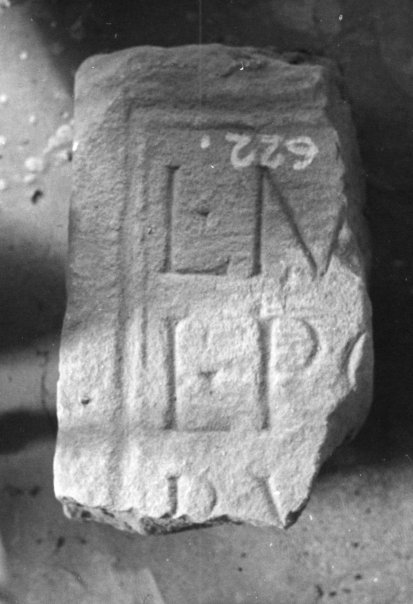
CIL XIII 11885 (from Mainz/Moguntiacum), similar to that imagined by Ausonius. – Image source: http://db.edcs.eu/epigr/bilder/$OS_CIL_13_11885.jpg

CIL XIII 11885 (from Mainz/Moguntiacum), similar to that imagined by Ausonius. – Image source: http://db.edcs.eu/epigr/bilder/$OS_CIL_13_11885.jpg

To commence this series, I would like to present a little-known poem by the 4th century Gallic poet Decimus Magnus Ausonius.

Ausonius, in his collection of Epitaphia Heroum, wrote a short poem called De nomine cuiusdam Lucii sculpto in marmore (‘On the name of some Lucius, carved in marble’, c. 32). Sesto Prete, in his Teubner edition of Ausonius’ poems, presented the text as follows:

Vna quidem, geminis fulget set dissita punctis

littera, praenomen sic <.L.> nota sola facit.

post .M. incisum est, puto sic: <.^.> non tota uidetur:

dissiluit saxi fragmine laesus apex.

nec quisquam, Marius seu Marcius anne Metellus

hic iaceat, certis nouerit indiciis.

truncatis conuulsa iacent elementa figuris,

omnia confusis interiere notis.

miremus periisse homines? monumenta fatiscunt;

mors etiam saxis nominibusque uenit.

The text translates, roughly, as follows:

One letter, indeed, yet it shines embedded in between two points: thus makes a single sign, •L•, a first name. After that an •M• has been carved, as follows, •^•, I think, one cannot see it in full: the top is mutilated and came off due to a fracture of the stone. Consequently, no one will be able to know from unambiguous evidence whether it is a Marius or Marcius or Metellus who lies here. Distorted lie the letters, with truncated shapes, everything died as a result of the mangled signs. Should we be surprised that people die? Monuments languish, and death even comes to stones and names.

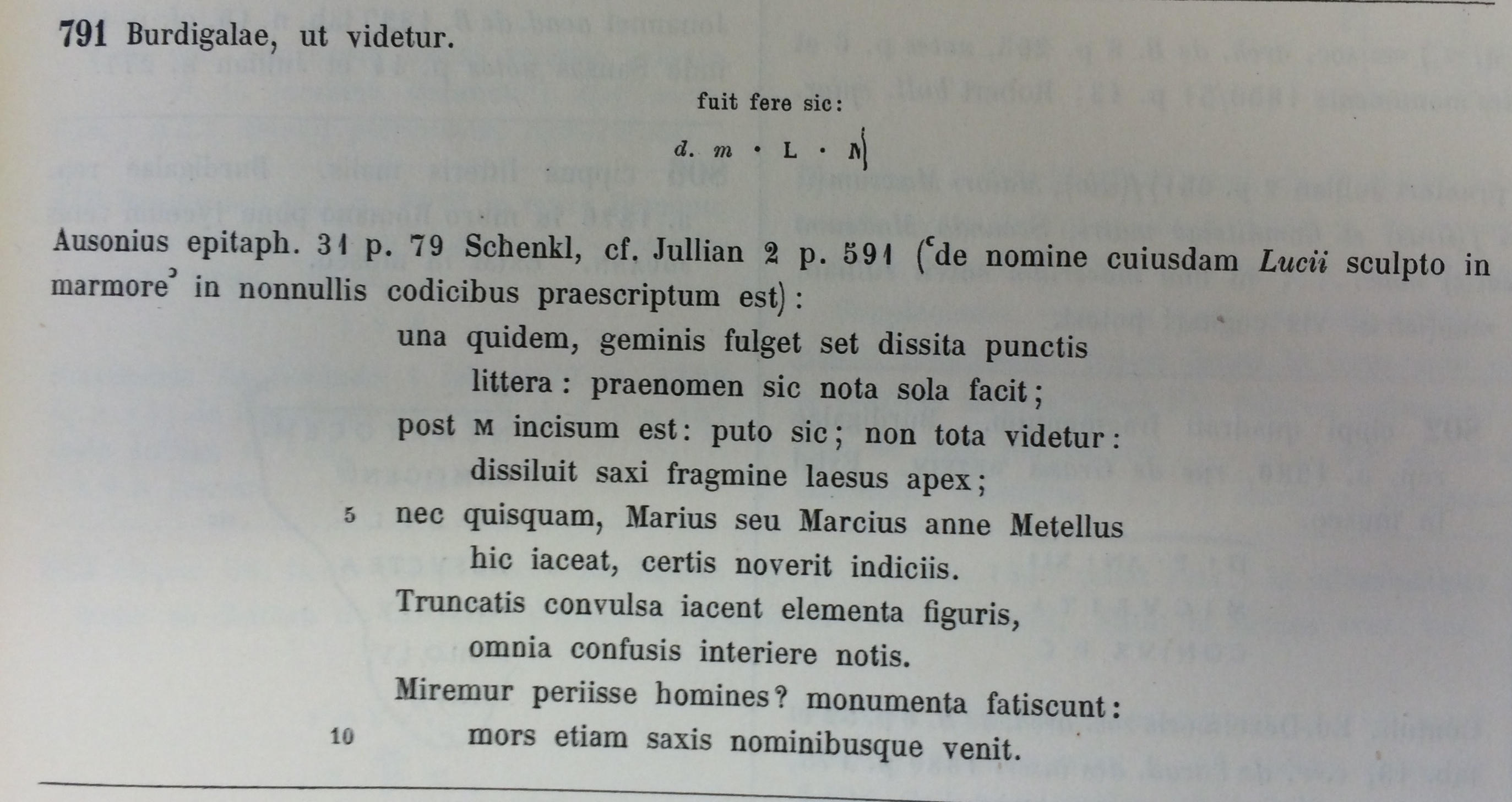
It is rather amusing to see that Otto Hirschfeld, the editor of the first volume of CIL XIII, decided to take Ausonius’ little piece literally, as evidence for an actual inscription from Bordeaux (Ausonius’ home town), ut videtur (‘as it would appear’):

CIL XIII 791.

CIL XIII 791.

Hirschfeld even added a D(is) M(anibus) (‘To the Manes‘) as an (arguably) lost initial part of the inscription – no doubt in an attempt to account for the dots that, according to Ausonius, surrounded the abbreviated first name (instead of just one dot following it, as one would expect if L(ucius) were indeed the first word of such an inscription).

Whether or not one would like to see Ausonius’ poem as evidence for an actual inscription (or as a mere literary imagination), the text manages to combine two essential aspect of Latin epigraphy.

It is testament to an unbroken desire to make sense of fragmented texts (in that regard, Ausonius’ description, albeit poetic in nature, does not actually diverge much from the technical prose of the volumes of the Corpus Inscriptionum Latinarum).

In addition to that, the text–  all too quickly dismissed as ‘trite in its conclusion of the decay of stone as metaphor for the ephemerality of man’ by Nigel M. Kay in his otherwise immensely useful and thorough commentary on Ausonius (p. 153) – invites study of the world of popular thought of the Roman Empire: a world in which the fear of being forgotten after death has been expressed many a time.

An illustrative example of that, randomly chosen from a wide range of texts, is the funerary inscription for Ennia Fructuosa from Lambaesis in the Roman province of Numidia (now Tazoult-Lambese, Algeria).

Its text, presumably dating to the third century A. D., reads as follows (CIL VIII 2756 = CLE 1604):

Quae fuerunt praeteritae
vitae testimonia nunc decla-
rantur hac scribtura. postre-
ma haec sunt enim mortis
solacia ubi continetur nom[i]-
nis vel generis aeterna memo-
ria. Ennia hic sita est Fructu-
osa karissima coniunx cer-
tae pudicitiae bonoque obse-
quio laudanda matrona.
XV anno mariti (!) nomen acce-
pit, in quo amplius quam XIII
vivere non potuit, quae non
ut meruit ita mortis sortem
retulit. carminibus defi-
xa iacuit per tempora mu-
ta ut eius spiritus vi
extorqueretur quam
naturae redderetur.
cuius admissi vel Ma-
nes vel di Caelestes e-
runt sceleris vindices.
Aelius haec posuit Procu-
linus ipse maritus legio-
nis tantae III Augustae
tribunus.

In translation:

This writing now declares what testifies to the life that has passed. For that is what is the ultimate solace in death, where eternal memory of the name and the family is preserved. Ennia Fructuosa lies here, dearest wife, of unique modesty and good towardliness, a praiseworthy matron. In the fifteenth year, she accepted the appellation of a married person, with which she was not allowed to live for more than thirteen years – she, who was not granted a fate of death that she deserved. Spellbound by magic charms she lied there for a long time, mute, so that her life breath wound its way out by force rather than to be restored to nature. The Manes or the heavenly gods will avenge the crime that has been allowed happened. Aelius Proculinus himself erected this monument, tribune of the great legio III Augusta.

This text, written in a form that blends Latin prose with less-than-perfect hexameters and senarii, purportedly written by a military tribune named Aelius Proculinus, is not only an expression of heartfelt love of a man who lost his wife too soon (and who gives an idea of his values and his views on life and death in general): it gives an idea of the concerns of Roman(ised) people in second and third century North Africa, their fear of death in a world that partly can only be explained in terms of magic and ritual – and their fear to be forgotten, unless their names and lives are recorded in lasting monuments.

To me, and for my new research project, however, the text is also an expression of something else. It is an example of what I would like to call ‘poetry of the people’: a text (allegedly) not written by a poet, but by a member of a society that, in certain contexts, valued poetic and poeticising works of art and put those on display; a text that tells a highly personal story, to commit it, along with its views and values, to an uncertain afterlife; a text that obfuscates any clear-cut lines between high art and pedestrian craftsmanship; a text that is hard to classify as either prose or verse.

And yet, a text that, quite undeniably, deserves to be listened to, with the side-effect that the death that ‘even comes to stones and names’, as Ausonius had put it, will be stalled for a little bit longer.

Posted in Carmina Epigraphica, Epigraphy, Poetry | Tagged , | 6 Comments

Ennius on War and (Dashed Hopes for) Peace

Quintus Ennius was one of ancient Rome’s greatest poets. He served as a soldier during the Second Punic War.

In his epic poem Annales (‘Yearbooks’), which survives in fragments, Ennius, far from being a pacifist himself (even in the fragments that are assembled below), commented on war and its effects numerous times.

Present conflicts across the globe invite a re-reading and silent reflection of some of the disiecti membra poetae, to use Horace‘s famous phrase (coined, in fact, for the very same Ennius), the limbs of a dismembered poet: a fragmented blog post, to express my perplexity.

When all hell breaks loose

(…) postquam Discordia taetra
belli ferratos postes portasque refregit (…)

(…) after gruesome Discord
had shattered open the iron posts and doors of war (…)

(Annales 225-6 S.)

What war causes in people

Pellitur e medio sapientia, vi geritur res,
spernitur orator bonus, horridus miles amatur.
haud doctis dictis certantes nec maledictis
miscent inter sese inimicitiam agitantes,
non ex iure manum consertum, sed magis ferro
rem repetunt regnumque petunt, vadunt solida vi.

Pushed away from the centre good sense, force rules the day,
despised the good orator, the horrid soldier cherished.
Fighting, not with learned words or curses,
they clash with one another, pushing hostilities,
laying hand onto one another not rightfully, but rather with the sword
they seek material gain and strive for power, advancing with brute force.

(Annales 247-53 S.)

What kind of person would seek armed conflict?

(…) stolidum genus Aeacidarum:
bellipotentes sunt magis quam sapientipotentes.

(…) That stupid family of the Aeacidae:
They are strong in battle rather than strong in their brain.

(Annales 197-8 S.)

Are there any alternatives to blind violence?

Nam vi depugnare sues stolidi soliti sunt:
astu non vi sum summam servare decet rem.

For seeking total victory with violence is what stupid boars usually do:
with wit, not violence – that is how it is becoming to save the highest good.

(Annales 96+97 S.)

* * *

So how can the gory beast that is Discordia be locked up and restrained again? How does one regain peace, and how can one find back to civilian life after armed conflict – a conflict potentially as big as the Second Punic War?

Sadly, Ennius does not tell us – at least he doesn’t in the surviving fragments. The one and only time the Latin term pax (‘peace, peace treaty’) features in the Annales, it does so in a moment of disappointment:

Orator sine pace redit regique refert rem.

The ambassador returns without peace and reports the matter to the king.

(Annales 202 S.)

Chances are that Ennius’ answer would have referred to the use of one’s brain, sapientia, as well as the means of debate and civic discourse, implicitly presented here as an alternative tools to solve conflicts – superior to the tool of violence, the tool of wild pigs.

 * * *

On a perhaps not altogether unrelated note, I greatly enjoyed reading Neville Morley’s blog post on Thucydides and Emotions and Atrocities.

Posted in Poetry | Tagged , | 1 Comment

Pompeiis Everywhere!

An (admittedly spectacular) archaeological excavation in County Durham is the most recent addition to excavation sites that have been proclaimed ‘the Pompeii of . . .

As I begin to lose track of the many Pompeiis that there are out there already, I herewith provide an overview (incomplete, no doubt: additions highly welcome!), and I would like to propose the following new rule:

Don’t call it a ‘Pompeii of the _____’ unless (i) it was destroyed by a volcano and (ii) you’d be prepared to call Pompeii a ‘_____ of Roman Campania’.

[I will make an exception for the amazing Lego Pompeii, of course.]

* * *

Pompeiis of the North

British Isles

Binchester:

Cirencester:

Craig Rhos-y-Felin/Stonehenge:

Culbin:

Dunluce (Dunlace) Castle (a.k.a. ‘Little Pompeii’):

Fenland (Must Farm, Peterborough):

London:

Island Mahee:

Peterborough:

Skara Brae:

Vindolanda:

Wroxeter:

Denmark

Greenland:

Skagen:

Germany

Iceland

Ireland

Carrickmines Castle:

Waterford:

Norway

Sweden

Pompeiis of the East

Afghanistan

[link to Pompeii somewhat tenuous]

China

Jehol Biota:

Lajia:

Tibet:

India

Indonesia

Japan

Japan’s northeastern coast:

Kanai Higashiura:

Greece

Olynthus:

Santorini:

Jordan

Poland

Qatar

Syria (a.k.a. the ‘Pompeiis of the Desert’)

Dura:

Palmyra:

Turkey

Ephesus:

Priene:

Ukraine

Pompeiis of the West

Austria

France

Italy (other than the Pompeii!)

Herdonia (a.k.a. la Pompei di Puglia):

Roscigno (a.k.a the Pompeii of the 1900s or ‘Twentieth-Century Pompeii’…):

Sardinia:

Sicily:

Val Camonica:

Spain

Cordoba:

Écija:

Pompeiis of Africa

Algeria

Tanzania

Sierra Leone

  • Bunce Island – read about the ‘Pompeii of the Atlantic slave trade’ here.

Tunisia

Pompeiis of the Americas

Argentina

El Salvador

Martinique

Mexico

United States

Gary, IN:

Ozette, WA:

Vore Buffalo Jump, Wyo.:

Pompeiis Down Under

New Zealand

Papua New Guinea

Pompeiis of the Middle Ages

Underwater Pompeiis

Pompeiis of … Whatnow!?

* * *

And what about Herculaneum?

Well, at least Rouen was a ‘Herculaneum of the Middle Ages’, apparently…

More recently, Akrotiri got upgraded to be a Herculaneum of the Aegean:

Also, the London-based Pompeii (see above) may, in fact, have been a Herculaneum instead:

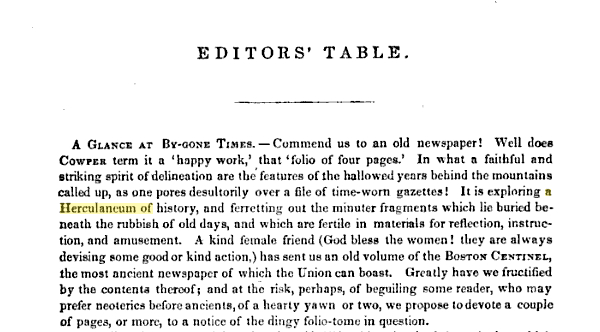
And then there is ……. the HERCULANEUM OF HISTORY! herculaneum

(to be continued, no doubt.) Original post: 25 June 2014; last update to the list: 18 November 2016.

Posted in Uncategorized | Tagged , | 5 Comments

From Pompeii, With Love

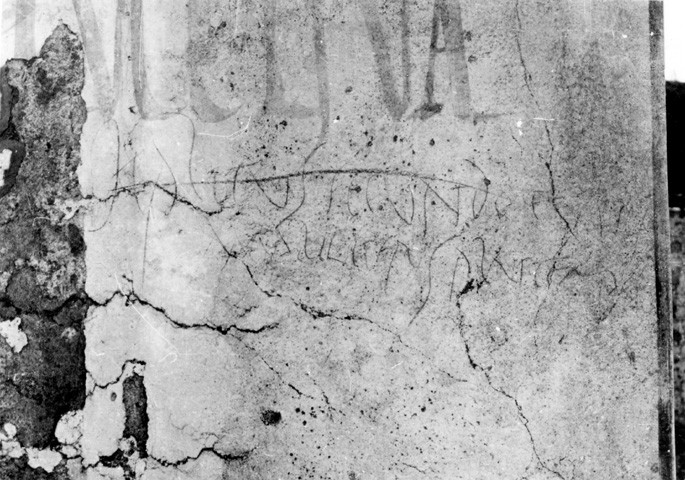
From Pompeii, with love. – Image source: http://db.edcs.eu/epigr/bilder.php?bild=PH0003731;PH0003745&nr=2.

From Pompeii, with love. – Image source: http://db.edcs.eu/epigr/bilder.php?bild=PH0003731;PH0003745&nr=2.

Exeter is a place that inspires me to talk about nonsense emerging from Pompeii. Seven or so years ago, I applied for a lectureship at the University of Exeter. For my presentation, I chose to talk about my initial observations regarding the spread of the verbal monstrosity that is Menedemerumenus, attested numerous times in Pompeii. My application was unsuccessful (no hard feelings!), but my initial exploration eventually resulted in a much richer joint publication with my colleagues Virginia Campbell and Matthew Nicholls.

I was grateful to get an opportunity to revisit verbal nonsense, as manifest in Pompeii, on occasion of an international conference Ancient Nonsense. Did the Greeks and the Romans have their own ‘Jabberwockies’ (22-24 July 2014), beautifully organised by Sara Chiarini. In what follows, I would like to make available to a broader audience some of the rather entertaining material that I got to examine on this occasion.

* * *

At Pompeii, we find numerous instances of the word amabiliter – ‘lovably’, ‘lovingly’, or ‘amiably’ – in contexts of varying complexity:

(1) Amabiliter. – ‘Lovably.’ (CIL IV 2032)
(2) Laculus | Priscillo | amabiliter | scr(ipsit) Epaphra | et | pereg(it) Elea | sitientes. – ‘Laculus lovably to Priscillus. Written by Epaphra, finished by Elea, both of which were thirsty.’ (CIL IV 2374 cf. p. 220. 465)
(3) Amabiliter sal(utem).  – ‘Greetings, lovably.’ (CIL IV 5419)
(4) Clodius | hic et ubici (!) | amabilit|er. – ‘Clodius, lovably, here and everywhere.’ (CIL IV 8556)
(5) Secun[do] | cum so[dale] | Hab[it]o | amabilit[er] | utiq(ue) sodales. – ‘To Secundus with his pal Habitus, lovably, like pals.’  (CIL IV 10227)
(6) Habitus Secundo et s[u]is | amabiliter salutem– ‘Habitus to Secundus and his folks, greetings, lovably.’ (CIL IV 10247)
(7) Secundo | plurimam | amabiliter | salutem. – ‘To Secundus, very many greetings, lovably.’ (Neue Forschungen 13)

In all cases, one is looking at greetings of sorts – seemingly in friendship, potentially with mild sexual overtones. Any doubts over the latter are immediately removed in the case of a rather lewd example from Herculaneum:

(8) Apelles Mus cum fratre Dextro amabiliter futuimus bis bina(s). – ‘Apelles Mus with his pal Dexter, amiably, we fucked two girls, on two occasions.’ (CIL IV 10678)

From a linguistic viewpoint, amabiliter, is an adverb. It is formed from the root *ama- (as in amare, ‘to love’), which generates the adjective amabilis, ‘lovable’. From this one then gets the adverb amabiliter, by means of adding the adverbial suffix –iter to the word stem amabil-.

Not a particularly spectacular selection of material so far, one might say – and quite rightly so: a mere greeting, as it would seem.

The next item, from Pompeii, would not seem to be particularly remarkable either. Instead of the amabiliter it simply shows an adverb that is (seemingly) derived from the adjective consociabilis, ‘suitable, fit, compatible’:

(9) Consociabiliter‘(CIL IV 2138 cf. p. 215; amended by Lebek, ZPE 45, 1982, 55)

But can this really mean what one would assume it means when strictly following the principles of Latin word formation? Suitably’? Why anyone would write this word on a wall?

A more plausible solution – assuming it is a greeting, like the aforementioned examples – would be this: it may well have been imagined (by its writer) to be an adverb that is, in fact, related to the noun consocius, ‘comrade, companion’. ‘Companionably’? While violating principles of Latin word formation, this at least would make some sense still.

Sticking to the ‘friendliness’ or ‘friendship’ theme for a little longer, here is another example. From frater, ‘brother’, instead of using the existing adjective fraternus, let us forge (in both meanings of that word) an (otherwise unattested) adjective – just for the sake (or the sound) of it: fratrabilis, ‘brotherly’, or, true to the principles of Latin word formation, ‘brotherable’. That would give the adverb fratrabiliter, ‘brother(ab)ly.’

Just to be clear, this is an entirely absurd formation, derived from an impossible root, as the –bilis suffix, in Latin, indicates a potential, a givenness, or a predisposition, in a medio-passive meaning. In other words, using the straightforward example, amabilis, ‘lovable’, is the quality of someone who may be loved (by others). What is the medio-passive potential in fratrabilis? Someone who may be brothered?

Whatever the case may be, the adverb fratrabiliter  features in the following Pompeian texts:

(10) Suilimea (!) Cissonio fratrabiliter sal(utem). – Suilimea [= Aemilius, spelled backwards!], to Cissonius, brotherably, greetings.’ (CIL IV 659 cf. p. 195)
(11) Coelius cum Rufio | et Eburiolo et Fausto | (f)ratrabiliter | Eburiolus Marinae | et Valeria(e) | Eburiolus Fausto | amico et Coelio | Faustiani. – ‘Coelius with Rufius and Eburiolus and Faustus, brotherably. Eburiolus to Marina and Valeria. Eburiolus to Faustus, the friend, and Coelius of Faustinianus (?). (CIL IV 8227)

So far, so good – everything moderately reasonable, if verging on the absurd in its expression, in the context of greetings (or so it would appear).

Things will go downhill from here, rather rapidly, as far as the level of being ‘sensical’, of ‘making sense’ is concerned.

What, for example, are we to make of a greeting ‘oral-rape-ably’, attested in a graffito at the exterior wall of the Pompeian basilica:

(12) Irrumabiliter. (CIL IV 1931)

Or ‘going-down-on-her-ably’, discovered at an outside wall between the entrances VI 15.22 and 23:

(13) Isidorus | verna Putiolanus | cunnuliggeter (?). – ‘Isidorus, homeborn slave from Puteoli, going-down-on-her-ably’. (CIL IV 4699)

Or ‘rushing-to-climax-first-ably’ (a meaning convincingly discussed by W. D. Lebek), found in a graffito that was discovered in building VII 7.5:

(14) Festinabiliter. (CIL IV 4758)

Or ‘bending-over-ably, butt-wiggling-ably’, in a graffito discovered at a tomb near the Porta di Nocera:

(15) Inclinabiliter | ceventinabiliter. (CIL IV 5406 = CLE 356 cf. p. 855)

Or ‘butt-wiggling-ably’ and another formation that yet awaits satisfactory explanation, but might well mean, e. g., ‘as-a-farmer-would-do-it-ably’, found in a graffito in dwelling V 2.7:

(16) Trebonius Euche ceventinabilite[r] | arrurabe[l]iter. – ‘Trebonius Euche, butt-wiggling-ably, as-a-farmer-would-do-it-ably(?).’ (CIL IV 4126)

No question: the range of playful imagination here is impressive, if (perhaps unsurprisingly) rather restricted to the swimsuit area of the human body.

What is more remarkable still, however, is that these playful formations (so far) have only become known from Pompeii. All of this suggests some kind of ‘in-joke’, a running-gag-style challenge, geographically restricted to Pompeii – and it would allow for some really interesting additions to work that is currently going on with regard to social network analysis in Pompeii, as an ‘in-joke’ like this can only spread on the basis of social networks and interactions.

As the playful joke is of a sexualised nature, one may infer that the writers were at least in their puberty, but quite possibly even beyond that age – possibly at an age that involved military training an service, as consociabiliter and fratrabiliter, items (9)–(11), would suggest.

A joke like this (‘okay, here is challenge: find an even more outrageous greeting involving the adverbial suffix –biliter’) is likely to go around, and get spread, in pubs, on the forum, and similar venues in which people gather and hilarity ensues.

The outline of the evidence, above, begins with the ‘sensical’ and ends with ‘most absurd’, and sees ‘sense’ or ‘meaningfulness’ disintegrate. This is a judicious arrangement – an arrangement that follows a linguistic point. While I would like to believe that this also follows the most plausible chronology of the general direction of travel, there is absolutely no evidence that, say, all those instances for amabiliter pre-date the more outrageous examples (12)–(16).

There is no evidence for such a claim whatsoever, and one must be very careful to avoid a teleological narrative.

But what alternative narratives could claim equal plausibility?

It seems necessary that amabiliter (or a similarly sensical term) must have been the point of departure, from which, and on the basis of which, some inhabitants of Pompeii chose to coin their derivatives ending in –biliter. A certain playfulness is even visible in those items that are still close, in terms of meaningfulness, to the term of departure, fratrabiliter: note the backwards spelling of Aemilius as Sulimea in item (10), a feature that is known from other inscriptions of Pompeii as well.

Outsiders at the time –i. e. those who were neither in the know and nor able to discern the underlying pattern of a wider phenomenon – the verbal meaning of virtually all individual tokens may have been explicable (although one must doubt that for item (16)). What they did not know, however, was what it meant to those who engaged in this little game.

Now, from afar, we are in no better position than an outsider at the time, and we cannot know just how wide-spread the knowledge of this joke was. Yet, based on the collection of the evidence, we are at least able to see the playful nature of the game and some of its underlying dynamics.

Posted in Epigraphy, Prose | Tagged , , | 2 Comments

Looking at War with Lucretius

The last few weeks and months saw the emergence of numerous new (and old) centres of conflict around the globe: Ukraine, Iraq, Israel and Palestine, and Syria are the most prominent regions that attracted, or continue to attract, attention of the media. Clearly, we continue to ‘live in a world that has walls, and those walls have to be guarded by men with guns’ so that at least some may sleep peacefully under that soothing ‘blanket of freedom’ provided by men (and women) in arms, provided by means whose nature one, more often than not, desires to ignore:

The extent of pain, misery, and destruction that armed conflicts bring about has not changed fundamentally over centuries. Yes, the pace of events may have accelerated, yes, weapons now are outrageously more efficient at killing people, yes, warfare seems to have become increasingly depersonalised at the inflicting end.

Or so it feels.

The Roman Epicurean poet Lucretius, in the fifth book of his didactic poem De rerum natura (‘On the nature of things’), however, shows how this feeling is not a new one. In the following passage he provides a narrative of what essentially is a prototype of the very same sensation (Lucr. 5.1281–1307):

Nunc tibi quo pacto ferri natura reperta
sit facilest ipsi per te cognoscere, Memmi.
arma antiqua manus ungues dentesque fuerunt
et lapides et item silvarum fragmina rami
et flamma atque ignes, post quam sunt cognita primum.
posterius ferri vis est aerisque reperta.
et prior aeris erat quam ferri cognitus usus,
quo facilis magis est natura et copia maior.
aere solum terrae tractabant, aereque belli
miscebant fluctus et vulnera vasta serebant
et pecus atque agros adimebant; nam facile ollis
omnia cedebant armatis nuda et inerma.
inde minutatim processit ferreus ensis
versaque in obprobrium species est falcis ahenae,
et ferro coepere solum proscindere terrae
exaequataque sunt creperi certamina belli.
et prius est armatum in equi conscendere costas
et moderarier hunc frenis dextraque vigere
quam biiugo curru belli temptare pericla.
et biiugo prius est quam bis coniungere binos
et quam falciferos armatum escendere currus.
inde boves Lucas turrito corpore, tetras,
anguimanus, belli docuerunt volnera Poeni
sufferre et magnas Martis turbare catervas.
sic alid ex alio peperit discordia tristis,
horribile humanis quod gentibus esset in armis,
inque dies belli terroribus addidit augmen.

The beautiful, if rather archaic-sounding translation of  W. E. Leonard renders this passage as follows:

Now, Memmius,
How nature of iron discovered was, thou mayst
Of thine own self divine. Man’s ancient arms
Were hands, and nails and teeth, stones too and boughs-
Breakage of forest trees- and flame and fire,
As soon as known. Thereafter force of iron
And copper discovered was; and copper’s use
Was known ere iron’s, since more tractable
Its nature is and its abundance more.
With copper men to work the soil began,
With copper to rouse the hurly waves of war,
To straw the monstrous wounds, and seize away
Another’s flocks and fields. For unto them,
Thus armed, all things naked of defence
Readily yielded. Then by slow degrees
The sword of iron succeeded, and the shape
Of brazen sickle into scorn was turned:
With iron to cleave the soil of earth they ‘gan,
And the contentions of uncertain war
Were rendered equal.
And, lo, man was wont
Armed to mount upon the ribs of horse
And guide him with the rein, and play about
With right hand free, oft times before he tried
Perils of war in yoked chariot;
And yoked pairs abreast came earlier
Than yokes of four, or scythed chariots
Whereinto clomb the men-at-arms. And next
The Punic folk did train the elephants-
Those curst Lucanian oxen, hideous,
The serpent-handed, with turrets on their bulks-
To dure the wounds of war and panic-strike
The mighty troops of Mars. Thus Discord sad
Begat the one Thing after other, to be
The terror of the nations under arms,
And day by day to horrors of old war
She added an increase.

Yet, neither the composition of the victims nor their trauma nor their suffering has changed fundamentally – even if the discourse about the impact of war and trauma on people certainly has:

One aspect about war and armed conflict more generally that would appear to be changing rather significantly at present, however, is the way in which one gets to look at these goings-on, especially when not immediately and directly involved in, or affected by, combat action oneself.

The availability of digital recording devices, coupled with the availability of online resources and social media proves to be a major game-changer in that regard.

What used to be hidden away, glossed over, censored, or redacted beyond recognition in broadcast and print media, now comes as a never-ending stream of footage, supplemented with a plethora of diverse, often conflicting explanations and interpretations of the visible (as well as a deeply problematic number of images of highly questionable authenticity).

Undiluted (if hardly unbiased) supply of raw images – graphic and shocking, but still only providing a very superficial idea of the depth of that abyss that is the human psyche – is of a nature that has the potential to initiate and to carry mass movements, online and elsewhere, that official outlets and state propaganda are anxious to suppress.

One may be tempted to think of this (comparatively new) supply of raw images as a way of making combat and fighting action more immediate to those who are not directly involved in it. Yet, however immediate and unimpeded the gaze since has become, the actual distance of the onlooker from the scene of events has not shrunk.

This may be an important factor, however, as Lucretius suggests that it may in fact be the actual distance that makes all the difference (Lucr. 2.323–332):

praeterea magnae legiones cum loca cursu
camporum complent belli simulacra cientes,
fulgor ubi ad caelum se tollit totaque circum
aere renidescit tellus supterque virum vi
excitur pedibus sonitus clamoreque montes
icti reiectant voces ad sidera mundi
et circum volitant equites mediosque repente
tramittunt valido quatientes impete campos;
et tamen est quidam locus altis montibus, unde
stare videntur et in campis consistere fulgor.

Again, when mighty legions, marching round,
Fill all the quarters of the plains below,
Rousing a mimic warfare, there the sheen
Shoots up the sky, and all the fields about
Glitter with brass, and from beneath, a sound
Goes forth from feet of stalwart soldiery,
And mountain walls, smote by the shouting, send
The voices onward to the stars of heaven,
And hither and thither darts the cavalry,
And of a sudden down the midmost fields
Charges with onset stout enough to rock
The solid earth: and yet some post there is
Up the high mountains, viewed from which they seem
To stand- a gleam at rest along the plains.

It may be shocking to many to see actual killings and mutilations of humans: real humans, not their representations in paintings, novels, or films – imaginations that will pass without consequence.

Yet, there remains to be an innate mechanism of distancing and dissociating oneself from what one can see.

For one thing, exposure to such footage, however graphic, does not get us involved in a more direct way. If anything, it does provide us with rather better seats in the war theatre, seats with a better view of the stage – and that does change and supplement the impressions one gets, making it harder, if not impossible, to ignore what one may wish to forget. In that regard, footage hardly ever provides information that is fundamentally new or unexpected: it illustrates, supplements, and confirms existing fears and suspicions, and it may thus provide a different angle on pre-existing knowledge of a distant beholder.

How should the onlooker respond? How is one supposed to react? How is this supposed to make one feel?

Should one just, romantically, hope for love to prevail over war and hatred, as Lucretius imagined at the opening of the first book (Lucr. 1.29–40)?

effice ut interea fera moenera militiai
per maria ac terras omnis sopita quiescant;
nam tu sola potes tranquilla pace iuvare
mortalis, quoniam belli fera moenera Mavors
armipotens regit, in gremium qui saepe tuum se
reiicit aeterno devictus vulnere amoris,
atque ita suspiciens tereti cervice reposta
pascit amore avidos inhians in te, dea, visus
eque tuo pendet resupini spiritus ore.
hunc tu, diva, tuo recubantem corpore sancto
circum fusa super, suavis ex ore loquellas
funde petens placidam Romanis, incluta, pacem;

Lull to a timely rest
O’er sea and land the savage works of war,
For thou alone hast power with public peace
To aid mortality; since he who rules
The savage works of battle, puissant Mars,
How often to thy bosom flings his strength
O’ermastered by the eternal wound of love-
And there, with eyes and full throat backward thrown,
Gazing, my Goddess, open-mouthed at thee,
Pastures on love his greedy sight, his breath
Hanging upon thy lips. Him thus reclined
Fill with thy holy body, round, above!
Pour from those lips soft syllables to win
Peace for the Romans, glorious Lady, peace!

Do graphic images and films trigger curiosity, revulsion, outrage? All of the above, or something else entirely? Does they result in people and governments taking action, or does it increase the feelings of help- and powerlessness?

Different people may have different answers to that question.

A particularly remarkable view on this matter has been offered by Lucretius at the opening of the second book of his De natura rerum  (Lucr. 2.1–13):

Suave, mari magno turbantibus aequora ventis
e terra magnum alterius spectare laborem;
non quia vexari quemquamst iucunda voluptas,
sed quibus ipse malis careas quia cernere suavest.
suave etiam belli certamina magna tueri
per campos instructa tua sine parte pericli;
sed nihil dulcius est, bene quam munita tenere
edita doctrina sapientum templa serena,
despicere unde queas alios passimque videre
errare atque viam palantis quaerere vitae,
certare ingenio, contendere nobilitate,
noctes atque dies niti praestante labore
ad summas emergere opes rerumque potiri.

‘Tis sweet, when, down the mighty main, the winds
Roll up its waste of waters, from the land
To watch another’s labouring anguish far,
Not that we joyously delight that man
Should thus be smitten, but because ’tis sweet
To mark what evils we ourselves be spared;
‘Tis sweet, again, to view the mighty strife
Of armies embattled yonder o’er the plains,
Ourselves no sharers in the peril; but naught
There is more goodly than to hold the high
Serene plateaus, well fortressed by the wise,
Whence thou may’st look below on other men
And see them ev’rywhere wand’ring, all dispersed
In their lone seeking for the road of life;
Rivals in genius, or emulous in rank,
Pressing through days and nights with hugest toil
For summits of power and mastery of the world.

Glad you weren't on board of MH17? – Image source: http://cdn3.spiegel.de/images/image-726382-galleryV9-bcik.jpg

Glad you weren’t on board of MH17? – Image source: http://cdn3.spiegel.de/images/image-726382-galleryV9-bcik.jpg

Lucretius outlines two steps of distancing oneself from encountering evil, death, and destruction, steps that he describes as suave (‘sweet, pleasant’) and dulcius (‘even sweeter’).

The first, more immediate response is joy – the joy of not being affected oneself. This is pure, egotistical mode, explicitly not an expression of Schadenfreude.

The second step is the delight of inhabiting edita doctrina sapientum templa serena, the proverbial ivory towers, from where they can see other people struggling with problems that they (think they) have long solved for themselves.

One such insight, straight from the ivory towers, might be the relativism behind a statement in the first book of the De rerum natura, in which Lucretius points out that, unlike certain innate qualities to the elements, which are permanent in nature, the human condition is not permanent (Lucr. 1. 455–8):

servitium contra paupertas divitiaeque
libertas bellum concordia cetera quorum

adventu manet incolumis natura abituque,
haec soliti sumus, ut par est, eventa vocare.

But state of slavery, pauperhood, and wealth,
Freedom, and war, and concord, and all else
Which come and go whilst nature stands the same,
We’re wont, and rightly, to call accidents.

Is there any consolation in the (true) observation that none of the above will last forever? Can there be, except for those who are not directly affected by all of this?

It seems hard to imagine.

Yet one must wish for those who are in control to find the tranquillity of Epicurean ataraxia that Lucretius advocates, to break the cycle of violence, greed, claims to domination, and revenge eventually, joining those who –

… hold the high
Serene plateaus, well fortressed by the wise,
Whence thou may’st look below on other men
And see them ev’rywhere wand’ring, all dispersed
In their lone seeking for the road of life;
Rivals in genius, or emulous in rank,
Pressing through days and nights with hugest toil
For summits of power and mastery of the world.

Posted in Poetry | Tagged , , | Comments Off on Looking at War with Lucretius

Voices of Sexism: the Active, the Passive, and the Middle

One of the great things about being a Classics lecturer is that I get to supervise a wide range of fantastic final-year projects every year: the creativity as well as the range of interest of my students is truly astounding, and this easily is one of the most rewarding aspects of my professional life.

Not all topics are surprising or altogether unpredictable, however.

Every year, without an exception, some students will propose to work on ‘the role of women in Roman antiquity’, typically coming from the perspective that ‘the role’ (what ‘role’? what is this, scripted theatre with stock characters?) has changed so much since then – and that Roman antiquity needs to be told off, from a Feminist or Gender Studies perspective, from the chronocentrist moral high ground of the twenty-first century.

Feminist Scholarship and Gender Studies have transformed my discipline, and they have changed – sometimes in quite radical terms – the way in which Classicists approach the ancient world nowadays: this is a success story, no question about that. Of course, I fully support these topics as best I can – under one firmly imposed condition: the approach must be academic and multifaceted (I work for a University after all), not polemic or political. It is not that I would not thoroughly enjoy the latter – but there are marking criteria to be met (and I am only male after all).

One of the more recent projects that I got to supervise had to do with the role (gah! there is that blasted ‘role’ again!) of women in ancient rhetoric. This experience – resulting in an excellent, critical assessment – urges me to comment, just very briefly, on the role of women in modern rhetoric.

Wait, why did I not qualify that last ‘role’, whereas I highlighted all the others?

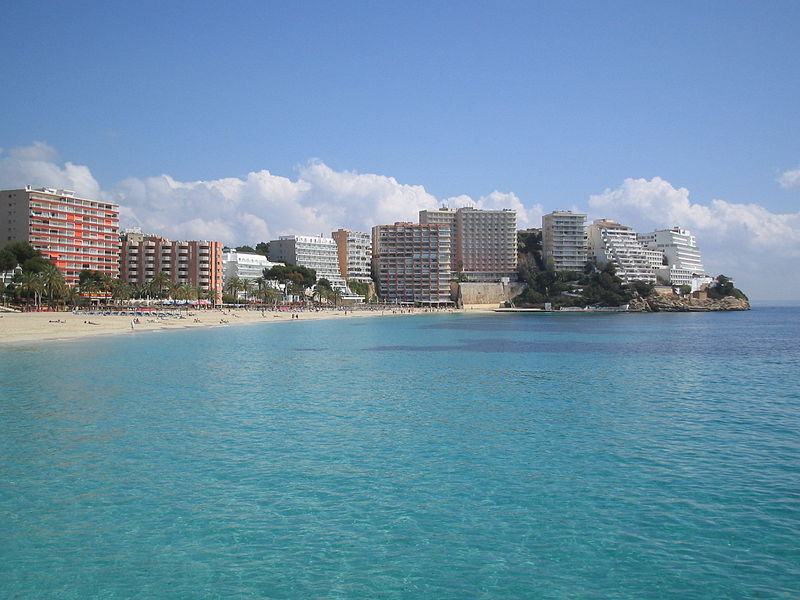
Well, there is a reason for that. It has to do with the coverage of a recent indecent incident in Magaluf, on the Spanish island of Majorca.

What had happened?

A young woman, now commonly referred to as ‘Magaluf Girl’, participated in a party game that required of her to perform acts of oral sex on a number of men in order to win a holiday. A holiday, as in ‘a drink called holiday‘, not as in ‘a vacation‘. This was taped, and once the footage had hit the desks of the British tabloids (The Sun in particular), all hell broke loose – in news articles, but also in the wide, wide world of social media, where an activity, hideously referred to as ‘slut shaming‘ – the twenty-first century’s pillorying (we are so much more civilised now, aren’t we?) –, continues to be all the rage.

What was remarkable, certainly in the early stages of this staged outrage, was the focus on the female part of this group event:

The female was subject to abuse (as if the public shame was not bad enough), dwelling on the public visibility of her sexual life as well as on the promiscuous behaviour that thus was exposed. The male part of this set-up remained invisible (and, notably, it was primarily the face of the female, too, that was exposed in the footage that was leaked, whereas those at the receiving end remained anonymous), and one must very much doubt that any of the males involved had to walk much of a walk of shame subsequently.

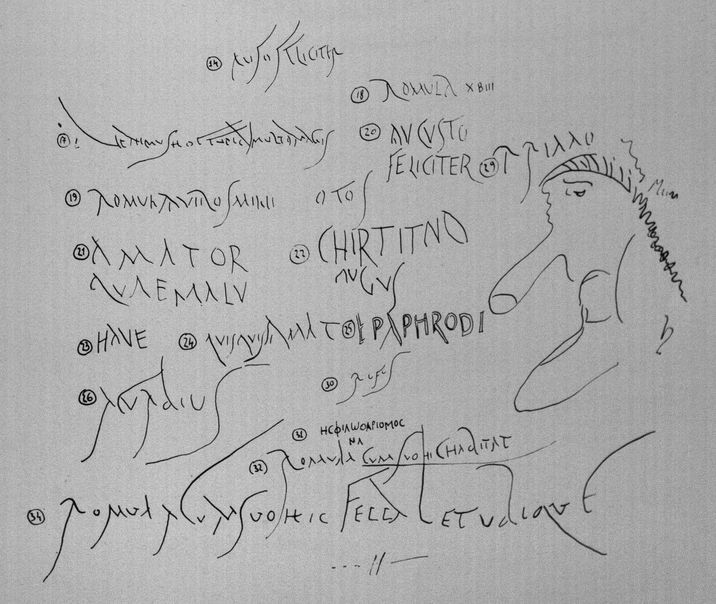
Ancient 'slut shaming' (from Pompeii). – Image source: http://db.edcs.eu/epigr/bilder/$IFabioRufo_00002.jpg.

Ancient ‘slut shaming’ (from Pompeii). – Image source: http://db.edcs.eu/epigr/bilder/$IFabioRufo_00002.jpg.

Is this really an indication of much progress from the times of first-century Pompeii, where, in the house of Fabius Rufus, a woman called Romula was ‘complimented’ on her exploits (cf. Varone, Erotica Pompeiana pp. 70–1):

Romula cum suo hic fellat et uubique

‘Romula sucks her man here and everywhere’

and

Romula viros mile trec[en]tos

‘Romula . . . thousands of men’

What is interesting, of course, is how shame continues to be assigned to the female (or, more broadly speaking: the penetrated) part of an sexual act. Less frequently, but equally predictably as the ‘role of women’ topics, I also get requests to supervise topics on Roman homosexuality – usually surrounding precisely surrounding that ancient distinction of active/passive parts, stressing the ‘positive-to-neutral’ view of the active player, as opposed to the ‘neutral-but-generally-more-negative’ view of the passive one. Surely, what worked for Socrates in his erastes/eromenos relationship to Alcibiades cannot be wrong now, can it?

There is an important (and hardly new or surprising) lesson in this: when two people do the same thing, it’s still not the same, or, as the Roman playwright Terence put it: aliis si licet, tibi non licet, ‘if it is allowed to some, it’s still not allowed to you’ (Ter. Heaut. 797).

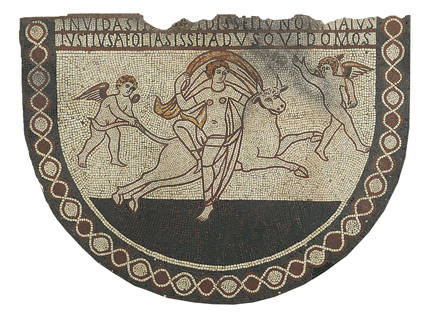
British Proto-Feminism: 'Had Juno seen the bull's attempts at swimming, she'd have been even more justified to visit the halls of Aeolus'. – Image source: http://www.english-heritage.org.uk/daysout/properties/lullingstone-roman-villa/history-and-research/history/4-from-paganism-to-christianity/.

British Proto-Feminism: ‘Had Juno seen the bull’s attempts at swimming, she’d have been even more justified to visit the halls of Aeolus’. – Image source: http://www.english-heritage.org.uk/daysout/properties/lullingstone-roman-villa/history-and-research/history/4-from-paganism-to-christianity/.

The same sentiment was expressed by later times as quod licet Iovi, non licet bovi, ‘Gods may do what cattle may not’ – a proverb that reaches its limits in such cases where the gods and the cattle are, in fact, identical. (Incidentally, does anyone else find it disturbing that our continent bears the same name as the victim of a case of mythical sodomy?).

There is another dimension to all of this, however, and this tends to be forgotten in current debates about debauchery and sexism – something that one may wish to call ‘the middle voice’ of sexism: there are companies and organisations making money out of this (from the organisers of the drinking event to news corporations). They exploit both males and females, at the expense of everyone’s integrity and humanity by means of staged scandals and a questionable prescription of moral standards.

There is no reason to feel morally superior to the inhabitants of the ancient Mediterranean, as long as such blatantly gendered responses, such blatant sexism, prevails.

Posted in Education | Tagged , , , | Comments Off on Voices of Sexism: the Active, the Passive, and the Middle