Late Homework: Seamus Heaney’s Aeneid, Book VI

The younger Seneca, in his Consolatio ad Polybium, praises Polybius for his translations of the classics: a Latin translation of Homer and a Greek translation of Vergil. Seneca writes (11.5-6):

Agedum illa, quae multo ingenii tui labore celebrata sunt, in manus sume utriuslibet auctoris carmina, quae tu ita resolvisti, ut quamvis structura illorum recesserit, permaneat tamen gratia – sic enim illa ex alia lingua in aliam transtulisti, ut, quod difficillimum erat, omnes virtutes in alienam te orationem secutae sint: – nullus erit in illis scriptis liber, qui non plurima varietatis humanae incertorumque casuum et lacrimarum ex alia atque alia causa fluentium exempla tibi suggerat. Lege, quanto spiritu ingentibus intonueris verbis; pudebit te subito deficere et ex tanta orationis magnitudine desciscere. Ne commiseris, ut quisquis exemplaris modo scripta tua mirabatur quaerat quomodo tam grandia tamque solida tam fragilis animus conceperit.

Turn, now, to those poems which the efforts of your genius have made famous and which you have turned into prose with such skill that, though their form has disappeared, they, nevertheless, retain all their charm (for you have so performed the most difficult task of transferring them from one language to another that all their merits have followed them into the foreign speech) – take into your hands whichever of the two authors you please, and you will find that there is not a single book of their writings which does not supply numberless examples of the vicissitudes of human life, of unexpected misfortunes, and of tears that for one reason or another have been made to flow.
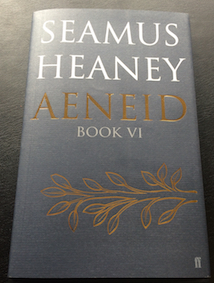
On my desk just now: Seamus Heaney's Aeneid 6.

On my desk just now: Seamus Heaney’s Aeneid 6.

It is with those words that one ought to introduce an appreciation of a translation of the sixth book of Vergil’s Aeneid that has just been published by Faber & Faber – a translation by the recently deceased Northern Irish poet Seamus Heaney.

Unlike Polybius, Heaney has not produced a rendering of the Aeneid in prose. In that regard, the form has not ‘disappeared’ – or not altogether disappeared: Vergil’s 901 lines have become 1222 lines in Heaney’s translation – an extra 33%, owed to the fact that the conciseness and brevity of a heavily inflectional language such as Latin cannot be rendered into English.

What is Heaney’s translation of Vergil’s Aeneid, book 6, the end of Aeneas’ Odyssey and his trip to the underworld, about?

He explains in an author’s note (p. VII) that –

‘This translation of Aeneid VI is neither a ‘version’ nor a crib: it is more like classics homework, the result of a lifelong desire to honour the memory of my Latin teacher at St Columb’s College, Father Michael McGlinchey (…).’

And on p. IX:

‘Michael McGlinchey created an inner literalist who still hunts for the main verb of a sentence and still, to the best of his ability, disentangles the subordinate clauses, although usually nowadays with the help of a crib from the Loeb Library or the old Penguin Classics. Yet nowadays too that sixth form homunculus must contend with a different supervisor, a writer of verse who has things other than literal accuracy on his mind and in his ear: rhythm and metre and lineation, the voice and its pacing, the need for a diction decorous enough for Virgil but not so antique as to sound out of tune with a more contemporary idiom – all the fleeting, fitful anxieties that afflict the literary translator.’

This outlines perfectly, of course, the considerations and constraints of any translator, and particularly any translator whose aspiration lies beyond the dubious achievement of producing mere translationese.

Cicero, in his Academica (1.10), suggests that one of the decisions that a translator may have to take is that between verba (‘words’) and vis (‘force’ ~ ‘[true] meaning’), a decision between a literal translation and something that would appear to capture the essence of the text whose rendering is to be achieved.

Heaney, in his note, expresses a different take on this.

For him, it was not a choice between faithful preservation of Vergil’s very words, which one might render more or less literally, or what Vergil, in fact, may have wanted to express. For him, it was a choice between the former and something that captures the quintessential beauty of Vergil’s language, that conveys the aesthetic experience in language and rhythm – the way Heaney understood it, the way Heaney sensed and perceived it.

The result is, indeed, a work of outstanding beauty – a work that will come to perfection through the skill and art of a performer. Heaney’s Aeneid, like Vergil’s, is a work to listen to, not just a work to read. (Listen, for example, to Edna O’Brien’s wonderful reading here.)

In this, he is much closer to the original than most others who have tried before him. Powerful eloquence, condensed to its very essence, with a fine ear for the nuances, mood, and pace of Vergil’s Aeneid VI, is the hallmark of what Heaney chose to call his ‘classics homework’.

Consider, for example, Heaney’s take on the (in)famous speech in which Aeneas addresses Dido in the underworld (Verg. Aen. 455-466; p. 26, ll. 612-627):

‘Unhappy Dido! So the news I got was true,
That you had left the world, had taken a sword
And bade your last farewell. Was I, O was I to blame
For your death? I swear by the stars, by the powers
Above and by any truth there may be under earth,
I embarked from your shore, my queen, unwillingly.
Orders from the gods, which compel me now
To travel among shades in this mouldering world,
This bottomless pit of night, dictated
Obedience then as well. How could I believe
My going would devastate you with such grief?
Stay a moment, don’t slip out of our sight.
Is there someone you are trying to avoid?
These words I’m saying to you are the last
Fate will permit me, ever.’

Heaney beautifully captures the poet’s meticulous care to present us with an Aeneas who, for the longest time, refuses to take ownership of his own fate and responsibility for his actions as well as the effects they have on others, and instead readily embraces any opportunity to credit divine intentions for his grandstanding and irresponsibility.

Invitus, regina, tuo de litore cessi.

I embarked from your shore, my queen, unwillingly.

Even when confronted with the most painful result of his actions, Aeneas manages to make everything about himself, incredulously asking Dido’s eternally silent shade if it was really him who had sent her to this mouldering world, this bottomless pit of night (per loca senta situ cogunt noctemque profundam / imperiis egere suis).

Heaney’s Aeneid VI preserves what Seneca called the charm and the merits of Vergil’s masterpiece. It does not attempt to outperform Vergil, and it does not distort the original, sometimes primordial, sometimes lyrically refined aesthetic and narrative experience.

The aesthetic experience that lies in Heaney’s ‘homework’ comes at a price, however – a price that Heaney clearly was willing to pay and that may not distract the majority of his readership too much. The price is what Cicero had called the vis: torn between the need to respect Vergil’s verba and the desire to live up to his self-imposed poetic standards, Heaney does not always do justice to what Vergil, in fact, was saying.

A crucial moment in that regard (though certainly not the only one) is Anchises’ famous prophecy of Rome’s future glory.

At Aen. 6.851-853, Vergil wrote:

tu regere imperio populus, Romane, memento
(hae tibi erunt artes), paci(s)que imponere morem,

parcere subiectis et debellare superbos.

Heaney’s translation of this pivotal moment (p. 46, ll. 1155-1159) –

‘(…) But you, Roman,
Remember: to you will fall the exercise of power
Over the nations, and these will be your gifts –
To impose peace and justify your sway,
Spare those you conquer, crush those who overbear.’

Apart from mere syntactical quibbles, Heaney did not really manage to capture the essential vis of these verba.

Anchises demands from Aeneas to remember the Romans’ artes (‘skills’ rather than ‘gifts’ – they are acquired abilities, not their innate ingenium) – the exercise of power and paci (or pacis) imponere morem, to impose the very character, the ethos (morem) on (or of) peace.

There is not even so much as a hint towards a need to justify their sway: this is what Romans will be good at, this is what Romans will be doing.

It would not do Heaney’s work any justice at all to blow such moments out of proportion, however. With Heaney’s Aeneid VI we have a masterpiece in our hands, a truly dignified, stunning work of art – an homage of a great poet for his predecessor, retaining all the charm and celebrating the merits of Vergil’s Aeneid in a timeless rendering that one will want to read as well as to hear being read by others.

This piece of homework may have been submitted late (something it has in common with the Aeneid itself, in fact), but it was well worth the wait.

Aeneid Book VI. Translated by Seamus Heaney. – Faber & Faber: London 2016. ISBN: 978-0-571-32731-7. £14.99.

Posted in Poetry | Tagged , , , , | 1 Comment

Seneca on Gender Equality

It is a common trope in present-day discourse that feminism and the enforcement of gender equality are destroying the very foundations of our societies and ultimately ruining everything for us, to the detriment of those who seek equality in the first place as well as everyone else.

This is clearly nonsense, and the trope is not even a modern one: it has been around for millennia, and it has been used whenever someone felt threatened in their comfortable privileges.

One might be tempted to say, for example, that already the younger Seneca made a very similar point when he writes that (Seneca, Epistles 95.20-1) –

Maximus ille medicorum et huius scientiae conditor feminis nec capillos defluere dixit nec pedes laborare: atqui et capillis destituuntur et pedibus aegrae sunt. Non mutata feminarum natura sed victa est; nam cum virorum licentiam aequaverint, corporum quoque virilium incommoda aequarunt. Non minus pervigilant, non minus potant, et oleo et mero viros provocant; aeque invitis ingesta visceribus per os reddunt et vinum omne vomitu remetiuntur; aeque nivem rodunt, solacium stomachi aestuantis. Libidine vero ne maribus quidem cedunt: pati natae (di illas deaeque male perdant!) adeo perversum commentae genus inpudicitiae viros ineunt. Quid ergo mirandum est maximum medicorum ac naturae peritissimum in mendacio prendi, cum tot feminae podagricae calvaeque sint? Beneficium sexus sui vitiis perdiderunt et, quia feminam exuerant, damnatae sunt morbis virilibus.

The illustrious founder of the guild and profession of medicine remarked that women never lost their hair or suffered from pain in the feet; and yet nowadays they run short of hair and are afflicted with gout. This does not mean that woman’s physique has changed, but that it has been conquered; in rivalling male indulgences, they have also rivalled the ills to which men are heirs. They keep just as late hours, and drink just as much liquor; they challenge men in wrestling and carousing; they are no less given to vomiting from distended stomachs and to thus discharging all their wine again; nor are they behind the men in gnawing ice, as a relief to their fevered digestions. And they even match the men in their passions; although they were created to feel love passively  – may the gods and goddesses confound them! – they devise the most impossible varieties of unchastity, and in the company of men they play the part of men. What wonder, then, that we can trip up the statement of the greatest and most skilled physician, when so many women are gouty and bald! Because of their vices, women have ceased to deserve the privileges of their sex; they have put off their womanly nature and are therefore condemned to suffer the diseases of men.

But it is worth reading this passage again – and to do so rather more slowly and carefully.

It seems beyond reasonable doubt to me that Seneca, in this passage, suggests that there is a specific ‘nature’ (natura) for either sex. As a stoic, Seneca would of course advocate the principle of living in accordance with nature (secundum naturam vivere).

It also seems beyond reasonable doubt to me that Seneca, in this passage, does not necessarily approve of the behaviour that certain women displayed at his day and age, namely their rivalling male indulgences, behaviours, and what he regarded as sexual ‘perversions’ (virorum licentiam aequare).

It is tempting to see this passage as historical evidence for a view that gender stereotypes that historians are keen to establish and to reinforce in their assessment of ancient Rome are more of a convenient historical fiction than an accurate description of what was, in fact, possible at the time.

But to focus on this alone would mean to miss an important point.

What Seneca says very clearly is that adopting a life according to a manly natura will, for anyone, male or female, come with inevitable ailments.

Seneca talks of corporum quoque virilium incommoda, ‘ills to which men are heirs’ (or, more literally, the ‘unpleasantries of male bodies’), and women choosing to adopt a male lifestyle  damnatae sunt morbis virilibus, are ‘condemned to suffer the diseases of men’.

Not to adopt the lifestyle of men for women might mean to maintain the beneficium sexus sui, the ‘privileges of their sex’. But are those privileges meaningful and desirable in the grander scheme of things?

There is a twofold lesson in what Seneca has to say:

First, all women have to lose when shedding their femininity (feminam exuerant), according to Seneca anyway, is the privilege of having beautiful, lasting hair and an alleged resilience to gout.

A small price to pay for equality.

Secondly, pursuing the natura of manliness means suffering from male diseases.

Can we do better than this?

If women can ‘overcome’ (victa) their natura, why should the same option be unavailable to men, as a means to cure their morbi viriles, the ‘deseases of men’ and to replace them with beneficia – by finding their true natura in something that is not associated with manhood and manliness first and foremost?

The ultimate cure might be to live as human beings, abandoning static, imposed gender stereotypes, associated behaviours, and their hideous and painful side effects and to celebrate diversity instead.

An appealing thought indeed on occasion of International Women’s Day.

Posted in Prose | Tagged , , , , , , , , | 4 Comments

Leap Day Harmony

Vergil‘s eighth Eclogue is a remarkable text. It presents a ‘song battle’ between Damon and Alphesiboeus, two pastoral poets, whose poetry is described in supernatural terms (Verg. ecl. 8.1-5, transl. H. R. Fairclough):

Pastorum musam Damonis et Alphesiboei,
immemor herbarum quos est mirata iuuenca
certantis, quorum stupefactae carmine lynces,
et mutata suos requierunt flumina cursus,
Damonis musam dicemus et Alphesiboei.

The pastoral Muse of Damon and Alphesiboeus, at whose rivalry the heifer marvelled and forgot to graze, at whose song lynxes stood spellbound, and rivers were changed and stayed their current – the Muse of Damon and Alphesiboeus I will sing.

Remarkably, the songs of Damon and Alphesiboeus both feature an iconic, recurring line – a refrain, so to speak.

Damon’s recurring line goes –

Incipe Maenalios mecum, mea tibia, uersus

Begin with me, my flute, a song of Maenalus

And, in variation, at the end of his song:

Desine Maenalios, iam desine, tibia, uersus

Cease, my flute, now cease the song of Maenalus

Alphesiboeus’ recurring line, in turn, –

Ducite ab urbe domum, mea carmina, ducite Daphnim

Bring Daphnis home from town, bring him, my songs

And, again in variation, as a concluding line:

Parcite, ab urbe uenit, iam parcite, carmina, Daphnis

Cease! Daphnis home from town, bring him, my songs

This may not seem at all remarkable from a modern perspective.

We are used to poems and songs structured around recurring elements. They provide us with a sense of order, stability, and structure, motifs around which poets and musicians will unfold and unleash their creativity and imagination.

Within the context of ancient poetry, however, recurring lines and refrains were an absolute exception rather than the rule (or so the surviving evidence would suggest).

Servius, Vergil’s ancient and hitherto unsurpassed commentator, does not fail to notice:

dicitur autem hic versus intercalaris, qui frequenter post aliquantulos interponitur versus, sicut intercalares dies et mensis vocantur, qui interponuntur, ut ratio lunae solisque conveniat.

We call it a ‘leap line‘ (versus intercalaris), when there is a line inserted regularly after a small number of lines, just like we call leap days and months what gets inserted so as to reconcile the logic of the moon and the sun.

The insertion of leap days is a millennia-old practice, designed to synchronise calendars with the course of the solar year and thus to ensure that months always coincide with the exact same season of year.

We may think of leap days as an oddity, as something extraordinary, due to their rareness, just as to Servius’ mind recurring lines in poetry were something extraordinary and rare.

Servius conceptualises the rare use of recurring lines in poetry, interspersed with some regularity in certain intervals, as the equivalent of a leap day (dies intercalaris) or even a leap months (mensis intercalaris): they enforce synchronicity, harmony, and order; they provide utter predictability, in accordance with the grander scheme of things in nature.

But perhaps Servius’ image allows for its own reversal:

What if Leap Day, like a refrain in a song or a poem, could be memorable for its comfortingly recursive nature and its provision of meaning?

What if Leap Day, like a refrain in a song or a poem, could provide us with a theme tune, a sense of overarching structure and stability, amidst the seemingly random flow of everyday life?

What if Leap Day, like a refrain in a song or a poem, could be something enchanting, something to look forward to like an old friend, not just as the odd one out?

It may be worth giving this a thought.

Posted in Poetry, Prose | Tagged , , , , , , | 3 Comments

A is for … the Ancient Roman Alphabet!

Ever wondered what Latin sounded like?

Here is how Martianus Capella, a writer of the early fifth century A. D., describes the phonetics of the Latin alphabet  (De Nuptiis Philologiae et Mercurii 3.261; cf. Gramm. VIII 307-8 K.):

A sub hiatu oris congruo solo spiritu memoramus.
B labris per spiritus impetum reclusis edicimus;
C molaribussuper linguae extrema appulsis exprimitur;
D appulsu linguae circa superiores dentes innascitur;
E spiritus facit lingua paululum pressiore,
F dentes labrum inferius deprimentes,
G spiritus cum palato; H contractis paululum faucibus ventus exhalat,
I spiritus prope dentibus pressis.
K faucibus palatoque formatur.
L lingua palatoque dulcescit.
M labris imprimitur.
N lingua dentibus appulsa collidit.
O rotundi oris spiritu comparatur.
P labris spiritus erumpit,
Q appulsu palati ore restricto.
R spiritum lingua crispante corraditur.
S sibilum facit dentibus verberatis.
T appulsu linguae dentibusque impulsis extunditur.
V ore constricto labrisque prominulis exhibetur.
X quicquid C atque S formavit exsibilat.
Y appressis labris spirituque procedit.
Z vero idcirco Appius Claudius detestatur, quod dentes mortui, dum exprimitur, imitatur.

In the translation of W. Harris Stahl, R. Johnson, and E. L. Burge –

We utter A with the mouth open, with a single suitable breath.
We make B by the outburst of breath from closed lips.
C is made by the back teeth brought forward over the back of the tongue.
D is made by bringing the tongue against the top teeth.
E is made by a breath with the tongue a little depressed.
F is made by the teeth pressing on the lower lip.
G, by a breath against the palate.
H is made by an exhalation with the throat a little closed.
I is made by a breath with the teeth kept close together.
K is made with the palate against the top of the throat.
L is a soft sound made with the tongue and the palate.
M is a pressing together of the lips.
N is formed by the contact of the tongue on the teeth.
O is made by a breath with the mouth rounded.
P is a forceful exhalation from the lips.
Q  is a contraction of the palate with the mouth half-closed.
R is a rough exhalation with the tongue curled against the roof of the mouth.
S is a hissing sound with the teeth in contact.
T is a blow of the tongue against the teeth.
U is made with the mouth almost closed and the lips forward a little.
X is the sibilant combination of C and S.
Y is a breath with the lips close together.
Z was abhorrent to Appius Claudius, because it resembles in its expression the teeth of a corpse.

Posted in Prose | Tagged , , , , , , | 8 Comments

Sweet Talk for Latin Lovers

With Valentine’s Day just around the corner, any respectable Latin lover will, of course, be keen to brush up on their relevant sweet talking skills.

Here are are some lines you may wish to rehearse for your Latin wooing and cooing pleasures.

They come from Plautus‘ play Asinaria (‘The Comedy of the Asses‘, translation by Wolfgang de Melo):

Asin. 664:

meus ocellus, mea rosa, mi anime, mea uoluptas

‘apple of my eye, my rose, my soul, my joy’

Asin. 666-8:

dic me igitur tuom passerculum, gallinam, coturnicem,
agnellum, haedillum me tuom dic esse uel uitellum,

prehende auriculis, compara labella cum labellis.

‘Then call me your little sparrow, your hen, your quail; call me your little lamb, your kid, or your little calf; grab me by the ears and put your lips on mine.’

Asin. 691-2:

mi Libane, ocellus aureus, donum decusque amoris,
amabo, faciam quod uoles, (…).

‘My dear Libanus, my golden eye, love’s gift and glory, please, I’ll do what you like, (…).’

Asin. 693-6:

dic igitur med aneticulam, columbam uel catellum,
hirundinem, monerulam, passerculum putillum,

fac proserpentem bestiam me, duplicem ut habeam linguam,

circumda torquem bracchiis, meum collum circumplecte.

‘Then call me your little duck, your dove, your puppy, your swallow, your jackdaw, your teeny-weeny sparrow, turn me into a reptile so that I have a double tongue. Put a chain around me with your arms, embrace my neck.’

Posted in Poetry | Tagged , , , | 9 Comments

Pancake Day, Roman Style

12728883_10208930162315912_22898715735313505_n

Roman ‘pancake’, “like an egg custard”: very many thanks to Anne Hudson for sharing the result of her attempt at this recipe – as well as this photo!

It’s Pancake Day!

Would you like to celebrate it, Roman style?

Here is a quick and easy recipe from the late antique Roman cook book De re coquinaria, ascribed to one Apicius (7.11.8, transl. W. M. Hill, adapted):

Ova spongia ex lacte: ova quattuor, lactis heminam, olei unciam in se dissolvis, ita ut unum corpus facias. in patellam subtilem adicies olei modicum, facies ut bulliat, et adicies impensam quam parasti. una parte cum fuerit coctum, in disco vertes, melle perfundis, piper adspargis et inferes.

Omelette soufflée: four eggs in half a pint of milk and an ounce of oil well beaten, to make a fluffy mixture; in a pan put a little oil, allow for it to form bubbles, and carefully add the egg preparation. Place it in the oven to let it rise and when one side is done, turn it out into a service platter fold it pour over honey, sprinkle with pepper and serve.

Bene tibi sapiat – enjoy!

Posted in Prose | Tagged , , , , , | 9 Comments

Harrowing Statues: Pliny, Hannibal, and Cecil Rhodes

History is like a bad dream from which one cannot wake.

Though undoubtedly related to what once must have been real, history merely exists in our collective and individual imaginations and re-imaginations. It is shaped by our fantasy and wishful thinking just as much as by factors completely out of our control. And whenever we desire to tell someone about one of our particularly vivid dreams, we never find anyone ready to confirm that what we were positive we experienced just now ever truly existed.

Like bad dreams, imaginations of history and how it all made sense at the time have their focal points as well as their blind spots. Like bad dreams, these may revolve around objects that at first seem almost insignificant and circumstantial, but all of a sudden develop a terrifying life of their own.

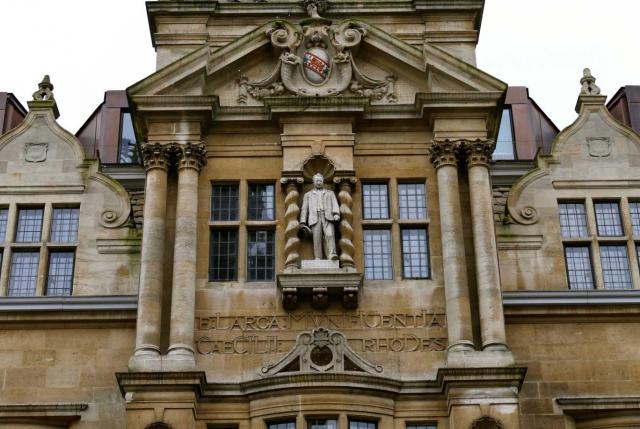
One such object – an object that has received a lot of attention recently and thus become a focal point of historical re-imaginations – is a statue of Cecil Rhodes, placed above the entrance of Oriel College, Oxford.

Following a similar movement at the University of Cape Town, a campaign arose at Oxford urging the college to remove the statue of their prominent alumnus and benefactor – #RhodesMustFall.

Yet, after much public debate and, more remarkably, a threat of current donors to withdraw millions, the college decided to keep the statue in its accustomed location.

Removal of statues has a long history. To anyone with a background in Classical Scholarship the idea of damnatio memoriae, ‘condemnation of memory’, is a familiar concept.

Unlike others, I do not see much of a problem with that; to me it seems like a liberating, perfectly rational act to rid oneself of the pictures of a harrowing, painful past that one would like to leave behind.

It is an act of cleansing, a proxy that allows us to act against an effigy in a way that we may not be able, or willing, to act against a real person.

Statues of fascist and communist leaders fell when the oppression of their regimes had been removed. Statues of Saddam Hussein fell, once it was safe to purify the urban landscape without risking political repercussions. Statues and inscriptions of disliked Roman rulers were defaced, altered, or destroyed after their deaths.

But it would be mistaken to think that damnatio memoriae was the Romans’ sole response to the visual representation of those whose effigies might be seen as triggers of deeply traumatic memories.

The Roman encyclopedic writer Pliny the Elder relates the following story about the urban decoration of the city of Rome (Plin. nat. 34.32; for a translation of Pliny’s works, and for book 34 in particular, see here):

Publice autem ab exteris posita est Romae C. Aelio tr. pl. lege perlata in Sthennium Stallium Lucanum, qui Thurinos bis infestaverat. ob id Aelium Thurini statua et corona aurea donarunt. iidem postea Fabricium donavere statua liberati obsidione, passimque gentes in clientelas ita receptae, et adeo discrimen omne sublatum, ut Hannibalis etiam statuae tribus locis visantur in ea urbe, cuius intra muros solus hostium emisit hastam.

‘The first statue publicly erected at Rome by foreigners was that in honour of the tribune of the people Gaius Aelius, for having introduced a law against Sthennius Stallius the Lucanian who had twice made an attack upon Thurii; for this the inhabitants of that place presented Aelius with a statue and a crown of gold. The same people afterwards presented Fabricius with a statue for having rescued them from a state of siege; and various races successively in some such way placed themselves under Roman patronage, and all discrimination was so completely abrogated that even a statue of Hannibal may be seen in three places in the city within the walls of which he alone of its national foes had hurled a spear.’

Three statues of Hannibal, Rome’s quintessential foe, attested at Rome in the first century A. D. (Pliny famously died in A. D. 79 during the eruption of Mt. Vesuvius), some 250 years after Hannibal posed the single most dangerous threat to the Roman state.

Pliny does not specify how Hannibal was depicted, who was responsible for the statues, or where exactly these statues were placed.

The fact that display of Rome’s nemesis in public spaces of the city of Rome was apparently tolerable, however, would suggest that these effigies were positioned in a way that seemed acceptable; that it triggered debate regardless can be seen from the fact that Pliny mentions it as the high point of an enumeration of public statues that were ‘erected at Rome by foreigners’ (ab exteris posita … Romae).

Position and presentation of public statues was a matter that Pliny understood perfectly well (Plin. nat. 34.17):

excepta deinde res est a toto orbe terrarum humanissima ambitione, et in omnium municipiorum foris statuae ornamentum esse coepere propagarique memoria hominum et honores legendi aevo basibus inscribi, ne in sepulcris tantum legerentur. mox forum et in domibus privatis factum atque in atriis: honos clientium instituit sic colere patronos. 

‘The practice of erecting statues from a most civilized sense of rivalry was afterwards taken up by the whole of the world, and the custom proceeded to arise of having statues adorning the public places of all municipal towns and of perpetuating the memory of human beings and of inscribing lists of honours on the bases to be read for all time, so that such records should not be read on their tombs only. Soon after a publicity centre was established even in private houses and in our own halls: the respect felt by clients inaugurated this method of doing honour to their patrons.’

Also (Plin. nat. 34.27):

Columnarum ratio erat attolli super ceteros mortales, quod et arcus significant novicio invento.

‘The purport of placing statues of men on columns was to elevate them above all other mortals; which is also the meaning conveyed by the new invention of arches.’

Statues are focal points of memoria, and to put them on pedestals means to showcase particularly noteworthy individuals who have risen above the masses in a manner that is worth remembering as well as inspiring.

Does that apply to Cecil Rhodes in 21st century Oxford?

There is hardly any need to explain why a statue of Cecil Rhodes would seem offensive to many nowadays (just as much as his presence was offensive to many then, just not those who put him on his Oxonian pedestal at the time), and there is hardly any requirement to explain how Rhodes’ ill-gotten gains have subsequently been used for rather better ends than Oxford’s generous donor himself would have imagined (or, in fact, approved of).

(Does that mean that Oxford need not care about its colonial past or that recipients of Rhodes scholarships at Oxford whose family history is related to parts of this globe that suffered under Rhodes’ activities should feel grateful for a ‘partial refund’? Hardly! It is the job of the present ‘to get off its backside and do better’, as Mary Beard put it on her blog a while ago.)

Oriel College, partly driven by financial pressures of current donors (or so one is led to believe), decided to keep Cecil Rhodes on his prominent pedestal, claiming that they will ‘seek to provide a clear historical context to explain why it is there’.

This may well be true – but the historical context to explain why it is there already exists (though it may not be easily accessible to everyone): there is a Latin inscription that reads –

rhodes.jpg

Rhodes’ statue and accompanying inscription, facing Oxford’s High Street. – Image source: http://static.independent.co.uk/s3fs-public/styles/story_large/public/thumbnails/image/2016/01/01/20/rhodes.jpg.

E larga munificentia
Caecilii Rhodes.

By means of the large munificence
of Cecil Rhodes.

How has this context changed after the pressure exercised on the college by its current donors?

Can this ever be anything else than a symbol that Oriel College will always, absolutely always, honour their wealthy donors, no matter how unethical their behaviour has been – from colonialists of profoundly upsetting proportions to those who resorted to threatening financial consequences in a debate that should be about historical awareness, moral responsibility, and self-representation?

It seems exceptionally unlikely to me that Oriel College will now add a line to this inscription, equally prominent in nature, stating precisely how it had become possible for Rhodes to become such a humanitarian (and why it was apparently impossible for the college to refuse the money at the time); but I remain open to pleasant surprises.

Pliny teaches us that it is possible to look at statues of those who represent for trauma and shame; that it is possible to look at statues of Hannibal in Rome.

But he also, quite rightly, teaches us that position is everything – and that the places where we put our statues is something that makes a statement about our current values and priorities, not merely about our past.

The position of Cecil Rhodes’ statue at Oriel College could hardly be more elevated or focal.

Suppressing our collective historical memory, damnatio memoriae, and iconoclasm cannot, and should not, be the answer. It will not fix the past, nor help us to redeem ourselves.

But Oriel College’s façade is not a museum or exhibition hall with neat labels and documentation attached to it. It is its shopfront, it is the college’s most obvious and iconic interface to the present world, its most obvious form of self-representation.

To pretend that focal objects don’t matter in our (and other people’s) imaginations of the past, as well as to call the debate over this statue a distraction, is hardly more compassionate than telling someone to stop having bad dreams while relentlessly reinforcing a focus on the effigy of a bogeyman that epitomises their suffering, while being a blind spot on our own conscience at best.

What some have called preserving history is in actual fact a deliberate, almost fiendish misnomer, for this is not about preserving history, but about preserving control over the narrative and thus about preserving the outcomes of history, whilst conveniently shunning responsibility, in the hope that future generations will extend us the same courtesy.

If it were truly and exclusively about preserving history (as some have fervently suggested), then this statue should have gone into an exhibition about Britain’s colonial past where it belongs in order to preserve memoria, but not remained on its pedestal, towering over Oxford’s High Street.

Posted in Epigraphy, Prose | Tagged , , , , , , , , , , | 2 Comments

Saxa Loquuntur: The Stones Are Talking

Read about my recent adventures at St. Albans Cathedral!

Alban Conversations

On January 16th, Peter Kruschwitz, Professor of Classics at the University of Reading, visited us to lead a study day on the topic of the Latin inscriptions of St Albans Cathedral.  Here is his report:

Wouldn’t it be exciting if a building as old and magnificent as the Cathedral and Abbey Church of St Alban could share with us some of the people and events that it has encountered during its history of almost one thousand years?

If it could tell us something about its worshippers, its visitors, and the events that took place in it?

Would we be prepared to listen?  What would we want to know?  What would we want to hear from a building so full of memories?

There are many ways in which one can approach an organic, ever-changing place of human activity and worship such as St Albans, of course.

A particularly exciting way…

View original post 1,693 more words

Posted in Uncategorized | 3 Comments

A Disarming Hug

January 21st. Apparently it is National Hugging Day: a day that ’embraces hugging’ (or so the organisers say).

Whatever next?

There are a great many hugs and passionate embraces in Latin literature.

Among my most favourite Roman hugs, however, I would have to list the double embrace of which Phaedrus tells in his fable Soror ad fratrem (Phaedr. 3.8):

Praecepto monitus saepe te considera.
Habebat quidam filiam turpissimam,
idemque insignem pulchra facie filium.
Hi speculum, in cathedra matris ut positum fuit,
pueriliter ludentes forte inspexerunt.
Hic se formosum iactat; illa irascitur
nec gloriantis sustinet fratris iocos,
accipiens (quid enim?) cuncta in contumeliam.
Ergo ad patrem decurrit laesura inuicem,
magnaque inuidia criminatur filium,
uir natus quod rem feminarum tetigerit.
Amplexus ille utrumque et carpens oscula
dulcemque in ambos caritatem partiens,
“Cotidie” inquit “speculo uos uti uolo,
tu formam ne corrumpas nequitiae malis,
tu faciem ut istam moribus uincas bonis.”

In  Christopher Smart‘s beautifully dated translation:

The Brother and Sister

Warn’d by our council, oft beware,
And look into yourself with care.
There was a certain father had
A homely girl and comely lad.
These being at their childish play
Within their mother’s room one day,
A looking-glass was in the chair,
And they beheld their faces there.
The boy grows prouder as he looks;
The girl is in a rage, nor brooks
Her boasting brother’s jests and sneers,
Affronted at each word she hears:
Then to her father down she flies,
Arid urges all she can devise
Against the boy, who could presume
To meddle in a lady’s room.
At which, embracing each in turn,
With most affectionate concern,
“My dears,” he says, “ye may not pass
A day without this useful glass;
You, lest you spoil a pretty face,
By doing things to your disgrace;
You, by good conduct to correct
Your form, and beautify defect.”

Winning at parenting – with a hug, as imagined two thousand years ago.

Posted in Poetry | Tagged , , , , , , | 1 Comment

A Poem Worthy of a Champion

This was an excellent weekend, as far as my Latin epigraphy geekiness goes.

On Friday and Saturday, I had the immense pleasure of preparing and leading a Study Day on Latin inscriptions for the Study Centre of St. Albans Cathedral – a delightful experience, about which I will blog for a different forum soon and which I hope will lead to future collaboration regarding the abundance of astonishing Latin texts in this extraordinary church.

Saturday night, I was invited to a party that took place in St. Margaret’s church in Stanford-le-Hope (Essex) – a church that boasts a history of 800+ years. Naturally, I could just have enjoyed the party – but me in a historical church without looking for traces of Latin? That is just not going to happen! (Sad, I know!)

Thus it turned out that there are (at least) two monuments in this beautiful historical building of interest to me – both related to a once local family called Champion.

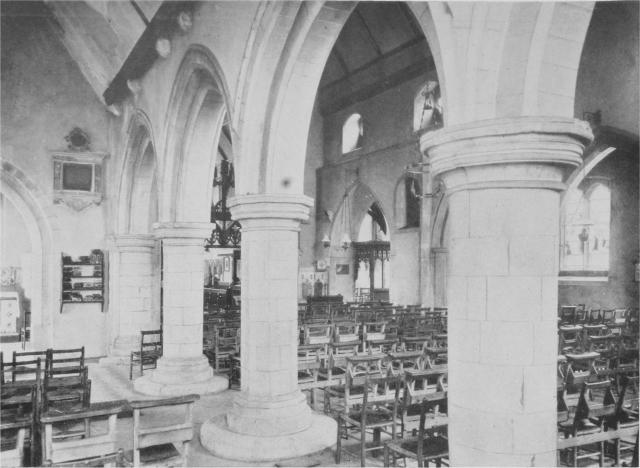
One of the inscriptions, on an east-facing wall of the north aisle of the north nave, is a monument commemorating one Richard Champion Esq. (d. 1599). It contains an (otherwise undocumented) poem. The monument is visible high up on the wall in this historical photo –


SLH

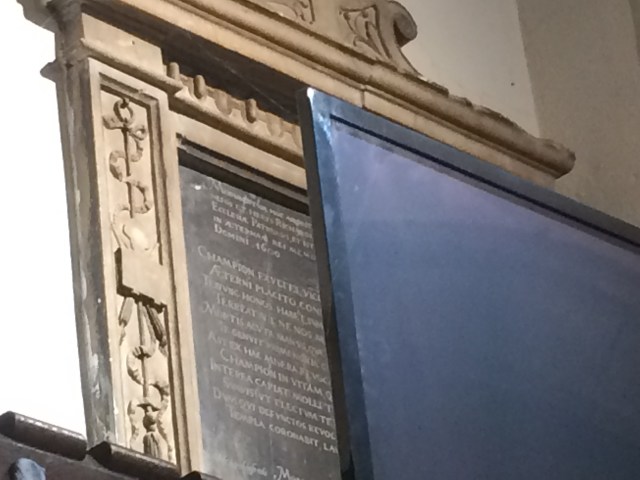
Unfortunately, the view is now blocked by a screen, and I was unable to make out much of the text at all (with old age comes fading eyesight – who knew!); the following photo was my best attempt, and thus at least some words can be detected by those who have a keen enough eye:

IMG_4044

Monument for Richard Champion Esq. (d. 1599). – Photo: PK, 2016.

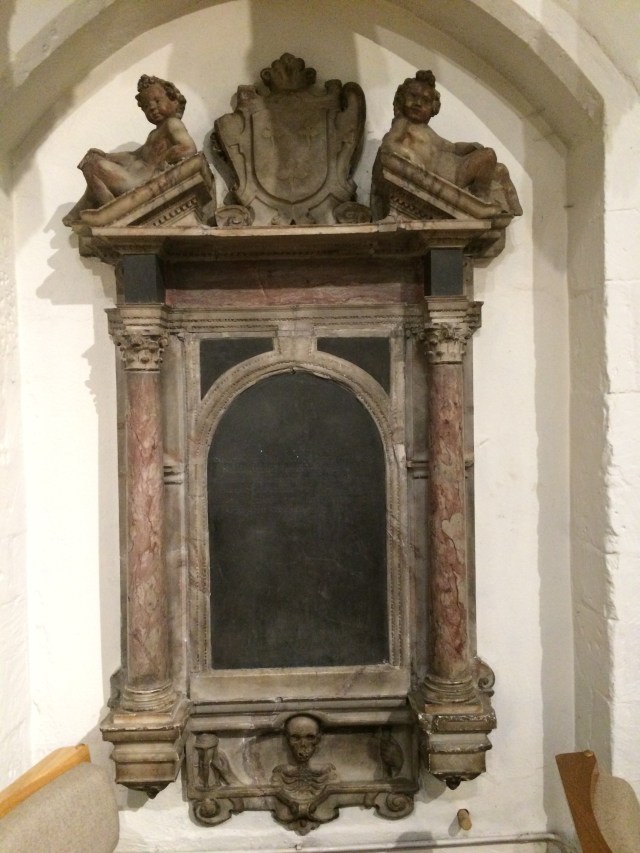
The second monument of interest to me – also with an inscribed poem – belongs to a man of the same name (but of an earlier generation): Sir Richard Champion (d. 1568), draper and Lord Mayor of London in 1565-6. The monument is mounted to the blocked north door of the church, in close proximity to the former monument:

IMG_4042

Memorial of Sir Richard Champion (d. 1568). – Photo: PK, 2016.

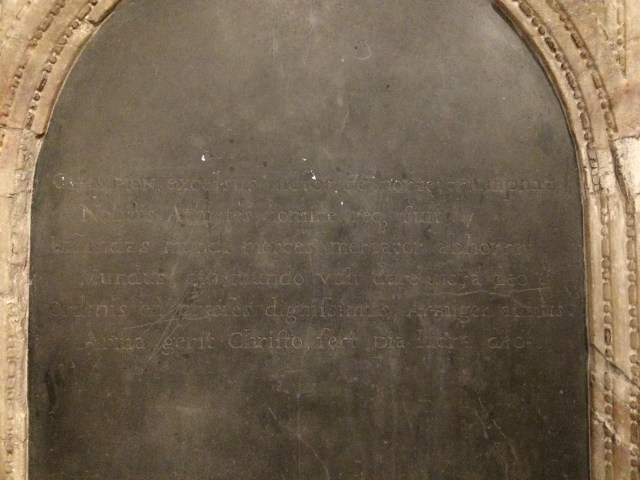
Its inscription is somewhat difficult to make out:

IMG_4041

Inscription for Sir Richard Champion. – Image: PK, 2016.

The text, neatly composed as a poem consisting of three elegiac distichs, reads as follows:

CHAMPION excelsus victor de morte triumphat:
Nobilis Athletes nomine req(ue) fuit.
Im(m)undas mundi merces mercator abhorret,
Mundus de mundo vult dare lucra deo.
Ordinis en praeses dignissimus Armiger almus
Arma gerit Christo, fert pia lucra deo.

In English:

Champion, a sublime winner, triumphs over death:
He was a noble athlete by name and in actual fact.
A merchant, he abhors the world’s foul goods,
Pure (himself), he wishes to bestow the gains of this world upon God.
Behold, the council’s most worthy president, an esquire, propitious,
He bears arms for the benefit of Christ and gives pious gains to God.

Impossible to bring out in a translation, the poem abounds with puns and word plays:

  • The name Champion is the basis for a reference to his being an athletes (‘athlete’) in line 2 as well as his being an excelsus victor (‘sublime winner’) already in line 1 – someone who triumphat (‘triumphs’) even over death (de morte).
  • He is a nobleman – thus a nobilis athletes, a dignified dignitary (Ordinis … praeses dignissimus, line 5), an esquire (Armiger) – and in fact his right to use a coat of arms (armi-ger ~ ‘arms-bearer’) is metaphorically put to good use when he is described as someone who bears arms (arma gerit, line 6) for Christ.
  • Champion, a draper and thus a merchant (mercator, line 3), does not enjoy merces (‘goods’ – i. e. those of trade), if they are foul: immundas … merces, immundus being an adjective derived from the word mundus which, like Greek kosmos, covers a spectrum of meaning from ‘order’ to ‘the order that is this world’ to ‘the/this world’.  This world’s (mundi, line 3 still) goods are, of course, immundas and thus worthy of contempt – yet, being pure himself (mundus, now an adjective denoting the opposite of immundas), he desires to bestow gains (lucra) upon God – made in this world (de mundo, if that is, in fact, what this phrase is supposed to mean).

Sir Richard Champion, alderman, sheriff, and Lord Mayor of London, once owner of Hassenbrook Hall, died without issue and was buried in the church of St Dunstan-in-the-East, London.

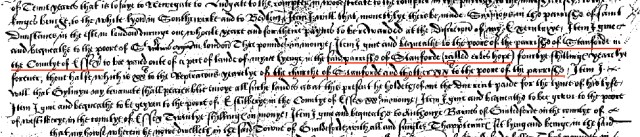
Several records document his being a generous benefactor during his lifetime. His will contains a contribution for the benefit of the church and the poor of Stanford:

champion

It is reasonable to assume that it was this generous contribution in particular that is more than richly alluded to in the remarkable little composition at St. Margaret’s church, Stanford-le-Hope.

Posted in Carmina Epigraphica, Epigraphy, Poetry | Tagged , , , , , , | 1 Comment