Casting the Die, Sounding the Charge

It was on January 10th, 49 B. C., allegedly, that Gaius Julius Caesar decided to cross the Rubicon – literally – and thus both to start a bloody civil war and to create a metaphor, for millennia to come, that describes the deliberate taking of a fatal step at a point of no return.

rubicon

Rubicon. – Image source here.

The incident is reported in several ancient sources, but it is Suetonius who, in his Life of Julius Caesar, preserves the Latin version of the famous phrase ‘the die is cast’, alea iacta est, ‘the game is on’ (Suet. Iul. 31–32, transl. J. C. Rolfe):

consecutusque cohortis ad Rubiconem flumen, qui prouinciae eius finis erat, paulum constitit, ac reputans quantum moliretur, conuersus ad proximos: ‘etiam nunc,’inquit, ‘regredi possumus; quod si ponticulum transierimus, omnia armis agenda erunt.’ cunctanti ostentum tale factum est. quidam eximia magnitudine et forma in proximo sedens repente apparuit harundine canens; ad quem audiendum cum praeter pastores plurimi etiam ex stationibus milites concurrissent interque eos et aeneatores, rapta ab uno tuba prosiliuit ad flumen et ingenti spiritu classicum exorsus pertendit ad alteram ripam. tunc Caesar: ‘eatur,’inquit, ‘quo deorum ostenta et inimicorum iniquitas uocat. iacta alea est,’ inquit.

Then, overtaking his cohorts at the river Rubicon, which was the boundary of his province, he paused for a while, and realising what a step he was taking, he turned to those about him and said: “Even yet we may draw back; but once cross yon little bridge, and the whole issue is with the sword.”  As he stood in doubt, this sign was given him. On a sudden there appeared hard by a being of wondrous stature and beauty, who sat and played upon a reed; and when not only the shepherds flocked to hear him, but many of the soldiers left their posts, and among them some of the trumpeters, the apparition snatched a trumpet from one of them, rushed to the river, and sounding the war-note with mighty blast, strode to the opposite bank. Then Caesar cried: “Take we the course which the signs of the gods and the false dealing of our foes point out. The die is cast,” said he.

A lot has been written about the crossing of the Rubicon and the phrase ‘the die is cast‘ (and its Greek origins). Equally, the role of visions, premonitions, dreams, and omens in Caesar’s life (right down to the point of his death) has been well-explored.

Moreover, historians such as Peter Wiseman (in Roman Drama and Roman History) and Gregor Weber (in Kaiser, Träume und Visionen in Prinzipat und Spätantike) have quite rightly pointed out that the introduction of this episode in Suetonius’ report may be testimony to an early dramatisation of this particular historical event for theatrical performance.

But what truly fascinates me about Suetonius’ report is something else. It is the role of music and sound as imagined in this report.

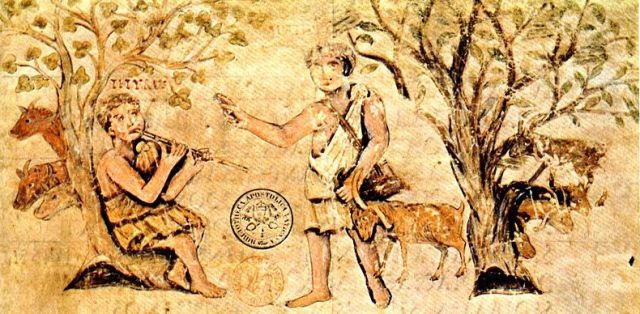
According to Suetonius, Caesar, his soldiers, and local shepherds encounter an apparition – an apparition that is described as of eximia magnitudine et forma, ‘of wondrous stature and beauty’. Sitting there, it played music upon a reed, harundine canens.

This creates an image of Pan, the god of shepherds, immersed in an idyllic, peaceful pastoral sphere and its archetypical music – the type that Vergil describes many a time in his Eclogues.

eclogues.jpg

Illustration of the Roman Vergil. Image source (cropped) here.

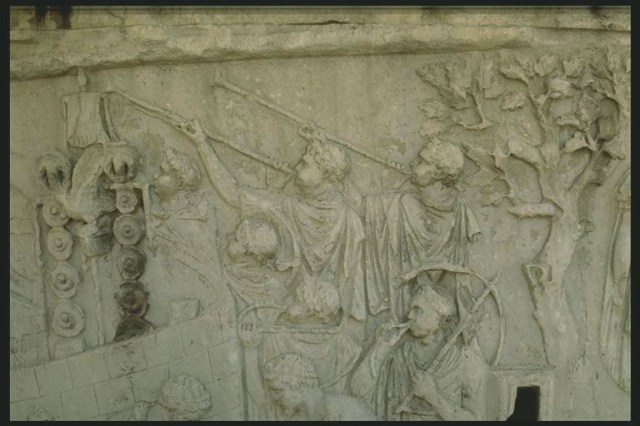
Attracting shepherds and soldiers alike, the apparition then suddenly grabs the war-trumpet (tuba) of one of Caesar’s aeneatores, ‘trumpeters’, rushes down to the river bank, and sounds the charge: ingenti spiritu classicum exorsus pertendit ad alteram ripam, ‘and sounding the war-note with mighty blast, [he] strode to the opposite bank’.

Caesar, who had briefly hesitated to risk everything, according to Suetonius’ account interprets this as a sign from the gods and thus decides to go to war.

The change in tune is sudden and unexpected.

The peaceful, idyllic world of an idealised pastoral sphere with its gentle tunes played on a reed, attractive to shepherds and soldiers alike, is suddenly abandoned and replaced with the discordant tune of the war-trumpet, whose sound was famously described first by Ennius (reported e.g. at Serv. Aen. 9.501) –

at tuba terribili sonitu taratantara dixit

But the war-trumpet spoke ‘ta-ra-tan-ta-ra’ with its horrible noise

and subsequently, based on the Ennian model, by Vergil (Verg. Aen. 9.503–504) –

at tuba terribilem sonitum procul aere canoro
increpuit, sequitur clamor caelumque remugit.

But the war-trumpet, with its bronze gifted with song, widely
rattles its terrible sound, followed by a clamour, and the sky resounds.

tuba

Depiction of the tuba on Trajan’s column. – Image source here.

The change in tune from peaceful singing (canens) to the mighty blast of the trumpet (ingenti spiritu classicum exorsus), and the change of instrument from the reed (harundo) to the war-trumpet (tuba) both symbolise the imminent departure: a departure from a world in which soldiers and shepherds alike, for a short, fleeting moment, get to share the peace and joy of a pastoral idyll, towards an era of new war heralded by the harsh, terrible sound of the tuba, in which the sound of music cannot prevail (Verg. ecl. 9.1–13, translation from here):

Lycidas:
Where are you heading, Moeris? To town, where the path leads?

Moeris:
O Lycidas, we’ve lived to see the time when a stranger,
owner of our land, could say (as we never thought could happen):
‘These lands are mine: you old tenants move on.’
Now sad and defeated, since chance overturns all,
we send him these kids (may no good come of it).

Lycidas:
Surely I’d heard that your Menalcas, with his songs,
had rescued all your land, from where the hills end,
where they descend, in a gentle slope, to the water
and to the ancient beeches, with shattered tops?

Moeris:
You heard it, and that was the tale: but our songs
are as much use, Lycidas, among the clash of weapons,
as they say the Chaonian doves are when the eagle’s near.

For Caesar, according to Suetonius’ account, the transition from the sound of the harundo to that of the tuba were the ‘signs of the gods’, the deorum ostenta, that he craved to avenge the inimicorum iniquitas, the ‘false dealing of our foes’ (a double motivation worthy of Homeric epic!).

For me, given that the crossing of the Rubicon symbolises an irreversible step (which may or may not have been necessary), the more important question is this, however: how does one achieve the transition back from that horrible taratantara noise of the war-trumpet to that gentle, civilised, idyllic sound of the reed?

Posted in Education, Poetry, Prose | Tagged , , , , , , , , , , , | 2 Comments

First Things First

Gaius Caelius Donatus of Oppidum Novum in the province of Mauretania Caesariensis (now Ain Defla, Algeria) was really looking forward to New Year’s Day.

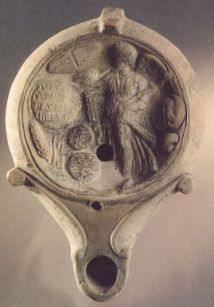
lamp

A Roman new year’s gift: the lamp’s inscription, amidst symbols of prosperity, contains the common phrase annum novum faustum felicem. – Image source here.

An auspicious day, the Romans marked New Year’s Day with religious ceremonies and sacrifice (as T. Vindol. II 265, a letter from Vindolanda, illustrates, for example), but also with notes (see, e. g., T. Vindol. II 261, another letter from Vindolanda), exchanging all kinds of little trinkets and foodstuffs, and quite possibly even cakes that wished others a ‘prosperous, well-omened new year’: annum novum faustum felicem.

But for Caelius Donatus, this one particular New Year’s Day (unfortunately, we cannot know the exact year) was more than that: it was supposed to be extra special!

A father of two sons and one daughter, Caelius Donatus had been elected chief magistrate of his local council, with oversight of local finance.

Many Roman offices were taken up on March 1st; but several communities introduced their new magistrates on January 1st, including that of Caelius Donatus.

The first of January therefore was the very day for him on which he finally could put on and boast the toga praetexta – the garment that distinguished him as a magistrate.

His family, his wife and his three children: they all must have been proud of him, his great achievement, and the prestige that came with it.

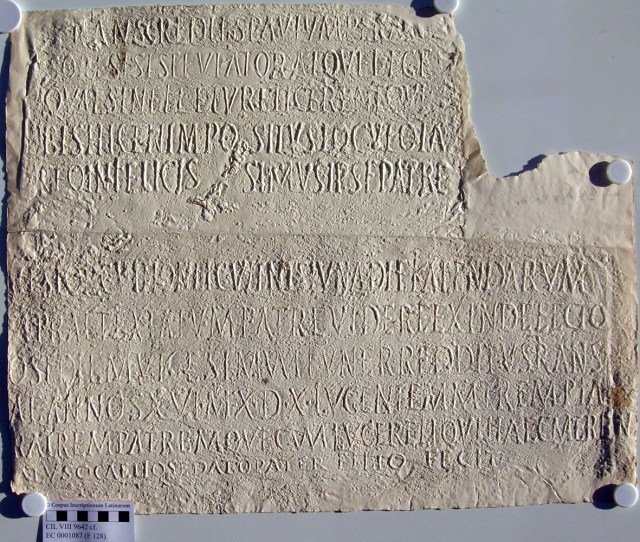
But then, all of a sudden, things took an unexpected, dramatic turn, as the following inscribed poem records (CIL VIII 9642 = VIII 21494 = CLE 1603 = ILS 6881):

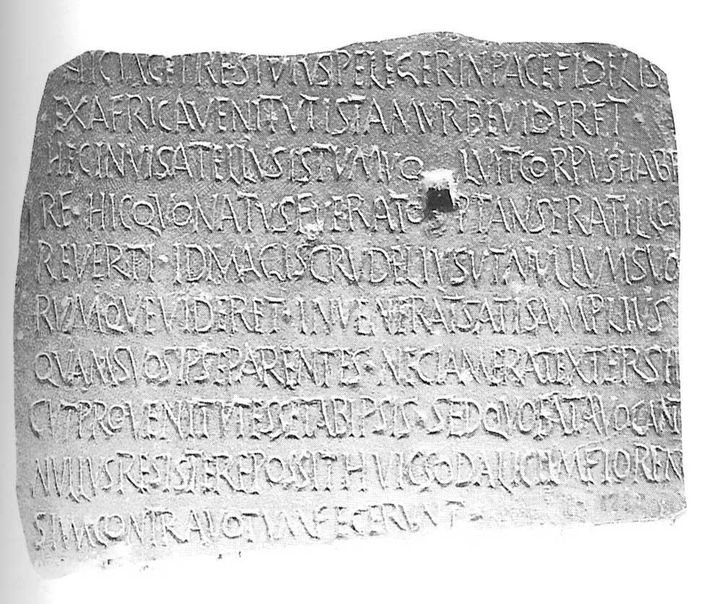
PEC0001087.jpg

CIL VIII 9642 (squeeze). – Image source: http://cil.bbaw.de/test06/bilder/datenbank/PEC0001087.jpg

Transgrediens paulumper (?) qu[ae]-
so resis{is}te viator atque lege
quae sine fletu re<l>i<g>ere (!) nequi-
bis. hic enim positus loculo ia-
ceo infelicissimus ipse patre
duoviro qu(a)estor(e) cui non licuit nisi una die Kalendarum
Ianuariarum praetextatum patre(m) videre. exinde lecto
receptus, post diem vi<c>esimum funeri redditus, trans-
gressus vitae annos XVI m(enses) X d(ies) X lugentem matrem pia
cum sorore fratrem patremque cum luce reliqui. haec maerens
C(aius) Caelius Donatus C(aio) Caelio Sedato pater filio fecit.

(i) As you pass by, please stay a little, wayfarer, and read what you will not be able to read out without crying.

(ii) For here, buried in this little plot, I lie, most ill-omened, born of a father who was duovir with oversight of financial affairs.

(iii) He was not allowed to see his father wearing the toga praetexta except for that one day on the first of January.

(iv) Subsequently, I was bedridden, then, on the twentieth day, I had to be handed over for funeral: I lived a life of 16 years, 10 months, and 10 days, and, together with my light of life, I abandoned my mourning mother together with my dutiful sister, my brother, and my father.

(v) Gaius Caelius Donatus, the father, had this made for Gaius Caelius Sedatus, his son, mourning these matters.

Gaius Caelius Sedatus fell ill and died at the (preliminary) high point of his father’s career, and it is hard not to see the father’s barely concealed anger and disappointment that resulted from son’s premature death and the way it had blighted the beginning, if not the entirety, of a year that was supposed to be special.

A blemish whose origins the father chose to relate to New Year’s Day, to what was meant to be his New Year’s Day:

Cui non licuit nisi una die Kalendarum
Ianuariarum praetextatum patre(m) videre
,

He was not allowed to see his father wearing the toga praetexta except for that one day on the first of January.

The father’s feelings are deeply engrained in the text’s structure.

The text of the inscribed poem rests on three fundamental pillars, of which the passage that I just quoted is the central one: (i) the customary address of the wayfarer, (iii) the observation that the son was not allowed to admire his father’s achievements for more than just a single day (above), and then (v) the final, mostly technical statement that Caelius Donatus had this memorial made for his son Sedatus.

These elements, presented in an impersonal third-person narrative, are interspersed with two segments in which Sedatus, the deceased son himself, is imagined to act as a first-person interlocutor: (ii) Sedatus remarks that he lies ‘here’, born of a (newly) distinguished father, and then (iv) he speaks of his sudden and lethal illness, through which he had to abandon his family and leave his mother in mourning.

On two occasions the deceased’s dialogue with the memorial’s impersonal voice thus adds a personal dimension to a narrative that more than anything else celebrates father’s achievement (rather than, for example, the boy’s promising potential) – and that even commemorates the father’s name before that of his prematurely deceased son (to whom this memorial belongs).

The first time he gets to speak for himself, the son is imagined to refer to himself as infelicissimus, most ill-omened, the opposite, to an extreme, of the felicem (i. e. ‘well-omened’ ~ ‘lucky’) element in the Roman New Year’s wish annum novum faustum felicem.

One cannot help but feel that this is mostly for a rather vain reason – namely because he was unable fully to enjoy the pleasure that (to his father’s mind) one must derive from having been granted the privilege to see one’s father as a provincial magistrate.

The second time, the son is made to recapitulate the story of his illness and his premature demise, describing himself as a cause of grief and mourning for his mother most of all. It is not until it comes to the mention of his creation of a funerary monument for his son that the father speaks of his own mourning – and he is in mourning over ‘these matters’ (haec maerens) rather than over his son.

In fact, even at the point of death of his son, Gaius Caelius Donatus did not manage to put his (now tainted) achievement into perspective. Much rather, his poem utilises the deceased boy and introduces him as someone who regrets having been denied the privilege to behold the father in his political role for more than a day.

When Caelius Donatus was wished a ‘prosperous, well-omened new year’, annum novum faustum felicem, he undoubtedly (on the basis of the above inscription) saw faustitas and felicitas in material wealth, political influence, and societal standing: a common notion, well expressed in the iconography of many New Year’s trinkets, including the clay lamp (above) with its depiction of ears of grain and coins.

A stark contrast to the use of faustus and felix in Terence‘s exclamation o faustum et felicem diem, ‘oh prosperous, well-omened day!’ at Andria 956, clearly resembling the Roman New Year’s wish at the very moment when after extended family stresses harmony gets restored and new, more peaceful beginnings are finally within reach.

Through the death of his son, the infelicissimus Caelius Sedatus, Caelius Donatus had to learn the hard way: true prosperity and true good fortune do not depend on one’s professional achievements alone, and our successes are worth but little if we cannot share them with those we love and those whose opinion matters to us.

Annum novum faustum felicem vobis  – a prosperous, well-omened new year to you, not just as professionals!

Posted in Carmina Epigraphica, Epigraphy, Poetry | Tagged , , , , , , , , | Comments Off on First Things First

A Medieval Cycle of Poems for Santa Claus

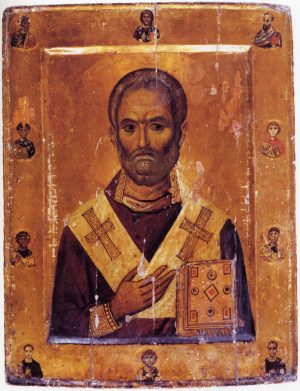
St Nicholas. 10th Century icon. – Image source: https://iconreader.files.wordpress.com/2011/12/sinai_10c.jpg.

St Nicholas (10th Century icon). – Image source: http://iconreader.files.wordpress.com/2011/12/sinai_10c.jpg.

In my search for something unusual and exciting for my readership to enjoy in the second half of December, I came across a most remarkable cycle of poems celebrating St. Nicholas of Myra, now more commonly known and worshipped in the Anglophone world and beyond as Santa Claus.

Transmitted in the Ms. Cotton Tiberius B. V, the poems would appear to date to the 10th-12th centuries (or perhaps, in some of their substance, even earlier).

Amounting to some 350 lines in total, the poems do not seem to have attracted much scholarly attention – or, in fact, ever been translated into English (or any other language, for that matter).

Without any desire to proselytise, or to upset anyone through the provision of a document and a frame of mind that is representative of a long bygone era, I herewith publish what I believe to be the first ever complete translation of this composition.

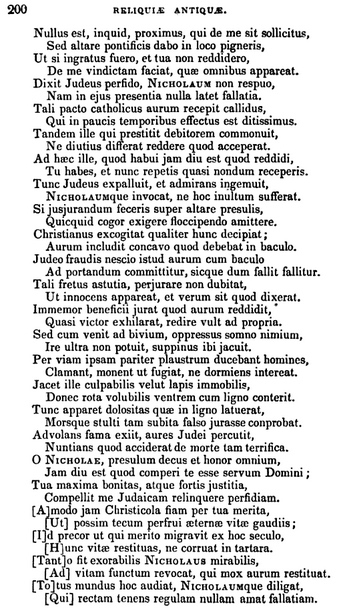
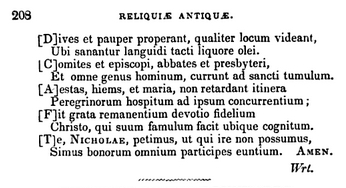
The Latin version is provided in the form of scans taken from Thomas Wright – James Orchard Halliwell’s Reliquiae Antiquae. Scraps from Ancient Manuscripts, Illustrating Chiefly Early English Literature and the English Language (London 1841, vol. I, 199 ff.). It will allow the attentive reader to discover the intricacies of this peculiar composition even further, noting, for example, the internal rhyme scheme of each line.

Encounter a medieval mode of story-telling, presenting us with an idea of a man readily given to threats and physical violence in his pursuit of good causes and of justice – a man whose actions and whose entire demeanour could not be much further from the grandfatherly, jovial, slightly bumbling, and somewhat grumpy Santa Claus figure of our own time. (That being said, he is, of course, equally creepy in his ability to appear unexpectedly as well as in his profound knowledge of people’s wicked deeds.)

Discover poeticising, glorifying stories, over one-thousand years old, of miraculous and fantastic interventions, of faith and spiritual encounters, of bravery and blackmail, of unfailing support for the poor, the wrongly accused, and the persecuted, and, most of all, of the fundamental belief that justice must prevail.

Be amazed at the truly bewildering justification provided for the violation and destruction of Saint Nicholas’ tomb and the pilfering of the his remains.

But, most of all, have a happy, peaceful holiday, everyone!
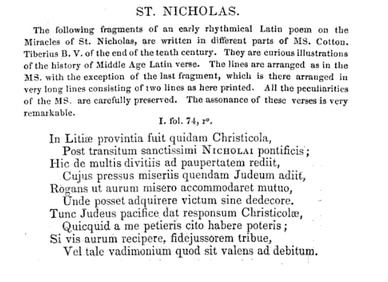
N1

In the province of Lycia, there lived a Christian,
After the demise of the most holy bishop Nicholas;
He had fallen back to poverty from his many riches,
And pressed by his poverty, he approached a Jew,
Asking if he would lend him, poor man, some money,
So that he might acquire a livelihood without shame.
The Jew gives the Christian the following response, placidly,
‘Whatever you ask from me, you may have in an instant;
If you wish to obtain money, provide a guarantor,
Or a surety of the kind that matches the value of the debt.’
N2

‘I do not have anyone close to me’, says he, ‘who would concern themselves with me,
But I promise on the altar of the bishop, in lieu of an actual deposit,
That, should I be ungrateful and not return your property,
he, who appears to everyone, may seek revenge against me.’
The Jew says to the trickster: ‘I will not reject Nicholas,
For in his presence there is no hidden fallacy.’
And thus the cunning Catholic receives the money,
Who then within only a very short amount of time became tremendously rich.
Eventually, the lender reminds the borrower
Not to delay any further his paying back of what he had received.
To this he responds, ‘What I had, I have long given back,
You have it, and now you ask back as if you had not received anything.’
The Jew was appalled and, in utter disbelief he groaned,
Invoking Nicholas, lest he let him get away without punishment:
“If you took an oath over the altar of a bishop,
whatever I’m compelled to exact (from you) I am happy to do without.’
The Christian considers how he might deceive him:
He hides the gold he owes in a hollow staff.
He then hands this staff with the gold to the Jew, unsuspecting such fraud,
To carry it, and thus to be misled, as he misleads.
Relying on such trickery, he is positive not to commit perjury,
So he appears to be innocent and to say the truth.
With no regard to the good deed he received, he swears that he had handed back the gold;
He rejoices as though he had won, and he wishes to go home.
But as he reaches a crossroads, he is overcome by great tiredness,
So that he could not proceed any further, so that he had to lie down right there.
Along the same way people led a carriage,
They shout, ask him to move, lest he died in his sleep.
But he, in his guilt, lies there, immobile, like a rock,
until the spinning wheel with its wood tears apart his stomach.
Then became clear the deceit that had been hiding in wood,
And the sudden death of the fool matches his perjury.
Rumour flies out, reaching the Jew’s ears,
Announcing what had happened, regarding that horrendous death.
‘Oh Nicholas, pride of bishops and everyone’s honour,
I have long understood that you are the Lord’s servant;
Your eminent goodness and strong sense of justice,
Urged me to relinquish my Jewish superstition.
Henceforth, I shall now be a Christian, thanks to your merits,
So that I may enjoy, together with you, the joys of eternal life;
This I ask you: that him who made the transition from this world
You restore to life, lest he rots in hell.’
Nicholas, the admirable, becomes open to persuasion by such a cause,
He brings the dead man back to life, so that may soon return the money.
May the whole world hear this and love Nicholas,
Who, holding on to the right rule, loves no fallacy.
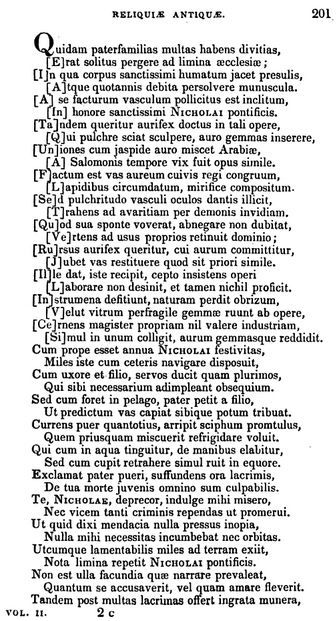
N3

A father of a family, in possession of many riches,
Used to travel to the threshold of his church –
In this church lies the body of a most holy bishop –
And to pay his debt in annual contributions.
He promised to make a precious little vessel,
In honour of the most holy bishop Nicholas.
Finally, he seeks out a goldsmith, versed in such work,
Who knows how to produce fine sculptures, to insert gemstones into gold,
To create a blend of jasper and Arabian gold:
There is hardly a work of its like from the time of Solomon!
A golden vessel was created, a match for any king,
With stones surrounding it, an amazing creation.
But the beauty of the vessel entices the eyes of the giver,
Dragging him towards greed, through the demon’s envy.
What he had vowed of his own volition he does not hesitate to withhold,
He maintains ownership, redesignating it for his own personal use.
Again he seeks out the goldsmith, whom he gives gold
And orders to recreate a vessel that is similar to the previous one.
He hands it over, the man receives it, pressing on with the work he begun
He does not cease to work, and yet he achieves nothing.
The tools are failing, nature spoils the refined gold,
Like highly fragile glass the gemstones fall off the work,
And as the master understands that his own craftsmanship is powerless,
He collects everything and returns the gold and the gemstones.
As it is nearly the time of the annual feast for Nicholas,
The knight plans to sail with everyone else,
With his wife and his son, he takes as many slaves as possible,
So that they pay him the necessary respect.
But as he gets on the open sea, the father orders the son
To take the aforementioned vessel and give him a drink.
The boy, rushing as quickly as he can, readily takes the goblet,
Which he desired to cool down a bit, before mixing wine in it.
As it moistens in the water, it slips from his hands,
But as he desires to retrieve it, he too slips into the sea.
The father shouts for the boy, shedding tears over his face,
‘I alone am to blame for the young man’s demise!
I beseech you, Nicholas, have mercy with me, wretched,
and don’t pay back in equal measure for the huge crime, as I would deserve.
When I lied to you, I was not pressed by any hardship,
Nor was there any necessity or barrenness upon me.’
As the pitiful knight reaches the land,
He returns to the well-known threshold of bishop Nicholas.
There is no such eloquence that could tell,
Just how much he blamed himself, or how bitterly he cried.
Finally, after many a tear, he offers the unwelcome gifts,
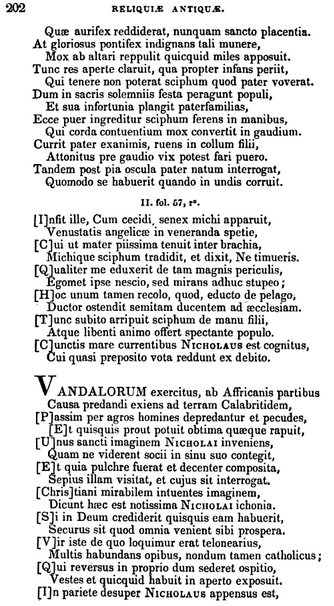
N4

Which the goldsmith had returned and which were never to please the Saint.
But the glorious bishop, offended by such a gift,
Soon pushed off his altar whatever the knight had placed on it.
Then the matter became exceedingly clear, why the boy had died,
Who could not hold on to the goblet that the father had vowed.
And while the people celebrate the holiday in sacred ceremonies,
And the father of the family mourns his misfortune,
Behold!, In comes the boy, carrying the goblet in his hands,
Quickly bringing the hearts of the onlookers to rejoice.
The father comes running, breathless, flinging his arms around the son’s neck,
Besides himself with joy, he barely manages to speak to the boy.
Finally, after deserved kisses, the father asks his son,
How he had been, since he had fallen into the waves.
He says: ‘When I fell, I saw an old man,
In the venerable appearance of angelic graciousness,
Whom his most pious mother held in her arms.
He gave me the goblet and said: Fear not!
How he led me out of such mighty danger,
I do not know. I am still astonished in my amazement.
The one thing I do remember, however, when I had escaped the sea,
There was a guide who showed me the way to this church.
Immediately he then takes the goblet from the hand of his son,
And offers it, glad in his heart, with all the people watching.
To everyone faring the sea Nicholas is well known,
And the gifts that have been promised to him in vows are presented deservedly.

When the Vandals’ army, from Africa
Coming to Calabrian lands to maraud,
loots men and lifestock alive, moving across the entire country,
And everyone snatches the best things he is capable to snatch,
One of them discovers an image of Saint Nicholas,
Which he hides in his fold, lest his companions see it,
And, as it was beautifully and decently crafted,
He looks at it frequently, wondering whose it was.
Looking at the amazing image of this Christian man,
They tell him that this is a most famous icon of Nicholas.
If he, whoever owns it, believed in God,
He could rest assured that everything would turn out well for him.
The man we are talking about was a publican,
With an abundance of wealth, but not yet a Catholic;
As he sat down in his own home, having returned,
He put his clothes and whatever else he had on display.
High up on the wall Nicholas was hung,
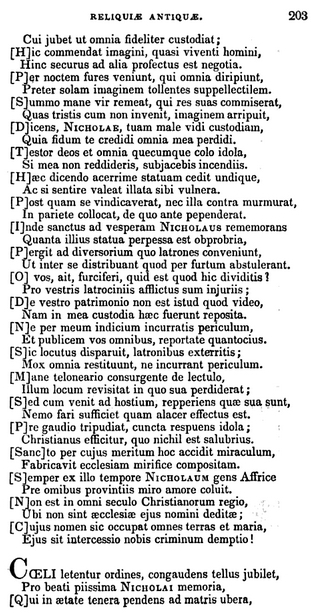
N5

And he ordered him to safeguard everything with diligence;
He gives his orders to the image just like one would to a living being;
Hence he tends to other business, with peace of mind.
During the night, thieves come, who steal everything,
Taking all the fixings, except for that very image.
As the man returns first thing in the morning and, distraught, could not find the things
That he had left behind, he grabs the image
Saying: ‘Nicholas, your protection I have experienced in a bad way,
Because I have deemed you trustworthy, I have lost everything.
I make the gods my witnesses and all those idols that I worship,
If you do not restore my property, you will be subjected to the fire.’
Saying such things, he thrashes the statue savagely from every side,
And as though it could feel it, it sustained wounds.
After he had inflicted punishment, which it took without so much as a whisper,
He places it on the wall, hanging it where it had been before.
Hence Saint Nicholas, around the evening, calling to mind
What ignomy his statue had to suffer,
Rushes to the lodgings where the bandits met
To distribute among themselves the loot that they had accumulated.
‘You rogues,’ said he ‘what is it that you are dividing up here?
For your thefts I have sustained these injuries;
What I see here is not of your inheritance,
For these objects were left in my custody.
Lest you be in danger, through my reporting you,
And I make you publicly known to everyone, return this posthaste.’
Thus he spoke and disappeared; the bandits were terrified.
Soon they restore everything, lest they be in danger.
In the morning, as the publican got out of his bed,
He revisits the place where he had lost his possessions.
But when he enters the room, finding what was his –
No one can describe how cheerful he became!
He dances full of joy, renouncing all idols;
He becomes Christian, which is the most salubrious thing there is.
For the saint, through whose merit this miracle had happened,
He built a church, beautifully constructed.
Ever since that time, the people of Africa worshipped
Nicholas, more than any other province, with wondrous love.
There is not a Christian region in this world
Where there are not any churches dedicated to his name;
His name thus conquers all land and sea;
Let his intervention deliver us from crime.

May the orders of heaven rejoice, earth be happy alike and join the cheer,
For the most pious memory of Saint Nicholas,
Who at a tender age, when he still clung to his mother’s breast,
N6

Gave a memorable example of self-restraint.
When he had been breast-fed on the fourth Friday,
Having received milk from the breast once, he refused to touch it again.
After the death of his father, he as the son had remained the sole heir,
Who put his inheritance to good use for the poor.
To him came a neighbour, who had three daughters,
Whom he offered for fornication, though he had been a noble.
Such lack of bread had pushed the poor man,
That he, once poor, wanted to live in such disgrace.
But tempered with the spirit of charity, Nicholas, a young man still,
Put an end to a sin whose number resembled that of the trinity.
Not yet made a bishop, he gave the young girls money,
He dispelled the father’s infamy and the daughters’ ignomy.
With such benefactions of a great character the young man
Had divinely deserved to become a powerful bishop.
Since then he appears to sailors who are shipwrecked in adverse wind
And call on him, as they speak to him:
‘Nicholas, if it is true what many say about you,
Help us quickly, lest we drown in these floods.’
He has appeared to those who shout in fear of such a threat,
He shows himself to those who invoke him, calls himself Nicholas,
And after the sea has crashed onto the masts and the ropes
And the rigging, he calms the heaving sea.
The ship-masters of Alexandria were thoroughly astounded
When they saw the copious abundance of grain.
Rationing it, they return the entire load in measure,
Despite what Nicholas had kept, as he had requested (of them).
As he reveals it, the terrible deceit is laid bare,
Which Diana had sent as a treacherous gift.
As they carry away and throw into the sea this superstition,
It heats up like a furnace and burns whatever it reaches.
Three innocent young men were doomed to be killed,
Whom he set free, unbound by powerful might.
Not much later, Constantine held others captive;
But I shall explain how it happened that he snatched them away from death.
An arrogant family from Phrygia denied the ruler what was due,
In response to which he, deservedly, ordered to press on to restrain them.
But when his men return as desired, having overcome the enemy by force,
Certain people, due to their envy, made up a lie;
They falsely claimed that their partners, Arpileon and the others,
Desired to be rulers, having stolen Caesar’s reign.
The governor was headed such malice, corrupted by a bribe,
And as a result of their fraudulent acts the men were thrown into jail.
After that, the ruler ordered the governor to have the innocent men killed,
Lest anyone else commits such an act in similar arrogance.
The jail’s guard became aware of the fraud;
N7

At night, they accomplish everything the way the judge had ordered;
Having heard of the deadly plan, the guard comes to those just men, locked up in prison,
But he cannot hide it from them, as tears are running down his cheeks.
As they see the guard, more pale than usual,
they ask him, astonished, if he had heard news about them.
‘Silent’, he said, ‘young men, you are altogether done for,
For the end of your lives is fast approaching.
A judge gave a cunning verdict about your death,
Rushing to have you executed before the day will break;
For laments and tears will not be able to save you,
Highest virtue will come to your support this night.’
Who would be able to express just how immense the sadness was
That dwells deep down in their hearts.
But as no mortal can bring help
And there is no hiding place to escape the danger,
Back to their mind came that, when they had travelled across the sea,
They had seen Nicholas, to whom they had entrusted themselves.
That is why they ask him more than all others in their prayers
That he who sets free others, may not forget his own servants.
In the same hour, hastening, minding his servants, the bringer of help
asks Constantine whether he was asleep or awake;
As he asks ‘Who are you, who thus came to me?’,
The saint responds: ‘I am Nicholas, the bishop of Lycia,
I came here out of compassion, lest your soldiers die
Whom I advise you not to touch, lest you wish to die this instant;
Know that a king mightier than you will raise war against you,
Whose strong victory you will not be able to resist;
If you choose to go to battle, and you will take him on,
You will be overpowered and die for the fact that you are a non-believer.
Having terrified the ruler, he rushes there quicker than the wind itself,
And terrifies even more those who had made the accusations against the men.
‘Impious, bandit, traitor, deserving of a wretched demise,
You will be punished for your greed.
You will be eaten by the worms, like a filthy dog,
Everyone will give your festering body a wide berth.
But I will mercifully show lenience in the face of your crimes under the following
condition: if you come clear, with regret, about what you wickedly have done.
Having heard this, the governor is shaken off his bed,
Fearful through the night he comes to the imperial palace.
Before the governor arrived, the emperor had got up,
And furiously he hurled many a threat towards him.
He in turn attempted to appease the ruler with words of peace,
Apologising himself for the crime, ordering for the captives to be brought in.
They were immediately handed over to the ruler, fearfully they expected their demise,
They sigh, they sweat of fear, they have no hope for their lives.
The ruler asks the soldiers, ‘Where is that man, Nicholas,
N8

Who, for better or worse, for his clemence, sets you free?’
To the sound of the well-known name of the bishop, they shout, shedding tears,
Raising their hands to the star, praising God’s glorious works,
Answering that in Lycia there is that city of the Myrians
In which the bishop lives, whom God gives glory,
Of whose prudence and brave patience
We have never seen another man, a man so good and yet so humble.
More than any other virtue, whose number in him is unrestricted,
Charity glows in him, which is the biggest one of them all;
We did entrust us to his prayers,
When we were on naval warfare against the barbarians;
There we were faithful to you,
For we conquered many an enemy with only a small number of soldiers.
The rebels that existed, and they could barely act as such,
We rendered your subjects – and tamer than lambs.
For such services we were sentenced to death,
Unless God sets us free through the merits of Nicholas.’
Who could have a chest so iron-hard, a heart so hard as stone,
That piety would not soften, for the sake of humanity?
Those who stood there in attendance could not contain themselves,
The soldiers’ eloquence elicited the tears of many.
Then finally the appeased ruler orders for the young men to be dressed properly,
Restoring the friendship they originally had.
Then he says, ‘Bring many a gift from me
To the saint bishop, about whom you have talked so much.
From his words I have learnt that you were not perfidious,
But in his testimony faithful in your service.
Nicholas, the bishop, indeed is most close to God,
Through whom we experience such miracles in our world.
That you live and understand, that you have been set free,
All that achieved his goodness and his mercy.
Bring him gifts, cloth and candles,
Which to receive he shall not reject in my memory.
I and my sons will be his servants,
For whom he may pray to God; may he no longer haunt me.’
Thus they quickly rush to board their vessels quickly with the present,
They bestow countless gifts upon Nicholas in Lycia.
On land and sea we know that Nicholas in particular
Quickly comes to the rescue of everyone who invokes him.
While we are in this world, let us ask from our Lord
That we may be mentioned in the heavenly prayers of this saint.
N9Let us praise God by whose providence
Nicholas becomes even closer to us than he was to begin with.
Whence the people of Greece and their Asian neighbours mourn him,
Myra in particular, now lacking this outstanding friend:
Their insulting him resulted in the fact that nowhere near to them
There is now a patron of such grace, of such excellence.
He was a lover of peace, while he flourished in this world,
After his demise he forever loves peaceful people,
He flees the Turks and the Pechenegs, wretched people indeed,
Who do not bestow what is due onto the creator of the universe.
The city of Bari, much beloved by God, well deserved
With great joy to receive Nicholas  and to provide a resting place.
The Baresi and Venetians with their most powerful ships
Often cross the seas for the purpose of trade.
Just in our times they reached, with ships full of grain,
Antioch, further away still than the province of Myra.
After they had sold their grain there, following divine admonition,
They were exposed to the plan, at God’s behest,
To break open, upon their return, the saint’s marble tomb,
With iron tools, prepared for this task.
By the Lord’s will and with the bishop’s help
They entered the church and carried out what they had been told.
There were four guards in the atrium
Who, in their usual custom, soak up the holy water with their brushes;
They are in the belief that these people wanted to bring the usual offerings,
So they do not hesitate to show whatever they desired to see.
Then one of the Baresi, daring and physically strong,
Brings an iron hammer, with which he smashes the tomb,
Under whose blow the inscription is demolished into many pieces.
Forth bursts an enticing fragrance
As though they were removed into the Lord’s paradise:
They had little hope of finding glory greater still afterwards.
From here they carry away the treasure, exceeding everything in value,
Push their vessels onto the sea, set sails into the wind immediately,
A prosperous journey brings home those cheerful fellows,
Who deliver the body of the venerable bishop.
A timid seaman was admonished in his dream;
To him he said: ‘Fear not to navigate strenuously,
The twentieth day will bring an end to your journey,
And meanwhile there will not be any trouble ahead on the sea.’
As it was announced, thus it happened, the saint disembarks by the riverbank,
And all Apulia, rejoicing, comes running to encounter him.
The sheer mass of miracles worked through his merits
Sets people across the globe in motion voluntarily.
N10

Rich and poor, they come running, to see the place
Where the limping are healed when touched by a drop of oil.
Earls and bishops, abbots and priests,
And all humankind, they come to the saint’s tomb.
Summer, winter, and the sea – they do not stall the journey
Of the pilgrims that come to him.
Graceful worship of the remaining faithful ensues
In Christ, who made him his servant and companion.
We beseech you, Nicholas, as we cannot go ourselves,
That we may be part of all the good people who go. (Amen)
Posted in Poetry | Tagged , , , , , , , , , | 8 Comments

Let us remember that this has happened

After the disintegration of the Roman Empire in the fifth century A. D., most of the Iberian peninsula eventually became part of the Visigothic Kingdom. A successor state to the (Western) Roman Empire, the Visigoths had gained control over Rome’s Iberian provinces as well as over parts of southern Gaul, and their influence was to be felt for some 300 years, from the early fifth to the early eighth century A. D.

While the Visigoths managed to control most of the territory of the Iberian peninsula, there were certain areas that remained notoriously contentious, controlled by independent Iberian tribes – areas in which armed conflict, campaigns, and skirmishes lingered for sustained periods of time.

Testimony to this period and its conflicts in this area is a Latin verse inscription, dating to the seventh century A. D., which was discovered in the vicinity of Córdoba/Corduba, in the province of Baetica, and which commemorates one Visigothic nobleman named Oppilanus.

Oppilanus’ inscription reads as follows (CIL II ed. alt./7.714 = CLE 721; for a drawing of the inscription, which does not appear to have survived, follow this link; further on this text cf. also here [in Spanish]):

Haec cava saxa Oppilani
continet menbra (!),
clarum in ortum natalium,
gestu abituq(ue) conspicuum.
opib(u)s qu(i)ppe pollens et ar-
tuum virib(u)s cluens
iacula vehi pr(a)ecipitur pr(a)edoq(ue)
Bacceis destinatur.
in procinctum (!) belli necatur
opitulatione sodalium desolatus.
naviter cede perculsum
cli(e)ntes rapiunt perem(p)tum,
exanimis dom{i}u(m) reducitur
suis a vernulis humatur.
lugit (!) coniux cum liberis,
fletib(u)s familia pr(a)estrepit.
decies ut ternos ad quater
quaternos vixit per annos,
pridie Septembium (!) Idus
morte a Vasconibus multat(u)s
(a)era sescentensima et octagensima.
id gestum memento.
sepultus sub d(ie) quiescit
VI Id(us) Octubres (!).

This hollow stone contains the limbs of Oppilanus, of noble birth and notable bearing and composure. Mighty in his strength and renowned for the strength of his limbs, he gets taught to throw javelins and prepared to become a marauder in the country of the Baccei.

Prepared for war, he gets killed, deprived of his fellows’ help. Severely beaten up in an ambush, loyal helpers carry him away as he is wounded. Lifeless, he is taken back home and buried by his servants. His wife mourns him, together with his children, his family resounds with fits of weeping.

When he was forty-six years old, he was mortally wounded by the Vascones on the 12th of September in the 680th era [i. e. A. D. 642].

Let us remember that this has happened.

Here he rests, the date of his burial was the 10th of October.

Oppilanus, according to his epitaph, was trained to operate as a (presumably militarily otherwise unaligned?) Visigoth marauder (praedo) in the territory of the Vascones – a term that is at least etymologically related to the ethnic and geographical term ‘Basque’, though not (necessarily) straightforwardly synonymous to the Basque people and their territory of our age.

Fully prepared to go to war, he soon fell victim to a skirmish, in which he was mortally wounded. Despite his loyal servants’ best efforts, his life could not be saved: lugit (!) coniux cum liberis, | fletib(u)s familia pr(a)estrepit – ‘his wife mourns him, together with his children, his family resounds with fits of weeping’.

Oppilanus, according to his epitaph, was a highly trained combatant – he was ready to fight as a praedo, ready to ambush and kill the enemy. His inscription takes great pride in this, praising both his manly physique and his fighting skills, which proved to be of no use to him after all, for things turned out the other way: it was Oppilanus himself who fell victim of a skirmish, and thus his family was devastated.

Did Oppilanus himself, did his wife, his children, his familia ever spare a single thought for the families of those whom Oppilanus had set out to fight?

We cannot know.

What we do know, from the inscription, is what his relatives wanted to remember.

Of course, they wanted to remember Oppilanus, their husband and relative, and they wanted to remember him as a noble fighter.

But his end was not noble.

It was brutal and horrendous, and even his friends could not prevent Oppilanus’ dire fate – his getting ambushed by those whom he himself had set out to attack. All that there was left for his loyal helpers to do was to pick up Oppilanus’ mutilated, lifeless body, to carry it all the way back home (from close to the peninsula’s north to Córdoba in the south), and to see to its getting buried.

It is the aspect of failure, suffering, and death at the hand of the enemy that this inscription places at its very centre: it is this aspect that constitutes, quite literally, its core message.

And this core message gets reinforced subsequently.

The key phrase, to my mind, is id gestum memento, ‘let us remember that this has happened’, referring to the entire unfortunate string of events and how it had turned out for Oppilanus and his family.

‘Lest we forget’ is a phrase in common use nowadays in the context of our commemoration of those who died in armed conflict; we use it in conjunction with ‘we will remember them’.

Id gestum memento, ‘let us remember that this has happened’, goes substantially beyond that, reminding us not only of the people, but of what happens when armed conflict seems like the noble and the right thing to do.

Id gestum memento, ‘let us remember that this has happened’, is a much better way of putting it, linking the events (and their motives) to those who took part in it.

Let us remember that this has happened, and that the inevitable outcome has been, and will always be, that –

lugit (!) coniux cum liberis,
fletib(u)s familia pr(a)estrepit.

His wife mourns him, together with his children, his family resounds with fits of weeping.

Posted in Carmina Epigraphica, Epigraphy, Poetry, Prose | Tagged , , , , , , , | 5 Comments

End Violence against Women!

November 25th has been declared the International Day for the Elimination of Violence against Women.

My colleagues at the EAGLE Europeana project have decided to mark the occasion with a reference to the funerary inscription of Prima Florentia, who died when her husband tossed her into the Tiber (AE 1987.177k).

I, too, would like to support this cause on my blog.

I therefore choose the following text from Lyon (CIL XIII 2182 = ILS 8512 = AE 2011.758):

D(is) M(anibus)
et quieti aeternae
Iuliae Maianae femi-
nae sanctissimae manu
mariti crudelissim(i) inter-
fect(ae), quae ante obi(i)t quam fatum
dedit. cum quo vix(it) ann(os) XXVIII ex
quo liber(os) procreav(it) duos puerum
ann(orum) XVIIII puellam annor(um) XVIII.
o fides, o pietas! Iul(ius) Maior fra-
ter sorori dulciss(imae) et [Ing]enuinius
Ianuarius fil(ius) eius p(onendum) [c(uraverunt) et su]b a(scia) d(edicaverunt).

To the Spirits of the Departed and the eternal rest of Julia Maiana, a most saintly woman, who was killed at the hand of her most cruel husband.

She died before the time that fate had decreed. She lived with him for 28 years, and by him gave birth to two children, a boy aged 19 and a girl aged 18.

What an expression of faithfulness, what an expression of dutifulness!

Julius Maior, her brother,  took care of the erection of this memorial for his sweetest sister, as did Ingenuinius Ianuarius, her son, and they dedicated it (while it was still) under the adze.

Posted in Prose | Tagged , , , , , | 9 Comments

Baby, It’s Cold Outside: Frosty Notes from Roman Britain

Last week I gave a research seminar paper at Reading about Britain’s most ancient poetry, the evidence for which I published on this blog a few months back in a freely available and downloadable e-publication called Undying Voices.

One of the inscriptions in this collection which has long fired my imagination is a fragmentary piece from Habitancum/Risingham in Northumberland, situated a few miles north of Hadrian’s Wall.

Its find context makes this piece Britain’s – and in fact Ancient Rome’s – northernmost (half-)surviving poem of the Roman period, and its content certainly lives up to any expectations that may come with that.

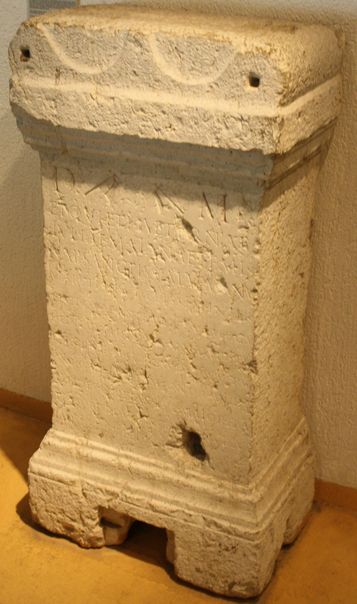
The inscription – engraved on a funerary altar that was subsequently cut in half lengthways, with only its right half surviving – reads as follows (CIL VII 1020 cf. p. 312 = RIB 1253 = Undying Voices no. 20):

[- – – Flam]inii ++nsae
[- – -]ae dominar-
[- – – se]mper geli-
[dis – – -]te pruinis
[- – -]++ qui sib[i]
[- – -]++++AS
[- – -]+FICTNI
[- – -]+ue frag-
[- – -]+E tibi pro
[- – -]rce pro
[- – -] Flaminius o-
[- – -]e profund-
[- – – l]ucem uolu-
[it – – -]dere uitae.

. . . of Flaminius . . .nsa
. . . dominate
. . . always in cold
. . . frost
. . . who himself
. . . . . . . . . . . . . . .
. . . broken
. . . to you for
. . . (spare?) for
. . . Flaminius . . .
. . . shed
. . . light . . . he wanted
. . . of life.

The poem, or so it would appear from its scarce remnants, referred to frosty conditions twice, once through the adjective gelidus (line 3–4), and then again by means of the noun pruina (line 4).

Frosty temperatures at Vindolanda in winter 2014. – Image source: https://twitter.com/vindolandatrust/status/540147824747622400.

Frosty temperatures at Vindolanda in winter 2014. – Image source: http://twitter.com/vindolandatrust/status/540147824747622400.

The presence of pruina (‘frost’) makes it exceptionally unlikely that the poet was talking about anything else than actual climate conditions: it would be rather out of place to use this specific word in the context of the underworld or death or some such, and wherever else it appears  in the Latin inscriptions, pruina always refers to actual places (cf. AE 1991.408; ICERV 349).

Chances are that Flaminius …nsa – a foreigner to Britain and soldier, most likely – complained about the constantly cold (semper!) weather north of Hadrian’s Wall during his life time to such an extent that his concerns even found their way into his commemorative inscription: why else would this matter be mentioned at all!

Or should one go even further and consider that he died of a cold, pneumonia, or hypothermia? Reports of Roman soldiers who froze to death  are certainly attested in the ancient sources, if related to other geographical contexts of the Roman empire – note, for example, Tacitus’ famous description of the hardship endured by Roman soldiers under Corbulo‘s command (Tac. Ann. 13.35):

retentusque omnis exercitus sub pellibus, quamvis hieme saeva adeo, ut obducta glacie nisi effossa humus tentoriis locum non praeberet. ambusti multorum artus vi frigoris, et quidam inter excubias exanimati sunt. adnotatusque miles, qui fascem lignorum gestabat, ita praeriguisse manus, ut oneri adhaerentes truncis brachiis deciderent.

The entire army was kept under canvas,notwithstanding a winter of such severity that the ice-covered ground had to be dug up before it would receive tents. As a result of the bitter cold, many of the men had frost-bitten limbs, and a few died on sentinel-duty. The case was observed of a soldier, carrying a bundle of firewood, whose hands had frozen till they adhered to his load and dropped off from the stumps.

Since I gave my paper (though presumably unrelated to it), a wave of winterly frost has hit Britain: in fact, some regions have already experienced this winter’s first snow, and this made me wonder: to what extent was cold weather, in fact, an issue Roman sources addressed – if potentially in rather less poetic ways than the Habitancum tombstone, above?

Remarkably, Tacitus, in his treatise Agricola, does not appear to see much of a problem with frost in Britain at all when he writes that (Tac. Agr. 12.3–4; translation from here) –

Caelum crebris imbribus ac nebulis foedum; asperitas frigorum abest. Dierum spatia ultra nostri orbis mensuram; nox clara et extrema Britanniae parte brevis, ut finem atque initium lucis exiguo discrimine internoscas. Quod si nubes non officiant, aspici per noctem solis fulgorem, nec occidere et exurgere, sed transire adfirmant. Scilicet extrema et plana terrarum humili umbra non erigunt tenebras, infraque caelum et sidera nox cadit.

The sky in this country is deformed by clouds and frequent rains; but the cold is never extremely rigorous. The length of the days greatly exceeds that in our part of the world. The nights are bright, and, at the extremity of the island, so short, that the close and return of day is scarcely distinguished by a perceptible interval.  It is even asserted that, when clouds do not intervene, the splendor of the sun is visible during the whole night, and that it does not appear to rise and set, but to move across. The cause of this is, that the extreme and flat parts of the earth, casting a low shadow, do not throw up the darkness, and so night falls beneath the sky and the stars.

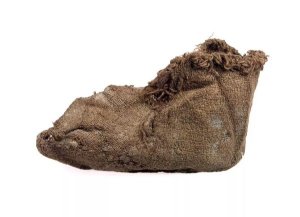
A child's sock from Vindolanda. – Image source: https://twitter.com/vindolandatrust/status/537590855037878273.

A child’s sock from Vindolanda. – Image source: http://twitter.com/vindolandatrust/status/537590855037878273.

Even though Tacitus clearly refers to the northernmost regions of Britain in particular in this description, he suggests that temperatures never really drop to excessive levels of cold – an observation that Flaminius …nsa may have disagreed with rather fervently.

At Vindolanda, situated a mere 20 miles southwest of Habitancum, a more realistic view on matters appears to have prevailed as well.

There are two pieces in particular that are of interest in this context, illustrating aspects of the immediate impact (and the potential level of disruption) caused by adverse weather conditions at Rome’s northernmost frontier.

First, in a letter written by Octavius (an entrepreneur) to one Candidus, Octavius proves reluctant to get traveling during adverse road (and thus presumably: weather) conditions, mindful of the hazards that this would pose to his draught animals (Tab. Vindol. 343.19–21):

. . . iam illec petissem
nissi iumenta non curaui uexsare
dum uiae male sunt

I would have already been to collect them except that I did not wish to be cruel to (or: injure) the draught animals while the roads are bad.

The letter does not contain a calendar date for us to establish a clearer understanding of the specific circumstances.

This is different in the second case, a (fragmentary) draft letter of Flavius Cerialis’ (i. e. the prefect of the ninth cohort of Batavians at Vindolanda), in which he speaks of his efforts of winterproofing the outfit (Tab. Vindol. 234):

column I:

Flauius Cerialis Septembri
suo salutem
quod uis domine cras
id est iii Nonas Oc[t]ó-
bres merc.. pa..[

. . . . . . . . .

column II:

qui feramus tem
pestates [[et hiem]] etiam si
molestae sint

Flavius Cerialis to his September, greetings. Tomorrow, which is 5 October, as you wish my lord, I will provide some goods (?) … by means of which (?) we may endure the storms even if they are troublesome.

Several scholars have argued that the correction of et hiem (crossed out by the scribe) to etiam (written above the original writing) was a scribal mistake due to an original mishearing of a dictated text.

This is extremely unlikely, however: not only is there a significant discrepancy between et hiem(em?) and etiam in terms of the vowels (and, to a lesser degree, the presence/absence of aspiration in hiem… vs. et-iam), but also an altogether different spread of word accents (èt híemem vs. étiam).

A significantly more plausible scenario is that the author of these lines, Cerialis, reconsidered his original version as he went along and made a correction along the lines that now survive.

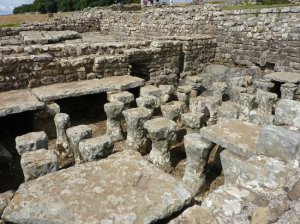
Roman heating arrangements at Housesteads Roman Fort. – Image source: http://media-cdn.tripadvisor.com/media/photo-s/04/63/70/eb/housesteads-fort-and.jpg.

Roman heating arrangements at Housesteads Roman Fort. – Image source: http://media-cdn.tripadvisor.com/media/photo-s/04/63/70/eb/housesteads-fort-and.jpg.

At Vindolanda, average temperatures in October range from 4.5–11ºC, a significant drop vis-à-vis the conditions in September these days (and clearly marking the approach of much lower winter temperatures), and chances are that this was not fundamentally different during the Roman period. In other words, in early October winter, with its storms, increased precipitation, and lack of sunshine, will have been very much on the prefect’s mind, and it is too easy to blame the evidence for a correction of et hiem on a mishearing scribe.

The point of Cerialis’ letter, however fragmentary in context, is clear: time to prepare for the inclemencies of weather during the winter months (tempestates), so that they may become bearable (qui feramus) even if unfavourable (etiam si molestae sint). This ties in, of course, with other letters discussing items of clothing and such (as well as archaeological evidence for soldiers’ clothing, heating arrangements, etc.).

With winter fast approaching in Britain, it is time to consider – as every year – what we may be able do to help those who still, quite literally, feel the chill: rough sleepers, the elderly and vulnerable, and – sadly – the ever-increasing numbers of refugees seeking shelter:

qui feramus tempestates [[et hiem]] etiam si molestae sint

so they may endure the (sc. winterly) storms even if they are troublesome.

Posted in Carmina Epigraphica, Epigraphy, Poetry, Prose | Tagged , , , , , , , , , , , , , | 2 Comments

War, Combat Trauma, and Poetry: Evidence for PTSD in the Latin Verse Inscriptions?

In my previous blog post, I introduced a text that provides an (albeit anecdotal) unusual view on the Roman army, its drill, its effectiveness, and the dehumanising, romanticising narratives that prevail around it.

The further one delves into the world of the Latin verse inscriptions, however, the more remarkable the material that one gets to encounter.

Recent years have seen a certain amount of professional and more general interest in evidence for combat stress reaction (WW I’s ‘shell shock’) and posttraumatic stress disorder (PTSD) in the classical world (see e. g. here, here, and here for such approaches, to offer but a small selection – a topic that created a more general media interest also).

Generally, while some interesting material has been compiled (and even utilised in attempts to provide treatment to soldiers and veterans suffering from such conditions), there remains a great deal of scepticism as to whether the evidence is strong enough to support the idea that PTSD really was a big(ger) issue in the ancient world or at least substantially comparable.

A source that – to my knowledge anyway – has not been mentioned before in this context is the following one, a funerary inscription (40 x 56 cm) from Henchir Suik / Tagremaret (Cohors Breucorum) in northwestern Algeria, where a Roman fort secured the Roman border of the province of Mauretania Caesariensis.

The inscription, written in somewhat irregular hexameters and dating to the third century A. D., reads as follows (CIL VIII 21562 = CLE 520):

D(is) M(anibus) s(acrum).
hic situs est quondam iuvenis
generoso nomine miles Ulp(ius) Op-
tatus quiq(ue) regens virgam decus et
virtutis honorem gestavit, proles
laudanda propagine longa. hi[c]
multos domuit stravitq(ue) per hos un-
diq(ue) montes infandos hostes teme-
rataque bella subiit et quid n[on m]ulti
poterant iuvene[s] hic semper [solus a]-
gebat. cum suam totam nimium
depend[ere]t iram obvius ipse furo[r]
pugnae Romanum iuvenem per
hostica vulnera misit. ipse tam[en]
victor telis undiq(ue) clus[us – – -]
gentis nequid fe[ra- – -]-
renit ipse suis [- – -]
cladiq(ue) et vita [- – -].

Sacred to the Spirits of the Departed.

Here lies a young man in former times, of noble name, a soldier, Ulpius Optatus. He sported a staff as an accolade and held a distinction of bravery, a praiseworthy offspring of an old lineage.

He vanquished and struck down many unspeakable enemies across these mountains around here, he engaged in many disgraceful campaigns, he always achieved entirely on his own what many young men could not do as a group.

As he unleashed his excessive anger in its entirety, that familiar rage of battle itself sent this young Roman straight into enemy-inflicted wounds.

Victorious, trapped by missiles everywhere, . . .

. . . of the tribe . . . nothing . . . wild . . . he himself for his . . .

. . . to the downfall and life . . .

Ulpius Optatus (presumably of African origin, as the name Optatus suggests), sporting both the noble name (generosum nomen) Ulpius – resembling that of Rome’s famous emperor Trajan! – as well as his military decorations, is described (presumably by his former fellow soldiers rather than his relatives, as the account contains little personal detail) as a daredevil soldier: he killed many enemies and thus distinguished himself.

But why are the enemies ‘unspeakable’ (nefandi)? Were they just deemed horrible – or is there more to this phrase? And why are the battles or wars that Ulpius Optatus fought described as disgraceful (temerata)? Was it the disgrace, the defilement (a meaning to which temeratus easily stretches), brought upon Ulpius Optatus, member of an African – perhaps even local? – elite (the inscription records his lineage as such!), because he had to fight against members of related tribes?

The wording seems too peculiar and emotional to be a mere criticism of a tactician’s planning. (Nothing much is known about the exact campaigns that are mentioned in this inscription; prior to the fouth-century revolt of Firmus, there is evidence for local insurgencies in this area of the Roman empire in the second half of the third century.)

Yet, despite all this, Ulpius Optatus managed to distinguish himself – to achieve single-handedly what even groups of young men could not achieve collectively.

And then the remarkable happened, it seems almost as though Ulpius Optatus snapped – he unleashed his entire exaggerated anger (cum suam totam nimium | depend[ere]t iram), and a familiar (obvius) rage of battle (furor | pugnae) sent him off into what, on the basis of the inscription’s account, sounds like a suicidal mission resulting from combat trauma – leaving Ulpius heavily wounded by the enemy, trapped under missile attacks from all around him.

The fragmentary nature of the text does not allow us to understand how the story ended for Ulpius Optatus – the few terms that stand out, though, suggest that it did not bode well for him: surrounded by enemies and under missile attack, he appears to have been able to achieve an initial victory – but what follows sounds less promising: we hear of a tribe (gens), of animal-like wildness (fera…), of a downfall or disaster of sorts (clades), and of life (vita) – a life lost, most likely, lost to exaggerated anger (ira) and battle-inflicted rage (furor).

Prediction is very difficult, especially if it’s about the future, they say.

An almost equally difficult task is to diagnose illnesses and conditions of people who lived in the past without autopsy, without their account of what had happened, and, of course, without a degree or any other relevant qualification in medicine or psychology.

Lack of specialist knowledge in adjacent or not-so-adjacent disciplines, however, never seems to be much of an obstacle to the notoriously über-confident classicist.

In that regard one may be bold and suggest, on the basis of the terminology, that – at least in the eyes of his fellow soldiers – something must have snapped in Ulpius Optatus. Perhaps this was caused by the nature of his assignments (which are described as disgraceful and defiling in this inscription), something that already before had made him seek extreme dangers, and that eventually sent him off on a more or less predictable suicide mission, killing himself alongside a maximum number of enemy fighters.

Just like the inscription of an ultimately unsuccessful eques singularis that I discussed in my earlier blog post, I see this inscription as a valuable addition to our overall concept of what service in the Roman army – especially in extreme regions of the Roman Empire – was like.

Mentally and physically exhausting, the demands of serving the Roman army did indeed leave individuals in difficult personal conflicts over the nature of their assignment (as certainly appears to be the case in the inscription, above). What is more, this was hardly a one-off scenario, as the inscription refers to the furor pugnae that killed Ulpius Optatus as obvius, ‘familiar’.

The account does not give enough information to be confident in one’s diagnosis. Moreover, one would have to be extremely cautious in such diagnoses anyway, avoiding assumptions along the lines of ‘every veteran is a ticking time bomb, just waiting to explode’ – a devastating and statistically entirely unjustified generalisation.

What gives a certain amount of safety in the assumptions over Ulpius Optatus, however, is the way in which his entire career is summarised as well as the way in which his exaggerated levels of sudden outbursts of aggressions are characterised.

Last but not least: one must not forget that the inscription is more than a historical document. It is a poem, commemorating Ulpius Optatus. It does so by using a lexicon of Roman epic and tragic poetry – creating a noble, brave, and distinguished persona of the deceased, a persona that then is confronted with sacrilegious personal conflict and overwhelming emotions beyond his personal, rational control.

Thus poetry and the language of images and metaphors became an opportunity for those who chose to commemorate Ulpius Optatus to give meaning and sense to his life – and his death.

Posted in Carmina Epigraphica, Epigraphy, Poetry | Tagged , , , , , , , , , , , , | 3 Comments

Lest We Forget

Until I moved to Britain, just over ten years ago, 11 November exclusively marked one thing for me: the beginning of the carnival season. In the United Kingdom, however, as well as in many other states, 11 November marks an altogether different occasion – it is Armistice Day or Remembrance Day.

A difficult day for a German citizen in Britain – even seventy years after WW II.

For me, this day is about remembering those who fought in battles and wars, led (or mis-led) by their betters, in the hope of achieving the best for their respective fatherlands – as well as to distinguish themselves; remembering those who got injured, those who suffered, those who died; remembering the horrendous cost of human life during the atrocities of war.

A day devoted to the human side of war. A day to be mindful of those who are engaged in armed conflict now (as well as their relatives!), and a day to show respect to those who did and who have paid a huge price for it.

A day and an aspect of human life we need not glorify or romanticise or promote, but must acknowledge and include in our thoughts if we would like this world to become a better place – not just a day when everyone must wear a poppy and bow down lower than Jeremy Corbyn did.

The human side and cost of war and military service is something one does not hear a lot about when it comes to the Roman army – one can tell from the levels of amazement surrounding the mostly trivial messages that survived in the Vindolanda writing tablets, showing that Roman soldiers and their relatives were just as bored, cold, and hungry as one would have expected of them in an outpost at the north-westernmost frontier.

Rome and her great literary writers were better at celebrating and showcasing their military endeavours in broad strokes.

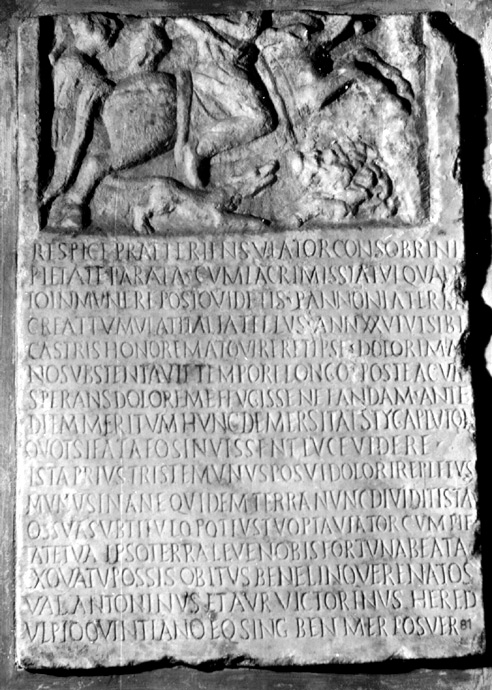
But occasionally, very rarely, we get to listen to voices that tell us of the other side of things – voices like that of the following inscribed poem that was discovered in the city of Rome and that commemorates one Ulpius Quintianus (CIL VI 32808 cf. p. 3385 = CLE 474):

Respice praeteriens, uiator, consobrini
pietate parata: cum lacrimis statui, quan-
to in munere posto uidetis. Pannonia terra
creat, tumulat Italia tellus ann(is) XXVI. ut sibi
castris honorem atquireret ipse, dolori ma[g]-
no substentauit tempore longo. postea cum
sperans dolorem effugisse nefandam, ante
diem meritum hunc demersit at Styga Pluton.
quotsi fata eo sinuissent luce uidere,
ista prius triste munus posui<sset> dolori repletus,
munus inane quidem. terra nunc diuidit ista
ossua sub titulo potius. tu opta, uiator, cum pie-
tate tua ipso terra leue, nobis fortuna beata,
ex qua tu possis obitus bene linquere natos.
Val(erius) Antoninus et Aur(elius) Victorinus hered(es)
Vlpio Quintiano eq(uiti) sing(ulari) ben(e) mer(enti) posuer(unt).

Behold as you pass by, traveller, the offerings made by a cousin’s dutifulness.

Under tears I erected what you see placed here as an offering.

Pannonian land begot, Italian land buries him at the age of 26. To acquire for himself by his own efforts the honour of having served the army, he endured great pain over a long time. Later, when he hoped to have escaped that unspeakable pain, Pluto plunged him into the underworld before his time was up.

Had the Fates allowed him to see the light, he himself, filled with pain, would have preceded me in the duty – an unrewarding duty, too! – to erect such [a memorial]. Now this soil spreads out his bones instead.

You, traveller, wish him, in your dutifulness, earth that rests lightly on him, (wish) us a blessed fate, so that you may safely relinquish your offspring after you died yourself.

Valerius Antoninus and Aurelius Victorinus, the heirs, had this set up for Ulpius Quintianus, Imperial Horseguard, who deserved it well.

From Pannonia (i. e. the area of modern-day Hungary) originally, Ulpius Quintianus – so his cousin tells us – tried to distinguish himself, seeking the honour of having served the army (ut sibi | castris honorem atquireret ipse).

One way of looking at this piece and its sculpture of an armed horseman, crushing the bodies of his defeated enemies with a ferociously barking dog to accompany him, would be simply to acknowledge and he was successful, too, having become a member of the equites singulares, the imperial horseguards. (Pannonians and Dacians were made members of this prestigious unit from the time of Septimius Severus, and soldiers who joined this unit, typically signing up for 25 years, were given Roman citizenship straight away.)

But in his striving for honour, according to the stone, Quintianus’ service in the Roman army mostly meant one thing for him: major pain, magnus dolor, endured for a long time (tempore longo) – and, in fact, unspeakable pain (dolor nefandus). While the stone does not tell us what had happened or what had caused the pain, it seems to be clear that Quintianus eventually resigned his service (postea … effugisse), in the hope that things would improve.

He hoped in vain, as he died shortly thereafter, far away from home, with his cousin as his closest family member around who would erect this stone in Quintianus’ honour.

Military service, pain, separation from one’s loved ones, and premature death – things we choose to remember on 11 November.

They were not alien to Rome’s armed forces – armed forces that are rather better known for their inflicting suffering and pain on countless peoples around the Mediterranean and beyond for centuries.

The true(r) picture is just very hard to spot indeed behind the layers of imperial propaganda and the deeply romanticising accounts of Rome’s imperial historians and inscriptions: they typically focus on the glorious generals and their outstanding centurions rather than those men who actually fought the battles for them, having joined the army for reasons romantic, honourable, or even entirely selfish – distinction, honour, glory, and citizenship.

In a world in which armed conflicts are increasingly taking the shape of an extended sick computer game, it is indeed important to remember that the first rule of war is that people get injured and die, and that pain, suffering, and death do not distinguish between right and wrong, justified and unjustified.

Our narratives may romanticise war and create dreams of honour, distinction, but reality will always remain brutal, painful, and best captured in casualty statistics: the very dichotomy that is at the heart of Quintianus’ epitaph as well as the very contradiction that is at the heart of our nations’ luring young people into military service and then leaving them and their families without necessary means and support.

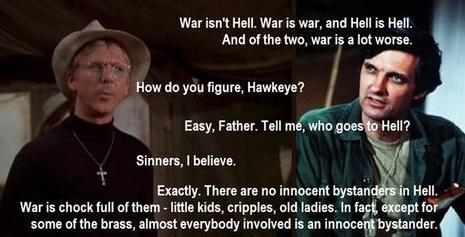
Image source: http://i.imgur.com/r0eGs0c.jpg?1.

Scene from M*A*S*H. – Image source: http://i.imgur.com/r0eGs0c.jpg?1.

And while we are in the remembering business: let us not forget all the innocent bystanders of war – civilian victims, people who get injured and/or lose everything, refugees, widows and widowers, orphans . . .

They all are part of the human cost of war, and they all are worthy of our commemoration.

Posted in Carmina Epigraphica, Epigraphy, Poetry | Tagged , , , , , , , | 4 Comments

Fruit of the Doom: an Image of Life, Death, and Letting Go in Roman Poetry

fruit_skull_1

Fruit of doom (artist’s impression). – Image source: http://www.zeixs.com/wp-content/uploads/2012/03/fruit_skull_1.jpg.

Death has been on my mind lately, having recently learnt of the untimely passing of two of my colleagues at the University of Reading.

Whether death was imminent or came suddenly, whether it hits the old or the young – sensations of unpreparedness, abandon, and unfinished business are likely occur, coupled with feelings for those whose lives are changed more dramatically still than one’s own due to someone’s passing away.

Little does it seem to matter that death is inevitable, part of the human experience, part of who we are, and part of how we live our lives. Little does it seem to matter that death is constant part of my own research – not so much because Latin is regarded a dead language, but because funerary poetry is at the heart of my research into the Carmina Latina Epigraphica.

You live. You die. Nobody knows what comes after that (or, in fact, what lies before it). As simple as that.

Or is it?

One could be inclined, of course, simply to accept and to embrace this. The result might look a bit like the sobering conclusion provided by following poem from a tombstone from the city of Rome (CIL VI 22215 cf. p. 3527 = CLE 801):

M(arcus) Marius M(arci) l(ibertus) Sa[- – -]
M(arco) Mario M(arci) l(iberto) Th[- – -]
suo et Mariae M(arci) l(ibertae) Faus[- – -]
Rufo uitai consolata [- – -]
quid sumus aut loquimur uita est quid deniq[ue nostra,]
uel modo nobis cum uixit homo, nunc homo no[n est]:
stat lapis et nomen tantum, uestigia nulla.
quid quasi iam uita est, non
est quod quaerere cu[res].

Marcus Marius Sa…, freedman of Marcus, for his Marcus Marius Th…, freedman of Marcus, and Maria Faus…, freedwoman of Marcus … (to Rufus … life’s … consoled …)

Who we are or what we say that our life is at last
just as a man was living with us just now, and now he is no more:
the stone stands and his name alone; no further traces.
Just what exactly life is – that is nothing you wish to enquire about.

But then there is something deeply unsatisfactory about this – uestigia nulla, ‘no further traces’: was it really all in vain, was it really all without meaning, without consequence? Should we seek to create meaning where there was none before to make our existences bearable and even worthwhile?

Death – and unexpected, untimely death in particular – raises profound questions: questions for which there are no definitive answers.

There are many ways in which one may approach such questions, of course, ranging from despair to scientific investigation.

What we, as humans, appear to be craving most of all, however, in our quest for meaning and guidance, are images and narratives – meaning-laden, yet easily accessible, intuitive reflections of real-life experiences that provide structure and direction to what we cannot (or do refuse to) otherwise fathom.

Such images and narratives are likely to succeed in cases in which they match an obvious, common everyday life experience to some of life’s biggest questions of them all: questions in which discrepancies between ‘academic’, philosophical responses on the one hand and popular wisdom on the other hand are especially noticeable.

A particularly interesting example for this can be seen in the context of the question ‘why do people die before old age?’ – a scenario, in which the sensation of ‘unfinished business’ prevails and in which an unjust, greedy fate receives many a scolding.

A striking verbal image, however, may provide a rather different perspective on matters, as the following poem suggests (CLE 1543; Rome):

Meam amice ne doleas sortem:
moriendum fuit,
sic sunt hominum fata,
sicut in arbore poma
immatura cadunt
et matura leguntur.

My fate, dear friend, mourn not: I had to die. That’s our human fate, just like on a tree fruits either tumble to the ground before their time has come or get collected when ripe.

There are two ways, the poem suggests, in which fruits – as a metaphor for human fate – will abandon the nourishing tree of life: either they tumble before ripe (immatura cadunt), or they will get collected (whether still on their branches or not) when the right time has come (matura leguntur).

This is usually the point where people say: ‘but that’s a commonplace, something from a textbook for the composition of inscribed funerary verse – it has been discovered in many places across the Roman Empire’. Nothing could be further from the truth. Yes, the image is a familiar one. But not only do we not have any credible evidence for the existence of such pattern books: we also have no reason to believe that the surviving instances for the use of this verbal image are interchangeable or even remotely the same.

Images, verbal or otherwise, commonplace or not, are surprisingly adaptable and accommodating – and every single onlooker will focus on what resonates most with their own experience.

Also from the city of Rome, just as the previous example, comes the following inscription (CIL VI 7574 cf. p. 3431 = CLE 1490):

– – – – – –
[- – -]RA[- – -]IA is quo modo
mala in arbore pendunt,
sic corpora nostra
aut matura cadunt aut
cito acerva ruunt.
Domatius Tiras
filiae dulcissimae.

. . . just in the same way that apples are hanging in a tree, thus our bodies either tumble to the ground when ripe or plummet to the ground quickly, unripe still. Domatius Tiras for his sweetest daughter.

At first glance, this expresses the exact same sentiment, through which a father, Domatius Tiras, apparently tried to console himself over the loss of his daughter. But there are noticeable differences. Not only were the poma (fruits) replaced with the more specific mala (apples); it is no longer a story about human fata, fates, but one about human bodies (corpora). Moreover, it is not about harvest and reaping of fruits (leguntur in the previous inscription), but one of their general falling down, either when ripe (matura) or, all too soon, while still unripe and unpalatable (acerva ~ acerba).

The differences may be deemed small – but they open up an opportunity to expand the fruit-related imagery, as acerba, denoting a form of being unpalatable commonly through bitterness, is a quality that in Latin is very commonly being associated with mors, death: mors acerba is among the most common figures of speeches in Latin funerary inscriptions.

Slightly different still, the image employed in a verse inscription from Cordoba in Spain (CIL II ed. alt./7.567; image here):

[D(is) M(anibus)] s(acrum)
[- – -] an(norum) XVIIII
[- – – h(ic)] s(ita?) e(st) s(it) t(ibi) t(erra) l(evis).
[doleas tu qu]i stas et releges titu-
[lum monu]menti mei qu(a)e XVIII anno
[iam finito] dulcissimae matris meae
[gaudium e]xcidi animo. et noli do-
[lere mate]r: (?) moriendum fuit sic
[ut sunt pom]a sic et corpora nostra
[aut matu]ra cadunt aut nimis
[acerba r]uunt.

Sacred to the Spirits of the Departed.

. . . , 19 years old, lies buried here. May earth rest lightly on you.

May you, who stands here and reads out my memorial’s inscription, feel the pain: having just finished my 18th year, I cut joy out of my sweetest mother’s heart. Do not be in pain, mother: I had to die: as if they are fruits, thus our bodies too either tumble to the ground when ripe or plummet, all too unripe still.

In this case, it is no longer just the similarity of the action (dangling, dropping) that provides the comparison between fruit (or apple) and human body (or human fate), but the human body is now declared to be tantamount to a fruit (sic ut sunt poma), therefore following the same principles of falling down at some point, whether when ripe or before that.

Moriendum fuit, I had to die – an unavoidable necessity, expressed before the image itself is introduced, just as in the following poem from Lucca in Etruria (CIL XI 7024 = CLE 1542):

D(is) M(anibus)
Nymphes.
Achelous et Heorte
filiae dulcissimae.
have.
tu [hic q]ui [stas atque spectas] monimentum
meum, [aspice quam indign]e sit data
vita m[ihi. quinque] annos
sui[- – – pare]ntes.
sextu[m annum insce]ndens
anim[am deposui mea]m.
nolite no[s dolere, paren]tes: mori-
endum fuit. pro[pe]rav[i]t aeta(s). Fatus
hoc voluit meus. sic quomodo mala
in arbore pendent si(c) corpora nostra
aut matura cadunt aut cit(o) acerba [r]uunt.
te, lapis, optestor leviter super ossa [re]sidas,
ni tenerae aetati tu [ve]lis gravis.
vale.

To the Spirits of the Departed of Nymphe. Achelous and Heorte (sc. had this made) for their sweetest daugther.

Greetings!

You, who stand here and look at my memorial, behold how undignified a life was given to me. For five years . . . the parents. As I was approaching the sixth year, I departed from my life. Do not vex yourselves, parents: I had to die. My lifetime was rushed. My fate desired this. Thus, how apples hang in a tree, thus our bodies either tumble to the ground when ripe or, all too quickly, they plummet, unripe still.

I ask you, stone, to rest lightly above my bones, lest you wish to be a heavy burden to a tender age.

Farewell!

The phrasing in the three aforementioned cases contrast cadere (‘tumble to the ground’) and ruere (‘plummet’). Both words denote the fruit’s downward movement from the branch to the ground. What exactly is the distinction? In the Digests, there is an interesting passage that might help to understand (Dig. 39.2.43.pr.6):

non videri sibi ruere, quod aut vento aut omnino aliqua vi extrinsecus admota caderet, sed quod ipsum per se concideret.

An object does not appear to ruere (‘to plummet’) when it drops (cadere, ‘tumble to the ground’) either through the wind or altogether driven by some other external force, but (sc. it does so) when it collapses (concidere) of its own accord.

The distinction, though from a different context, may, in fact, be important: when ripe (matura), fruits will come off easily e. g. by wind; when unripe still (immatura, acerba), there would appear to be some internal cause for the sudden, unexpected drop – quod ipsum per se concideret, as the Digests put it.

This maps on to a passage from Cicero’s treatise Cato Maior on old age, where Cato is represented as saying the following (Cic. Cato mai. 71, transl. W. A. Falconer):

Itaque adulescentes mihi mori sic videntur, ut cum aquae multitudine flammae vis opprimitur, senes autem sic, ut cum sua sponte nulla adhibita vi consumptus ignis exstinguitur; et quasi poma ex arboribus, cruda si sunt, vix evelluntur, si matura et cocta, decidunt, sic vitam adulescentibus vis aufert, senibus maturitas; quae quidem mihi tam iucunda est, ut, quo propius ad mortem accedam, quasi terram videre videar aliquandoque in portum ex longa navigatione esse venturus.

Therefore, when the young die I am reminded of a strong flame extinguished by a torrent; but when old men die it is as if a fire had gone out without the use of force and of its own accord, after the fuel had been consumed; and, just as apples [a judicious translation; the Latin has, in fact, poma, fruits] when they are green are with difficulty plucked from the tree, but when ripe and mellow fall of themselves, so, with the young, death comes as a result of force, while with the old it is the result of ripeness. To me, indeed, the thought of this ‘ripeness’ for death is so pleasant, that the nearer I approach death the more I feel like one who is in sight of land at last and is about to anchor in his home port after a long voyage.

Ripeness for consumption, re-conceptualised by Cicero’s Cato as a reassuring thought for old age, is something that inspires little hope in those who think of themselves (or their beloved) as far away from that age still; Cicero’s Cato offers advice to those who are rather closer to old age than those who got commemorated through the aforementioned memorials.

In a way then, those who chose the sentiment and its imagery for those memorials and developed it further, thinking it through, noticing that death does not only come to those who are old, and expanding the image accordingly along the lines suggested by nature herself. There is not just vis, force, alone that may cause unripe fruits to plummet: it may be a quality of the fruits themselves, whether or not determined by fate, that initiates their untimely fall from the nourishing tree.

Thus far, it seemed logical to assume that the tree itself, with its fruit, is a general, unspecific provider of life to everyone alike – whether they die young or old. But it is possible to push the imagery even further still. As early as in the Iliad, the image of the (family) tree has been used – not with reference to the fruit it bears, but with regard to its ever-changing foliage, as an image for the many subsequent generations that make a family’s lineage (Il. 6.144–9; transl. A. T. Murray):

τὸν δ᾽ αὖθ᾽ Ἱππολόχοιο προσηύδα φαίδιμος υἱός:
‘Τυδεΐδη μεγάθυμε τί ἢ γενεὴν ἐρεείνεις;
οἵη περ φύλλων γενεὴ τοίη δὲ καὶ ἀνδρῶν.
φύλλα τὰ μέν τ᾽ ἄνεμος χαμάδις χέει, ἄλλα δέ θ᾽ ὕλη
τηλεθόωσα φύει, ἔαρος δ᾽ ἐπιγίγνεται ὥρη:
ὣς ἀνδρῶν γενεὴ ἣ μὲν φύει ἣ δ᾽ ἀπολήγει.

Then spake to him the glorious son of Hippolochus: ‘Great-souled son of Tydeus, wherefore inquirest thou of my lineage? Even as are the generations of leaves, such are those also of men. As for the leaves, the wind scattereth some upon the earth, but the forest, as it bourgeons, putteth forth others when the season of spring is come; even so of men one generation springeth up and another passeth away.’

But what if we ourselves were to be the tree in this ever-changing, ever-shifting image . . . ?

The author of the stoic treatise De remediis fortuitorum (‘On remedies against happenstance’), sometimes assigned to the younger Seneca, advises in the case of child-loss without any display of gratuitous kindness (Rem. fort. 13.1–3):

‘Amisi liberos.’ Stultus es, qui defles mortem mortalium. quid istic aut novum aut mirum est? quam rara est sine isto casu domus? Quid, si infelicem voces arborem, quod stante ipsa cadunt poma? et hic tuus fructus est. Nemo extra ictum vulneris positus est: ducuntur ex plebeia domo inmatura funera, ducuntur et ex regia. Non est idem fati ordo, qui et aetatis. non quomodo quisque venit, emittitur. quid hic tamen est, quod indigneris? quid contra exspectationem tuam evenit? periere perituri. ‘sed ego illos superstites optaveram.’ sed hoc nemo tibi promiserat.

‘I lost my children.’ You are stupid, as you weep over the death of mortals. What is new or strange here? How rare is a household without such an incident! What if you were to call a tree ill-omened, as its fruits tumble to the ground while itself still stands? And this is your fruit! No one is above the blow of such a wound: there are premature burials in a plebeian household, and they exist in royal ones as well. Fate does not form the same orderly queue as does age. One does not get to leave in the same way one arrived. What is it anyway that you take offence with? What happened against what you were expecting? Those who were to die … they died. ‘But I had hoped that they would outlive me.’ But no one promised you that!

Harsh words, no doubt – emphasising the supreme rule of order as established by fatum, fate (rather than one established by one’s date of birth). This recurs in a poem from Aix-en-Provence commemorating a physician (CIL XII 533 cf. p. 814 = CLE 465; images here):

Paulo siste gradum, iuvenis
pie, quaeso, viator, ut mea per
titulum noris sic invida fata. uno
minus quam bis denos ego vixi per ann(o)s,
integer innocuus semper pia mente
probatus, qui docili lusu iuvenum
bene doctus harenis pulcher et ille fui
variis circumdatus armis. saepe feras lusi,
medicus tamen is quoque vixi et comes
ursaris, comes his qui victima(m) sacris
caedere saepe solent et qui novo tempore
veris floribus intextis refovent
simulacra deorum. nomen si quaeris
titulus tibi vera fatetur:
Sex(tus) Iul(ius) Felicissimus.
Sex(tus) Iulius Felix
alumno incompara[bili et]
Felicitas f[ec(erunt)]. ||

Tu quicumque legis titulum
ferale(m) sepulti,
qui fuerim, quae vota mihi,
quae gloria disce:
bis denos vixi depletis
mensibus annos,
[e]t virtute potens et pulcher
flore iuventae
[e]t qui praefferrer (!) populi
laudantis amore.
[q]uit mea damna doles? fati
non vincitur ordo.
[res] hominum sic sunt ut
[citre]a (?) poma:
[aut matur]a cadunt aut
[immatura] leguntur.

Stall your travels a little, dutiful young man, I ask you, wayfarer, so that you get to know, through my inscription, just how invidious my fate was. I lived for one fewer than twenty years, unharmed, without a fault, always under the guidance of a dutiful mind – I was the beautiful one, well taught in the arena through the skillful game of the young, also clad in varying armour. Often I challenged wild beasts, and yet I led a life as a physician as well, joining the bear-baiters also, and accompanying those who usually to slay the beasts for sacrifices and to those who during the time of a new spring redecorate the statues of the gods with interwoven flowers. If you ask my name, the inscription will reveal it truthfully: Sextus Iulius Felicissimus. Sextus Iulius Felix and Felicitas had this made for their incomparable foster-child.

You, whoever you read this funerary inscription of this deceased, learn who I was, what my fate was, and in what honour I was held: I lived for twenty years, with just a few months short of that, mighty in bravery, beautiful in the flower of my youth, and a favourite in the love of the people and their praise. Why does my loss cause you pains? One cannot overcome the order imposed by fate. Human affairs are just like those golden fruits: either they tumble to the ground when ripe or they get collected before.

What at first glance may seem like yet another manifestation of the same sentiment is, however, its exact inversion: the poem from Rome that was used as a starting point for our considerations, above, put it in the opposite order:

sic sunt hominum fata,
sicut in arbore poma
immatura cadunt
et matura leguntur.

That’s our human fate, just like on a tree fruits either tumble to the ground before their time has come or get collected when ripe.

How come?

There are three possible explanations:

  • The (alleged) inversion may be a mere oversight of the scholar who restored the text (one might just as well supply something along the lines of [immatur]a cadunt aut | [iam matura] leguntur, maintaining the established order), or
  • the writers had different types of fruit in mind, or
  • the writers had different approaches to what a premature death meant in the grander scheme of things: forceful removal from the stem (in the case of the inscription from Rome) vs. careful selection at the time of one’s physical peak (in the case of the inscription from Aix-en-Provence), before, past one’s prime, the only way was down.

The last explanation may well be the most likely one, connecting this text with the well-known principle that those whom the gods love die young.

Verbal imagery, however close it gets to resembling uninspired commonplace thinking, can be surprisingly flexible and accommodating, depending on how far authors are prepared to push their metaphors.

The verbal image that draws on the observation of varied behaviours of fruits on a tree, employed as a means to explain how it is that some people die sooner than others, is no exception to that.

Does it help us to address, or even to overcome, the sensations of unpreparedness, abandon, and unfinished business that emerge when confronted with death (and premature death in particular)? And how much of a difference does it make whether one gets to read about it in the context of a philosophical treatise or adopted as a motto by someone who personally experienced such loss?

You tell me.

Posted in Carmina Epigraphica, Epigraphy, Poetry | Tagged , , , , , , , , , , , | 2 Comments

Howdy, Stranger . . . !

As the current debate over refugees, migrants, EU-wide quotas, and immigration-vs-national identity strikes increasingly bizarre, shrill, and discordant notes, I recently had the pleasure to contemplate in somewhat greater depth a remarkable funerary inscription from Aquileia in north-east Italy:

CLE 2199. – Image source: http://db.edcs.eu/epigr/bilder.php?bild=$InscrAqu_03_03180.jpg.

CLE 2199. – Image source here.

The inscription’s text, engraved on a medium-sized marble panel (66 x 47 cm) that would appear to date to the fifth century A. D., a text that shows several dactylic runs without ever altogether amounting to a poem written in hexameters, reads as follows (CIL V 1703 = CLE 1878 adn. = CLE 2199 = ILCV 4813a):

Hic iacet Restutus peleger in pace fidelis.
ex Africa venit ut istam urbe(m) videret.
hec invisa tellus istum voluit corpus habe-
re. hic quo natus fuerat optans erat illo
reverti. id magis crudelius ut nullum suo-
rumque videret. invenerat satis amplius
quam suos ipse parentes. nec iam erat exter, si-
cut provenit ut esset ab ipsis. sed quo fata vocant
nullus resistere possit. huic sodalicium Floren-
sium contra votum fecerunt.

Here lies, faithful in peace, Restutus, a foreigner.

He came from Africa, so as to visit that city. This spiteful soil desired to hold on to him as a corpse. He held the desire to return there from where he hailed. The situation was made a lot worse still by the fact that he did not get to see any of his family members again. Yet he had got to meet rather more still than his parents (sc. here): no longer was he an alien, but he was to live as if he was an offspring of ourselves. Yet, no one may resist (sc. going) where fate is calling.

For him the sodalicium Florensium had this made, against their vow.

The inscription honours one Restutus who is described as peleger, which has been (sufficiently credibly) explained as a variant of Classical peregrinus (cf. Ital. ‘pellegrino’, Engl. ‘pilgrim’) – suggesting that he was a foreigner of sorts at least to this part of the Roman Empire (without necessarily implying any specific legal status to the man or even suggesting that he was not a Roman citizen: in fact, the name that he is given in this inscription, Restutus, is perfectly Roman and reasonably well attested).

In addition to that, the opening line also suggests that Restutus was of Christian faith – the phrase in pace fidelis is an unambiguous giveaway for that.

Restutus’ origin was in Africa – not very specific information, of course, though one must wonder if this refers to the province of Africa proconsularis more specifically, where the name Restutus is well attested otherwise as well.

Why did he come to Aquileia? The inscription is not altogether clear about that – all it says is that he desired to see ista urbs, ‘that city’: was that city Aquileia? Or Rome, in fact? (And if the latter, why would he take such a detour from Africa, going via Aquileia? Was this part of his pilgrimage?)

The word used for the pilgrimage-related context of Restutus’ travel is videre, ‘to visit’ – a paradigm that is immediately picked up in the next sentence in the term invisus, literally ‘un-seen’, denoting something that conveys an evil, spiteful gaze: the tellus, the soil of Aquileia, that had its own plans for Restutus – to hang on to him forever … as a corpse (assuming that istum is, in fact, a reference to Restutus, and not an alternative form for istud, which would give a slightly different nuance to the text: ‘to hold on to that body’).

Restutus appears to have dwelled in Aquileia for an extended period of time – a period of time, however, during which he never gave up hope of returning home. The intensity of his desire to return is expressed in the phrase optans erat, ‘he held the desire’, as in ‘he was wishing (all the time)’ – heightening the immediacy of the phrase vis-a-vis the more common way of expressing an action that went on for a longer period of time in Latin: optabat.

Quite apart from Restutus’ inability to return home, what appears to have tormented him in particular (note the hyper-characterisation of his pains in the double comparative magis crudelius!) was the physical separation from his family (expressed in an ut-clause rather than a Classically elegant accusative-cum-infinitive: times for prescriptive grammar rules are a-changin’!).

But what was magis crudelius, more crueller (if you will), was also a blessing in a way (or so the inscription wishes to make us believe): for Restutus found satis amplius (‘sufficiently more’, quite literally – another hyper-characterisation) in terms of a replacement at Aquileia for what he had been forced to leave behind in Africa: his parents!

No longer was he regarded an outsider, an alien: nec iam erat exter – he was treated as if he was an offspring of the community where he was grounded against his plans, as the rather convoluted phrase sicut provenit ut esset ab ipsis, barely rendered as ‘he was to live as if he was an offspring of ourselves’ is trying to explain to its readership.

But no one can escape death – and so the (otherwise unknown) sodalicium Florensium (which could be anything from a burial society to a religious community of some sort) decided to do the decent thing, much against what they had hoped to do: they organised his burial and gave him this monument contra votum (‘against their vow’, a phrase that is a not altogether uncommon expression in contexts in which friends rather than family members took care of a burial).

One may easily overlook this text as one of hundreds of thousands of Latin inscriptions – as one of thousands of poetic and poeticising Latin poems on tombstones.

Doing so, however, means overlooking a text that, more so than most other ancient Latin texts, captures perfectly the worries of staggering numbers of displaced people (back then just as much as nowadays): the fear of dying far away from one’s home, without any hope of seeing one’s native soil and one’s family again; the fear of permanently remaining an alien, without a domicile, without a network of friends, without being part of a community.

The sodalicium Florensium, whoever they were, claim to have made a difference in the life of Restutus – and they have made a difference beyond the time of his life, in the commemoration of his death.

They gave him dignity in a foreign place, and they claim to have given him the same support, and more, that he could have expected from his own parents, so that he no longer had to feel like an alien – he had become one of them (and still he always desired to go home!).

What a beautiful statement to make, and what a beautiful way to be commemorated.

Will our own communities be able to write similarly touching, unquestioningly welcoming statements on the tombstones of those foreigners who die far away from their home and family?

Posted in Carmina Epigraphica, Epigraphy, Poetry | Tagged , , , , , , , , , , , | 65 Comments