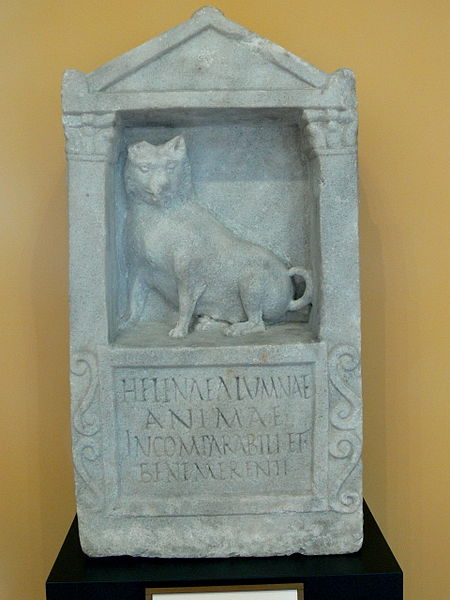
A couple of months ago, I wrote about the poem for a Roman lap-dog named Margarita (‘Pearl’), whose splendid inscription I managed to visit in the British museum.
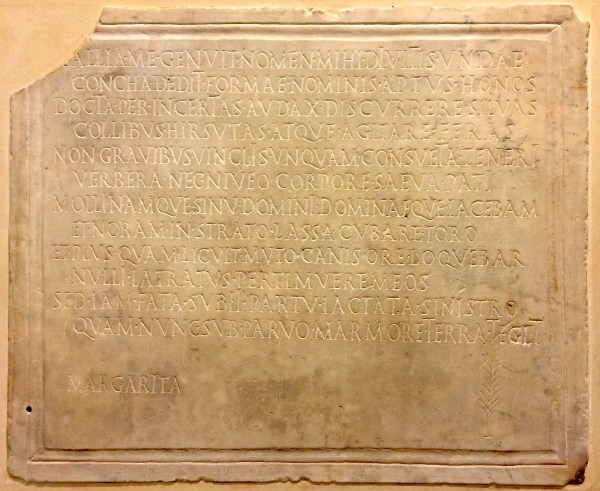
Epitaph for Margarita. – Photo: PK (2015).
The text of the inscription – moving, personal, and affectionate – has been on my mind ever since.
Several weeks ago, I revisited the inscription, when I became increasingly intrigued by the poem’s explicit reference to the absence of violence and cruelty from Margarita’s well-protected, carefree life.
There is more to be explored, however.
An aspect that I had not thought through before, but that I was prompted to consider more recently, is related to the poem’s conclusion: a conclusion that I, clearly lacking empathy and delicacy of feeling, did not find all that remarkable at the time:
sed iam fata subii partu iactata sinistro
quam nunc sub parvo marmore terra tegit.
But I have already met my fate, stricken down during ill-omened whelping – me, whom earth now covers under this little marble plaque.
Death – even death under particularly moving circumstances – is such a ubiquitous feature of the Latin verse inscriptions that it, at times, seems to cause a certain numbness in my brain (in addition to its regular numbness, that is).
From an unfeeling academic perspective, there are two things that are clear about a mother’s death in childbirth: first, it was a significantly more common occurrence in the ancient world than it is now in modern societies; secondly, for all its violently traumatic potential, death in childbirth is a prime recurrent motive of story-telling (ancient and modern) – providing a narrative that functions as a feminine counterpart to the theme of paternal abandonment.
From a caring, humane, and plain human perspective, of course, it is hard to think of a scenario in which the long-awaited joys of young parenthood and the sheer horrors of bereavement and helplessness would be intertwined to an even higher degree.
There are several Latin inscriptions that allow a glimpse into this nightmarish scenario.
An inscription from Salona/Solin in Dalmatia, for example, mentions the pains of what turned out to be a deadly, unsuccessful birth after all (CIL III 2267 cf. p. 2260):
D(is) M(anibus). | Candidae coniugi bene me|renti ann(orum) p(lus) m(inus) XXX qu(a)e me|cum vixit ann(os) p(lus) m(inus) VII | qu(a)e est cruciata ut pari|ret diebus IIII et non pe|perit et est ita vita fu|ncta. Iustus conser(vus) p(osuit).
To the Spirits of the Departed. For Candida, my most deserving wife, aged approximately 30 years, who lived with me for approximately 7 years, who was tortured in her attempt to give birth for 4 days and did not give birth and thus died. Iustus, her fellow slave, erected (sc. this memorial).
Equally heartbreaking is the story recorded in a memorial from Sarnum/Sarno, dedicated to a woman named Orestilla by her husband, who also mentions that he does so against what he had promised the gods in case of their not answering his prayers, contra votum (CIL X 1112 = ILCV 4363):
Felix Orestilla qu(a)e | feliciter Crispino Euodio | nupsit puerperio vix | educta infeliciter obiit. | maritus pientiss(imus) ucsori s(uo) | b(ene) m(erenti) fecit | contra votum.
Fortunate Orestilla [rather than Felix Orestilla], who, under good fortune, was married to Crispinus Euodius, died unfortunately, barely emerged from childbirth. Her most dutiful husband had this made for his well deserving wife, even though his prayers were not answered.
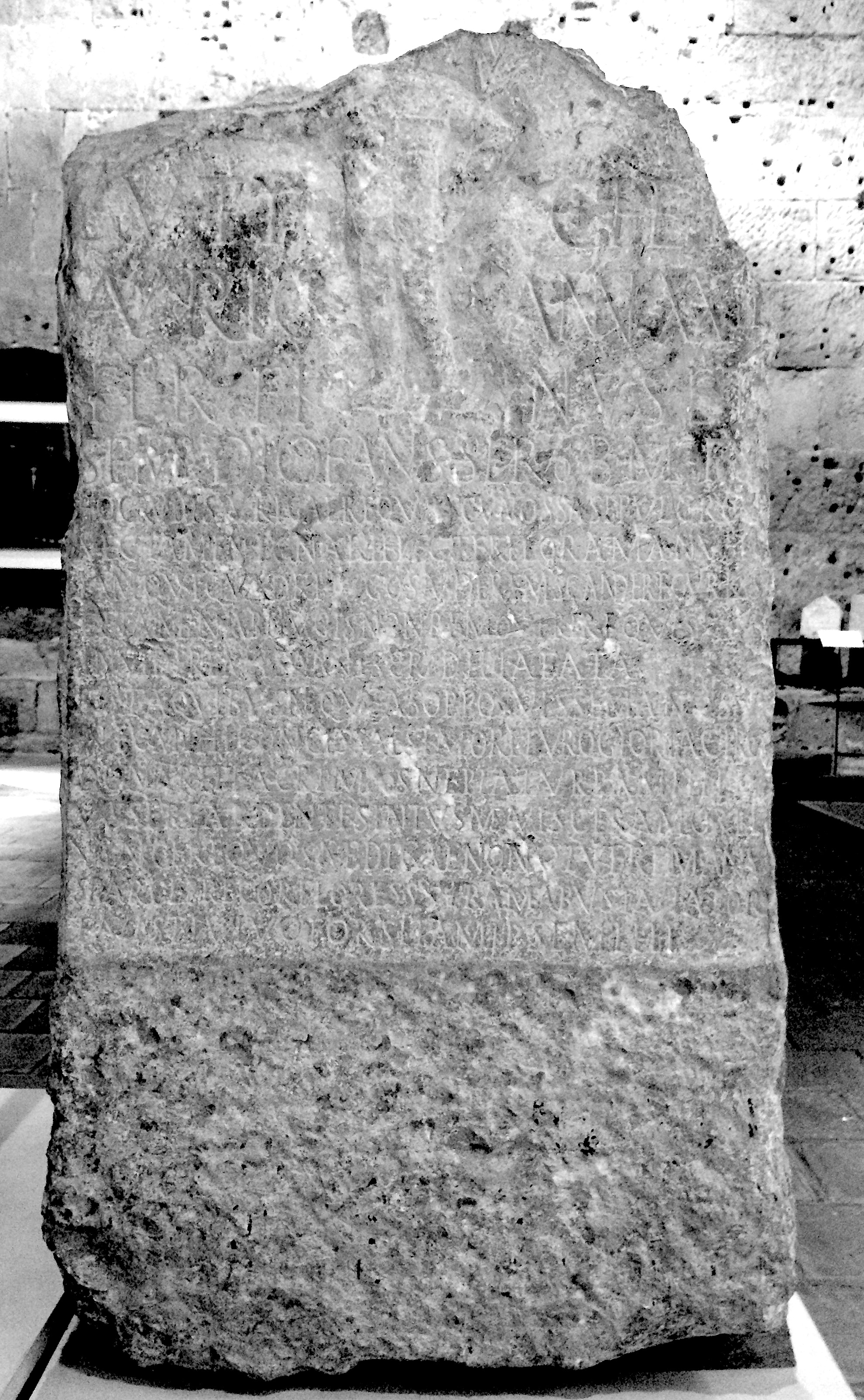
A similar story is known for one Aeturnia Zotica from Ankara, which expressly refers to the concept of maternal abandonment (Galatia; CIL III 272 cf. p. 975 = III 6759 = ILS 1914; image available here):
D(is) M(anibus) (sa)c(rum). | Aeturniae Zotic(a)e | Annius Flavianus | dec(urialis) lictor Fufid(i) | Pollionis leg(ati) Gal(atiae) | coniugi b(ene) m(erenti). vixit | ann(is) XV mens(ibus) V | dieb(us) XVIII. quae | partu primo post | diem XVI relicto | filio decessit.
Sacred to the Spirits of the Departed. For Aeturnia Zotica: Annius Flavianus, decurialis lictor of Fufidius Pollio, legate of Galatia, for his well deserving wife. She lived 15 years, 5 months, 18 days. She died 15 days after her first childbirth, with the boy left behind.
While adding a sense of pain, tragedy, and helplessness to their account, the texts of these three inscriptions remain relatively factual, down to the level of the (presumably) factual listing of the number of days that were involved when the incidents unfolded.
There are not only prosaic accounts of such experiences, however: poetic forms of expression have also been sought – offering the advantages of refuge and consolation in artifice and a world in which trauma becomes controllable through narrativisation and the incomprehensible becomes fathomable through a supporting framework of familiar imagery.
Only very rarely poeticising approaches remain as short and factual as the following piece from Salaria/Ubeda la Vieja (Hispania citerior; HEp 4.495 = HEp 5.526 = AE 1991.1076 = AE 1994.1060):
Gemina D(ecimi) Pu-
blici Subici ser(va) an(norum)
XXV h(ic) s(ita) e(st). obi(i)t in
partu. C(aius) Aerariu[s l(ibertus)]
posuit [ci]ppum. pa-
[rca fuer]as. mihi si qu[a]
inferi sapent vi m[e]
abduceres. si me
amasti fac abd[u]-
cas. s(it) t(ibi) t(erra) l(evis).
Gemina, slave of Decimus Publicius Subicius, aged 25, is buried here. She died in childbirth. Gaius Aerarius, freedman, had this cippus erected. You were thrifty. If the gods of the underworld had any reason towards me, you’d take me away by force. If you loved me, have me taken away. May earth rest light on you.
It feels as though Gemina’s thriftiness was depicted in the wording of the text itself (a form of verbal artistry known from other instances as well), allowing little space for mourning.
This, however, is an exception.
The single most remarkable case (to my mind anyway) is a heavily damaged, but plausibly restored inscription from Salona/Solin in Dalmatia, which expresses the trauma and the pain in all its undiluted force (CIL III 9632 cf. p. 2326 = CLE 1438a-b = CLE 2133a = ILCV 2368 add. = ILJug 3.2420):
[Heu, q]uamquam las[si cunctamur]
sca[lpere versus],
utpote qui [maesto funere con]-
[ficimur] idcircoque [omni luctus renovatur in]
ictu,
audemus tamen haec e[dere cum]
gemitu
ex iu[- – -]
– – – – – –
[- – – g]e[n]itam.
[huic placidam requiem tri]buat deus omni-
[pote]ns rex [insontique animae s]it bene post obitum.
[multa tulit nimis adversi]s incommoda rebus
[infelix, misero e]st fine perempta quoq(ue)
[quadraginta a]nnos postquam trans-
[egit in aevo].
[fu]nesto gravis heu triste puerperio
nequivit miserum partu depromere fetu(m)
hausta qui nondum luce peremptus abiit,
adque ita tum geminas g[e]mino cum corpore
praeceps
laetum (!) ferali [transtu]lit hora an[imas].
at nos maerentes coniux natique
generque
carmen cum lacrim[is] hoc tibi [condidimus].
Woe is us! Even though, exhausted, we hesitate to inscribe these verses (for, as we are moved by this sad funeral, our sadness is thus renewed with every stroke [sc. of the hammer/chisel]!), we still dare to make this public, together with our lamentation … [several words missing here] … daughter.
May God, the all-powerful king, grant her peaceful rest, and may he be well-disposed towards her innocent soul after her death.
Ill-fated, she took many inconveniences in an overly harsh world, and she died a wretched death as well, after she had survived forty years in her life. When she was pregnant, woe is us! the sadness!, in calamitous childbirth she was unable to bring forth, through giving birth, the wretched offspring, who left, dead, before he even managed to see the light, and thus a rushed death in a funereal hour took double souls with a doubled body.
But we, the husband and the children and the son-in-law, give you this poem in mourning, together with our tears.
Embedded in opening and closing lines that refer to the artifice of an inscribed poem, likening the forceful process of stone-carving to inflicting pain on oneself, and divided by a central invocation of God the Almighty, the poem reflects on the daughter’s life (fragmented) and the special circumstances of her death.
The deceased’s suffering throughout her lifetime culminates in an extraordinary death by childbirth. The delivery (puerperium) is described as funestum – hinting death and burial, a grotesque, outrageous oxymoron in conjunction with the process of birth. A similar antithesis is contained in the notion that the offspring died before he even got to see the light of day.
A particular verbal gem is to be seen in the expression geminas g[e]mino cum corpore … animas, two souls and two bodies were snatched away, but while the two souls are clearly separate (in the plural), the body is still perceived as one (in the singular), and thus described as doubled.
A similar idea is expressed in a poem from Tusculum, dating to the first century A. D., driving the idea a little further still (CIL XIV 2737 = CLE 1297):
Rhanidi Sulpiciae l(ibertae)
delicio.
nata brevi spatio, partu subiecta nec ante
testatur busto tristia fata Rhan<i>s.
namque bis octonos nondum compleverat annos
et rapta est vitae, rapta puerperio.
p<ar>entis tumulus duo funera corpore in uno,
exequias geminas nunc cinis unus habet. ||
Sulpicia Trionis l(iberta)
Rhanis
For Rhanis, freedwoman of Sulpicia, our delight.
Born only a short while ago, not accustomed to birth before, Rhanis bears witness to a sad fate on her pyre. For she had not yet completed sixteen years and was snatched away from her life, snatched away in childbirth.
This parent’s tomb contains two burials in a single body, one pile of ashes the remains of two.
Sulpicia Rhanis, freedwoman of (Sulpicia) Trio.
Who is to blame?
Just like its Tusculan counterpart, the poem from Salona/Solin doesn’t seem to ask that question. Life was harsh on the deceased, and she was ill-fated (infelix) – an attitude reflected in an inscription from Satafis/Ain el Kebira in the province of Mauretania Caesariensis (CIL VIII 20288 = CLE 1834 = ILCV 3436):
D(is) M(anibus) s(acrum).
Rusticeia
Matrona
v(ixit) a(nnos) XXV.
causa meae mortis partus fatu[mque malignum].
set tu desine flere mihi kariss[ime coniux]
[et] fil(ii) nostri serva com[munis amorem].
[- – – ad caeli] transivit spi[ritus astra]
[- – -] maritae [- – -].
Sacred to the Spirits of the Departed.
Rusticeia Matrona [or: the matron] lived 25 years.
The cause of my death were childbirth and spiteful fate. But you stop crying for me, my most beloved husband and pay heed to the love of our mutual son. My soul has gone to the stars in heaven [what follows cannot be translated/interpreted; all that remains visible is the word ‘wife’].
Those who were left behind in the inscription from Salona/Solin conceive themselves as having a hard time coming to terms with the incident: memory is painful, and the act of remembering re-opens wounds that are barely healing: the gift of the poem is coupled with the survivors’ mournful tears – perhaps hoping to find a means to contain and compartmentalise their pain in the future, after this act of duty and remembrance has been fulfilled.
Similar expressions of pain can be found in a poem that was discovered in the city of Rome, which, however, is rather less concerned with any attempts to reflect on the duality of life and death as well as on the tragic irony of finding the two juxtaposed: instead, it seeks refuge in art for art’s sake, as the poem itself eventually points out (CIL VI 28753 cf. p. 3536 = CLE 108 cf. p. 854; image available here):
Veturia Grata. ||
Vel nunc morando resta, qui perges iter,
Etiam dolentis casus adversos lege:
Trebius Basileus coniunx quae scripsi dolens,
Vt scire possis infra scripta pectoris.
Rerum bonarum (!) fuit haec ornata suis,
Innocua simplex quae numquam serbabit dolum,
Annos quae vixit XXI et mensibus VII
Genuitque ex me tres natos quos reliquit parbulos,
Repleta quartum utero mense octavo obit.
Attonitus capita nunc versorum inspice,
Titulum merentis oro perlegas libens:
Agnosces nomen coniugis Gratae meae.
Veturia Grata
Perhaps take a break now and rest, as you are about to make your journey, and read of the adverse turns of fate of someone who is in pain: I, Trebius Basileus have written this, in pain, so that you may learn the writings, below, straight from my heart.
She was decorated with her gifts of goodness, innocent, uncomplicated, who never planned deceit: she lived 21 years and 7 months and she gave birth to three little children of mine, which she left behind: she died, her uterus filled again, for the forth time, in the eighth month.
Thunderstruck now behold the beginnings of the lines, read willingly, I request, the inscription of someone who deserves it: you will learn the name of my dear wife [or, due to wordplay with the etymology of the name: my wife Grata].
Maternal death did not necessarily mean death of the child as well, as the following third-century inscription from Alba Fucens in Samnium shows (CIL IX 3968 = CLE 498):
D(is) M(anibus) [s(acrum)].
Aediae [- – -].
Haec tenet exanimam [tellus natalis, in urbe]
quae nupsit Roma, morbi [sed fraudibus atri]
post annos ueniens uisum La[ris arua paterni]
incidit infelixs pregnax, sa[luamque puellam]
enixa est misera acerbaq[ue decidit ipsa]
lugentesque suos miseros [cum prole reliquit]
et tulit Elysium uiginti e[t quattuor annis].
Eutyches et Hi[- – -].
Sacred to the Spirits of the Departed.
To Aedia …
This land, the land of birth, holds a deceased woman, who got married in the city of Rome, but, cheated by a dark illness, as she visited after years the realm of her paternal household, she died, ill-fated, pregnant: she, wretched, gave birth to a healthy girl, and bitterly she fell down dead, leaving her family, together with her offspring, in mourning, and she moved into the underworld aged twenty-four.
Eutyches and Hi…
Blaming the deceit of a ‘dark illness’ (morbus ater), Aedia’s relatives offer the narrative of a woman torn between her native land (Alba Fucens) and the city of Rome, where she married, letting her return to her homeland coincide with her death in high pregnancy – yet the child, a girl, could be saved and was healthy.
The proximity of exanimam (‘deceased woman’) and tellus natalis (‘land of birth’ – incidentally not just for Aedia, but also for her daughter!), if restored correctly, in the first line is rather striking.
The concept of maternal abandonment (again: if the text has been restored correctly!) features prominently, mixing expressions of pity (infelixs, ‘ill-fated’, misera, ‘wretched’) with imagery of deceit and bitterness (fraudibus, ‘cheated’, acerba, ‘bitterly’).
The most poignant expression of despair over maternal abandoment, however, can be found in an inscription from Carthage, commemorating Daphnis, a slave-girl who is presented as interfering with her master’s plans regarding her life on multiple levels (CIL VIII 24734 = CLE 2115 = ILTun 987; image available here):
Daphnis ego Hermetis coniunx sum libera facta;
cum dominus vellet primu(m) Hermes liber ut esset,
fato ego facta prior, fato ego rapta prior.
quae tuli quod gemui, gemitus viro saepe reliqui,
quae domino invito vitam dedi proxime nato.
nunc quis alet natum? quis vitae longa ministrat?
me Styga quod rapuit tam cito eni(m) a(d?) superos.
pia vixit annis XXV. h(ic) s(ita) e(st).
I, Daphnis, Hermes’ wife, was freed. While my master wanted to free Hermes first, I was made free before, by fate, I was snatched away before, by fate. By embracing what I mourned, I left my husband with frequent mourning, as I just very recently gave life to a son, against the wish of my master. Who will now feed the son? Who will cater for him for the duration of his life? For death snatched me so quickly to the heavenly gods.
She lived dutifully for 25 years. She is buried here.
The sense of realism behind this inscription – praising the deceased as dutiful (pia), yet demanding an answer to the question of who is supposed to take care of the boy whom the master did not want – may seem brutal. Then again, to the present day employers seem to have a keen interest in the question as to whether their employees intend to become parents, focusing on the economic cost (to them!) of the miracle of life and the need for childcare.
Margarita’s owners do not seem to have thought that way, which may suggest that the puppy (or puppies) did not survive either.
The main difference between the dog’s epitaph and all other texts that were presented here is, however, that Margarita’s owners were the only ones who, despite their loss, felt as though they could focus on the delightful time they got to spend with their canine companion – a facet conspicuously absent from all the poems presented here written for women, who tragically lost their lives in childbirth.
How come?
Turns out, Margarita, for all that humanising language used in her epitaph, was ‘just a dog’ after all.




 The Petrified Muse
You must be logged in to post a comment.