I see friends shaking hands, saying how do you do…

Last week’s blog post dealt with one of the more bizarre little incidents from the 2014 FIFA world cup – Luis Suárez’s biting of Giorgio Chiellini. An equally iconic scene of this year’s world cup, rather more amusing, was that moment when a FIFA official snubbed one of the referees by means of entirely ignoring the ref’s extended hand for a handshake:

http://www.youtube.com/watch?v=F–cHUtZf60

The referee handled this situation with grace and humour – and received his handshake after all.

Other failed attempts at shaking hands, however, have made it into the history books.

One such example is that of one Nebridius, a prefect who, according to Ammianus Marcellinus, was denied a handshake by the Emperor Julian (Amm. Marc. 21.5.12):

When these words of his were heard, the soldiers who were nearest to him were greatly enraged, and wished to kill him; but he threw himself at the feet of Julian, who shielded him with his cloak. Presently, when he returned to the palace, Nebridius appeared before him, threw himself at his feet as a suppliant, and entreated him to relieve his fears by giving him his right hand. Julian replied, “Will there be any conspicuous favour reserved for my own friends if you are allowed to touch my hand? However, depart in peace as you will.”

The idea of the handshake as an expression of friendship is a fairly universal one. In 1967, Louis Armstrong recorded the song What a wonderful world – a song that offered an idyllic, romanticised view of the world and its beauties for a time of political upheaval and civil unrest:

http://www.youtube.com/watch?v=E2VCwBzGdPM

In this song, Armstrong suggests that –

I see friends shaking hands, saying how do you do. They’re really saying, I love you.

Clasped Hands motive, Salt Lake Temple. – Image source: http://www.moroni10.com/lds/temple_tour/symbols/clasping-hands-motif.html.

Clasped Hands motive, Salt Lake Temple. – Image source: http://www.moroni10.com/lds/temple_tour/symbols/clasping-hands-motif.html.

Just how charged with meaning the handshake’s symbolism is, becomes clear when one considers its use more broadly, including in iconography.

A good example for that can is the Salt Lake Temple, the temple of the Church of Jesus Christ of Latter-Day Saints (LDS), more commonly known as the Mormons.

Each of this structure’s central towers displays a pair of clasped right hands, that are commonly interpreted as an invocation of the ‘clasped hands of fellowship’, as expressed in Galatians 2:9:

And when James and Cephas and John, who seemed to be pillars, perceived the grace that was given to me, they gave the right hand of fellowship to Barnabas and me, that we should go to the Gentiles and they to the circumcised.

Another interpretation of the symbolism of the clasped hands at the Salt Lake Temple, however, relates the same image to Jeremiah 31:32:

Not like the covenant that I made with their fathers on the day when I took them by the hand to bring them out of the land of Egypt, my covenant that they broke, though I was their husband, declares the Lord.

This is a rather different handclasp, of course – one in which the hands involved belong to entities of very unequal standing and power, creating a firm, oath-like bond between them.

Of course, just to be difficult, the two different types of handshakes cannot always be kept separate.

The current Wikipedia entry for ‘Women’s rights‘, for example, shows the following image of a Roman sculpture, in the collection of the National Roman Museum – Baths of Diocletian in Rome (accessed 30 June 2014).

The caption for this image on Wikipedia then goes on to explain that this is a –

Couple clasping hands in marriage, idealized by Romans as the building block of society and as a partnership of companions who work together to produce and rear children, manage everyday affairs, lead exemplary lives, and enjoy affection‘.

A romantic view, explaining the concept of a manus (= ‘hand’) marriage, yet strangely neglectful of the fact that in Roman marriages, too, there was, of course, a significant power imbalance, to the advantage of the male.

As a matter of fact, the clasped hands, the datae dext(e)rae in Latin, are a common part of Roman iconography, whenever it comes to bonds that are tied in relationships characterised by power imbalance.

The Latin term for such bonds, potentially sealed with a handshake, is fides – a term that eventually became the English word ‘faith’ (and thus continues to be used to describe a bond, a mutual relationship, between entities that are thought to be of unequal power).

The abstract concept of fides, when represented in Roman iconography, usually appears with the datae dext(e)rae. One such example, commemorating (or invoking) the fides exercituum (‘trust of the armies’), was issued under Vitellius, the short-lived Emperor of A. D. 69.

This can be filled with meaning even further when one considers literary references to the fides handshake – for example the agreement between Aeneas and King Latinus, mentioned in the first book of Livy’s work (Liv. 1.1.8):

When he heard that the men were Trojans, that their leader was Aeneas, the son of Anchises and Venus, that their city had been burnt, and that the homeless exiles were now looking for a place to settle in and build a city, he was so struck with the noble bearing of the men and their leader, and their readiness to accept alike either peace or war, that he gave his right hand as a solemn pledge of friendship for the future. A formal treaty was made between the leaders and mutual greetings exchanged between the armies.

Latinus extends his hospitality to the Trojan newcomers, foregoing alternative options as to how to welcome the foreign intruders of his territory.

This alternative interpretation of the handshake, focusing on the uneven spread of powers among those who shake their hands (or get coerced into doing so), is a fairly universal one.

An expression of that, in political iconography, could seen, for example, in the logo of the Socialist Unity Party of Germany (‘Sozialistische Einheitspartei Deutschlands’, SED).

The party’s symbol – clasped hands in front of a red flag – was designed to remind of the unification of the Communist Party (KPD) and the Social Democrats (SPD) into this new structure.

As a matter of fact, however, this unification of the two parties was anything but uncontroversial or entirely voluntary (certainly from the perspective of the Social Democrats).

Returning to Ammianus Marcellinus’ report, one may now understand that, very clearly, Nebridius and Julian applied fundamentally different interpretations of what a handshake, in public, in a charged environment (a ‘photo op’, as one would call it now), could mean.

Friends shaking hands. (Image capture from a recent promotional video of the University of Reading.)

Friends shaking hands. (Image capture from a recent promotional video of the University of Reading.)

For Nebridius it implied protection for him (as a suppliant/client) through Julian’s patronage. Julian, in turn, offered an interpretation of the handshake as an expression of friendship (not necessarily in the Roman meaning of the term, implying, again, patronage), reserved for special people in his life.

In the case of the FIFA referee, it was the opposite: clearly, the referee wanted to extend a friendly gesture, and this is why the official’s response came across as rude and snubbing. (A negative reading of the same incident would have to result in accusing the referee of making an attempt to curry favour with the official.)

The bottom line? Unlike in Louis Armstrong’s beautiful song, it is not only friends who can be seen shaking hands: any iconic display of a handshake must raise the question: are those who clasp hands here equals, or is this an attempt at forming a bond, forming a relationship with an unequal power balance?

Posted in Prose | Tagged , , , | 1 Comment

Love Bites

One of the more bizarre stories of the 2014 FIFA World Cup was the Luis Suárez biting incident: Uruguay’s striker, currently playing for Liverpool, bit Italy’s Giorgio Chiellini.

Suárez has a remarkable history of this peculiar behaviour:

http://www.youtube.com/watch?v=rh08-gMnIFY

Meanwhile, the incident has resulted in a record ban for Suárez as well as in a predictable stream of creative effusions on the internet.

Beyond a doubt, Suárez needs help of some sort (certainly not that of the media, though – or that of this blog, for that matter).

What could be the explanation for Suárez’s behaviour?

Was he just as eager as the young Alcibiades, perhaps, who, too, is reported to have bitten an opponent during sports (Plutarch, Alcibiades 2.1-2)?

φύσει δὲ πολλῶν ὄντων καὶ μεγάλων παθῶν ἐν αὐτῷ, τὸ φιλόνεικον ἰσχυρότατον ἦν καὶ τὸ φιλόπρωτον, ὡς δῆλόν ἐστι τοῖς παιδικοῖς ἀπομνημονεύμασιν. ἐν μὲν γὰρ τῷ παλαίειν πιεζούμενος, ὑπὲρ τοῦ μὴ πεσεῖν ἀναγαγὼν πρὸς τὸ στόμα τὰ ἅμματα τοῦ πιεζοῦντος, οἷος ἦν διαφαγεῖν τὰς χεῖρας. ἀφέντος δὲ τὴν λαβὴν ἐκείνου καὶ εἰπόντος· ‘δάκνεις, ὦ Ἀλκιβιάδη, καθάπερ αἱ γυναῖκες,’ ‘οὐκ ἔγωγε,’ εἶπεν, ‘ἀλλ᾽ ὡς οἱ λέοντες.’

He was naturally a man of many strong passions, the mightiest of which were the love of rivalry and the love of preëminence. This is clear from the story recorded of his boyhood. He was once hard pressed in wrestling, and to save himself from getting a fall, set his teeth in his opponent’s arms, where they clutched him, and was like to have bitten through them. His adversary, letting go his hold, cried: ‘You bite, Alcibiades, as women do!’ ‘Not I,’ said Alcibiades, ‘but as lions do.’

Or it could have been an expression of passion of different sorts, along the lines expressed by the Roman Epicurean poet Lucretius (Lucr. 4.1073-85) . . .

Nec Veneris fructu caret is qui vitat amorem,
sed potius quae sunt sine poena commoda sumit;
nam certe purast sanis magis inde voluptas    1075
quam miseris; etenim potiundi tempore in ipso
fluctuat incertis erroribus ardor amantum
nec constat quid primum oculis manibusque fruantur.
quod petiere, premunt arte faciuntque dolorem
corporis et dentes inlidunt saepe labellis    1080
osculaque adfigunt, quia non est pura voluptas
et stimuli subsunt, qui instigant laedere id ipsum,
quod cumque est, rabies unde illaec germina surgunt.
sed leviter poenas frangit Venus inter amorem
blandaque refrenat morsus admixta voluptas.     1085

Nor is he who shuns love without the fruits of Venus, but rather enjoys those blessings which are without any pain: doubtless the pleasure from such things is more unalloyed for the healthy-minded than for the love-sick; for in the very moment of enjoying the burning desire of lovers wavers and wanders undecided, and they cannot tell what first to enjoy with eyes and hands.

What they have sought, they tightly squeeze and cause pain of body and often imprint their teeth on the lips and clash mouth to mouth in kissing, because the pleasure is not pure and there are hidden stings which stimulate to hurt, even that whatever it is from which spring those germs of frenzy.

But Venus with light hand breaks the force of these pains during love, and the fond pleasure mingled therein reins in the bites.

Perhaps we will find out some day.

Suárez’s grandmother suggested that her grandson had been treated like a dog by FIFA. The footage, however, largely suggests that his conduct on this occasion was somewhat short of that of an adorable lap-dog – a lap-dog that could get away with lovable little nibbles (CIL XIII 488 = CLE 1512):

Quam dulcis fuit ista quam benigna
quae cum viveret in sinu iacebat
somni conscia semper et cubilis
O factum male Myia quod peristi
latrares modo si quis adcubaret     5
rivalis dominae licentiosa
O factum male Myia quod peristi
Altum iam tenet insciam sepulcrum
nec saevire potes nec insilire
nec blandis mihi morsibus renides     10

How sweet she was, how kind,
while she lived she used to lie in my lap
always a confidante of sleep and the couch.
O the sad day, Myia, when you died.
You would bark liberally if anyone should lie
on your mistress as a rival.
O the sad day, Myia, when you died.
Now a deep tomb holds you unconscious,
you can neither howl nor be silent,
nor do you delight at me with your bites or caresses.

Suárez explanation made matters worse, as he claimed that these things happen all the time: a damaging comment, somewhat along the lines of maxime mortiferi morsus solent esse morientium bestiarum (‘the bites of dying animals tend to be particularly deadly’, Florus, Epitome 1.31.43).

Except that Suárez’s comments clearly ended up biting himself.

At any rate,  his opponents must remain hopeful that this was the last time Suárez would bite someone, and that the involved parties will be able to reconcile. Or, as Pope Symmachus had put it, in an inscription that was produced after the schism over his papacy came to an end (ICUR II 4108 = ILCV 985, line 3):

ni(hi)l formido valet, morsus cessere luporum.

Dread achieves nothing: the bites of the wolves have stopped.

Posted in Carmina Epigraphica, Epigraphy, Poetry | Tagged | 2 Comments

Ulpian and Cicero on Internet Security

A strange thing happened the other day. On one of the main Classics-related listservs, the Liverpool-based ‘Classicist list‘, an email that contained several internal, private email messages (that clearly were never intended to be seen by anyone other than their respective recipients) was sent out to the entire mailing list. Its content, once it was leaked into the public domain, was of a nature to cause significant embarrassment to those mentioned and/or involved in said email – a nightmare for everyone involved.

As became clear relatively quickly, this incident was not one of those regrettable, yet common ‘reply all and accidentally make a complete fool of yourself’ mishaps. Much rather, it was pointed out, the incident was the result of what appears to have been a deliberate, malicious act that involved the hacking and promulgation of emails through an open mail relay, cautiously concealing the perpetrator’s true identity.

The incident – the traces of which were (thankfully) removed from the listserv’s archive in due course by its strenuous administrator – raises a number of questions, legal and internet-security-related, and one must hope that the guilty party will have to face the consequences. But who can press charges? The sender? The recipient(s)? The owner of the hacked email server? Anyone else whose name thus entered the public domain (whether in a potentially face-threatening manner or not)? All of the above?

This conundrum reminded me of a passage in Justinian’s Digest, conveying the view of Ulpian (47.2.14.17, transl. S. P. Scott):

Si epistula, quam ego tibi misi, intercepta sit, quis furti actionem habeat? et primum quaerendum est, cuius sit epistula, utrum eius qui misit, an eius ad quem missa est? et si quidem dedi seruo eius, statim ipsi quaesita est, cui misi: si uero procuratori, aeque (quia per liberam personam possessio quaeri potest) ipsius facta est, maxime si eius interfuit eam habere. quod si ita misi epistulam, ut mihi remittatur, dominium meum manet, quia eius nolui amittere uel transferre dominium. quis ergo furti aget? is cuius interfuit eam non subripi, id est ad cuius utilitatem pertinebant ea quae scripta sunt. et ideo quaeri potest, an etiam is, cui data est perferenda, furti agere possit. et si custodia eius ad eum pertineat, potest: sed et si interfuit eius epistulam reddere, furti habebit actionem. finge eam epistulam fuisse, quae continebat, ut ei quid redderetur fieretue: potest habere furti actionem: uel si custodiam eius rei recepit uel mercedem perferendae accipit. et erit in hunc casum similis causa eius et cauponis aut magistri nauis: nam his damus furti actionem, si sint soluendo, quoniam periculum rerum ad eos pertinet.

If a letter which I have sent to you should be intercepted, who will have a right to bring the action for theft? And, in the first place, it must be ascertained to whom the letter belonged, whether to the person who sent it, or to him to whom it was despatched. If I gave it to a slave of him to whom it was sent, it was immediately acquired by the latter. If I gave it to his agent, this is also the case, because, as possession can be acquired by means of a free person, the letter immediately became his property; and this is especially true if he was interested in having it. If, however, I sent a letter which was to be returned to me, it will remain mine, because I was unwilling to relinquish or transfer the ownership of it. Who then can bring the action for theft? He can do so who is interested in not having the letter stolen, that is to say, the individual who was benefited by what it contained. Therefore, it may be asked whether he, also, can bring the action for theft to whom the letter was given in order to be conveyed to its destination. He can do so if he was responsible for the safe-keeping of the letter, and if it was to his interest to deliver it he will be entitled to an action for theft. Suppose that the letter stated that something should be delivered to him, or done for him; he can then bring an action for theft, if he assumed responsibility for its delivery, or received a reward for carrying it. In this instance, he resembles an inn-keeper, or the master of a ship; for we grant them an action for theft, if they are solvent, as they are responsible for property.

In the interest of those affected by the Classicist-list incident, one must hope that the guilty party will be found – and that, if and when it comes to that stage, the judges involved will show similar diligence in their approach to that displayed in the Digest – equating the role of the hacked email server to that of the servus or procurator.

Legal matters to one side, there is little effective protection against the (by now omnipresent, proactive, and systematic) undermining of what once was supposed to be a fundamental legal principle, the secrecy of correspondence – a principle infringed by inquisitorial authorities, paranoid employers, shameless corporations, and criminal others ever since ancient times:

(…) scripsi ad te tabellariosque complures Romam misi; scripsi etiam ad senatum litteras, quas reddi vetui priusuam tibi recitatae essent, si forte mei obtemperare mihi voluerunt. Quod si litterae perlatae non sunt, non dubito, quin Dolabella, qui nefarie Trebonio occiso Asiam occupavit, tabellarios meos deprehenderit litterasque interceperit.

I wrote to you and sent a number of messengers to Rome. I also wrote a despatch to the senate, which I said was not to be delivered until it had been read to you—if by any chance my messengers have chosen to obey me. If these letters have not reached you, I have no doubt that Dolabella, who seized the government of Asia after the abominable murder of Treboinius, has caught my letter-carriers and intercepted the despatches.

(Cicero, Ad Familiares 12.12)

Little – far too little – has been done recently to defend this principle: a widespread discourse of fear and intimidation has rendered the citizens even of non-totalitarian states ready to surrender a fundamental right of theirs, and, as ultimate cycnicism, left them prepared to be grateful for it, too.

What is the solution? Is it simply a matter of being more cryptic in one’s emails (if one cannot trust the security of the medium), as Cicero – mutatis mutandis – suggested (Cic. Att. 1.9, transl. E. Shuckburgh):

Nimium raro nobis abs te litterae adferuntur, cum et multo tu facilius reperias, qui Romam proficiscantur, quam ego, qui Athenas, et certius tibi sit me esse Romae quam mihi te Athenis. Itaque propter hanc dubitationem meam brevior haec ipsa epistula est, quod, cum incertus essem, ubi esses, nolebam illum nostrum familiarem sermonem in alienas manus devenire.

I get letters from you far too seldom considering that you can much more easily find people starting for Rome than I to Athens: considering, too, that you are more certain of my being at Rome than I of your being at Athens. For instance, it is owing to this uncertainty on my part that this very letter is somewhat short, because not being sure as to where you are, I don’t choose my confidential talk to fall into strange hands.

Or does Cicero give better advice still in another letter to Atticus (Cic. Att. 10.8.1, transl. D. R. Shackleton Bailey)?

Res ipsa monebat et tu ostenderas et ego videbam de iis rebus quas intercipi periculosum esset finem inter nos scribendi fieri tempus esse.

As the nature of the case warns us, as you have pointed out, and as I see for myself, it is time for us to give up writing on topics which would be dangerous if intercepted.

In the end, it is not a necessarily matter of stopping speaking one’s mind and communicating difficult matters. Yet, the potential (and proven) vulnerabilities of electronic (and more generally: written) communication clearly must be considered at all times, as each and everyone of us, completely out of the blue, could become the next victim of such malicious activity.

In that regard, the now rather old-fashioned approach of ‘talking to each other’, without leaving written traces, may not have been such a bad idea after all.

Posted in Prose | Tagged , , | Comments Off on Ulpian and Cicero on Internet Security

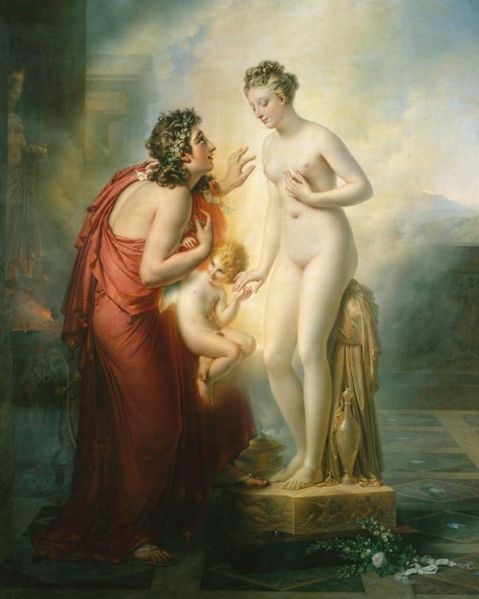
Pygmalion Takes the Turing Test

Girodet, Pygmalion et Galatée. – Image source: http://commons.wikimedia.org/wiki/File:Girodet_Pygmalion.jpg.

Girodet, Pygmalion et Galatée. – Image source: http://commons.wikimedia.org/wiki/File:Girodet_Pygmalion.jpg.

A few days ago, my colleague Prof. Kevin Warwick organised a Turing test competition at the Royal Society in London (in conjunction with the University of Reading), on occasion of the 60th anniversary of Alan Turing‘s death. Hailed as a success by some, the test left others with a distinct feeling that the results had left something to be desired.

The current set-up of the Turing test is somewhat different from what Turing originally proposed, namely a test whereby an interlocutor had to discern as to whether he (or she) was talking to a male or a female person (as opposed to a choice between ‘human’ vs. ‘machine’) through a computer interface. In other words, the way in which the test has since evolved has replaced the gender divide with the human/technology divide – an aspect that may be of some interest to psychoanalysts (and that should be of rather more interest to those who work on the technological side of it, unless they wish to operate in a historical and philosophical vacuum).

The field of ‘artificial intelligence‘ (AI) is a fascinating one – not only from the perspective of a tech geek (which I am not), but also from a philosophical point of view, triggering anxieties and fears alongside hopes for the future. It has been a subject of many works of art and literature – prominently featuring, for example, in the film The Matrix, in which AI is a deep, fundamental threat to human civilisation, or in the recent Swedish TV production Real Humans.

The fantasy that machines one day may resemble humans so closely that they become interchangeable is not a new one – there are many examples, including ones from the ancient world. A famous example can be found in Ovid‘s Metamorphoses, in the story of Pygmalion:

‘Pygmalion had seen them, spending their lives in wickedness, and, offended by the failings that nature gave the female heart, he lived as a bachelor, without a wife or partner for his bed. But, with wonderful skill, he carved a figure, brilliantly, out of snow-white ivory, no mortal woman, and fell in love with his own creation. The features are those of a real girl, who, you might think, lived, and wished to move, if modesty did not forbid it. Indeed, art hides his art. He marvels: and passion, for this bodily image, consumes his heart. Often, he runs his hands over the work, tempted as to whether it is flesh or ivory, not admitting it to be ivory. He kisses it and thinks his kisses are returned; and speaks to it; and holds it, and imagines that his fingers press into the limbs, and is afraid lest bruises appear from the pressure. Now he addresses it with compliments, now brings it gifts that please girls, shells and polished pebbles, little birds, and many-coloured flowers, lilies and tinted beads, and the Heliades’s amber tears, that drip from the trees. He dresses the body, also, in clothing; places rings on the fingers; places a long necklace round its neck; pearls hang from the ears, and cinctures round the breasts. All are fitting: but it appears no less lovely, naked. He arranges the statue on a bed on which cloths dyed with Tyrian murex are spread, and calls it his bedfellow, and rests its neck against soft down, as if it could feel.

The day of Venus’s festival came, celebrated throughout Cyprus, and heifers, their curved horns gilded, fell, to the blow on their snowy neck. The incense was smoking, when Pygmalion, having made his offering, stood by the altar, and said, shyly: “If you can grant all things, you gods, I wish as a bride to have…” and not daring to say “the girl of ivory” he said “one like my ivory girl.” Golden Venus, for she herself was present at the festival, knew what the prayer meant, and as a sign of the gods’ fondness for him, the flame flared three times, and shook its crown in the air. When he returned, he sought out the image of his girl, and leaning over the couch, kissed her. She felt warm: he pressed his lips to her again, and also touched her breast with his hand. The ivory yielded to his touch, and lost its hardness, altering under his fingers, as the bees’ wax of Hymettus softens in the sun, and is moulded, under the thumb, into many forms, made usable by use. The lover is stupefied, and joyful, but uncertain, and afraid he is wrong, reaffirms the fulfilment of his wishes, with his hand, again, and again.

It was flesh! The pulse throbbed under his thumb. Then the hero, of Paphos, was indeed overfull of words with which to thank Venus, and still pressed his mouth against a mouth that was not merely a likeness. The girl felt the kisses he gave, blushed, and, raising her bashful eyes to the light, saw both her lover and the sky. The goddess attended the marriage that she had brought about, and when the moon’s horns had nine times met at the full, the woman bore a son, Paphos, from whom the island takes its name.’

(Ovid, Metamorphoses 10.243-97, transl. A. S. Kline)

Ovid’s vision of Pygmalion resembles that of the development of the Turing test: the female – by which Pygmalion is repulsed in ‘real’ life – gets replaced with an artificial object, designed to give a more-than-lifelike, improved imitation of a woman. Eventually Pygmalion’s desire for his creation goes so far that he hopes for it to cross the object/human divide – a wish that in this myth was fulfilled by divine intervention.

This, in turn, however, means: in spite of Pygmalion’s great gift as a sculptor, he still lacks an essential skill that fundamentally divides humans from the gods of classical mythology: the ability to inspire actual life in inanimate objects.

Posted in Poetry | Tagged , , | Comments Off on Pygmalion Takes the Turing Test

Children, Love, and Memory

Reading’s magnificent Saint Laurence church houses many a Latin inscription, some of which date back as far as the late medieval period.

St_Laurence's_Church,_Reading_1

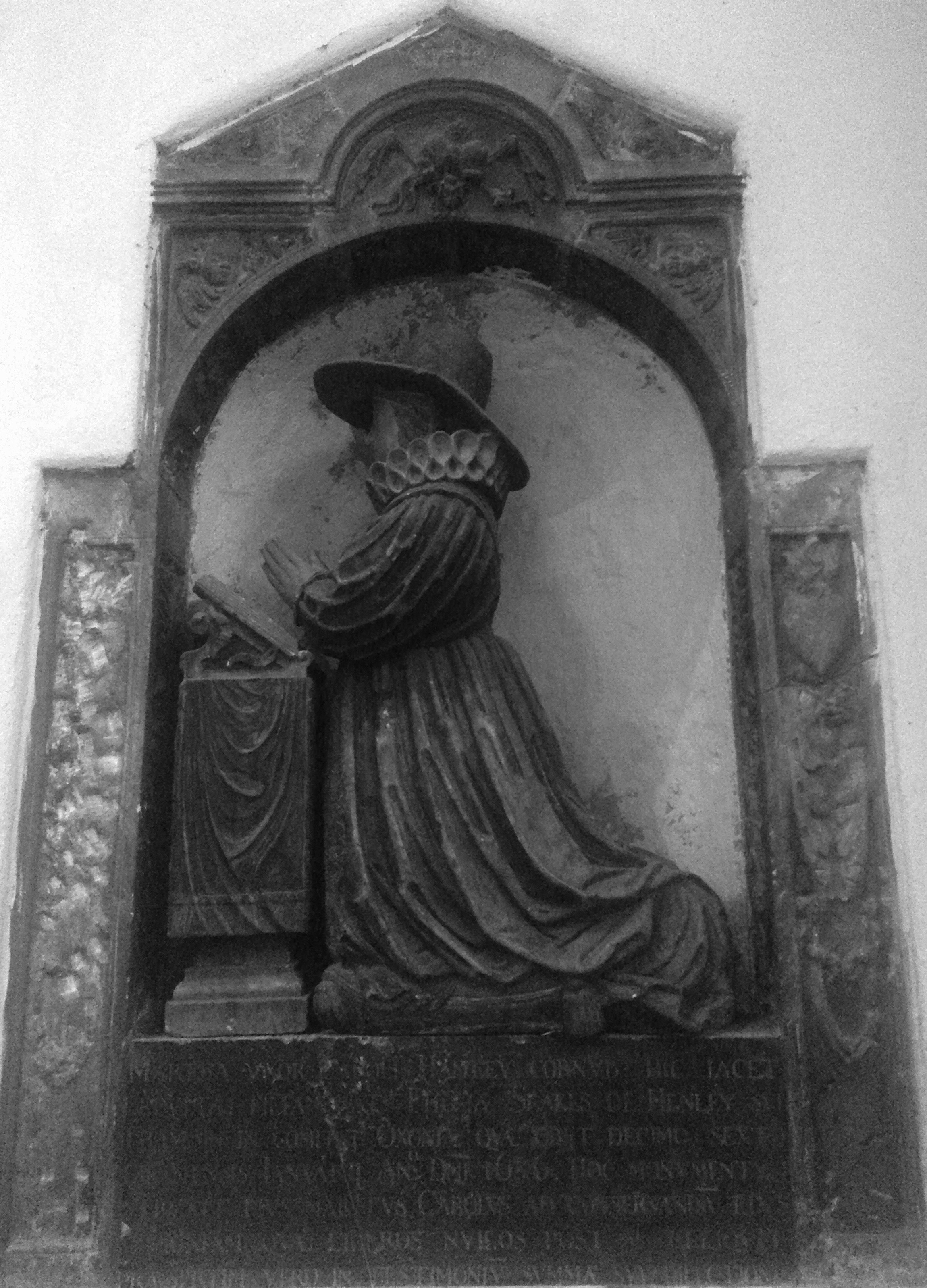
Among these treasures, there is a remarkable funerary monument, dedicated to one Martha Hamley:

Monument for Martha Hamley. – Photo (c) PK, 2014.

Monument for Martha Hamley. – Photo (c) PK, 2014.

The monument displays a figure, female, wearing hat and ruff while kneeling at a bench (of the prie-dieu type). Below the central sculpture, one reads the following inscription:

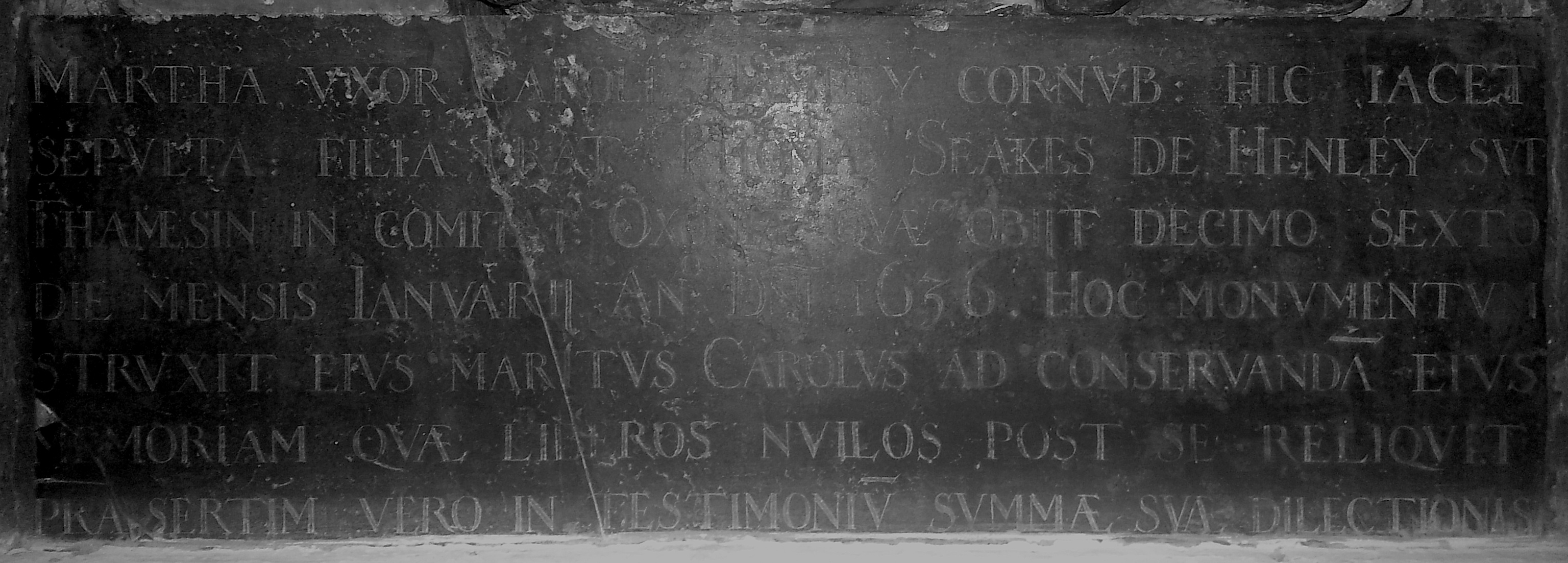
Inscription for Martha Hamley. – Photo (c) PK, 2014.

Inscription for Martha Hamley. – Photo (c) PK, 2014.

Martha, uxor Caroli Hamley Cornub(iensis), hic iacet
sepulta. Filia erat Thomae Seakes de Henley sup(er)
Thamesin in comitat(u) Oxoniae, quae obiit decimo sexto
die mensis Ianuarii an(no) D(omi)ni 1636. Hoc monumentum
struxit eius maritus Carolus ad conservandam eius
memoriam quae liberos nullos post se reliquit,
praesertim vero in testimonium summae suae dilectionis.

Martha, the wife of Charles Hamley of Cornwall, lies buried here. She was the daughter of Thomas Seakes of Henley-upon-Thames in Oxfordshire, who died on the sixteenth day of the month of January, AD 1636. This monument was erected by her husband Charles to preserve the memory of her, who did not leave behind any children, but particularly as a testimonial to his extraordinary affection.

Written in or around 1636 – Charles I. was king of England, the University of Oxford was given a Great Charter, granting it the right to print ‘all manner of books’, and Europe was in the middle of the Thirty Years’ War  –, Martha’s inscription, like many others, talks about the deceased just as much as about those who were left behind.

The inscription claims to have been set up to commemorate Martha; yet, one does not actually learn much about her, apart from her name, the names of her father and her husband, the childlessness of their marriage, and the claim that she was loved by her husband.

As is known from other documents, Martha’s father, Thomas Seakes, was an apothecary in Henley-on-Thames. Her husband, Charles Hamley (from Kent), in records of the Corporation, is referred to as ‘Mr Saunders’s man’, which, in turn, appears to be a reference to one John Saunders, an influential man in politics at the time.

The husband, or so the text purports, has the monument erected for two reasons: first, to commemorate his wife quae liberos nullos post se reliquit, ‘who did not leave behind any children’ – one feels almost compelled to infer ‘because she did not leave behind any children’; secondly, because he loved her very much.

The way in which the text presents this matter, when taken in conjunction with the sculpture of a pious lady, could lead to believe that the couple’s childlessness was a major issue during their lifetime and for their relationship – those who are well-versed in Latin inscriptions may recall the presentation of the same issue in the so-called Laudatio Turiae, for example.

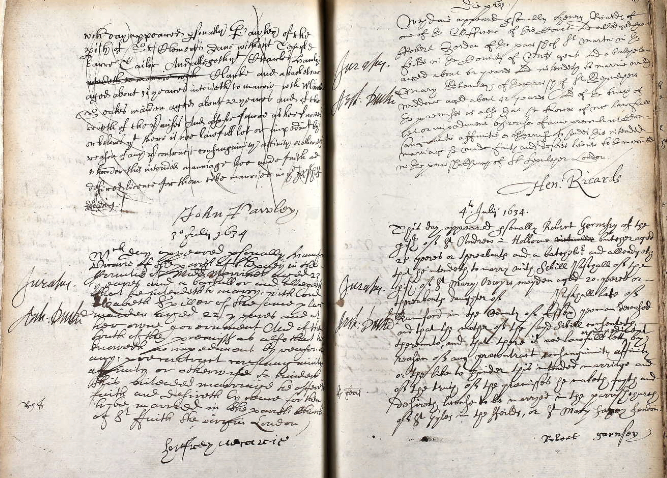
Marriage allegation of Martha Seakes and Thomas Haml(e)y.

Marriage allegation of Martha Seakes and Thomas Haml(e)y.

In actual fact, however, the inscription does not say so – and further research shows that one must be extremely cautious with such far-reaching conclusions. As becomes clear very quickly, the reason for their childlessness (most likely) was that Martha either died too young or – again, a wild claim, rooted in the fact that children are mentioned at all – in childbirth.

How does one know?

Archival research reveals: Martha Seakes married Charles Hamley in mid 1634, only about a year and a half before she died. Their marriage allegation (of 30 July 1634) is kept in the Marriage Bonds and Allegations records in the London Metropolitan Archives.

The text suggests that Martha was 22 years old at the time. Her spouse, in turn, was already 31. If this is correct, one can infer that when Martha died in January 1636, she was at the age of 23 or 24.

In that regard, one must take the text for what it says: the monument has been designed to extend the memory of Martha Hamley (née Seakes), taking on what (according to the frame of mind of this text, anyway) would have been her progeny’s task: to testify to their mother’s virtues and achievements.

So far, the monument has made a good job of it.

Posted in Epigraphy, History of Reading | Tagged , , | Comments Off on Children, Love, and Memory

Demagoguery and Populism

In the wake of recent elections, both at a local level in Britain and, more generally, for the European Parliament, there was a lot of talk about the (continued) rise of demagogues and populism, often with a backwards nationalist or even racist agenda.

Demagoguery is a label quickly handed out by mainstream media and established parties, as shorthand, designed to insult those players on the political stage who manage to mobilise (and potentially even sway) those parts of a disenfranchised populace that feel as though they have a bone to pick with the establishment.

Definitions of demagoguery typically include references to a demagogue’s studiously targeted appeal to the electorate’s desires and prejudices, adding out that this brand of politics operates in irrationality rather than rationality.

This is a rather patronising view, as it were, as all political parties, in democratic systems everywhere, appeal to rational as well as irrational concerns – and there is, of course, nothing wrong per se with irrational worries shared by a large(r) group: they may be indicative of an actual problem.

Populism, in that regard, acts no more rationally or irrationally than any other kind of politics: in fact, populist tactics are as rational and carefully construed as it gets, especially when ‘sold’ by someone who has a higher-than-average level of charisma.

Politicians and parties that tend to attract (and reject) the label ‘populism’ typically provide a mixture of two main strategies that lead to their success: an appeal to the only true, unacquired human emotion – fear (in its various manifestations) –, combined with a simple rhetorical device: a claim to represent ‘merely’ the will of the ‘normal people’, to form a ‘people’s army‘ even, while devoid of institutional power or authority.

This claim, on average, is demonstrably false – on both counts: populist parties have the same institutional standing as any other political party, and they, too, in their views represent but a segment of any given society.

Still the rhetorical trick manages to create the illusion of an underappreciated underdog who, if there were any justice, should be loved by all. Rhetoric is a dangerous weapon:

On my authority, therefore, deride and despise all those who imagine that from the precepts of such as are now called rhetoricians they have gained all the powers of oratory, and have not yet been able to understand what character they hold, or what they profess; for indeed, by an orator everything that relates to human life, since that is the field on which his abilities are displayed, and is the subject for his eloquence, should be examined, heard, read, discussed, handled, and considered; since eloquence is one of the most eminent virtues; and though all the virtues are in their nature equal and alike, yet one species is more beautiful and noble than another; as is this power, which, comprehending a knowledge of things, expresses the thoughts and purposes of the mind in such a manner, that it can impel the audience whithersoever it inclines its force; and, the greater is its influence, the more necessary it is that it should be united with probity and eminent judgment; for if we bestow the faculty of eloquence upon persons destitute of these virtues, we shall not make them orators, but give arms to madmen.

(Cicero, De oratore 3.54–55, transl. J. S. Watson).

What is more, the rhetoric trick tacitly introduces a divide between ‘the state’ (sometimes replaced with the imagery of a ‘ruling class’) and ‘the common people’, that – at least in a democracy – should not actually exist. Finally, it dissociates the populist from currently ruling politicians and their failures, thus making them better than everyone else.

The idea of ‘the normal people‘, down-to-earth and inhabiting ‘the heartland’ (as opposed to some kind of elite, usual qualified by terms such as ‘urban’, ‘metropolitan’, ‘media’, or ‘intellectual’), too, of course, is a rhetorical trick.

Obviously, the rhetorical trick is designed to suggest that certain segments of a society are more authentic and representative of the society as a whole than others – others, that are typically described as ‘detached’ from reality.

The rhetorical trick behind this movement, behind the notion of ‘the normal people, cunningly binds together rather diverse groups of people with the promise of forming an authentic, genuine, and honest expression of the will of the people as a whole. Or as Catiline put it, according to Sallust‘s historical monograph on the Catilinarian conspiracy of 63 B.C. (Sall. Catil. 20.3-9, transl. J. C. Rolfe):

But because I have learned in many and great emergencies that you are brave and faithful to me, my mind has had the courage to set on foot a mighty and glorious enterprise, and also because I perceive that you and I hold the same view of what is good and evil, for agreement in likes and dislikes — this, and this only, is what constitutes true friendship. As to the designs which I have formed, they have already been explained to you all individually. But my resolution is fired more and more every day, when I consider under what conditions we shall live if we do not take steps to emancipate ourselves. For ever since the state fell under the jurisdiction and sway of a few powerful men, it is always to them that kings and potentates are tributary and peoples and nations pay taxes. All the rest of us, energetic, able, nobles and commons, have made up the mob, without influence, without weight, and subservient to those to whom in a free state we should be an object of fear. Because of this, all influence, power, rank, and wealth are in their hands, or wherever they wish them to be; to us they have left danger, defeat, prosecutions, and poverty. How long, pray, will you endure this, brave hearts?

Of course, Catiline’s followers – brought together by this movement – could not have been any more diverse (Sall. Catil. 14.1–6):

In a city so great and so corrupt Catiline found it a very easy matter to surround himself, as by a bodyguard, with troops of criminals and reprobates of every kind. For whatever wanton, glutton, or gamester had wasted his patrimony in play, feasting, or debauchery; anyone who had contracted an immense debt that he might buy immunity from disgrace or crime; all, furthermore, from every side who had been convicted of murder or sacrilege, or feared prosecution for their crimes; those, too, whom hand and tongue supported by perjury or the blood of their fellow citizens; finally, all who were hounded by disgrace, poverty, or an evil conscience — all these were nearest and dearest to Catiline. And if any guiltless man did chance to become his friend, daily intercourse and the allurements of vice soon made him as bad or almost as bad as the rest. But most of all Catiline sought the intimacy of the young; their minds, still pliable as they were and easily moulded, were without difficulty ensnared by his wiles. For carefully noting the passion which burned in each, according to his time of life, he found harlots for some or bought dogs and horses for others; in fine, he spared neither expense nor his own decency, provided he could make them submissive and loyal to himself.

Catiline – traditionally seen overly negative: he may well have tried to address an actual social problem of the Late Republic – promised anything to anyone, and in doing so he displayed a distinct lack of principle: increasing the number of followers for one’s own cause, at any cost, is represented as more important to him than taking a firm, principled stance.

This is what makes him both dangerous and a demagogue – a model followed by many self-proclaimed leaders of the people since.

Cicero, in his fourth Catilinarian Oration, in a speech that discusses the option at hand with regard to the punishment of the conspirators, introduces a remarkable distinction between the demagogue (contionator, literally ‘someone who addresses a contio‘) and a politician who genuinely cares for the people, when he refers to Caesar and his proposal to spare the conspirators’ lives (Cic. Catil. 4.9, transl. C. D. Yonge [adapted]):

Habemus enim a Caesare, sicut ipsius dignitas et maiorum eius amplitudo postulabat, sententiam tamquam obsidem perpetuae in rem publicam voluntatis. Intellectum est, quid interesset inter levitatem contionatorum et animum vere popularem saluti populi consulentem.

For we have from Caesar, as his own dignity and as the illustrious character of his ancestors demanded, a vote as a hostage of his lasting good-will to the republic; it has been clearly seen how great is the difference between the levity of demagogues, and a disposition really attached to the interests of the people.

The levitas contionatorum, the ‘levity of demagogues’, according to Cicero, is the opposite of a long-standing, principled stance that invites discussion and disagreement, but remains reliable in its substance.

But who represents the principled stance, without populism?

Those who, for the longest time, have characterised the European Union as the demonic bogeyman (but not done anything about it – in fact: the contrary, as they of course know of the immense benefits of their membership, even when it comes at a great cost)? Those who have subscribed to the anti-immigration rhetoric in a claptrap sensationalist move, while in power, and not achieved anything (as it would be a predictable economic disaster).

Hardly.

If the levitas contionatorum succeeded, it may just mean that those who decided to sow wind now get to reap whirlwind: for if the actual choice is between populism and populism, one might as well pick the original.

Posted in Prose | Tagged , , , , | Comments Off on Demagoguery and Populism

Neither the First, Nor the Wurst

When Conchita Wurst, the carefully designed and meticulously planned stage persona of the Austrian artist Tom Neuwirth, won the 2014 European Song Contest with his song Rise Like A Phoenix, a majority of people simply enjoyed the power of music and a performance that most impressively managed to deceive the eye and blur common male/female gender divisions.

Everything about Conchita Wurst’s stage appearance suggests ‘female’: an immaculately groomed, angelic face, long hair, diva-esque attire, alluring body movement, the name, and, of course, the voice. Yet, this face comes with a beard (again, immaculately groomed), revealing the artist’s actual gender –providing a visible, constant element of disturbance to the artifice (an aspect that, remarkably enough, has resulted in some debate over the ‘correct’ iconography of  drag queens even in LGBT circles).

A bearded man. Female appearance and attire. A beautiful voice. There is absolutely nothing unsettling about any of these features. If they appear individually.

Yet, when combined, one can be certain that some narrow-minded dunce will come along and decry the end of Western civilisation as we know it. (George Carlin said it best: ‘some people are really f—ing stupid!’)

Of course, one could argue that a civilisation that was both horrendous enough to invent, and resilient enough to survive witch burnings, the Spanish inquisition, two world wars, and even the holocaust, yet is likely to fall due to the success of a man in drag in a song competition, may not actually be entitled to survival – after all, Darwin made a case for the survival of the fittest, not the survival of the twittest.

Chances are, however, that Western culture will survive.

Perhaps it will even become a slightly better, more advanced, more inclusive, more open-minded civilisation still – a civilisation that eventually moves on from perceiving a gender-blurred art performance as a threat to its nauseating cult of masculinity; a civilisation that  moves on to become a society in which masculinity never again has to be asserted by anyone posing publicly as pharmaceutically enhanced and chemically preserved half nude, displaying a yearning for his lost youth, subjecting men, women, and animals equally to wanton acts of cruelty.

Too unrealistic? Too esoteric? Too religious?

Yes, sadly.

Yet, there is something deeply religious, something deeply spiritual about Conchita Wurst’s appearance, and this may well add to the ways in which one responds to her persona.

A lot has been written about the self-chosen surname of Conchita Wurst. Not so much about the first name. Conchita, a diminutive form of Concha, short for the Spanish name ‘(Immaculada) Concepción‘, immaculate conception – commemorating Christian dogma regarding the birth of Mary, the saviour’s mother, according to Christian faith. (This is not the story, mind, that the artist tells when asked about the origins of his name.)

The very face of Conchita Wurst, too, as has been observed by others before, is styled closely to resemble the iconography of Jesus Christ.

The religious connotations stretch beyond the Judaeo-Christian context, however. The sexual allure, including the fantasies that result from blurring gender distinctions, is something that had already been conceptualised by non-Christian cultures of the ancient Mediterranean.

This is true far beyond the realm of show business (where female roles, in Classical times, were typically played by males). Macrobius, for example, reports the existence of a sanctuary on Aphrodite-Venus’s birth island of Cyprus displaying a statue of her with blurred gender lines (Macr. sat. 3.8.2–3, transl. R. A. Kaster):

Signum etiam eius est Cypri barbatum corpore, sed veste muliebri, cum sceptro ac natura virili: et putant eandem marem ac feminam esse. Aristophanes eam Ἀφρόδιτον appellat. Laevius etiam sic ait:

Venerem igitur almum adorans
si femina sive mas est,
ita uti alma Noctiluca est.

Philochorus quoque in Atthide eandem adfirmat esse lunam, et ei sacrificium facere viros cum veste muliebri, mulieres cum virili, quod eadem et mas aestimatur et femina.

There’s also a statue of Venus on Cyprus, that’s bearded, shaped and dressed like a woman, with scepter and male genitals, and they conceive her as both male and female. Aristophaness calls her Aphroditus, and Laevius says:

Worshiping, then, the nurturing god Venus,
whether she is male or female,
just as the Moon is a nurturing goddess.

In his Atthis, Philochorus, too, states that she is the Moon and that men sacrifice to her in women’s dress, women in men’s, because she is held to be both male and female.

A similar report of the cult statue of a Venus Barbata is reported in Servius’ commentary on Vergil’s Aeneid (at. 2.623) and other places in ancient literature, and there is significant evidence for gender-ambiguous deities in the ancient world – yet it may well be the love goddess herself (who also often appears in androgynous shapes) who is the most intriguing, blurring and removing boundaries in an area in which gender, gender preference, and gender assignment would appear to play a role of great importance.

It is little wonder that such ambiguity, perceived as irrationally threatening by some, has become part of religious worship: as Rudolf Otto has shown, the tremendum (tremble- or fear-inducing) in a mystery is one of the two central aspects that inextricably linked to the wider notion of ‘the holy’. The second one according to Otto, is the fascinans, the fascinating, the innate quality that attracts our gaze and forces us to watch.

If this is something that could happen and that could be displayed and even worshipped in societies that had much clearer defined gender roles than our own, then, one would hope, this need not be a problem now.

Unless, of course, one wishes to turn it into one, for one’s own sinister political or commercial purposes.

Posted in Poetry, Prose | Tagged , , | 1 Comment

The Divine Riches of the Latin Language

My son’s interest in the Latin language, fuelled by his engaging Latin teacher, remains unbroken. Recently, for example, he wished to discuss the authenticity of some volumes of John Maddox Roberts‘s beautifully entertaining SPQR series with me (to a depth that should leave the production team of the 2014 Pompeii film red-faced).

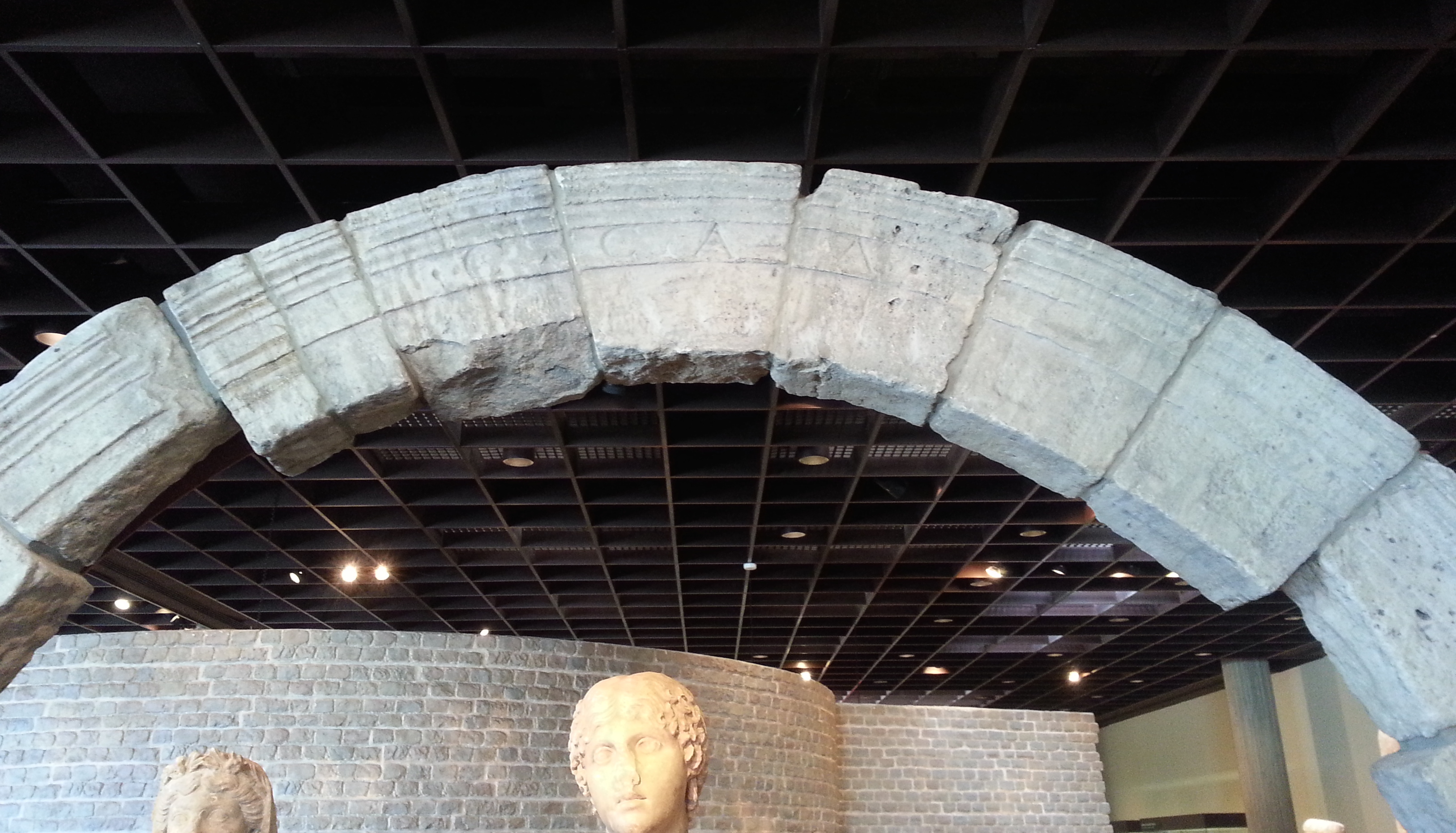
Roman city gate of the CCAA, imaginatively inscribed with ... CCAA. Römisch-Germanisches Museum, Cologne. – Photo: PK, 2014.

Roman city gate of the CCAA, imaginatively inscribed with … CCAA. Römisch-Germanisches Museum, Cologne. – Photo: PK, 2014.

In order to provide some further inspiration, we decided to spend a few days of this year’s Easter vacation in the German city of Köln, Cologne, or, as my son preferred to call it (by its full Latin name), Colonia Claudia Ara Agrippinensium, or shorter: CCAA.

In Roman times, Cologne was the capital of Germania Inferior, and, consequently, it is unusually rich in Roman remains – many of which are on display in the Römisch-Germanisches Museum, next to Cologne’s iconic cathedral.

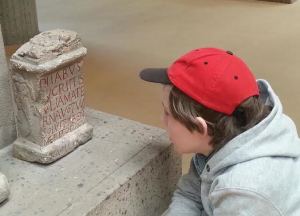
During our visit we had endless hours of fun in this magnificent museum, and – in addition to time spent on exploring the digital 3D reconstructions of Roman Cologne – my son spent a significant amount of time studying the Latin inscriptions that were on display.

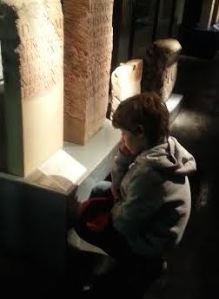
A similar amount of fun was had in the underground exhibition of the so-called Praetorium, where the foundations of the palace of the provincial governor of Germania Inferior survive to the present day.

My son studying a Latin inscription in the Römisch-Germanisches Museum (Cologne)

My son studying a Latin inscription in the Römisch-Germanisches Museum (Cologne)

One of the recurring features of the Latin inscriptions (of Cologne just as much as everywhere else, of course) is mention of gods or other spirits – dei, deae, divi, divini.

This reminded him (and me) of a question he had asked a few weeks earlier, and which I had shamefully delayed to answer: is there a link, etymologically, between divus (‘godlike’) and divinus (‘divine’) on the one hand and dives (‘rich’) on the other?

Or, as my son had put it in a Skype conversation, just to puzzle his already perplexed father a little further … suntne divini divites?

The answer is … probably yes, actually. Divus, as Latin deus, is related to an Indo-European root that signifies ‘heaven’ or ‘sky’ (incidentally, the same root that survives in the English word ‘Tuesday’ and German ‘Dienstag’).

Dives, in turn, has been explained in relevant etymological dictionaries as an adjective that denotes the (pecuniary) power of someone upon whom the gods do smile – in a similar way in which fortuna-tus may refer to someone who has been blessed, financially, by Fortuna.

Morphologically, the word formation appears to follow a simple logic: a dives being someone whose influence (and affluence) is based on the approval of the divi just as an eques (‘knight’, ‘horseman’) is someone whose might is based on the power of equi (‘horses’).

My son studying Latin inscriptions in the Cologne Praetorium exhibition. – (c) PK, 2014.

My son studying Latin inscriptions in the Cologne Praetorium exhibition. – (c) PK, 2014.

Sadly, my son was not the first to have noticed the similarity between those words. Apart from the aforementioned etymological dictionary (and others), Francis Edward Jackson Valpy, for example, son of famous Reading schoolmaster Richard Valpy, in a (long obsolete) etymological dictionary wrote:

Dives, rich. From Divus. Like the Gods in ease and affluence. Plautus: “Dei divites sunt, Deos decet opulentia.”

Valpy’s definition, although illustrated with a Plautus quote, resembles rather more closely what Varro had already written in the first century B. C. (Varr. ling. 5.92):

dives a divo, qui ut deus nihil indigere videtur.

‘Dives [rich] from divus [godlike], for such a person, like a god, appears not to experience a lack of anything.’

In other words: even in the Late republic, the cognate nature of the two words, divus and dives had been assumed – and one could push this rather further still, e. g. by way of reference to the Greek concept of eudaimonia (‘wealth’, literally ‘a state of being accompanied by good spirits’) or, in fact, the name(s) of Ploutos-Plouto(n), the Greek god(s) of the Underworld and/or Riches. whose names quite literally translate as ‘Wealth’, a notion preserved also in his Latin counterpart Dis (obviously related to the same root as the aforementioned terms).

For the latter, Quintilian the rhetorician gives a rather amusing definition (at Quint. inst. 1.6.34):

A contrariis aliqua sinemus trahi, ut ‘Ditis’, quia minime dives,

We allow certain things to obtain their name from opposites, like ‘Dis’, for he is not rich at all.

This definition follows the logic of the so-called antiphrasis, for which the neatest Latin example is the infamous canis a non canendo (‘a dog is called a dog because it can’t sing’).

At any rate, as far as etymology is concerned, matters appear to be clear – the notion of divus, godly, gives rise to the notion of dives, rich.

Yet, the way in which my son had phrased his question in Latin – suntne divini divites – is an open invitation to reflect some more on the relationship between the two, for, due to the beautifully ambiguous word-order, it could mean both ‘are the gods rich’ just as much as it could mean ‘are the rich divine’. The former appears to be implied in the etymology. But what about the latter . . . ?

Valpy, above, had adduced a Plautus quote to support his etymological claim. In current editions (e. g. in the new Loeb edition, masterfully edited by Wolfgang de Melo), the quote from Plautus – Trinummus 490 – reads slightly differently from what Valpy thought to be the correct version:

di divites sunt, deos decent opulentiae
et factiones, verum nos homunculi,
satillum animai qui quom extemplo emisimus,
aequo mendicus atque ille opulentissumus
censetur censu ad Accheruntem mortuos.

Only the gods are rich, and displays of power and connections are only appropriate for the gods; but we are mere men: as soon as we let go of the little seed of our soul, the beggar in his death is rated with an equal rating in the Underworld as the richest of men.

The speaker of this passage, an old-man character called Philto, offers his musings on Death, the great leveller: death does not only lift the boundaries between rich and poor, but also draws a clear line of distinction between the divine and mere mortals, for only the former may keep their possessions in eternity.

Stasimus, a slave who witnesses Philto’s words, says in an aside remark (Trin. 495–6):

mirum quin tu illo tecum diuitias feras.
ubi mortuos sis, ita sis ut nomen cluet.

Surprised if you weren’t going to find a way to take your riches with you there. When you’re dead, be dead in a way that the name is chiming.

This comment has resulted in numerous attempts at correcting the words, or coming to terms with its meaning. What is clear is that it ought to be (a) a funny, (b) ironic, and (c) potentially snide remark, not an attempt at out-philosophising Philto’s words.

My best bet would be that Stasimus says that (i) he’d be very surprised if close-fisted Philto weren’t going to find a way to take his money with him, and that (ii) if he in fact didn’t after all, he’d finally live up to the promise of his name, Philto (a name derived from Greek φιλεῖν, ‘to love’).

Generosity of a father or a patron, in Roman plays, as e. g. Cynthia Damon in her book on parasites and patronage in Roman comedy has demonstrated, is indeed something that has the potential to make said person appear almost god-like in the eye of the son or client.

Rhine river at Cologne, with a view on the opposite riverbank, the location of a Roman army camp called 'Divitia' (now Deutz). – (c) PK, 2014

Rhine river at Cologne, with a view on the opposite riverbank, the location of a Roman army camp called ‘Divitia’ (now Deutz). – (c) PK, 2014

The most iconic passage in that respect comes from Terence, a comedic playwright who produced his plays just one generation after Plautus, who makes Phormio, the infamous parasite of the eponymous play utter the following words (Ter. Phorm. 344–5, transl. J. Barsby):

haec quom rationem ineas quam sint suavia et quam cara sint,
ea qui praebet, non tu hunc habeas plane praesentem deum?

When you consider how pleasant this all is and how expensive, don’t you regard the man who provides it as a manifest god on earth?

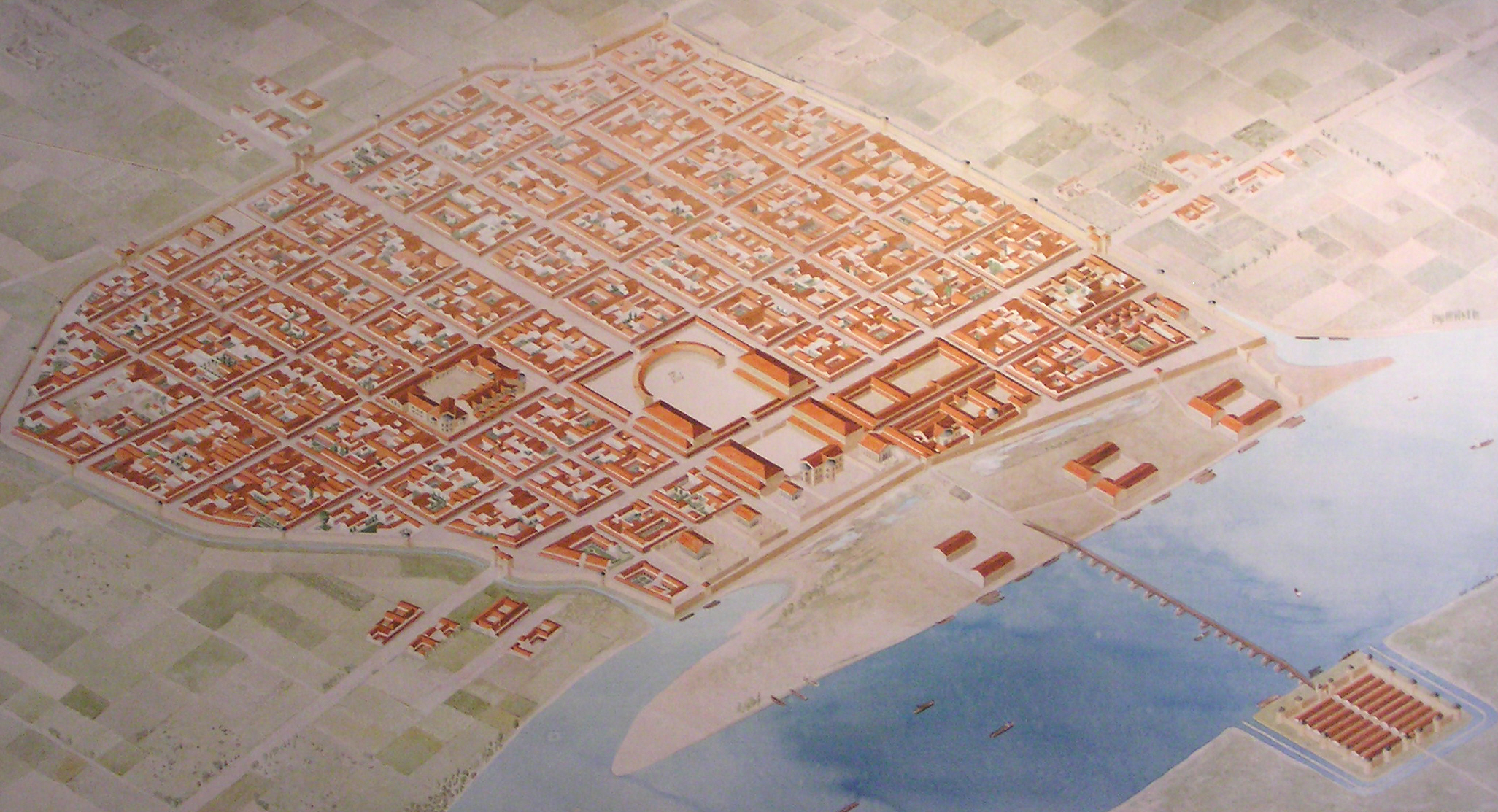
Reconstruction of Roman Cologne and camp Divitia. – Image source: http://upload.wikimedia.org/wikipedia/commons/2/2b/Roman_Cologne,_reconstruction.JPG

Reconstruction of Roman Cologne and camp Divitia. – Image source: http://upload.wikimedia.org/wikipedia/commons/2/2b/Roman_Cologne,_reconstruction.JPG

Yes, the rich may appear divine: sunt divini divites … if they allow others, too, to benefit from their wealth and share it.

Incidentally, similarly wishful thinking appears to be behind the name of the very district of Cologne in which we stayed: Köln-Deutz.

Historically, the name ‘Deutz’ is derived from the name of a Constantinian camp, Divitia, an expression of a wish for prosperous times, most likely, for a place that was situated just opposite Roman Cologne, on the right riverbank, and connected to the CCAA by a now long-gone bridge across the Rhine (of well over 200 metres’ length).

Well played, son. Well played. (And thank you for your help with this blog post!)

Posted in Education, Epigraphy, History of Reading, Poetry, Prose | Tagged , , , , , | 2 Comments

Pompeii 3D

Paul W. S. Anderson’s Pompeii film – marketed as Pompeii 3D – has been released in the UK after all (how did the dubbing from English into English take so long…?). In the aesthetic tradition of the peplum films, Pompeii tells the story of a young man from Britain who, as a child, had to witness how his entire tribe was butchered by the Romans, then became a slave and, eventually, a gladiator.

Too quick and too good for spectacles in the British province, Milo – the Celt, a skilled fighter and horseman – eventually ends up in Pompeii, to fight Atticus, an experienced gladiator, who is hoping for a life in freedom after one last fight.

Matters get more complicated as Milo becomes infatuated with a girl of the local elite. The girl shares his feelings, but also is hoping to escape marriage with Corvus, a Roman senator, ‘arranged’ by the girl’s ambitious father, who is hoping to build a new Pompeii, funded by either the Emperor or Corvus himself. Needless to say that Corvus was responsible for the slaughter of Milo’s people in Britain.

Matters find a dramatic ending when Pompeii, already plagued by constant earthquakes, eventually gets to experience the eruption of Mt Vesuvius.

Classical scholars and historically-minded amateurs alike find great pleasure in pointing out historical inaccuracies in sword-and-sandal films, and Pompeii is an open invitation to that exercise. (With regard to that, has anyone pointed out yet that Romans typically spoke Latin, not, in fact, English? And why does Atticus, the heroic, somewhat condescending black gladiator, have to be portrayed with a thick accent, whereas all other barbarians seem to cope with English pronunciation just fine?)

No, this is not what Pompeii looked like. No, this is not what the eruption of Vesuvius looked like. No, this is not a historic tale.

This is Gladiator meets The Horse Whisperer meets Sharknado, with added fire and a lot of gratuitous violence, told with sadly rather too little tongue-in-cheek irony.

Rather more worrying than the levels of historical ‘accuracy’ (what is that, anyway?), one must take issue with the thin story line, the wooden acting (and epic over-acting – is there no better way to assert an epic nature of a film), and absolutely cringeworthy dialogues, all designed in such a quality that they do not unnecessarily distract attention from the state-of-the-art CGI.

Is it worth getting riled up about the misrepresentation of what we (seem to) know about what happened during Pompeii’s final hours?

No, it is not.

Is it worth getting riled up about the way in which this film wastes an opportunity to explore the fantasy space and the fascination of the audience when it comes to disasters such as Pompeii’s dramatic demise, related to the primordial fear that nature will ultimately always control us (and not the other way round)?

You decide.

The CGI is pretty impressive, though – shame one cannot use it for didactic purposes now, as it does not follow the actual layout of the city.

Posted in Uncategorized | Tagged | 3 Comments

Mortifying Teachers

Traumatic, unbearable experiences that seem to shatter our grasp of reality trigger a simple coping mechanism: when one encounters something that seems to come close to our wildest nightmares in real life, one is inclined to narrativise, to fictionalise – to turn what has happened into a story that at least sounds plausible.

One such example is the unbelievable, horrendous death of a British school teacher: a Spanish and Religious Education teacher at a college in Leeds was killed, reportedly by one of her students, who is said to have attacked her, in a most despicable act, in the classroom, mid-lesson, with a knife and to have stabbed her to death.

The story has been reported as the ‘first ever student murder of a teacher in UK class‘, and it brings back powerful memories of similar incidents in other countries – most notably the U.S. Subsequently, media reports have created a narrative that have turned the teacher into an almost superhuman hero and saint and the alleged perpetrator into a drug-using loner (with the ultimate Great British insult added: he was middle-class, too!).

The following considerations, while sparked by this outrageous crime, are unrelated to the actual case. They are observations on the discourse that surrounds this case, like many other similar ones, with no intention to hurt the feelings of those who have to come to terms with a horrendous, life-changing incident.

It will be of little (or in fact: no) consolation to those directly affected by this crime – in fact, they may find this to be adding insult to their injury  –, but the sad truth is: many people get killed, every day, and many, if not most, of them do not receive the same level of attention.

Not all men (and women!) are equal in death. When teachers die in acts of violence, they become instant heroes.

The same applies to soldiers who get killed outside of battle, and it also applies to policemen and firefighters who die while doing their job: they all represent roles and ideals in society that are larger than life. When a taxi driver, a mechanic, a judge, or even a medical doctor suffer freak deaths – well, that’s sad, but ultimately – such is life: apart from personal stories, few claims for heroic worship tend to get made for them. And when a prostitute or a homeless person gets killed . . . ? Death is an extremely classist matter.

Yet, what is remarkable about this?

Well, chances are – and again, I do not wish to cast even the faintest shade over the life and achievements of the Leeds teacher or anyone else specifically! – that not every teacher is a hero. Some teachers may in fact be really rather awful (which does not mean, of course, that they deserve a horrendous death!).

Yet, we are still to await the news report of a teacher killed in the classroom that points out that this very teacher truly was a piece of work. (If a teacher is bad in news reports, it is usually to do with inappropriate relationships between them and their pupils – with a certain variation on the theme depending on the gender spread: somehow a female teacher having an affair with a male student seem to be marginally more acceptable, in public opinion, than a male teacher having an affair with a female student.)

The relation of fantasy and violent behaviour in real life is an interesting one. Is it fantasy that allows us to explore what is beyond reach in reality, or does fantasy show us what is within reach, while in real life we choose to restrict ourselves?

In the 1980s, there was a computer game for the Commodore C64 called Teacher Busters. It was banned in Germany, which added to its popularity in subculture. The idea of this game was to put ammunition on a tank and to go for a hunt for one’s teacher – it is both amusing and shocking to find it played now, some thirty years later, on YouTube for public entertainment:

One must wonder how many teachers had to die multiple virtual deaths – a (admittedly rather sick) coping mechanism with stress and perceived unfair, harsh treatment by figures of authority.

A teacher killed in real life, ideally a moral person exercising their authority, provides the subject for a tragedy – a quasi-hero who had to face an unfair fate. In a virtual scenario, such as the computer game, the same rules do not appear to apply – regardless of just how sickening one may find such games.

Yet, the motive can be elevated even further – and here, after long last, this becomes relevant to the student of the Classical world. Can the motive of killing one’s own teacher ever become something comedic?

Yes, it can, to the present day – regardless of whether or not one finds this to happen in poor taste.

Plautus, in his play Bacchides (‘The Two Bacchises’), did think so, too. In the second scene of the play, he puts Lydus, a paedagogus, and Pistoclerus, his tutee, on stage. Pistoclerus is increasingly annoyed by the way Lydus treats him – he feels patronised and abused by him. Finally Pistoclerus bursts forth (Plaut. Bacch. 155):

Fiam, ut ego opinor, Hercules, tu autem Linus.

I’ll turn into Hercules, I guess, and you’ll be Linus.

This is anything but a nice wander through Greek mythology: Linus was Hercules’ (music) teacher, and Hercules famously slays him in an outburst of anger, when he felt mistreated. Apollodorus, in his Bibliotheke, a collection of classical myths, relates the story as follows (2.4.9):

‘Hercules was taught to drive a chariot by Amphitryon, to wrestle by Autolycus, to shoot with the bow by Eurytus, to fence by Castor, and to play the lyre by Linus. This Linus was a brother of Orpheus; he came to Thebes and became a Theban, but was killed by Hercules with a blow of the lyre; for being struck by him, Hercules flew into a rage and slew him. When he was tried for murder, Hercules quoted a law of Rhadamanthys, who laid it down that whoever defends himself against a wrongful aggressor shall go free, and so he was acquitted.’

The same story, before Plautus ever made his casual comment, was the subject of comedic treatment by Greek authors, not least in the genre of the satyr play.

Where is the humorous element? How can this possibly be entertaining, an event that in real life has no comedic potential whatsoever (but is typically described as tragic)?

In the case of Hercules, it seems, it is virtually impossible for any literary author to take Linus’ perspective: Linus had it coming (or so the myth goes, anyway!), and Hercules was the right person to commit this crime – Hercules, the literary archetype of the comedic over-strong, under-brained numbnuts (regardless of how much Disney wanted to rehabilitate him at that front).

It may just be that Hercules’ simple, unreflective way of dealing with abuse, in a controlled fantasy space no less, offers comic relief to a situation that in real life, as much as it has been experienced by everyone, does not ever allow for a physical solution of the same type.

Is this what allows this story to work, in literature and on stage?

Plautus’ paedagogus remains alive, thankfully, despite the obvious threat. He answers Pistoclerus back with an equally mythic example (Plaut. Bacch. 156-7):

pol metuo magis ne Phoenix tuis factis fuam
teque ad patrem esse mortuom renuntiem.

By Pollux, I am rather more afraid that I’ll become a Phoenix to your deeds, and that I get to report your death to your father after all.

Phoenix, Achilles’ advisor, famously accompanied Achilles to Troy and had to report Achilles’ death to his father.

Pistoclerus, in turn, says (Plaut. Bacch. 158):

satis historiarum est.

Enough of those old stories already!

If only real life horror stories could be averted with similar ease . . .

Posted in Education | Tagged , | Comments Off on Mortifying Teachers