Epigraphy CIS – Cause of Death: (illegible scrawl)

Latin inscriptions are fascinating. Like personal letters of the same time, they allow unique glimpses into the ancient world and the fate of individuals – if, in the case of tombstones, usually through the prism of the perception of those who lived to inscribe a story rather than necessarily those who experienced them.

How annoying therefore, when a text that has the word ‘fascinating’ written all over it, withstands any attempt to elicit relevant information at a crucial point.

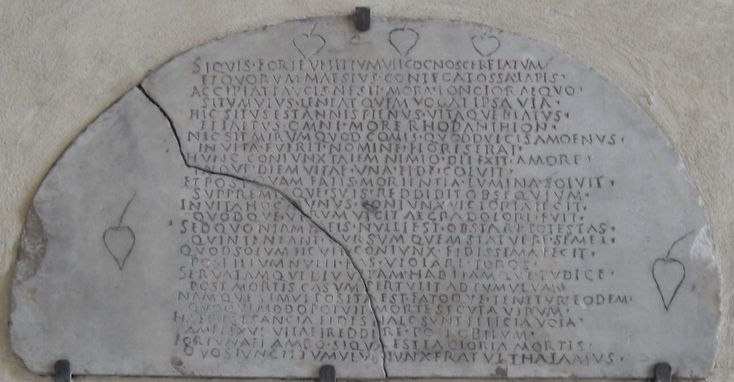
Inscription for L. Alius. – Image source: http://db.edcs.eu/epigr/bilder.php?bild=PH0001264;$CIL_01_03358a.jpg&nr=1 (c) CIL - BBAW>

Inscription for L. Alius. – Image source: http://db.edcs.eu/epigr/bilder.php?bild=PH0001264;$CIL_01_03358a.jpg&nr=1 (c) CIL – BBAW>

A most remarkable case in that respect is an inscription from Heba (Magliano) – near Grosseto – in Etruria.

The text, inscribed in unskilled letters on an otherwise undecorated slab of stone, reads as follows (CIL I² 3358a):

L(ucius) Al(l)ius C(ai) f(ilius)
an(n)orum natus
XXV mortu(u)s est
VEVENE quia
suas iniurias de-
fendebat. Al(l)ias
C(ai) f(ilias) fecerunt.

The text, a product of the first century B. C., is easily understood – for most of it:

Lucius Al(l)ius, son of Gaius, age in years 25, has died […] for he tried to stand up against the allegations against him. The Al(l)iae, daughters of Gaius, had this (monument) made.

A crucial element, right in the centre of the inscription – at the beginning of the middle line – remains unclear. The text reads VEVENE, without any indication of word division (which is present in all other cases).

The passage in question has, of course, already attracted a certain amount of academic interest. An early editor has tried to explain ve-bene as ‘less good’, creating thus both a new (and implausible) word and a sense that does not really check out with the overall diction of the text.

Heikki Solin, in turn, has tried to explain the phrase either as v(a)e ven(a)e ‘woe is the vein’ (with monophthongization of the ae diphthong, as common in Latin – the phrase being a reference to cutting open one’s blood vessels in a suicide attempt) or, preferably, as ve⌈n⌉en⌈o⌉ ‘by means of poison’ (with two misspellings in an inscription that otherwise does not show such features).

Solin’s ideas of suicide or, alternatively, of murder by poison, originally published in Arctos 15 (1981), has been widely accepted, and perhaps rightly so: the imperfect tense of defendebat suggests a drawn-out attempt of the deceased to defend himself – an event that is eternally linked to his death, whether self-inflicted or brought upon L. Al(l)ius.

There are a couple of oddities about this inscription, however, that one must consider:

  • Unlike as is fairly common in Republican inscriptions, the first line does not stick out to the left: instead, the whole inscription, in its arrangement, is aligned to the left. Moreover, the word division between the deceased’s first name, L(ucius), and his family name, Al(l)ius, is strangely inserted in the space reserved for the L.
  • Even though otherwise the letter E is consistently spelled as E, it appears – twice (and for no obvious reason) – in its cursive spelling II in de|fendebat in lines 5–6. Incidentally, de|fendebat also provides the only instance of word division over two lines in this inscription – unnecessary, as the whole text could have been arranged with defendebat in line 6, while bumping the names of the relatives, the Al(l)ias, to the final line.

Could it be the case that these oddities carry meaning?

It could be.

The current arrangement of the text produces an acrostic:

L – A – X – V – S – F – C.

This could – tentatively – be read as L(ucius) Axus f(aciendum) c(uravit), ‘Lucius Axus took care of that’. Axus is a rare, yet not altogether unattested name – though one may be surprised to find it relatively early in this region.

If this observation is correct (and it is little more than mere speculation!), then one may take this observation as a hidden allegation, potentially supporting the theory that Al(l)ius’ death was perhaps not self-inflicted after all.

What is all the more peculiar (if the explanation is correct!), of course, is the naming and shaming of the perpetrator – expressing upset about iniuriae is one thing, as the famous inscription of Vesonius Phileros from Pompeii demonstrates (AE 1964.160, transl. A. E. Cooley):

Hospes paullisper morare | si non est molestum et quid euites | cognosce amicum hunc quem | speraueram mi esse ab eo mihi accusato|res subiecti et iudicia instaurata deis | gratias ago et meae innocentiae omni | molestia liberatus sum qui nostrum mentitur | eum nec Di Penates nec inferi recipiant.

Stranger, delay a brief while if it is not troublesome, and learn what to avoid. This man whom I had hoped was my friend, I am forsaking: a case was maliciously brought against me; I was charged and legal proceedings were instituted; I give thanks to the gods and to my innocence, I was freed from all distress. May neither the household gods nor the gods below receive the one who misrepresented our affairs.

In Phileros’ case, the name of the wrongdoer may possibly be inferred from the context.

Naming and shaming through a hidden message, however, as potentially seen in the Al(l)ius inscription, would be something rather different.

Posted in Epigraphy, Prose | Tagged , | Comments Off on Epigraphy CIS – Cause of Death: (illegible scrawl)

Two Easter Tales

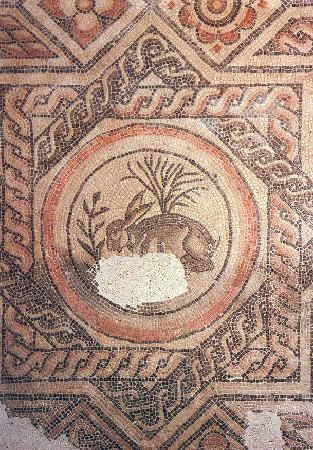
The Easter Bunny in Roman Britain (or not): The famous Hare mosaic from Cirencester. – Photo courtesy of Tripadvisor (source: http://media-cdn.tripadvisor.com/media/photo-s/01/11/9d/e4/the-museum-s-famous-hare.jpg)

The Easter Bunny in Roman Britain (or not): The famous Hare mosaic from Cirencester. – Photo courtesy of Tripadvisor (source: http://media-cdn.tripadvisor.com/media/photo-s/01/11/9d/e4/the-museum-s-famous-hare.jpg)

Easter tends to be a most cheerful holiday for Christians – and Not-Quite-So-Christians – all over the world, an occasion on which public life is suspended: celebrated in early spring, when nature finally resumes its life and the sun starts to feel warm again, Easter is a holiday of hope and peacefulness, celebrating the resurrection of Jesus following his crucifixion on Good Friday.

As Easter is eagerly awaited by children across the globe (just as much as by the chocolate industry), the following two ancient Easter tales may provide a somewhat different perspective.

The deep meaning of Easter, for devout Christians, has a long tradition. One can only begin to fathom the joy, for example, which the early Christians must have felt when their offspring was born around Holy Week.

An expression of such joy can be seen in an inscription from the city of Rome – an inscription that has Easter written all over it (ICUR VI 15895 = ILCV 1541):

Natus <p>uer nomine Pascasius | dies pascales prid(ie) Nov(as) (!) April<es> | die Iobis (!) Fl(avio) Constantino | et Rufo vv(iris) cc(larissimis) conss(ulibus) qui vixit | annorum VI percepit | XI Kal(endas) Maias et albas suas | octabas (!) pascae ad sepulcrum | deposuit d(ie) IIII Kal(endas) Mai(as) Fl(avio) Basilio | v(iro) c(larissimo) c[ons(ule)].

A boy named Pascasius – he was born on 4 April, a Dies Iovis (Thursday), of Easter week, during the consulship of Flavius Constantinus and Rufus, the viri clarissimi [A. D. 457]. He lived for six years, was baptised on 21 April and he deposited at the tomb his albs on the eighth day of Easter, on 28 April, under the consulship of Flavius Basilius, vir clarissimus [A. D. 463].

Initially, the inscription may not seem to convey much of the happiness or sadness, respectively, that the parents must have felt about their son’s birth and death around Easter: instead it focuses on the Easter motive itself (which gets somewhat lost in the heavy-handed indications of dates for birth, baptism, and death).

It is possible to go further, however, and to discover some of the parental feelings as they lie hidden in this text. As their boy was born during Easter week A. D. 457, the parents decided to name him Pasc(h)asius – a talking name, derived from pascha, the Latin(ised) term for the Easter holiday.

Alas, their boy was short-lived and died at the age of six – just a week after Easter, still wearing his white outfit as typically worn for the baptism (which in the early stages of Christianity was a sacrament linked to Easter specifically).

A rather more gripping expression still, document to the joy and hope that was Easter to members of the early Christian church, can be seen in a funerary inscription from Manastirine (Solin/Salona, in modern-day Croatia). In this text, the parents of a daughter – a girl called Flavia – all too soon after the birth of their child had to mourn her early demise (CIL III 9586 = ILCV 1523 = ILJug 2364):

Flaviae infanti dulcissimae, quae sa|na mente salutifero die Paschae glo|riosi fontis gratiam con[sec]uta est | supervixitque post baptismum sanctum | mensibus quinque. vix(it) ann(os) III m(enses) X d(ies) VII. | Flavianus et Archelais parentes filiae | piissimae. | depositio XV Kalendas Septembres.

For Flavia, the sweetest baby, who, of sound mind, on the redeeming day of Easter, obtained the grace of the glorious font, and survived, after the blessed baptism, for five months. She lived 3 years, 10 months, 7 days. Flavianus and Archelais, the parents, for their most beloved daughter. Buried 18 August.

The text, inscribed on a sarcophagus in the 4th century A. D., stresses the salubrious, redeeming nature of the Easter holiday, as perceived by this family. The parents would appear to stress just how the neophyte’s baptism helped their daughter Flavia to live for another five months, before she died so very young – just under the age of four.

The day of Easter itself is described as salutiferus, ‘a bringer of health’ or ‘a bringer of salvation’, and Flavia’s fate, after her baptism, is referred to as supervivere, ‘to survive’, ‘to continue to live’.

Both expressions convey a sense of hope, of reaching for the unreachable – making it likely that the child was ailing to a degree that an additional five months were indeed perceived as a blessing: a very personal Easter miracle for Flavianus and Archelais, granting their daughter, too, as it would appear, at least five months of additional lifetime.

Posted in Epigraphy, Prose | Tagged , , | 1 Comment

Why Learn a Foreign Language?

The following considerations were part of a paper presented at a British Academy Early Careers Regional Event: ‘Linguistic Diversity and Cultural Identities in Europe: Oral Voices and Literary Languages (Eurotales: an Exhibiting and Museographical Experiment)’ on 11 April 2014 in Reading (organised by Dr Nadia Cannata, hosted by Dr Paola Nasti, and sponsored by Prof. Brian Richardson, FBA).

Dealing with the confusion of tongues

Multilingualism and foreign language education are topics that feature regularly in the news.

Most recently, there was the publication of a report that shows how numbers of students who are to take up modern language degree courses at University keep dropping – accompanied by government announcements of sweeping changes to the school curriculum. At the same time, even communication in one’s own mother tongue may pose some interesting challenges.

About time, therefore, to revert to the topic of ancient multilingualism and its evidence in the Latin inscriptions!

A while ago, I published a blog entry discussing the ‘Uses and Benefits of Multilingualism‘, exploring the evidence from a funerary inscription from Roman North Africa. As I pointed out on that occasion, ‘in addition to Rome and some Italic regions, Africa is in fact the sole area of the Roman Empire in which multilingualism seems to have made it into the canon of topoi on funerary inscriptions’.

This may make a lot of sense in the contest of multilingual North Africa. But how does the same subject get presented in Mainland Italy?

Just how many languages did they speak…?

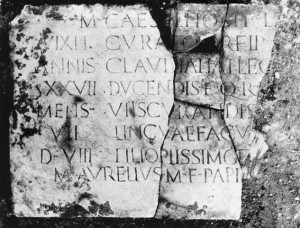
Inscription for Marcus Caesellius. – Image source: http://db.edcs.eu/epigr/bilder.php?bild=PH0008042

Inscription for Marcus Caesellius. – Image source: http://db.edcs.eu/epigr/bilder.php?bild=PH0008042

Let us consider someone, from the city of Rome, who – to say the least – was a good speaker.

Marcus Caesellius was a member of the senatorial class, who lived around the first half of the third century A. D. We know of him from a sizeable inscribed marble tablet (90 x 75 cm survive), discovered in Rome at the Via Appia, by the Casale San Paolo.

The text of his funerary inscription – fragmented, but restored by Géza Alföldy in CIL volume VI 8.3 – reads as follows (CIL VI 41218):

  • First line:

M(arco) Caesellio M(arci) f(ilio) La[eliano?]

To Marcus Caesellius Laelianus (?), Son of Marcus.

  • Left column:

Vixit
annis
XXVII
mens(ibus)
VII
d(iebus) VIII.

He lived 27 years, 7 months, 8 days.

  • Right column:

Curator[i] rei p(ublicae) [- – – sodali Augustali]
Claudiali allec[to inter quaestorios VIvir(o) turmis]
ducendis eq(uitum) R(omanorum) [trib(uno) mil(itum) leg(ionis) – – – IIIIvir(o)]
viis curandis [- – – utriusque]
linguae facu[ndissimo in causis incomparabili]
filio piissimo e[t – – -].

Curator Rei Publicae … sodalis Augustalis Claudialis, co-opted to the quaestorian rank, sevir turmis ducendis equitum Romanorum, military tribue of the … legion, quattuorvir viis curandis … most eloquent in either language, incomparable in legal cases, the most dutiful son and …

  • Bottom line:

M(arcus) Aurelius M(arci) f(ilius) Papi[rius Socrates v(ir) p(erfectissimus) pater filio fecit].

Marcus Aurelius Papirius Socrates, son of Marcus, vir perfectissimus, the father, had this made for his son.

Caesellius, a lawyer among other things, has thus been restored to have been utriusque linguae facundissimus, ‘most eloquent in either language’, i. e. Latin and Greek.

The surviving part of the inscription (in the right-hand column), however, only documents that he was ‘most eloquent in a language’, but does not specify which one (or how many). Caesellius brother, whose inscription also survives (CIL VI 41219), however, has only been described as Latinae linguae facundissimus, ‘most eloquent in Latin’ – an inscription that otherwise is very similar to that of Caesellius.

Considering how Caesellius’ inscription, above, is fragmented, one cannot be absolutely positive that Alföldy’s supplement utriusque (‘eloquent in either language’) is correct. It is possible that Caesellius was ‘just’ extremely good at Latin.

Yet, Alföldy’s supplement is altogether convincing due to the space that needs to be filled, most likely – a measure, which can be calculated from other lines.

Be that as it may, the Caesellius inscription raises a number of important questions:

  1. Why the desire to commemorate someone’s linguistic abilities on a tombstone?
  2. Was the level of multilingualism truly exceptional?
  3. What does this tell us about multilingualism, orality, and literary language – if anything?

And, of course … why would it be noteworthy, in the city of Rome herself, to emphasise one’s ability to speak Latin well…?

Considering the Context

It seems sensible to contextualise the above inscription within the wider context of evidence for multilingualism in the Latin inscriptions.

For the purposes of this presentation, I will not consider texts that clearly are bilingual (as they do not necessarily relate to the honorand’s own abilities).

I will not consider, either, Greek inscriptions that highlight multilingualism, as, under the Roman Empire, at least a minimum amount of multilingualism that involve Latin is to be expected. (It could be rather interesting, of course, to compare varying strategies across the main linguistic divide of the Empire, but that is a different matter.)

It then is important to remind oneself of a few essential issues:

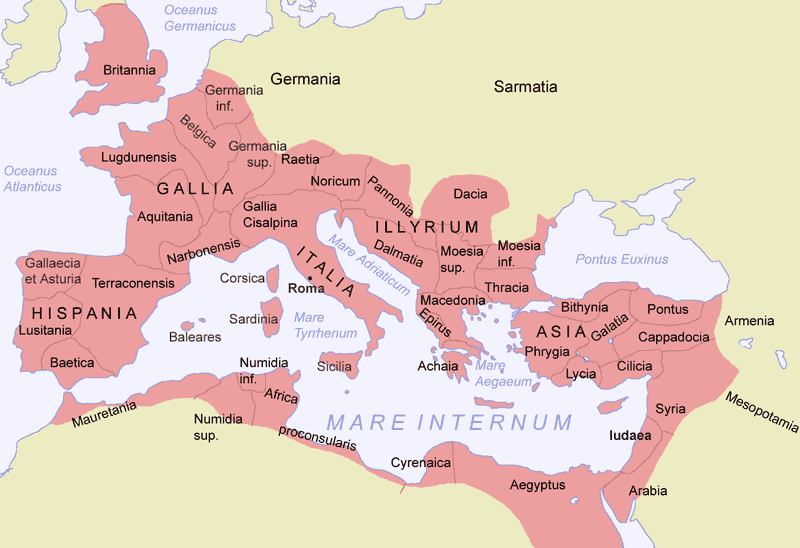
  • Giving an idea of space: the dimensions of the Roman Empire. – Image source: http://upload.wikimedia.org/wikipedia/commons/c/ca/Roman_Empire_Map.png

    Giving an idea of space: the dimensions of the Roman Empire. – Image source: http://upload.wikimedia.org/wikipedia/commons/c/ca/Roman_Empire_Map.png

    The Latin language was a language actively spoken for almost 1,500 years, taking its name from the region of Latium, the geographical context of the City of Rome. From being the language of a small city state, initially, it eventually became the language of an empire that spanned from Britain to middle East, from Scotland and the Netherlands to the Egyptian desert.

  • We can study the development of Latin, following the established systematic of Eugen Coseriu, from a number of different perspectives: diachronic (throughout time), diatopic (throughout space), diastratic (throughout society), diaphasic (across registers and technical language uses), and diamesic (with emphasis on the medium). Typically, however, scholarship focuses on the first two (variation throughout time and space, with some interest in social variation, with an oversimplifying concept of upper/lower classes).
  • Bi- and multilingualism, across time and space (at the very least) was a fluctuating, complex phenomenon, and we must do away with the simplistic Greek/Latin divide that we are accustomed to. The recent classics on this matter, Bilingualism and the Latin Language as well as The Regional Diversification of Latin, 200 BC – AD 600, both authored by Jim Adams, give an impressive idea of the number of languages that one must take into account as spoken alongside Latin.
  • Language, linguistic diversity, and cultural identity are concepts deeply interrelated. How is this negotiated, how is it regulated? Chances are that, in our evidence, we will but get but a minimal glimpse of the true picture.
  • Literary language, as well as technical languages (in the case of our Roman lawyer, Caesellius), are but reduced varieties of a rather more complex whole, the entity that I would like to call ‘Latin’. While we tend to focus on these, they may constitute not even the most significant part of ancient reality – where much stronger emphasis needs to be placed upon spoken language than today (or so it tends to be claimed).

Looking at the evidence for multilingualism in the documented Latin inscriptions, one soon begins to discover some interesting peculiarities.

The most interesting peculiarity that emerges is what has been stated initially: there are but two (or three) main geographical contexts for such texts: i) Italy (and, as potentially different from that, the city of Rome herself), and ii) Roman North Africa.

There (so far) does not appear to be any evidence for such comments from Britain, Spain, France, or Germany, to cover the main Western (Latin-speaking) provinces, from which one certainly could expect similar evidence.

Could there be an explanation for that? We have considered potential reasons for such texts in Africa. But what about Italy and Rome herself?

Commemorating Bilingualism in Latin Inscriptions from Mainland Italy

Here is the evidence from mainland Italy – minus a mention in the famous funerary poem for Vettius Agorius Praetextatus, a high-ranking member of the elite and holder of numerous priesthoods (which, while complex in and by itself, does not add anything to the overall picture).

On average, the date of the following inscriptions falls into the later Roman Empire rather than earlier times.

  • From Rome – a Christian poem (ICUR IV 10888 = ILCV 729 add. = CLE 1964):

Priscorum interpres vatum doctorq(ue) [bilinguis]
Deuterius placida securus pace quiescit.

Translator of old poets, teacher, bilingual, Deuterius rests, free from sorrows, in placid peace.

  • Equally from Rome and again with a Christian background (CIL VI 33929 = ICUR I 1978 = ILCV 742 add.):

Dalmatio filio dulcissimo toti|us ingeniositatis ac sapienti|ae puero quem plenis septem an|nis perfrui patri infelici non licu|it qui studens litteras Graecas non | monstratas sibi Latinas adripuit et in | triduo ereptus est rebus humanis III Id(us) Fe(b)r(uarias) | natus VIII Kal(endas) Apr(iles) Dalmatius pater fec(it).

For Dalmatius, the sweetest son, of utter ingenuity and intellect, a boy whose company the hapless father was not even allowed to enjoy for seven full years, a boy, who acquired Greek and thus acquired Latin, too, even though it was not even shown to him: he was snatched away from this world on 11 February, born on 25 March: Dalmatius, the father, had this made.

  • From Pozzuoli (CIL X 1779):

D(is) M(anibus) | T(ito) Fl(avio) Antonino nep(oti) | Fl(avii) Antonini p(rimi)p(ilaris) font(?) | litter(is) Graec(is) et La|tinis qui vix(it) ann(os) XVIIII | m(enses) II d(ies) XXII parent(es) infelic(es).

To the Spirits of the Departed. For Titus Flavius Antoninus, grandson of Flavius Antoninus, primipilaris (…) in Greek and Latin writings, who lived 19 years, 2 months, 22 days: the hapless parents.

  • From Piacenza (CIL XI 1236):

V(ivus) f(ecit) | C(aius) Terentius | Fructus | sibi et | Attico ser(vo) | qui vixit ann(os) | XX litteratus | Graecis et Latinis | librarius | partes dixit CCC. | in fr(onte) p(edes) XV | in ag(ro) p(edes) XXV.

While still alive, Gaius Terentius Fructus had this made for himself and for Atticus, his slave, who lived for 20 years, well trained in Greek and Latin, book copier, capable of doing divisions by (up to?) 300. 15 feet wide, 25 feet deep.

  • From Alife (CIL IX 2340):

Q(uinto) E(gnatio?) G(allieno?) L(- – -) L(- – -) Tarronio Pisonino c(larissimo) v(iro) | nobili genere nato | [G]raecis ac Latinis litteris | erudito Q(uintus) E(gnatius?) G(allienus?) Perpetuus v(ir) c(larissimus) | pater fecit | annos vixit n(umero) XVIII mens(es) n(umero) X d(ies) n(umero) XXII.

For Quintus Egnatius (?) Gallienus (?) L. L. Tarronius Pisoninus, vir clarissimus, offspring of a noble family, educated in Greek and Latin literature: Quintus Egnatius (?) Gallienus (?) Perpetuus, vir clarissmimus, the father, had this made. He lived 18 years, 10 months, and 22 days by number, respectively.

Making Sense of the Evidence

To be sure, the aforementioned inscriptions are altogether unrelated to one another.

Yet they come with a complex common theme, as far as their mention of multiple languages is concerned: this complex theme can be outlined as follows: they all combine assertion of general education and learnedness with a claim to linguistic competence and reference to social class (or, failing that, age, if the latter is remarkable).

All the texts are document to a certain social aspiration – whether it is the patron who makes a case for his slave, or the father for his young son, or someone for a learned translator of Graeco-Roman poetry.

One must also stress the peculiarity that the evidence crosses the divide of pagan and Christian – noteworthy, as, in terms of education and its relation to Roman pagan upper-class behaviour, Christian instruction occasionally varies rather significantly from its pagan counterpart.

In that respect, one can observe a marked difference from the statements made in these late texts from the Appennine peninsula (where mention of Latin skills should barely constitute praise, unless they are truly exceptional!) and the behaviour that was established for the African counterpart: in mainland Italy, multilingualism, where it reaches a certain level, is a value that one may promote even in the context of funerary inscription as a claim to superior education and as an expression of social aspiration.

Would one advertise multilingualism on tombstones e. g. in 21st century Britain? Hardly. But it is worth thinking about the question as to whether how we do, and how we should, value the same competencies: in the Italic way (as an assertion of class and standing), or in the way the inscription from Ammaedara suggested: as an expression of education that supports one’s entrepreneurial spirit?

Posted in Education, Epigraphy | Tagged , | Comments Off on Why Learn a Foreign Language?

Misappropriation and Misapprehension: Vergil on 9/11

Memorials are difficult: what do we wish to remember, and how, and why? This becomes all the more apparent, the more prominent and the more emotive a monument is in its context.

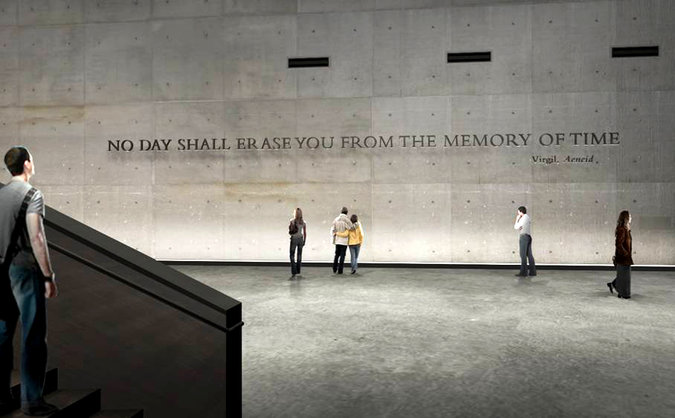
Recently, there has been some (renewed) debate over the use of a quotation from Vergil’s Aeneid (Aen. 9.447) for the  9/11 memorial in New York.

The memorial, the critics say, allegedly ‘misuses a passage’ by removing it from its original context – commemorating the death of friends rather than mourning randomly inflicted carnage.

In the line’s original context, the poet celebrates his poetic prowess that will result in eternal memory of Nisus and Euryalus, two valiant Trojan warriors, who were close friends (with clear homoerotic undertones in the narrative).

The line(s) in question read thus (Verg. Aen. 9.446-9; translation from here):

Fortunati ambo! si quid mea carmina possunt,
nulla dies umquam memori vos eximet aevo,
dum domus Aeneae Capitoli immobile saxum
accolet imperiumque pater Romanus habebit.

Happy pair! If my poetry has the power,
while the House of Aeneas lives beside the Capitol’s
immobile stone, and a Roman leader rules the Empire,
no day will raze you from time’s memory.

Line 447 (nulla dies umquam memori vos eximet aevo), rendered ‘no day shall erase you from the memory of time’ in the memorial’s inscription, invokes Euryalus’ own words, some two-hundred lines earlier (Aen. 9.281-3):

(…): me nulla dies tam fortibus ausis
dissimilem arguerit; tantum fortuna secunda
haud adversa cadat. (…)

(…) No day will ever find me separated from such
bold action: inasmuch as fortune proves kind
and not cruel. (…)

At any rate, Vergil’s line (as is true for many lines of many of the classical poets) appears to have become somewhat iconic already in antiquity – one can find it, for example, almost verbatim, in a funerary poem from the City of Rome (CIL VI 25427 = CLE 1142, final lines):

fortunati ambo si qua est ea gloria mortis
quos iungit tumulus iunxerat ut thalamus.

Happy pair, if there is something to that glory of death,
as their tomb had united them like a bedchamber.

One may, of course, wonder if it is a case of ‘misappropriation’ of Vergil’s lines that happens in the 9/11 memorial – as opposed to that Roman tombstone, where the setting is not altogether dissimilar to that in the Aeneid.

Before one jumps to bold conclusions, however, one should be mindful of the fact that Vergil himself was one of the keenest promoters of such forms of ‘misappropriations’, except that in his case we tend to think of artistic borrowings.

The line in question, as used in the 9/11 memorial, is an example of that. Some five years before Vergil died (and left an unfinished Aeneid to be burnt by the Emperor Augustus), Propertius had written the exact same thing – at Elegies 3.2.25-6, which in turn is a reference to Horace’s famous Ode 3.30 monumentum exegi aere perennius (translation from here):

fortunata, meo si qua es celebrata libello!
    carmina erunt formae tot monumenta tuae.
nam neque pyramidum sumptus ad sidera ducti,
    nec Iovis Elei caelum imitata domus, (20)
nec Mausolei dives fortuna sepulcri
    mortis ab extrema condicione vacant.
aut illis flamma aut imber subducet honores,
    annorum aut tacito pondere victa ruent.
at non ingenio quaesitum nomen ab aevo   (25)
    excidet: ingenio stat sine morte decus.

Happy the girl, who’s famed in my book! My poems are so many records of your beauty. The Pyramids reared to the stars, at such expense; Jupiter’s shrine at Elis that echoes heaven; the precious wealth of the tomb of Mausolos; not one can escape that final state of death. Their beauty is taken, by fire, by rain, by the thud of the years: ruined; their weight all overthrown. But the name I’ve earned, with my wit, will not be razed by time: Mind stands firm, a deathless ornament.

Propertius celebrates the fame of the girls he commemorates in his erotic elegies – so is Vergil, too, to blame of misappropriation?

Be that as it may.

Vergil’s line, borrowed by those who designed the 9/11 monument, has a history in the context of funerary commemoration – both in literary imagination and in real life (and death), and its context reminds us that there are things more lasting than any built structure ever will be (with the possible exception of the Egyptian pyramids): poetry.

This may not be such a bad thing to remember.

Whether this is what we were supposed to remember, as intended by those who used the line, is a different matter, of course.

Posted in Carmina Epigraphica, Epigraphy, Poetry | Tagged , , | Comments Off on Misappropriation and Misapprehension: Vergil on 9/11

Waxing Poetic: Bees and Death (and Bee Death)

The issue, and in fact the very idea, of bee death and colony collapses – a constant feature of the news for a number of years now – is deeply worrying and unsettling: how will we all survive, if the pollinators die – the pollinators of the very crops that we need in huge amounts?

The most recent addition to the record of bad news in this regard, as to be published in the UN’s Intergovernmental Panel on Climate Change (IPCC) report, is our growing understanding and appreciation of the impact of climate change on food security.

Long-term changes to our climate may have a significant impact on the cycles of the life of animals and plants, including that of plants and bees, and it remains to be seen just how easily pollinators will be able to adapt their life cycles to a changing dynamic of the flora.

The study of evolution has taught us, of course, that nature is likely to find a way to respond to changing environments (though not, perhaps, to the rapid changes inflicted to it by human civilisations).

This raises an interesting question: considering that we cannot actually predict how nature is going to change (and to cope) with the ongoing threat to current types of pollinators, how come we feel so strongly about them?

Clearly, popular responses to issues such as bee death and colony collapse are not informed first and foremost by the fundamental understanding of the relevance of pollination alone.

Much rather, it would seem that, the life-threatening significance to one side, the concept of ‘bee death’ in itself has an almost poetic – fundamentally tragic – ring to it.

The honey bee is an animal that to us, perhaps like no other, is associated with life and the sweetness of life itself. The mythic symbolism of the bee is ancient and complex. The Roman poet Vergil, in a famous passage of his Georgics, celebrates the bees – as an instructive foil for human life, labour, and statal organisation (georg. 4.1–280).

A one-line poem from Pompeii cuts right to the chase as regards the symbolism of bees (CIL IV 8408a):

Amantes ut apes vita(m) mellita(m) exigunt.

Lovers, like bees, lead a honey-sweet life.

So how can these animals, in the phrase ‘bee death’, possibly be brought together with something as cruel and terminal) as death . . . ?

Interestingly enough, in ancient Greece and Rome, bees played a major role in funerary cults – as a symbol of hope, afterlife, and resurrection.

A number of poetic inscriptions attest to this, when they mention that the monuments of the dead have turned into a shelter of (bee) life. A funerary poem from the City of Rome goes as far as representing the very tomb itself as a beehive (CIL VI 30113 = CLE 1262):

– – – – – –
sic pia, sic felix, sic quod vita beata

contigit et cunctis auxilians bonitas.
nos tamen hic cruciat dolor intimus et pia cura,
quod te festinans apstulit atra dies.
numina tunc inferna, precor, patri date lucos
in quis purpureus perpetuusque dies.
hic certe ut meruit cunctast data cura sepulcro
texeruntque favi de Siculis apibus.

(…) so dutiful, so lucky, so happy a life he held, and a good nature that came to the help of everyone. But us hurts this pain, deep inside, and dutiful care, for a black day snatched you away rapidly. Spirits of the Underworld, I beseech you, give our father a grove in which there is crimson, eternal daylight. Here, as he deserved, every care has been given to the tomb itself, covered in honeycomb from Sicilian bees.

This must be seen in conjunction with a couple of texts – again poetry from Roman tombstones – that reflect on the ‘secondary’ (involuntary, yet poetic) use of funerary monuments as nesting site for wild bees.

A monument from Arles (Arelate) offers the following text (CIL XII 743 = CLE 454):

Aeliae Aelia[nae].
Littera qui nosti lege casum et d[ole puellae]:
multi sarcophagum dicunt quod cons[umit artus],
set conclusa decens apibus domus ist[a vocanda].
o nefas indignum iacet hic praecla[ra puella],
hoc plus quam dolor est, rapta est specios[a puella].
pervixit virgo ubi iam matura placebat,
nuptias indixit, gaudebant vota parentes:
vixit enim ann(os) XVII et menses VII diesque XVIII.
o felice patrem qui non vidit tale dolorem.
heret et in fixo pectore volnus Dionysiadi matri
et iunctam secum Geron pater tenet ipse puellam.

For Aelia Aeliana. You, who know the letters, read of a girl’s fate and feel the pain: many call a sarcophagus what consumes the limbs: but one must call this a house for bees, shut, and proper. Oh, here lies – an unworthy sacrilege! – a beautiful girl: this is more than just pain, an attractive girl has been snatched away. The girl lived to enjoy aspects of maturity, she announced her marriage, the parents were delighted over the pledge: for she lived 17 years, 7 months, and 18 days. Oh lucky father, who did not get to see such pain. Dionysias, the mother, has a wound tacked onto her heart, and, united with himself, Geron, the father, himself holds the girl.

The poem, expressing a mother’s mourning over the loss of her daughter (and her husband), playfully explores the term ‘sarcophagus’ (literally: ‘flesh-eater’), suggesting that this is in fact a misnomer: the coffin does not (or so the inscription suggest) consume the flesh of the dead, it gives a home to the bees, who will eventually inhabit this as their decens domus, their proper home.

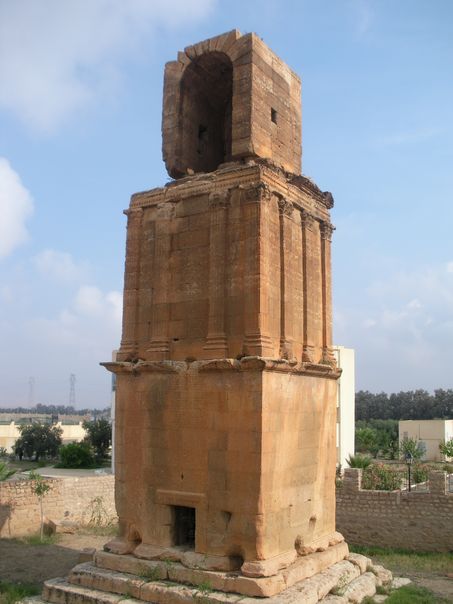
Monument of the Flavii at Kasserine. – Image Source: http://db.edcs.eu/epigr/bilder/$CIL_08_11300b_2.jpg

Monument of the Flavii at Kasserine. – Image Source: http://db.edcs.eu/epigr/bilder/$CIL_08_11300b_2.jpg

The same idea is driven to an even higher level, adding olfactory sensations to the artifice, in a famous, very long poem from the extraordinary monument of the Flavii at Kasserine (Cillium).

The relevant passages of the poem(s) – poems that consist of a total of 110 lines – read as follows: (CIL VIII 212=11300b = CLE 1552a and CIL VIII 213=11300c = CLE 1552b):

quid non docta facit pietas: lapis ecce foratus
luminibus multis hortatur currere blandas
intus apes et cerineos componere nidos
ut semper domus haec thymbraeo nectare dulcis
sudet florisapos dum dant nova mella liquores.

What does a sense of filial duty not achieve: behold, the gaping stonework, with many a light crack, invites enchanting bees to go inside and to build their waxy nests, so that this home forever will exude a sweet scent from the nectar of thyme, when new honey produces flower-dripping juices.

Driving the imagery just as much to an extreme as the entire monument, this poet sees the way in which a stone structure allows nature to take its course as an act of ancestor worship: bees that nest in the monument will eternally provide a sweet scent worthy of the revered ancestor.

The poet was so taken by the idea that he reverts to it in a twenty-lines postscript to the poem itself (just to make sure the monument’s (sadly lost) weather vane, in the shape of a cockerel, does receive mention as well!). The passage in question, offering a spectacular backdrop for the final punchline, reads as follows:

Huc iterum, pietas, venerandas erige mentes
et mea quo nosti carmina more fove.
ecce Secundus adest iterum qui pectore sancto
non monimenta patri, sed nova templa dedit.
quo nunc Calliope gemino me limite cogis
quas iam transegi rusus adire vias:
nempe fuit nobis operis descriptio magni:
diximus et iunctis saxa polita locis
circuitus nemorum currentes dulciter undas
atque reportantes mella frequenter apes.

Filial duty, direct your worshipful mind to this place again and support my poems in your accustomed fashion. Behold, Secundus is back once again, who, in a reverent frame of mind, gave his father not so much a monument, but a new type of temple. Calliope, you now force me, in a double path, to walk the ways that I had already passed: indeed, we gave a description of the great work: we mentioned the stones, polished and carefully arranged, the waves, running sweet through the adjacent groves, and the bees, that frequently bring back the honey.

Here, in the inscription from Kasserine, the bees have become virtually the sacred priests that support the worship of the human dead.

It is hard to imagine what a world without bees would look like, and we all should hope that it does not come to that. The loss would not only be a factual one – it would be a highly symbolic loss as well, a loss that goes to the core of a human symbolism that existed since ancient times.

Posted in Carmina Epigraphica, Epigraphy, Poetry | Tagged , , | Comments Off on Waxing Poetic: Bees and Death (and Bee Death)

Discussing Cicero, Against Verres II 1.53 ff. (for A-level students)

Reading’s Department of Classics was delighted to host the 2014 Ancient World Study Day on March 26th.

On this occasion, I was invited to offer a talk on Cicero’s speech In Verrem 2.1.53 ff., the OCR set text for 2014, which I have now made available on YouTube:

http://www.youtube.com/watch?v=5QdpZvJvfQ4

The handout to accompany this lecture can be obtained from here: 2014_Verres_HO (pdf format).

Posted in Education, Prose | Tagged | Comments Off on Discussing Cicero, Against Verres II 1.53 ff. (for A-level students)

The cold grave that is the deep, deep sea

There still is no (confirmed) trace of Malaysian Airlines Flight MH370. The last few days, however, saw a number of reports that focused on (potential) debris in the Indian Ocean, and the continuous silence of flight systems and crew, passengers, or potential hijackers would appear to render a crash into the ocean the most likely scenario at this stage.

One can only imagine the ordeal relatives of the occupants of the plane continue to go through – the absence of answers, of certainty, of closure must be deeply unsettling (and hard to understand, to say the least, in age that has become the paragon of data collection and world-wide surveillance).

The desire to locate the final resting place of one’s relatives, the wish to mark it in a religious or quasi-religious manner, appears to be deeply rooted in human nature – what else (apart from the rather worldly issue of insurance claims, sadly, as well as the – mostly unrealistic – hope to find survivors at long last) would be the explanation for the expensive hunt for the remains of those who were lost in plain crashes in remote areas?

In the ancient world, the hope to retrieve the bodies of victims of shipwrecks, and to bury them, must have been rather limited to begin with. Yet, as inscriptions show, it was not completely out of the question. The following text from Autun is one such example (CIL XIII 2718):

Eufronia Euf[r(oni)] | filia et m[at(er)] | naufragio |necta nat[a] | pri(die) Kal(endas) No[v(embres)] | percepit | III Id(us) April(es) | decessit pri(die) Kal(endas) Mai(as).

Eufronia, daughter of Eufronius and a mother, killed in a shipwreck (sc. lies here). Born on 31 October, gave birth on 11 April, died 30 April.

Something similar appears to apply in a text from Chester (RIB I 544):

[- – – – – -] | opt[i]onis ad spem | ordinis | (centuria) Lucili | Ingenui qui | naufragio perit | s(itus) e(st).

[- – – – – -], of the Optio-soon-to-be-promoted, in the century of Lucilius Ingenuus, who had died in a shipwreck, lies here.

A rather more common scenario, however, should be that of a body missing – a fate that, for those left behind, results in the need to come up with a cenotaph.

One such example is reported in the tombstone of a boy named Ursinus, in a tombstone that was discovered at Baška Voda (in the Roman province of Dalmatia, now Croatia). The text, partly poetic in nature, tells of his father’s pains when uncertainty had become certainty after all (CIL III 1899 = CLE 826):

D(is) M(anibus) | M(arcus) Allius | Firminus | Ursino f(ilio) | C(ai) Septimi | Carpopo|ri delica|to infeli|cissimo p(uero) | naufragio | obito an(norum) XI | cuius mem|bra consum|sit maris | per | se quot nomen | titulus praestat | suisq(ue) dolorem.

To the spirits of the departed. Marcus Allius Firminus for his son Ursinus, delight of Gaius Septimius Carpoporus, a most unlucky boy, who died in a shipwreck at the age of eleven, whose body the sea has devoured. How many a time does an inscription display a name on it – and thus bring pain to the relatives.

Similarly, an funerary poem from Ravenna tells the following story (CIL XI 188 = CLE 1210):

Duo Iuvan(ensium?) Lupi et Apri. | una Iuvaniae domus | hos produxit alumnos. | libertatis opus contulit una dies | naufraga mors pariter rapuit | quos iunxerat ante | et duplices luctus | sic periniqua dedit.

[This is the monument of] two from Iuvanum (?), Lupus and Aper. One house in Iuvanum brought forth these two as its foster-children, a single day bestowed the gift of liberty upon them. [The fate of] death in shipwreck snatched away alike those whom it had united before, and thus, most unfairly, brought about double grief.

Another poeticising  variation on the same motive was discovered in Padua (CIL V 3014 = CLE 2209):

D(is) M(anibus). | P(ublio) Pom(peio?) | Firmo | infelic(issimo) | quem ma|ris apstulit | undis  Iul(ia) | Olympia ma|rito b(ene) m(erenti) p(osuit).

To the spirits of the departed. For Publius Pompeius (?) Firmus, the most wretched, who was snatched away by the waves of the sea: Iulia Olympia had this erected for her well-deserving husband.

Or in a prose text from Ancona (CIL IX 5920):

D(is) M(anibus). | M(arco) Gratio Co|ronario qui | in mare vi tem|pestatis deces(sit) | Scaefia Calliope | coniugi optimo | et Scaefiae Ter|tullae filiae d|ulcissimae quae | vixit annum d(ies) XIII | b(ene) m(erenti).

To the spirits of the departed. For Marcus Gratius Coronarius who died at sea due to the force of a storm: Scaefia Calliope had this erected for the best husband and for Scaefia Tertulla, her sweetest daughter, who lived one year and thirteen days: she was well deserving.

Occasionally, Latin funerary inscriptions do not spare grim and gruesome detail. One such text from Solin in Dalmatia (Croatia), for example, reminds us that even those who already were with one foot in the cold grave that is the deep, deep sea and then managed to escape this fate, are not necessarily safe from a horrendous death soon afterwards (CIL III 8910):

[n]aufragio exi|sse annum | vertentem |vixisse pos an|num mano uma|na sublatum | esse Aur(elius) Aeladi(us) | pater filio pi|entissimo | pos(uit).

Escaped from a shipwreck, lived over the course of a year, then killed by a human hand. Aurelius Aeladius, the father, had this erected for his most dutiful son.

All these texts are testimony to grim fates and deep grief of those left behind. Yet, they also are an expression of the desire to cope and to come to terms with a traumatic loss.

One must hope that this step will soon become possible for those who experience deep anguish over the fate of their beloved ones aboard the Malaysian Airlines flight.

Posted in Carmina Epigraphica, Epigraphy | Tagged , | Comments Off on The cold grave that is the deep, deep sea

Disappearing into thin air

The mysterious story of Malaysian Airlines Flight MH370 is likely to fill news media for the foreseeable future: how can a Boeing 777 disappear into thin air? What happened to its passengers? Who was (or is) involved in this?

The vast majority of those who read about the story will respond in two obvious ways: i) curiosity, and potentially anxiety, over the bewildering notion that an entire airplane can just disappear without leaving any traces (assuming that official sources have made available all relevant information), and ii) suspense, eager to hear the end of it.

Those, however, who had their relatives and friends on board this aeroplane must feel differently. Torn between hope and despair: the hope that there will be closure, the hope perhaps that someone (or everyone) will have survived whatever has happened – and despair over one’s own powerlessness to find a solution, over the deeply disturbing silence from the aircraft’s instruments (and those on board, of course), and, if one is to fear the worst, over the absence of a space for mourning.

It would be cynical and deeply inappropriate to point out that similar or worse has happened to others before. It would be both obvious and unhelpful to point out that governments may well do more to ensure the security of air travel (without merely hiking up the already ludicrous security checks at airports). Yet, offering somewhat of a perspective may not be an altogether mistaken idea.

Ancient literature is full of stories about abductions, disappearances, and reappearances. In fact, already the Iliad has the story of an abduction at its very heart, and throughout its narrative numerous people disappear and return, sometimes under rather bizarre circumstances and with divine interference. Engagement with such literary imaginations may help to address both the depths of human fantasy and real-life trauma.

But what if these stories become reality? How can one cope?

Without offering any interpretation or insight on what has happened with flight MH370, it may not come amiss to note a handful of ancient Roman inscriptions that report potentially similar scenarios and that, sometimes with vivid immediacy, outline the horror, the sorrows, and the coping mechanisms of those left behind.

The texts follow in no specific order. They do not represent ‘a full picture’ by any means. They are what they are: anecdotal evidence for life and death in the Roman world, as told by those left behind.

1. CIL III 2544 = CLE 818: Funerary inscription for a man abducted by bandits (fragmentary)

C(aio) Tadio C(ai) f(ilio) Severo | abducto a latronibus | ann(orum) XXXV et | Proculo f(ilio) ann(orum) VI | [- – -]bricia L(uci) l(iberta) Primigen(ia) |[co]niugi et filio pos(u)it | [fili]us hunc titulum | [debeb]at ponere matri / [- – – – -].

For Gaius Tadius Severus, son of Gaius, abducted by bandits at the age of 35, and his son, Proculus, aged 6, [—]bricia Primigenia, freedwoman of Lucius, had this inscription set up for her husband and her son. The son should have set up an inscription like this for his mother . . .

2. CIL VIII 14608: Inscription for a cenotaph of soldier who died en route

L(ucius) Silicius Opta|tus vix(it) an(nos) L | [i]nterceptus | in itinere | huic veteran[i] | morant[es] | Simittu [de] | suo fecer(unt).

Lucius Silicius Optatus lived for 50 years. He was snatched away en route. The veterans at Simittu had this (monument) made for him at their own expense.

3. AE 1934.209: Fragmentary inscription for a man killed while travelling between Viminacium and Dasminium

D(is) M(anibus) | Fl(avio) Kapitoni liber|to qui casu Vimi|nacium Dasmini a | latronibus atro|cissima(m) mortem | [per]pessus est Fl(avia) Va|[- – -] mater filio | [- – -]S[- – -].

To the Manes. For Flavius Kapito, freedman, who suffered a most horrendous death by the hands of bandits, at random, between Viminacium and Dasminium. Flavia Va[- – -], the mother, for her son . . .

4. CIL XIII 3689 = CLE 618: Funerary poem for a victim of banditry

Qui dolet interitum mentem soletur amore. | tollere mors vitam potuit, post fata superstes | fama viget. periit corpus sed nomen in ore est: | vivit laudatur legitur celebratur amatur. | nuncius Augusti velox pede cursor [- – -] | cui Latiae gentis nomen patriaeque Sabinus | o crudele nefas tulit hic sine crimine mortem | damnatus periit deceptus fraude latronum. | nil scelus egisti. fama est quae nescit obire. | posuit Furius.

He who suffers from the experience of death, finds consolation of his mind in love. Death was able to remove life. After death, however, renown survives and thrives. The body has died, but the name is on everyone’s lips: it lives, it receives praise, it gets read, it is celebrated, it is loved. An imperial messenger, a swift-footed runner . . ., hailing from Latium, of Sabinian descent, o cruel injustice: he was taken, sentenced to death without a cause: he died, deceived by the treacherous acts of bandits. You have done no wrong. It is renown that cannot die. This stone was set up by Furius.

5. CIL II 3479 = CIL II 5928 = CLE 979: Funerary poem for a youth killed by bandits

Q(uintus) Lu(sius) L(uci) f(ilius) Seni[ca] | [moll]em robusteis nondum formata iu(v)ent[us] | [ae]tatem Lusi vi[r]ibus induerat | [cum] carae exoptans conplexum saepe soror[is] | [mul]ta viae dum volt millia conficere | [caeditu]r infesto concur[s]u forte latronum | [sic ra]pit hoc [cla]des corpus acerba nimis | [illa a]etas credo hoc tribuit tempore m[ortis] | [ut b]ona non meminit seic mala ne timeat.

Quintus Lusius Senica, son of Lucius. The beautiful youth of Lusus had not yet equipped his tender age with strength robust enough, when, hoping for many an embrace from his sister, he wished to complete a travel of many miles: he was killed, at random, in a hostile stick-up by bandits: this this disaster, all too bitter, snatches his body. His age, I believe, added something to the time of his death, for just as he did not yet have a concept of the good, he was not afraid of evil.

All of these texts testify to the anxiety of those who are left behind in the event of an accident – accidents that invert the natural order of things, accidents that unexpectedly snatch away those whose death comes altogether unexpectedly. They tell of the anguish as well as of the devastating realisation of what had happened to their loved ones.  They provide a marker of space, of monumental closure, for those who survive – a space to remember and to come to terms with their own traumatic experience. Yet, most of all, perhaps, they offer a glimmer of hope and meaning in events that exceed comprehension.

Posted in Epigraphy | Tagged , , , | 2 Comments

Pliny on Regulus: ‘Will two stories serve you, or must you have a third, according to the canon of the schools?’

The following text was presented at the JACT GCSE Latin and Greek Conference at Westminster School London on 14 March 2014. I am immensely grateful to Ms Katharine Radice for the invitation to this event.

I.

Pliny did not like Regulus. He really did not. The twentieth letter of the second book of the Younger Pliny’s collection of letters – a text that purports to have been sent to one Calvisius Rufus – leaves little doubt: Marcus Aquilius Regulus was a monster, a legacy hunter (in addition to his well-known role as a professional denouncer in court under Nero and Domitian), in short, an altogether despicable person.

Which raises an obvious question: … so what?

Why does Pliny bother to write about him? Are things not bad enough already – do we need a lengthy letter recording this scum’s actions for posterity ? And should we, disregarding any shred of decency ourselves, and in open violation of the secrecy of correspondence and letters, be reading Pliny’s effusions?

The latter question is easily answered. Yes, we should – for Pliny’s letters, as we have received them, are not transcripts of actual letters. They were prepared for publication by the author himself, as he points out in the first letter of his first book, directed to Septicius Clarus, the prefect of the Praetorian guard. There is little reason to believe that a great deal of these letters preserved their original shape as a result of this editorial process – in fact, quite the contrary: there are excellent reasons to believe that Pliny edited them,  and re-wrote them, with a more general audience in mind.

That first letter of the first book is worth looking at in somewhat greater detail still. Pliny writes (Plin. epist. 1.1):

Frequenter hortatus es, ut epistulas, si quas paulo curatius scripsissem, colligerem publicaremque. Collegi non seruato temporis ordine — neque enim historiam componebam –, sed ut quaeque in manus uenerat. Superest ut nec te consilii nec me paeniteat obsequii. Ita enim fiet, ut eas quae adhuc neglectae iacent requiram et si quas addidero non supprimam.

You have often urged me to collect and publish any letters of mine which were composed with some care. I have now made a collection, not keeping to the original order as I was not writing history, but taking them as they came to my hand. It remains for you not to regret having made the suggestion and for me not to regret following it; for then I shall set about recovering any letters which have hitherto been put away and forgotten, and I shall not suppress any which I may write in future.

Letters composed with some care, epistulae quas paulo curatius scripsissem, not in chronological sequence (for that would constitute historia), but ‘as they came to hand’, ut quaeque in manus uenerat. What other ordering principles are there, though, other than ‘chronological’ or ‘by interlocutor’? Pliny’s letters do not follow either principle in their arrangement. And are we looking at a throwaway comment, or was it in fact Pliny’s actual intention to avoid the impression of a chronological historia? But why? And what exactly is his ‘anti-historia, genrewise-speaking?

What I propose to do, for the remainder of my paper today, is to ponder this matter somewhat further, using the twentieth letter of the second book – the letter to Calvisius Rufus, on the subject of Regulus – as my main paradigm.

II.

I am not an expert in curriculum design. I do not understand why, of all the possible texts, someone felt it necessary to choose Pliny’s letter to Calvisius as a text for GCSE level Latin. Admittedly, it is not the lamest text Pliny ever wrote (he left those to his infamous tenth book of letters, those letters written to the Emperor Trajan), but surely there are more exciting stories out there that one could read. That being said, what I understand even less than the choice, is the chunk of text that is designed for consumption: the GCSE level text does not represent the full text of the letter. And this is where matters get rather amusing.

How come?

The set relates two episodes of the life of Regulus, describing, in some detail, his dealings as a legacy hunter: first, he defrauds Piso’s widow Verania, then fails to do the same to Velleius Blaesus. The text does not have much of an opening – Pliny comes across as a story salesman (Plin. epist. 2.20.1):

Assem para et accipe auream fabulam, fabulas immo; nam me priorum noua admonuit, nec refert a qua potissimum incipiam.

Have your copper ready and hear a first-rate story, or rather stories, for the new one has reminded me of others and it doesn’t matter which I tell first.

Fabula – a story, my translation suggests. You recognise the word, for it survives in the English language as well: fable. But fabula signifies rather more than just ‘a story’. Derived from fari, to speak, it is a tale – and fabula, from the earliest documented periods, becomes the technical term for a theatrical performance, a play, drama: a dramatic performance made of pure gold, in this case, as Pliny would appear to suggest.

Will it be a comedy? A farce?

A tragic trilogy, following the custom of, and worthy of, classical Athenian theatre?

III.

The first fabula, chronological or not (Pliny almost appears to resume the idea that he had developed in his first epistle, namely his reluctance to write history in a chronological fashion – and it is in fact the most recent incident that is on the top of Pliny’s play bill!), is the case of Verania.

Regulus is described as the marito inimicissimus, the most hated man, as far as Verania’s husband – L. Calpurnius Piso Licinianus – is concerned. Verania, too, could not face him: he was ipsi inuisissimus. Yet, he manages to deceive Verania, performing bogus acts of medicine and sacrifice, resulting in Verania’s legacy left for Regulus. Pliny comments (Plin. epist 2.20.6):

Facit hoc Regulus non minus scelerate quam frequenter, quod iram deorum, quos ipse cotidie fallit, in caput infelicis pueri detestatur.

This is the kind of scandalous thing Regulus is always doing, calling down the wrath of gods (which he always manages to escape himself) on to the head of his unfortunate boy.

The wrath of gods, the ira deorum, is a tragic motive par excellence, and it is perfectly in keeping with the tragic genre as well, that said ira affects Regulus’ blood line, not just him (if him at all), triggered by Regulus’ frequent scelus: Regulus’ own child dies young.

In fact, the whole story unfolds in five classical acts:

  1. Verania is seriously ill.
  2. Regulus appears, a visit bad enough in and of itself, but worsened by his intrusion of the private space of the bedroom (proximus in toro sedit again reminds of dramatic language, to be sure);
  3. Regulus performs an act of divination (including a reading of entrails and of cosmological signs) – followed by an extended silence;
  4. Breaking the artificial suspense eventually, Regulus gives his verdict and performs an illegitimate, nefarious sacrifice;
  5. Verania changes her testament and dies, not without noticing her mistake – alas, it is too late to reverse the decision.

IV.

 The second fabula is less successful for Regulus, but by no means any less theatrical (and dramatic). Velleius Blaesus, a rich man and former consul, is approached by the ever-greedy Regulus. The story then unfolds in four essential steps:

  1. Regulus urges Blaesus’ doctors to extend his life-time for as long as possible (with the obvious, sinister motive of becoming an heir to Blaesus’ estate).
  2. Blaesus changes his will.
  3. Regulus now urges the doctors for the exact opposite, asking them just how much longer they wish to keep Blaesus alive artificially.
  4. Blaesus dies, but it turns out that he left Regulus nothing.

Apart from the feeling that Regulus’ actions, in an act of poetic justice, were given their due (namely: absolutely nothing), the central element – Regulus’ remarkable change of character – is noteworthy. Here is how Pliny puts it (Plin. epist. 2.20.8):

Postquam signatum est testamentum, mutat personam, uertit allocutionem isdemque medicis.

Once the will is signed there is a change of front, and the same doctors are attacked.

The repeat address of the same group by the protagonist, Regulus, already is somewhat of a giveaway. To make things even more obvious, however, Pliny uses a technical term of Roman theatre, persona – character. Personam mutare – this is rather strong language, in fact: it does not imply a minor shift in behaviour, nor does it imply a personality change. Following the logic of Roman theatre, this means: the same actor takes on an altogether different role, very much like that well-known character in Plautus’ Poenulus, who suggests, upon his departure, that alius nunc fieri uolo, ‘I now wish to become someone else’ (which applies to the actor, not the stage character of the play).

This is where the GCSE Latin text ends.

V.

It is not, however, where Pliny’s text ends, and as I have suggested before, this is, in fact, rather amusing. The main provider for light entertainment in this context is the very next sentence, following the cut-off point of the set passage. Pliny asks (Plin. epist. 2.20.9) –

Sufficiunt duae fabulae, an scholastica lege tertiam poscis? est unde fiat.

Are two stories enough, or do you want another according to the rule of three? There are plenty more I could tell you.

Well, two stories would appear to have been enough for those who chose this set text. It certainly was not good enough for Pliny, for he continues and offers two more movements: i) a third example, and ii) an overall interpretation to unlock his narrative. We will need to cover both aspects.

Before that, however, one must point out that, once again, the translation does not actually do the text justice. The translator glosses over the expression an scholastica lege tertiam poscis, when the translation reads ‘do you want another according to the rule of three’. It is even more mistaken in translating est unde fiat (‘there is [material] whence this could happen’) as ‘[t]here are plenty more I could tell you’: it just is not in the Latin.

Be that as it may, this sentence – which I just had to use as the title for my presentation – requires further elucidation. It has been explained by means of comparison to a comment made by the Roman rhetorician Quintilian, who, in a chapter on the appropriate division and design of speeches, writes (Quint. inst. 4.5.3):

Quapropter ne illos quidem probauerim qui partitionem uetant ultra tris propositiones extendere: quae sine dubio, si nimium sit multiplex, fugiet memoriam iudicis et turbabit intentionem, hoc tamen numero uelut lege non est alliganda, cum possit causa pluris desiderare.

I cannot therefore approve either of those who insist that a partition must not include more than three propositions. No doubt, if it contains too many items, it will escape the judge’s memory and disturb his attention; but it should not be tied down by law, as it were, to this number, since a cause may well need more.

Quintilian was a great mind – Rome’s first professor of Latin – and he naturally challenges the idea that you always must give three examples, not more, not less, of anything. Pliny’s qualification of this rule as scholastica – headmaster-ish – appears to be derogatory as well, implying lack of vision and flexibility for the sake of it. Yet, this comment does not prevent him from adducing a third example – an example that those who set the GCSE text felt should be omitted.

Which is a shame, because the stories so far lack an essential turn. Let’s remind ourselves: what have we encountered so far?

  1. A story in which Regulus urges a female to change their testament. This is successful, the person dies, and Regulus inherits something.
  2. A story in which Regulus urges a male to change their testament. This is unsuccessful (which Regulus may not have known at first), the person dies, and Regulus inherits nothing.

What else do we need? Well, there are two options, realistically:

  1. A story in which Regulus urges someone to change their testament. This is unsuccessful, the person does not die, and Regulus inherits nothing.
  2. A story in which Regulus urges someone to change their testament. This is successful, the person does not die, however, and Regulus inherits nothing for the time being (which, if revealed, would be rather embarrassing).

VI.

The first option would be fantastically boring (even by Pliny’s standards), so naturally the third example that we get from Pliny embraces that latter scenario – here it is in translation (Plin. epist. 2.20.10–11):

The noble lady Aurelia had dressed in her best for the ceremony of signing her will. When Regulus arrived to witness her signature, he asked her to leave these clothes to him. Aurelia thought he was joking, but he pressed the point in all seriousness, and to cut a long story short, he forced her to open the will and leave him what she was wearing: he watched her writing and looked to see if she had done so. Aurelia is in fact alive today, but he forced this on her as if she were on the point of death. And this is the man who accepts estates and legacies as if they were his due.

When compared to the previous two, this one is somewhat of a satyr play – providing comic relief after the two rather dramatic fabulae that came first. Yes, Aurelia’s dress may have been fancy and expensive – yet it is funny to hear that this is what Regulus is asking for, causing disbelief in the ancient audience (Aurelia herself cannot believe it, either) as well as in a modern one. Yet, it is comic entertainment that has gone sour, as Regulus succeeds with his request – except that Aurelia now refuses to die, prolonging Regulus’ wait.

Aurelia’s disbelief again resorts to festival language – Aurelia ludere hominem putabat, ille serio instabat, ‘Aurelia thought he was joking, but he pressed the point in all seriousness: Aurelia thinks this was a comedy performed at her, without realising that she was, in fact, in the middle of a rather serious act (if still in the middle of a dramatic performance, too).

 VII.

I hope it has become clear by now that Pliny, in the twentieth letter of his second book, has quite carefully assembled three stories around Regulus fashioned to represent, or at least to resemble, different takes on staged performances. They revolve around the same issues, but they offer different nuances, different outcomes, different views on the recurring character’s nature. This could easily be a TV mini-series thus far, a somewhat irritating soap opera involving a legacy hunter and professional denouncer – except, there is no happy ending, only poetic justice: a family curse, failure, and coming across as effeminate and somewhat of a pervert.

Pliny, however, goes beyond what a playwright could do: he offers, openly, now more like a third-rate fabulist, an interpretative reading of all of this (Plin. epist. 2.20.12 ff.):

But why do I rouse myself over this, when I live in a country which has long offered the same (or even greater) reward to dishonesty and wickedness as it does to honour and merit? Look at Regulus, who has risen by his evil ways from poverty and obscurity to such great wealth that he told me himself when he was trying to divine how soon he would be worth sixty million sesterces he had found a double set of entrails which were a sign that he would have twice that sum. So he will, too, if he goes on in the way he has begun, dictating will which are not their own to the very people who are wanting to make them: the most immoral kind of fraud there is.

This may seem like a huge disappointment – the whole letter nothing but a complaint about the rotten morals of the times of present, utilising but the evil deeds of one (admittedly rather outrageous) example. Yet, this may be too simplistic a take on this matter. ‘But why do I rouse myself’, in the original, is a Greek quote, borrowed from Demosthenes’ speech On the crown, where it features in the context of a very similar complaint.

Alla ti diateinomai, ‘but why do I work up such a tension in me’ (the imagery is related to the tension in a bow, in archery)  – yes, why?

Considering the overall presentation of this letter, it would seem fair to suggest that, whatever Pliny says on other occasions, it is not so much a general complaint about the immoral, dire situation of the Roman Empire and its politics, not pessimism about the impact of the reign of Domitian, and the slow restoration of the state under Nerva and Trajan. Much rather, one might argue, it feels as though that it is the overwhelming lack of justice done to those who manoeuvre in the bilge waters of this vessel that is the Roman state:

in ea ciuitate, in qua iam pridem non minora praemia, immo maiora nequitia et improbitas quam pudor et uirtus habent

in a country which has long offered the same (or even greater) reward to dishonesty and wickedness as it does to honour and merit

Pudor and uirtus, those central values of Rome’s old aristocracy – the code to live by for true aristocratic, epic heroes, to prevent tragic events from taking place. Why, why, Pliny asks, can they be undermined – and still those who circumvent them, do appear to get away with this, making a mockery out of a material that otherwise perfectly well qualifies for the subject matter of a fabula: Regulus needs to get his comeuppance.

VIII.

At the beginning of my presentation, I raised the question what Pliny meant when he talked about his collection, the value of writing letters (history as opposed to anti-history), and his notion of writing some of them curatius, with greater attention to detail or with greater care, if you will.

If historical chronology does not matter, if this is not history, if Pliny introduces his letter using the term fabula, something that he is willing to sell at a steal, considering its quality (fabula aurea): should we perhaps prepared to listen to Pliny more carefully after all?

What if what Pliny has to offer here, in this letter, is a miniature tragic trilogy, a triple Roman praetexta (as plays in Roman dress were called), whose actual tragic dimensions do not lie so much in the failures and evil deeds of the main character (who is despicable, for sure)? What if the actual tragic dimensions lie in the society at large, a society that does not only create such types and lets them prevail, but that does not even notice its own flaws – resulting in a scenario for which katharsis, cleansing, is out of reach?

A tragedy is a fantasy, to be sure, a fantasy from which we can escape.

A tragedy, a fantasy, that has become reality – there is a word for that as well.

We call it a nightmare.
Posted in Education, Prose | Tagged , | 1 Comment

Sorting Out Pompeii

Reports on the crumbling state of the Campanian excavation site of Pompeii – incidentally a UNESCO heritage site as well– come up every few months: they tend to point out that, following a period of bad weather, some structure collapsed (or was badly damaged), and then typically proceed to decry decades of (alleged and / or proven) mismanagement of this heritage site. This, topically, must be accompanied by pointing at the incompetence of the Italian authorities – as if that indication of nationality in and by itself would go to prove that Pompeii’s fate is already sealed … again.

Damaged tomb wall in PompeiiMost recently, following a spell of bad weather, among other things, a wall collapsed that belonged to an enclosure of a tomb at Pompeii’s Porta Noceraimages so impressive, that swift action was called, following the inevitable display of quasi-avuncular chauvinism towards the Italian authorities (because clearly everyone else is capable of maintaining their heritage sites, historical structures, and housing in general without fail).

I am not in a position to judge anyone’s shortcomings, forms of corruption, or mismanagement. Chances are that, wherever people are involved, human error, poor judgement, and questionable behaviour becomes a factor – inevitably so: this is not an excuse, but a general observation.

But is that really the only aspect that one should look into? Would it be worthwhile to ask, for example, if modern restorations of the ancient structures are more prone to collapses than the original buildings? Or whether it is in fact the impact of natural events (such as extended period of rain) that is to blame for the collapses rather than alleged or actual mismanagement, pure and simple?

Having studied Pompeii in general and its epigraphy for a long time now, I feel obliged to say: while the eruption of Vesuvius encapsulated and ended life in Pompeii in a way that gives us the impression of a place where time stands still, the very same city, following its excavation, has been brought back to life – yet, not life as we know it: Pompeii, in its exposed, ruinous, uninhabited state has become somewhat of a zombie (rather than a carcass left to rot).

Yet, what we encounter today in terms of a crumbling Pompeii, is nothing that was altogether alien to Pompeii in the ancient world, except that Pompeii now lacks its inhabitants – the people who would take care of their own affairs and look after their property.

Or as an ancient inscription has it, thought to have been designed to advertise the refurbishment and hiring out of an inn called ‘The Elephant’ (CIL IV 806 – to accompany a shop-sign that displayed an elephant):

Sittius res-
tituit
Ele
phan-
tu(m).

Sittius took care of the refurbishment of The Elephant.

Pompeii has not (significantly) shifted away from its original location, and it is still subject to the environmental influences similar to those that it experienced just under 2,000 years ago: why would it require less of an effort to maintain it now than it did back then? In fact, due to its ruinous state, Pompeii now may well require even more of an effort than ever before, as structures that originally rested under protective roofs are exposed to inclemencies of weather in a way that they were not ever meant to be.

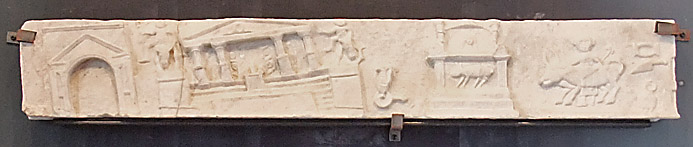
In A. D. 62, seventeen years before its destruction, Pompeii was hit by an earthquake of extraordinary dimensions (if we are to trust the ancient sources) – an earthquake depicted on a relief discovered in the house of the notorious Lucius Caecilius Iucundus  at Pompeii (or so one would hope, taking a favourable view on the sculptor’s abilities):

pompeii_earthquake

Relief from the House of Caecilius Iucundus. – Source: http://www.vroma.org/images/raia_images/pompeii_earthquake.jpg

Ancient sources report an astonishing level of destruction caused by this incident. Tacitus, for example (Tac. Ann. 15.22), writes that –

Isdem consulibus gymnasium ictu fulminibus conflagravit, effigies in eo Neronis ad informe aes liquefacta. et motu terrae celebre Campaniae oppidum Pompei magna ex parte proruit; (…).

Under the same consuls, a gymnasium was struck by lightning and burned down; the statue of Nero in it was molten into an amorphous mass. Also, due to an earthquake, the busy Campanian town of Pompeii largely collapsed; (…).

The Younger Seneca, in his Naturales Quaestiones (6.1.2–3), goes into more detail:

Nonis Februariis hic fuit motus Regulo et Verginio consulibus, qui Campaniam, numquam securam huius mali, indemnem tamen et totiens defunctam metu, magna strage uastauit: nam et Herculanensis oppidi pars ruit dubieque stant etiam quae relicta sunt, et Nucerinorum colonia ut sine clade ita non sine querela est; Neapolis quoque priuatim multa, publice nihil amisit leuiter ingenti malo perstricta: uillae uero prorutae, passim sine iniuria tremuere. Adiciuntur his illa: sexcentarum ouium gregem exanimatum et diuisas statuas, motae post hoc mentis aliquos atque impotentes sui errasse.

On the Nonae of February, there was that earthquake, under the consulship of Regulus and Verginius, an earthquake that destroyed Campania with brutal force, a landscape that was never untroubled by this sort of evil, yet largely undamaged and altogether free of fear: A large part of the town of Herculaneum fell, however, and shaky stand what is left in the colony of Nuceria, so that devastation and complaint prevail in equal measure; Naples, too, lost a lot in terms of private property, but nothing in terms of public buildings, hit lightly by this massive disaster: villas, however, collapsed, and there was a widespread tremor overall, if without causing damage. In addition to that, a flock of 600 sheep was killed and statues were smashed to pieces, and some people, traumatised by the events started to wander about, unable to re-gain control over themselves.

The ancient sources, too, tell us about central government support for the cities hit by this disaster – not altogether different from current responses at all. Suetonius, for example, in his Life of Titus (8.3) writes that –

Quaedam sub eo fortuita ac tristia acciderunt, ut conflagratio Vesevi montis in Campania, et incendium Romae per triduum totidemque noctes, item pestilentia quanta non temere alias. In iis tot adversis ac talibus non modo principis sollicitudinem sed et parentis affectum unicum praestitit, nunc consolando per edicta, nunc opitulando quatenus suppeteret facultas.

Some random and sad things happened under his rule, such as the eruption of Mt. Vesuvius in Campania and the fire of Rome (for three days and just as many nights), also a plague that does not compare lightly with others. In those many and significant catastrophes, he did not only show the concern of an Emperor, but the unique care and compassion of a parent, offering consolation through his public statements just as much as he offered financial relief to whatever extent he could provide.

In addition to that, Rome’s emperor Vespasian sent officials to Pompeii, to sort out illegal landgrabs at Pompeii – an event recorded on a number of stones that mention the efforts of one Titus Suedius Clemens in particular, e.g. in CIL X 1018:

Ex auctoritate |Imp(eratoris) Caesaris | Vespasiani Aug(usti) | loca publica a privatis | possessa T(itus) Suedius Clemens | tribunus causis cognitis et | mensuris factis rei | publicae Pompeianorum | restituit.

By the authority of Imperator Caesar Vespasian Augustus, Titus Suedius Clemens, tribune, had the public land that was taken into possession by private people, restored to the City of Pompeii, following an investigation of the matter as well as a surveying process.

In addition to public support, the Pompeians appear to have embraced private initiative – whether in their ‘getting on with things’ (as documented in the extensive repair work that can be seen in the post-earthquake period, unfinished still by the time of Pompeii’s destruction by Mt. Vesuvius in A. D. 79) or as part of attention-grabbing euergetism, as displayed in a famous inscription at the restored Temple of Isis (CIL X 846):

N(umerius) Popidius N(umeri) f(ilius) Celsinus
aedem Isidis terrae motu conlapsam
a fundamento p(ecunia) s(ua) restituit. hunc decuriones ob liberalitatem
cum esset annorum sexs ordini suo gratis adlegerunt.

Numerius Popidius Celsinus, son of Numerius, had the temple of Isis, collapsed during the earthquake, restored from its foundations from private funds. The town-councillors adopted him to their ranks for this act of generosity free of charge, even though he was only six years old.

The contentious issue of underage town-councillors to one side, what this inscription shows is that structural damage, caused by natural forces, may mean opportunity just as much as it means a problem.

Which brings us back to modern-day Pompeii.

Pompeii, during its first life, has seen the detrimental impact of natural forces (as well as many a man-made disaster) upon its built structure and infrastructure. The inhabitants’ response was stoic – free of fear, as the Younger Seneca called it. Refurbishment, reconstruction of private and public buildings was the response, supported by the central government in Rome in the case of extreme events, with an opportunity for private benefactors to advertise their (not altogether unselfish) generosity. This was at a time when Pompeii was still alive and inhabited.

Brought back to life – if in its distinctive zombie-esque state – Pompeii still requires the same attention and the same level of public and private initiative, at all times, and potentially even more so than ever before, as (i) the structures have changed in nature following the impact of the eruption, and (ii) private initiative, as taken by the inhabitants of Pompeii, no longer is an option.

It is easy to pour scorn and contempt over the administrative shortcomings of those in charge of Pompeii. Yet, one may wish to give due consideration to the scale of their task – a task that was impossible to achieve even at the best of times, when it could be shouldered by hundreds and thousands of stubborn, fear-free individuals who inhabited Pompeii as well as the Emperor of Rome.

Posted in Epigraphy, Prose | Tagged , | Comments Off on Sorting Out Pompeii