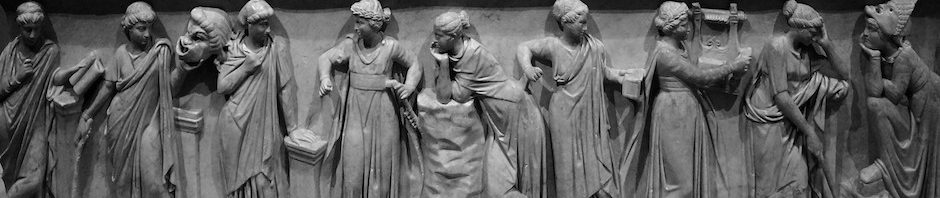
The Power of Song and Music at Pompeii

Clearly some houses at Pompeii are more prone to disaster than others. Not only was dwelling III 5.1, the shop and house of Pascius Hermes, destroyed and covered by volcanic matter just like everything else at Pompeii: it was damaged by a WW II bomb in 1943 as well.

Street music scene on a Pompeian mosaic

Street music scene on a Pompeian mosaic

A third misfortune related to this building was recorded on a pilaster that belonged to a balcony – a balcony, that had already collapsed when the building was excavated in 1918. The inscription, a graffito, reads as follows (CIL IV 8873 = Zarker 156; I give the reading and translation of Elizabeth Woeckner, slightly modified in order to reflect the idiosyncrasies in spelling in the Latin):

Themis amat deos. uinca(t), uinca(t) pantorgana Tal[us]
Cytaredus cantat Apolo, tibicina n<e>mpe ego.
Came<l>opardus abet cor ut Acille<s> ob clarit[atem].
Sum rabid<a>. I<a>m Vulcanus <e>m medicina est.

Themis loves the gods. Let Talus win, let him win the musical contest.
Apollo the citharode sings. Surely I am a tibicina.
The giraffe has a heart like Achilles on account of its distinctiveness.
I am furious. Behold now. Volcanus is the cure.

Decrying the absence of justice (Themis appears to be preoccupied with her divine friends), the tibicina – a flute-girl, and according to the text itself the author of this little piece – emphatically shouts: ‘let Talus win’ (Talus being her rival in a musical competition, called pantorgana, ‘all-instrument [contest]’, as it would appear), repeating the painful uincat. Talus next appears as the mythological cithara-player Apollo, the divine inventor of the lyre and permanent winner in the lyre-vs-flute contest with Marsyas – increasing the contrast even further by the introduction of a gender distinction between the players of the prestigious cithara and the lowly tibia.

The following line – an insult, no doubt – is less clear, except that it combines an impressive, yet distinctively non-brave animal, the giraffe, with the bravest of the Greeks at Troy, Achilles: a pun on the deceptive nature of the tibicina‘s rival? At any rate, her fury persists, and only the destructive forces of Vulcan appear to be good enough to provide a cure.

The inscription, seemingly rambling in its unfolding, is far more than a spontaneous outburst of anger. It is poeticising, a so-called commaticum, consisting of lines that closely resemble established rhythmical patterns of well-known verse types, but do not altogether adhere to their required formal standards. It also provides us, however, with an opportunity to have a quick glance at the relevance of music at Pompeii in general and its mentions in the Pompeian inscriptions in particular.
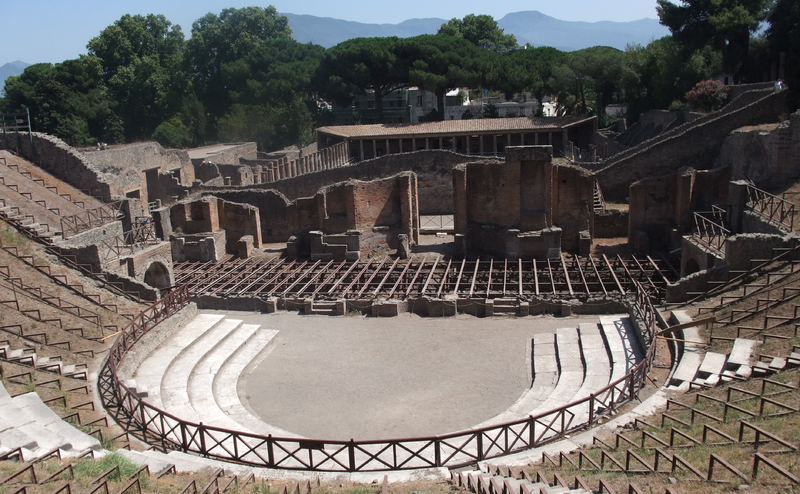
odeonExcavations at Pompeii brought to light not only numerous actual musical instruments: the ruins preserve dedicated buildings for poetic and musical performances – Pompeii’s theatre district with its odeum – as well as well-known visual representations of musical scenes.

Moreover, the walls preserved dozens of poems (or quasi-poems, such as the tibicina‘s, above), so-called Carmina Epigraphica, inscriptions in verse.

Some of the Pompeian Carmina Epigraphica are of outstanding literary quality – most notably perhaps the set of poems (or the one extended poem?) that were discovered in the theatre district with the signature of one Tiburtinus: Tiburtinus epoese – ‘Tiburtinus made this’ (CIL IV 4966 ff. = CLE 934 f.). The opening lines of this cluster of texts, describing the overwhelming fires of passion, lust, and love, read thus (transl.: Antonio Varone):

[Quid f]it? Vi me, oculi, posquam deducxstis in ignem
[no]n ob uim uestreis largificatis geneis.
[Vst]o non possunt lacrumae restinguere flamam,
[hui]c os incendunt tabificantque animum.

What’s happening? Oh, eyes, you forcibly dragged me into the fire;
Now, unforced, you flood my cheeks.
But never can the tears extinguish the flame.
These things burn the face and eat away the mind.

The unrestrained, ambiguous power of love emanates from these lines – a fire very different from those that the tibicina had in mind, yet not at all less devastating in its potential. It is love, too, that plays a central role in the following example, again a carmen epigraphicum, if rather fragmentary. More remarkably, however, the text draws attention to its actual form by means of its use of the relevant term carmen in its final surviving line (CIL IV 3691 = CLE 951):

[Non] ego tam
[c]ur[o] Venere[m]
[d]e marmore
factam
c[a]rmin[inibus?]
– – – – – –

I am not concerned with a Venus made of marble as much in my songs…

… than, presumably, a Venus made of flesh and blood, deserving of hymnic praise just like the goddess of love herself…?

Several other inscriptions mention the term carmina, ‘songs’, ‘chants’, ‘spells’ – and it is not at all clear in all cases what the writer had in mind (CIL IV 1598. 2361?. 4401. 5304; one may have to add CIL IV 1635, previously read as carminibus credo, ‘I fell for charms’ or some such, which triggered numerous fantastic explanations, all of which are most certainly wrong, as the two words may not even be part of the same text, as the design and possibly even the writing itself go to prove).

A clear literary allusion is hiding behind CIL IV 10085a, originally edited as carmina aio summa uiri (‘I pronounce songs, of the highest quality, of the man’), but clearly misread and misinterpreted, as Heikki Solin in his caustic Gnomon review of the relevant volume of CIL has shown. Instead, the text reads, most likely:

Carmina non memini

I don’t remember those songs

– a rather amusing remark, considering that the person who writes this both claims not to remember songs, and writes what he (presumably) remembers of a song.

One song that got remembered at Pompeii, was Vergil’s eighth Eclogue, as the following quote of line 70 of said text goes to prove (CIL IV 1982 = CLE 1785 adn. = 2292 adn.):

Carminibus
Circe socios
mutavit
Olyxis.

With songs (or: spells) Circe bewitched the companions of Odysseus.

This is not what happens in Homer, of course, but it gives a vivid impression of the Roman concept of carmen, words put in a quasi-magical order, to unfold their power upon recital – whether poetic, part of witchcraft, or as elements of religious rituals.

The tibicina of the first text, above, was angry – rabida, as she says. Is her poeticising text itself then a carmen, jinxing her successful rival Talus, and invoking the devastating powers of Vulcan?

It was the power of Vulcan – the power of Pompeii’s neighbourhood volcano Vesuvius (which allegedly was not known to be a volcano by the Pompeians, or so most scholars seem to think) – that unleashed its forces, somewhat rather more drastic than the tibicina may have envisioned. At the same time, rather ironically, it thus preserved a note recording and cursing the success of Talus as well.

Posted in Carmina Epigraphica, Epigraphy, Poetry | Tagged , , , | 1 Comment

Grand Theft Pompeii

Pompeian mosaic advising to 'beware of the dog' (cave canem): did it help to keep the petty thieves out...?

Pompeian mosaic advising to ‘beware of the dog’ (cave canem): did it help to keep the petty thieves out…?

Just off Pompeii’s principal street, the so-called Via dell’Abbondanza (‘Street of Abundance’), painted onto a pilaster between two doorways, the following (somewhat fragmentary) inscription was discovered (CIL IV 64):

Vrna aenia pereit de taberna.
Sei quis rettulerit dabuntur
HS LXV, sei furem
dabit unde [re]m
servare po[ssimus] HS XX[- – -].

A metal vessel disappeared from this tavern. If someone retrieves it, 65 sesterces will be given; if the thief is tipped off, so that we can salvage our property, 20(?) sesterces…

The inscription appears to date back to the Republican or early Imperial period – certainly a text of the first century B. C., as the spellings (and the letter shapes) make clear.

While this inscription is not entirely clear about the question as to whether the metal vessel (presumably made of copper or bronze) was actually stolen, accusations of theft and thievery are not altogether uncommon on the walls of Pompeii. The spectrum covers –

(i) simple insults, with or without names mentioned, such as the following ones:

  • CIL IV 1715: furuncule (‘petty thief!’)
  • CIL IV 3150: fures (‘thieves!’)
  • CIL IV 4764: Perari fur es (‘Perarius, you are a thief!’)
  • CIL IV 4776: Labicula fur est (‘Labicula is a thief!’)

(ii) somewhat overblown, humorous insults such as CIL IV 1949:

Oppi emboliari fur furuncule.

Oppius, you clown [or: poofter?], thief, petty thief!

– and, of course, (iii) fully fledged accusations (CIL IV 3990 col. 1):

L(ucius) Statius
(mulieris) l(ibertus)
Philadelpus
fur est 

Lucius Statius Philadelphus, freedman of a woman, is a thief.

(There may, of course be further evidence hiding in other inscriptions, such as CIL IV 1319, but the reading is less clear.)

At any rate, this set of inscriptions can be supplemented by texts that can be understood as precautionary measures. A number of times, one reads short texts that translate as ‘Thief, beware!’, e. g. in CIL IV 6701: Fur caue | SIQ (?). The same text, however, also features inscribed on portable objects:

  • CIL IV 6253: Fur caue mal(um)
  • CIL X 8067.6a: [F]ur caue || [m]alum.
  • CIL X 8067.6b: Fur cau(e) || malu(m).

More remarkable still, however, is a graffito that was inscribed in a triclinium of a relatively humble dwelling (CIL IV 4278):

Fures
faras (!)
frugi intro.

Thieves out, honest folk come in!

The presence of thieves and brigands can also be surmised from at least two rather remarkable campaigning posters. The former ‘promotes’ the election of Vatia to aedile (CIL IV 576):

Vatiam aed(ilem)
furunculi rog(ant).

Vatia for aedile: supported by the petty thieves.

The second one, less well known perhaps, purports to be in support of Popidius Ampliatus (CIL IV 7851):

L(ucium) Popidium L(uci) f(ilium) Ampliatum
aed(ilem) Montanus cliens
rogat cum latrunculari(i)s.

Lucius Popidius Ampliatus, son of Lucius, for aedile: supported by his client Montanus in conjunction with the brigands.

What any of the afore-mentioned thieves, whether petty or on a larger scale, actually stole, we cannot know. We cannot even be certain that they stole anything. It may just have been a common insult without any actual reference to larceny.

The latter aspect has been stressed a lot with regard to the electoral propaganda before (also in the light of similar insults hurled against Vatia in particular), suggesting that this was but a form of discrediting the candidate in question. But can one really be all that sure?

Is it altogether out of the question to assume that those phrases, furunculi and latruncularii, refer to bands that sought to acquire their street credibility through a somewhat thuggish-sounding name, for example – the modern counterpart of the motorcycle club Bandidos springs to mind? Or is such thinking too anachronistic for first-century Pompeii?

Perhaps this goes too far.

A rather sweet theft (and the thief’s amends) is recorded in the following example from the house of Fabius Rufus (NFPompei 66):

Vasia quae rapui quaeris formosa puella.
accipe quae rapui non ego solus ama
quisquis amat valeat.

The kisses that I stole you demand back, beautiful girl: take back what I stole (and not I alone!): love me! Whoever loves, may prosper!

Posted in Epigraphy, Poetry, Prose, Uncategorized | Tagged , , , | 1 Comment

When it rains, it pours (Or: Don’t just do something, stand there!)

The Roman historian Tacitus, in his work Agricola in the context a passage that comments on the British isles’ multus umor terrarum caelique (‘the excessive moisture of the soil and of the atmosphere’) famously writes (Tac. Agr. 12):

Caelum crebris imbribus ac nebulis foedum; asperitas frigorum abest.

Their sky is maimed with frequent rain and fog: it does not get terribly cold, though.

Yet, even Tacitus quite possibly would have been mildly surprised at the extraordinary period of torrential rainfall and high winds that Britain recently had to face, and whose effects will remain to be visible for the foreseeable future.

The severeness of the weather, with its main side effects (flooding in particular) resulted in an exceptional level of disruption to infrastructure and transportation in Britain – an infrastructure that, due to its relative age, rests on somewhat shaky foundations at the best of times.

There are three general responses to this scenario, which (by order of rapidly decreasing bonkerdom) can be described as follows: i) identify scapegoats (ideally driven by utterly conspicuous political agendas rather than actual scientific insight); ii)  analyse the actual causes and long-term changes; iii) show community spirit, take action, and get on with life as much as possible.

The latter appears to have been the response of the Roman Empire in the case of a reported disruption to public life that was experienced in third-century Roman North Africa. An inscription, put up during the reign of the rather notorious Emperor Caracalla, reads as follows:

Imp(eratori) Caes(ari) M(arco) Au|relio Seuero | Antonino Pio Fel(ici) | Aug(usto) diui Septimi | Seueri Pii Arab(ici) Adiab(enici) Parth(ici) max(imi) | Britt(annici) max(imi) Aug(usti) et Iuliae Domnae Aug(ustae) | matris Caesar(is) et senatus et patriae | filio diui M(arci) Ant(onini) Pii Germ(anici) Sarmat(ici) | nep(oti) diui Ant(onini) Pii pronep(oti) diui Hadr(iani) | abnep(oti) diui Tra(iani) Parth(ici) et diui Neru(ae) | adnep(oti) Parth(ico) max(imo) trib(unicia) pot(estate) III imp(eratori) III | co(n)s(uli) IIII p(atri) p(atriae) proco(n)s(uli). Res pub(lica) | Cuiculitanorum uias torren|tibus exhaustas restituit ac no|uis munitionibus dilatauit.

To Imperator Caesar Marcus Aurelius Severus Antoninus Pius Felix Augustus, son of the late Septimius Severus Pius Arabicus Adiabenicus Parthicus maximus Britannicus maximus Augustus and Julia Domna Augusta, mater Caesaris (!) et senatus et patriae, grandson of the late Marcus Antoninus Pius, great-grandson of the late Hadrian, great-great-grandson of the late Nerva, Parthicus maximus, with tribunicia potestas for the third time, imperator for the third time, consul for the fourth time, father of the fatherland, proconsul. The community of Cuicul has restored the roads that were destroyed by torrential rainfalls and extended on new foundations.

This inscription commemorates the building works carried out by the community of Cuicul, dedicated to Rome’s emperor – and it does not only name the torrential rainfall as the cause, it also mentions the community’s swift action to use this opportunity for work carried out in order to widen the road. What a welcome opportunity.

This inscription is one of quite a few texts discovered in the same area mentioning extensive road network repairs following rainfall, yet with the texts spanning a time period of some sixty years – raising obvious questions: just how much rain was there, just how much damage did it do, … and just to what extent exactly did those who produced these inscriptions actually understand what they wrote (as opposed to copying a perceived template, as it has been argued recently).

Of course, the rain in Numidia may have been very bad indeed. On the other hand, very much like Britain’s infrastructure in some areas, that of Roman North Africa, too, may have been rather dated and generally in a regrettable state of disrepair.

In fact, some of the inscriptions that pertain to the same area would appear to suggest. Here is the example of CIL VIII 10304 from Cirta/Constantine, referring to roadworks carried out under an emperor even more notorious than Caracalla, namely Elagabalus, one of Caracalla’s more immediate successors:

Imp(erator) Caesar | diui Magni | Antonini Pii | filius diui Seue|ri Pii nepos | M(arcus) Aurelius [An]|[toninus] Pius Felix | Aug(ustus) pontif(ex) max(imus) | trib(unicia) pot(estate) II co(n)s(ul) II | designatus III proc[o(n)sul] | felicissimus adque | inuictissimus ac super | omnes [re]tr[o p]rincipes | indulgentissimus | uiam imbribus et | uetust[ate] conlaps[am] | cum pontibus | restituit.

Imperator Caesar Marcus Aurelius Antoninus Pius Felix Augustus, son of the late Magnus Antoninus Pius, grandson of the late Severus Pius, pontifex maximus, with the tribunicia potestas for the second time, consul for the second time, designated consul for the third time, proconsul, altogether the most fortunate, unvanquished, and indulging above all earlier emperors, had the road that was destroyed by rain and as a result of its age, together with its bridges, restored.

A welcome opportunity to repair what was in dire need of repair anyway – with the added benefit of having a natural force as a patient culprit?

What Caracalla and Elagabalus understood was that, in addition to carrying out the actual work, any government must aim to make it clear to its subjects that it will put the essential interests of the populace first.

In that respect, the inscriptions do not only look backwards in their commemoration of building works carried out in the public interest: they also have a forward-looking role, as they can be read as the state’s continuous guarantee of safety and public order: they are a political advertising tool par excellence.

The modern day counterpart to these inscriptions are the images of politicians  ‘in wellies and staring at floods‘ (as it has humorously been dubbed): they do not (only) come to offer support and relief to those affected by the extent of the natural forces that currently batter Britain: they are token gestures for photo ops that may have the potential to say more than actual words and actual deeds appear to achieve (or so some may think).

The problem, very much like with the Roman inscriptions, is, of course, that the political manoeuvres behind them remain rather conspicuous – especially when pointing out at the same time that the current postholder (like Elagabalus) is ready to be more indulgent than anyone else ever before him.

Or as David Cameron put it: money is no object. (Except, of course, it still is.)

Posted in Epigraphy, Prose | Tagged , , , | 3 Comments

Lecture: ‘Aufidius was here. (Really? And where exactly?)’

Today I had the great pleasure to open the ‘Pompeii: The Present and Future of Vesuvian Research‘ seminar series at the University of Leeds, organised by Dr Virginia Campbell and Dr Rick Jones.

A video of my lecture is now available on YouTube:

The handout is available here: Aufidius was here_HO.

Posted in Epigraphy, Poetry, Prose | Tagged , , , , | Comments Off on Lecture: ‘Aufidius was here. (Really? And where exactly?)’

An Olympic Shitstorm

Poking fun at Russia and its organisation of the 2014 Winter Olympics in Sochi has become a new pastime.

Among the more recent entertaining news feature stories of loos that lack dividing walls between individual toilets – a gaffe that has triggered yet another predictable shitstorm (quite literally, for a change) as well as a lot of web-based creativity.

While the absence of proper cubicles in the loo may seem surprisingly liberal for a country whose current government otherwise frowns upon any acts of homosexuality, communal latrines are, of course, not a new invention. A disturbing thought nowadays, partly due to current notions of shame and disgust, they were perfectly normal, for example, in the Roman world (and some of the most famous thinkers of the ancient world have even, if ironically, been credited with behavioural advice for such places):

A libelous poem of Martial’s, for example, suggests that communal loos in ancient Rome provided an opportunity to meet and mingle:

In omnibus Vacerra quod conclavibus
consumit horas et die toto sedet,
cenaturit Vacerra, non cacaturit.

That Vacerra spends his time in all the privies, sitting there all day: it’s so that Vacerra gets to eat, not to poop.

The problem with a communal loo is, of course, that, once there are no physical barriers in between the fellow users, other barriers may soon fall as well. Suetonius reports how the poet Lucan, after he had fallen out with Nero, behaved in that environment (Suet. Vita Luc. p. 51 R; transl. Rolfe – Goold):

neque uerbis aduersus principem neque factis extantibus post haec temperauit, adeo ut quondam in latrinis publicis clariore cum crepitu uentris hemistichium Neronis magna consessorum fuga pronuntiarit: ‘sub terris tonuisse putes.’

[H]e afterwards did not refrain from words and acts of hostility to the prince, which are still notorious. Once for example in a public privy, when he relieved his bowels with an uncommonly loud noise, he shouted out this halfline of the emperor’s, while those who were there for the same purpose took to their heels: ‘you might suppose it thundered ‘neath the earth’.

In that respect, the visitors to Sochi’s communal loos may wish to rehearse a line of the mimographer Laberius, who in his play Compitalia famously wrote (frg. 22 Panayotakis):

sequere me in latrinum, ut aliquid gustes ex Cynica haeresi

Follow me to the loo to get a taste of the Cynic school.

Posted in Poetry, Prose | Tagged , , , , | Comments Off on An Olympic Shitstorm

Gay Weather

Weather prediction appears to be a difficult and complex task that, in order to arrive at reliable results, should not be left to a single amateur. Or so I thought… (After all, there had to be a good reason as to why, for example, my own University alone employs a significant number of staff who are highly respected, in fact world-leading, professionals in that area!)

Then, however, I read that a Henley-on-Thames town councillor, David Silvester (UKIP, formerly a member of the Conservative party), had come up with a remarkably simple explanation for the storms and floods in the UK recently, rendering scientific method (almost) obsolete.

According to Silvester, the recent havoc caused by the floods (not least in Henley, which was badly affected) was in fact ultimately due to the British Prime Minister’s acting ‘arrogantly against the Gospel’ when supporting same-sex marriage.

In a letter to the Henley Standard, Silvester wrote: ‘The scriptures make it abundantly clear that a Christian nation that abandons its faith and acts contrary to the Gospel (and in naked breach of a coronation oath) will be beset by natural disasters such as storms, disease, pestilence and war.’

Silvester’s comments have resulted in a spectacular – dare I say? – wave of creative outbursts all over the web, ridiculing the embarrassing backwardness of his remarks. There is little need to add to those at this point – e. g. by pointing out the hilariousness that lies in the use of the term ‘abundantly’ (~ ‘overflowing’, from Latin unda, ‘wave’) in the aforementioned statement. It condemns itself.

So why talk about this issue further then, rather than letting it fall into well-deserved oblivion?

There might be two reasons to do so.

First, from the perspective of a Classical Scholar, I could not help but think of a passage in Livy‘s work Ab urbe condita, when I first encountered this sexualised approach to weather and disaster.

The passage in question comes from a (fictive) speech attributed by Livy to Appius Claudius, a speech exhorting the Roman people to ‘man up’ during the campaign against Veii of 403 B. C. (transl. B. O. Foster):

Adeone effeminata corpora militum nostrorum esse putamus, adeo molles animos, ut hiemem unam durare in castris, abesse ab domo non possint? ut, tamquam navale bellum tempestatibus captandis et observando tempore anni gerant, non aestus, non frigora pati possint? erubescant profecto, si quis eis haec obiciat, contendantque et animis et corporibus suis virilem patientiam inesse, et se iuxta hieme atque aestate bella gerere posse, nec se patrocinium mollitiae inertiaeque mandasse tribunis, et meminisse hanc ipsam potestatem non in umbra nec in tectis maiores suos creasse.

Do we think the bodies of our soldiers so effeminate, their hearts so faint, that they cannot endure to be one winter in camp, away from home; that like sailors they must wage war with an eye on the weather, observing the seasons, incapable of withstanding heat or cold? They would certainly blush if anyone should charge them with this, and would maintain that manly endurance was in their souls and bodies, and that they could campaign as well in winter as in summer; that they had given the tribunes no commission to protect softness and idleness; and that they were mindful that their grandsires had not founded the tribunician power in the shade or under roofs.

The rhetoric of this passage builds on the ideology of manliness as the capability to withstand any inclemency of weather. It is for the soft and the effeminate, in turn, to be dependent on ‘gay weather’ – and to fall apart when the going gets tough, weather-wise: nothing that a true, manly Roman would ever want to let happen to himself (or so Livy’s Appius Claudius does wish to make us believe).

Secondly, from the perspective of a linguist, it is a rather ironic fact that in the wake of the Silvester incident, the phrase ‘gay weather’ appears to have changed its meaning (at least for the time being):  the adjective ‘gay’ originally does not only refer to events joyful, carefree, and merry; it also implies ‘beautiful’ and ‘bright’.

In that respect, ‘gay weather’ originally denotes the exact opposite of what it would seem to imply now – compare the (surprisingly fitting) final four lines of Muriel Rukeyser‘s poem The Face of the Dam: Vivien Jones:

And the snow clears and the dam stands in the gay weather,
O proud O white O water rolling down,
he turns and stamps this off his mind again
and on the hour walks again through town.

Remarkably enough, the German term for gay (as in ‘male homosexual’), schwul, too, can be related back to meteorology, as e. g. Heiko Motschenbacher in a recent work on Language, Gender, and Sexual Identity has discussed. The term schwul is related, etymologically, to schwül, meaning ‘muggy’. The implication of steaminess and warmth is also present in the derogatory term ‘warmer Bruder’ (lit. ‘warm brother’, roughly an equivalent of English ‘faggot’).

It may well be worth re-examining the weather-related discourse and imagery surrounding common notions of homosexuality, as part of a refined queer linguistics, in order to gain a better understanding of underlying attitudes and prejudice.

This, however, is nothing that can be achieved in a mere blog-post.

Posted in Prose | Tagged , , , | 2 Comments

Hot Air and Sage Advice, or: Human, All Too Human (A Blog Post for Free Thinkers)

There has been a remarkable wave of outputs recently, traditional and web-based, that conceptualised the wish to find ancient Roman fore-runners of the walls of social media, counterparts for toilet graffiti and related witticisms, or at least some proto-memes by ‘the other 99% of the ancient world’ – preferably from the walls of Pompeii and Herculaneum. This is, of course, in addition to the usual, unstoppable flood of popular media outpourings that present ancient erotic art and its reworkings as some kind of mysterious, strangely appealing, yet ultimately revolting freak show.

Whence this most recent wave of publications that indulge in the promotion of (mostly) Erotica Pompeiana – those texts that seem to come straight from a Corpus Inscriptionum Latrinarum? (Here is hoping my former colleagues in Berlin at the CIL will eventually forgive me for this inevitable pun!)

It may be indicative of the process of new generation’s (re-)appropriation of classical material – material that in actuality has been known and studied for a long time. (None of the texts or artefacts that were discussed recently were altogether new or unknown or, in fact,  inaccessible even to a general audience: they have been in the public domain a long time.)

It may also be an expression of the desire to find some historical meaning, precedence, and light relief to this generation’s own, busy times, reminding of the essentials of the human experience in a humorous fashion.

… or it may just be the beautifully childish desire to say something obscene, loudly and in public, and still not take responsibility for it – just because it feels like such an enormous (even physical) relief?

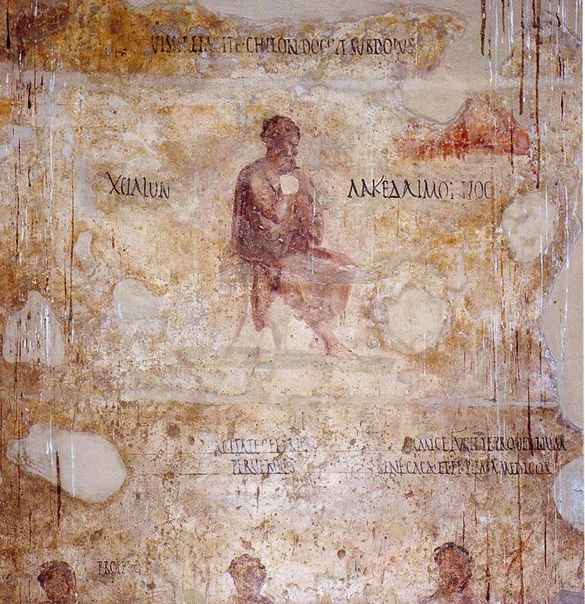
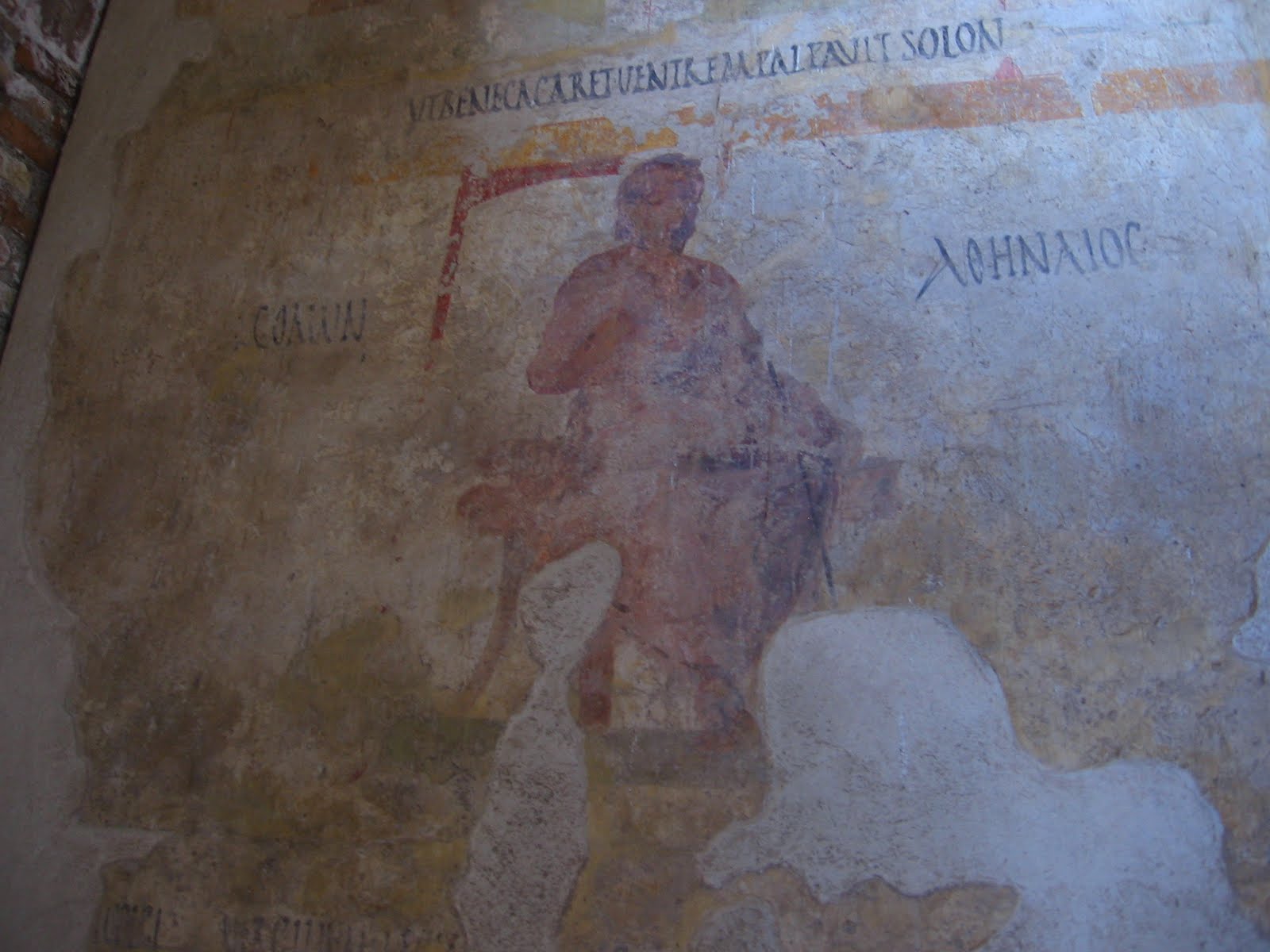
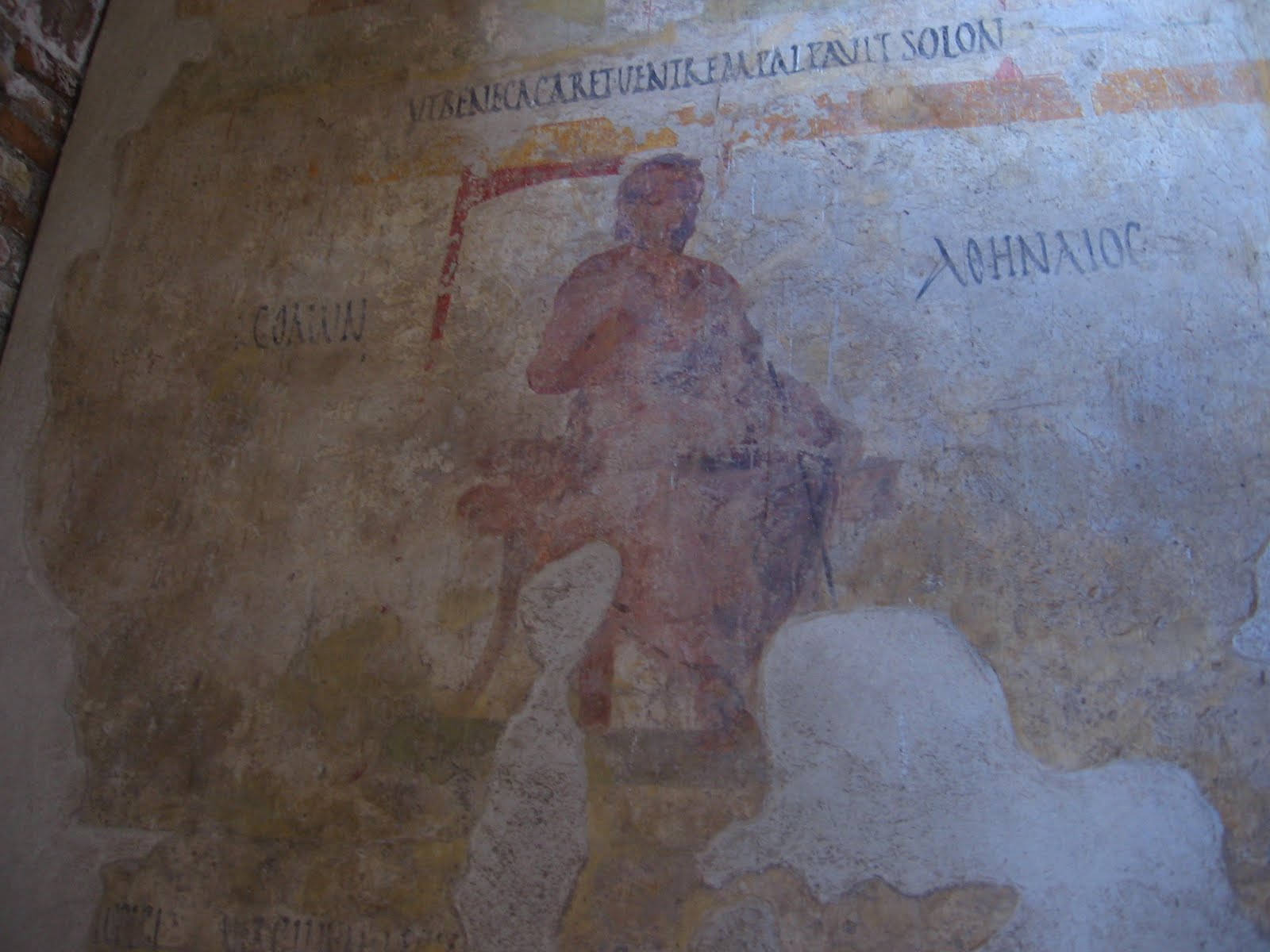
In order to achieve relief, it is useful fully to digest – intellectually, of course – what one has taken in, as a famous inscribed painting from Ostia, Rome’s ancient harbour, appropriately points out. In a gnome of lasting philosophical value, it commemorates the wisdom of Solon, one of the legendary seven sages of ancient Greece:

Vt bene cacaret uentrem palpauit Solon.

‘In order to have a good shit, Solon rubbed his belly.’

Of course, there is nothing really surprising or particularly remarkable in the fact that the Ancient Greeks and Romans, too, enjoyed writing obscenity and defacing walls by means of graffiti, painted inscriptions, and satirical drawings. The detection of a more or less unbroken continuity of everyday human practice does not really bear any significance for its modern counterpart(s): it does not add any deeper meaning, it does not provide any justification, it does not add any measurable value to its continuation(s).

Yet, there appears to be something profoundly liberating and comforting about the (unsurprising, predictable, and minimal) insight that we are all human, sharing basic needs and desires, including the fatuous wish to be able to say something utterly frivolous and to get away with it. An even more comforting experience (to many) is the observation that this type of mischievous behaviour, too, is a human constant.

After all, everyone likes a fart joke!

Chilon (Ostia). — Image source: http://db.edcs.eu/epigr/bilder/$Zarker_00018.jpg

What else could be the explanation for a second panel from the aforementioned inscribed painting from Ostia – this time a panel displaying the Greek sage Chilon – like Solon one of the proverbial seven sages! – sitting on a latrine, while the inscription spells out Chilon’s sagest advice yet:

Vissire tacite Chilon docuit subdolus.

‘Crafty Chilon taught how to fart silently.’

Does it not feel reassuring to be part of a community of practice that has been in existence from the beginning of time?

No, really, everyone likes a fart joke – preferably in conjunction with the demolition of an otherwise unreachable idol (an idea that has resulted in numerous pastiches on YouTube).

From the perspective of a Classical Scholar who has worked on this material for many years, it is nothing short of delightful to see not only how the products of high culture of the ancient Mediterranean continue to unfold their potential, but also how all those seemingly insignificant, everyday practices and utterings continue to fascinate and to inspire a wide audience.

At the same time, however, it makes one wonder where Classical Scholarship is going with the wealth of inscribed material that the walls of Pompeii and Herculaneum provide.

Yes, some outstanding linguistic work on this material has been produced.

Yes, there is an ongoing effort to understand more about the spatial arrangements, about written multi-user communication, and about access to inscribable wall-space. Yes, an effort is being made to harvest the onomastic data and put it in perspective with what else we know about the inhabitants of the ancient settlements.

Will that be it? What will be the Classicists’ response to the unbroken fascination that emerges from the ever-recurring popular publications (and their sometimes rather deplorable quality, one should add)? Have we even begun to approach and conceptualise the psychology of writing in the public domain, on material that is less than ideal for use as stationery, for example? Have we even begun to appreciate the aesthetics of writing on walls, for example?

Perhaps we, as academics, can try a little harder, without (like popularising outputs) only ever repeating the same twenty-odd texts over and over again – those few handfuls of texts that get mentioned when one talks about the graffiti of the ancient world.

Or as Thales famously said:

Durum cacantes monuit ut nitant Thales.

‘Thales instructed those who have difficulties to shit to strive.’

Posted in Carmina Epigraphica, Education, Epigraphy, Poetry | Tagged , , , , , , | 2 Comments

Plautus on Immigration and Domestic Policy

The Roman playwright Titus Maccius Plautus (254-184 BC) wrote a play called Mostellaria (‘The Spectre’ or ‘The Haunted House’).

In the second scene of the play, Philolaches, a young man who enjoys life rather more than he should while his father is away, in an extended monologue, speaks thus –

auscultate, argumenta dum dico ad hanc rem:
simul gnaruris uos uolo esse hanc rem mecum. 
100
aedes quom extemplo sunt paratae, expolitae,
factae probe examussim,
laudant fabrum atque aedes probant, sibi quisque inde exemplum expetunt,
sibi quisque similis uolt suas, sumptum operam non parcunt suam.

atque ubi illo immigrat nequam homo, indiligens 105
cum pigra familia, immundus, instrenuos,
hic iam aedibus uitium additur, bonae cum curantur male.

Listen while I repeat my proofs of this fact; I want you to be equally knowing with myself upon this matter. As soon as ever a house is built up, nicely polished off, carefully erected, and according to rule, people praise the architect and approve of the house, they take from it each one a model for himself. Each one has something similar, quite at his own expense; they do not spare their pains. But when a worthless, lazy, dirty, negligent fellow betakes himself thither with an idle family, then is it imputed as a fault to the house, while a good house is being kept in bad repair.

The speaker of this passage (whose translation has been taken from here) distinguishes neatly between the deeds of the architect, responsible for the original structure, and the worthless tenant, responsible for the subsequent fate of it. He elaborates:

atque illud saepe fit: tempestas uenit,
confringit tegulas imbricesque: ibi
dominus indiligens reddere alias neuolt; 110
uenit imber, perlauit parietes, perpluont,
tigna putefacit, perdit operam fabri:
nequior factus iam est usus aedium.
atque ea haud est fabri culpa, sed magna pars
morem hunc induxerunt: si quid nummo sarciri potest, 115
usque mantant neque id faciunt, donicum
parietes ruont: aedificantur aedes totae denuo.

And this is often the case; a storm comes on and breaks the tiles and gutters; then a careless owner takes no heed to put up others. A shower comes on and streams down the walls; the rafters admit the rain; the weather rots the labours of the builder; then the utility of the house becomes diminished; and yet this is not the fault of the builder. But a great part of mankind have contracted this habit of delay; if anything can be repaired by means of money, they are always still putting it off, and don’t do it until the walls come tumbling down; then the whole house has to be built anew.

Philolaches then proceeds to compare the upbringing and edification of men to that of buildings, in a passage that is still worth reading for educationalists.

What makes Plautus’ text so interesting, however, is that line 105, in the first item (above), contains the first surviving instance of the Latin verb immigrare (‘to go into’, ‘to step in’ – ‘to betake oneself thither’ in the above translation). Immigrare is, of course, the the etymological root of the English term ‘immigration’, the very term that is at the heart of a heated political debate in the United Kingdom at present.

Would it be all too cheeky, then, to propose a playful allegorical interpretation of the Plautine passage in the light of current affairs (and in keeping with Roman textual scholarship), based on the tenuous link provided by the etymology?

The ‘immigrant’ in Plautus – when ‘a worthless, lazy, dirty, negligent fellow‘ with ‘with an idle family‘ – is thought to be the tenant of the house: the immigrant here is the landlord and head of the household, taking over responsibility for the dwelling’s upkeep after the architect designed it beautifully.

So the immigrant, when lazy and negligent, can bring damage. But what if the immigrant is in actual fact the one who is already in the house, what if the immigrant is the one who has stepped in to take responsibility? It is this immigrant’s, this landlord’s neglect, in Plautus’ version, that ultimately brings shame upon the house, as he fails to take care of it with sufficient care and sense of duty, causing lasting damage and decay.

Philolaches reflects on his own personal development, after his escape from his paternal supervision:

But I was always discreet and virtuous, just as long as I was under the management of the builder. After I had left him to follow the bent of my own inclinations, at once I entirely spoiled the labours of the builders. Idleness came on; that was my storm; on its arrival, upon me it brought down hail and showers, which overthrew my modesty and the bounds of virtue, and untiled them for me in an instant. After that I was neglectful to cover in again; at once passion like a torrent entered my heart; it flowed down even unto my breast, and soaked through my heart. Now both property, credit, fair fame, virtue, and honor have forsaken me; by usage have I become much worse, and, i’ faith (so rotten are these rafters of mine with moisture), I do not seem to myself to be able possibly to patch up my house to prevent it from falling down totally once for all, from perishing from the foundation, and from no one being able to assist me. My heart pains me, when I reflect how I now am and how I once was, than whom in youthful age not one there was more active in the arts of exercise, with the quoit, the javelin, the ball, racing, arms, and horses. I then lived a joyous life; in frugality and hardihood I was an example to others; all, even the most deserving, took a lesson from me for themselves. Now that I’m become worthless, to that, indeed, have I hastened through the bent of my inclinations.

One can only hope that current house owners, literally and figuratively speaking, especially when they talk about immigration will demonstrate a similar level of self-reflection, avoiding to point at others when decrying a state (present or future) of decline and decay of what is remembered as a once beautiful structure.

Incidentally, Plautus uses the verb immigrare once more in this context. At the very beginning of the final quote, where the translation says –

After I had left him to follow the bent of my own inclinations, at once I entirely spoiled the labours of the builders

the Latin reads:

postea quom immigraui ingenium in meum, 135
perdidi operam fabrorum ilico oppido.

Posted in Poetry | Tagged , , , , , | Comments Off on Plautus on Immigration and Domestic Policy

Digesting Food for Thought

Delivering my paper 'Inscribing the Uninscribable'

Delivering my paper ‘Inscribing the Uninscribable’ at the ‘Manuscripts and Epigraphy’ conference (Hamburg, 15 November 2013).

Travel broadens the mind, they say. This may not always be the case, but it most definitely was my experience when I was fortunate enough to attend the conference ‘Manuscripts and Epigraphy’ in mid-November, impeccably organised by the Centre of Manuscript Cultures at the University of Hamburg. The variety of topics and papers at this conference was highly rewarding and truly inspirational.

Among the particularly remarkable discoveries for me at this conference was to learn of the existence of hundreds of thousands of (often fragmentary) lettered wooden tablets from Japan. These tablets, often fragmentary and never really intended to survive for a long time, are referred to as mokkan (木簡).

These documents from Japan contain a wide variety of texts and serve an equally wide range of communicative purposes. Unsurprisingly, they raise the same questions about literacy and handwritten communication as the graffiti and the letters that are preserved from the ancient Mediterranean, and, interestingly enough, due to the perishable nature of the material, they also raise the same questions about modes of preservation as the wooden tablets preserved from the ancient world.

A Mundane, Yet Primordial Need

Much to the entertainment of the audience (and to the bewilderment of the excellent speaker, I suspect), I was particularly struck by a set of texts discovered at the Former Imperial Audience Hall of the Nara Capital, a site that dates back to the eighth century A. D.: not only do they highlight the constants of the human experience, but they embody, in their beautiful simplicity and striking, humble straightforwardness, some of the very problems of current debate on ancient literacy.

The tablet that stood out to me from the presentation was this one:

Mokkan tablet. - Source: http://archaeology.jp/sites/2009/01heijo/0110s.jpg

Mokkan tablet. – Source: http://archaeology.jp/sites/2009/01heijo/0110s.jpg

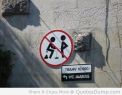
The item advises: ‘do not urinate here’, and it is thought to have been directed at the workforce that helped building the site (again, raising some interesting questions over the recipients’ assumed low ability to decipher encrypted speech).

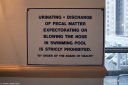
Signs of similar content are not unknown to our own cultural experience (note the faulty spelling of ‘deficating’, too!):

Sacred Texts or Actual Communication?

Texts similar to the above are known from the ancient world as well, of course. Some of them, like this famous example from Solin/Salona are rather monumental and ornate:

CIL III 1966. -- (c) Wien, Kunsthistorisches Museum. -- Source: http://www.ubi-erat-lupa.org/img/monuments/9660.jpg

CIL III 1966. — (c) Wien, Kunsthistorisches Museum. — Source: http://www.ubi-erat-lupa.org/img/monuments/9660.jpg

The text inscribed underneath a sculpted relief representing the goddess Hecate reads: Quisq(ue) in eo uico stercus non posu|erit aut non cacauerit aut non m|iauerit habeat illas propitias | si neglexerit uiderit (‘Anyone who has not dumped any filth in this village nor shat nor peed, may enjoy the mercy of her [sc. of the Hecate Triformis]; if disregarded, beware!’).

Matters of public hygiene, combined with religiously motivated threats (especially whenever seen in conjunction with the potential desecration of loca religiosa) are not uncommon – and many a tomb inscription explicitly prohibits such activities.

This raises an interesting question, of course, namely: does the existence of such signs, in the Roman world, presuppose sufficient literacy levels for the general public to appreciate the content of the text? Is it telling that the sculpture in the above example is rather more central to the overall appearance than the text itself? (But if that is the case, and if literacy levels are low, why bother in the first place?)

Is the religious context and markedness of texts like the above one from Solin/Salona the main and symbolic point – overruling the need to understand the content of the inscription itself (as would be the case with spells and curses, for example)?

Classical Scholars tend to be overly (and unduly) pessimistic when it comes to literacy levels in the Roman Empire – surely there is a difference between those who could decipher a simple message (or compose one) and those who were able to appreciate the great authors of Latin literature. The same is true for the aforementioned mokkan from Japan – and this parallel becomes particularly interesting. The text from Japan is unambiguously non-religious: it is simple and straightforward, it addresses the workforce of the site, and it gives a straightforward message (which is more than what one can say for the convoluted text from Solin/Salona, for example).

A Pompeian Crapshoot

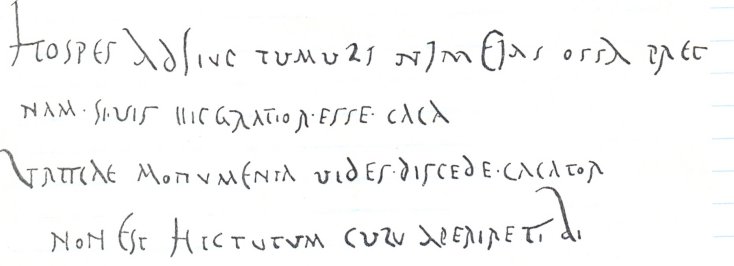
The Roman world, too, had such simple instructions to those who were potentially ready to foul the cityscape – and the walls of the Campanian settlement of Pompeii preserved multiple examples. Only very few of them are as complex as the one from Solin/Salona – such as the following jokey-obscene one, a poem, that, in rather remarkable Latin, purports to come from a tomb (but was actually discovered at a doorway of a house).

Hospes adhuc tumuli ni meias ossa prec[antur] | nam si uis (h)uic gratior esse caca | Vrticae monumenta uides discede cacator | non est hic tutum culu(m) aperire tibi (‘Stranger, my bones beg you not to pee at my tomb: if you want to do the deceased an even bigger favour: take a dump! You see the tomb of Urtica [= ‘Stinging Nettle’]: go away, shitter! It is not safe for you to open your buttocks here!’).

The same playfully obscene idea of rather intimate punishments for fouling exists in literary texts, e. g. in Martial and the Carmina Priapea.

Rather more straightforward, however, are those texts that merely say ‘Shitter, beware’ (cacator, caue malum or Caue malum, cacator), attested more than half a dozen times at Pompeii (cf. CIL IV 3782. 3832. 4586. 5438. 7714. 7715. 7716). These simple texts – painted or scratched – must have been crystal-clear to its intended readership.

What is interesting is that occasionally such texts (just like those against loiterers) were occasionally accompanied by visual representations of serpents and snakes (cf. CIL IV 6641 for an example to do with defecation near a street shrine). Persius, Satires 1.112-4, who mentions this practice,  seems to imply that the representation of snakes creates a sacred space – perfectly possible, but surely not the first thought and immediate association of those who behold the image (or the text and the threats they contain).

Afterthoughts

Even a simple sign – like one that says ‘do not urinate here’ – can become something complex, once it encounters the largely humour-free brain of a German philologist. It raises a number of questions, in fact, and the comparison of such signs, across languages and cultures, helps to address these to an extent:

  • Two texts stating the same do not necessarily communicate the same message. The somewhat long-winded Latin poem that pretends to come from a tomb suggests may be little less than a witty joke (punning on the name Urtica ~ ‘Stinging Nettle’), whereas the shorter ones in their straightforwardness and simplicity would appear to express a desire to be taken seriously.
  • Media matter. A complex stone inscription, with an ornate relief, conveys a different message (and may be more of a symbol than part of verbal communication) than inscriptions that focus on the verbal message alone (and potentially merely illustrate the threatening nature by means of an image). In that respect, the stone inscription from Solin/Salona may work in the opposite way from the illustrated wall inscription CIL IV 6641, where snakes are a powerful visual marker (similar to pictograms on modern signs?), but not the main focus of the overall scenario.
  • Simplicity of expression and a strict focus on the message appears to be the most obvious way to communicate a message that is meant to be taken seriously and adhered to by the public – this is just as true for the Pompeian inscriptions as it is true for the mokkan from Japan – the text that sparked it all.

These musings raise another issue: how do texts that address a general public and wish to express a directive, in no uncertain terms, phrase this matter? Are there general politeness rules that apply? Is linguistic politeness in these matters something useful or ultimately something counterproductive?

This, however, would be another blog post entirely.

Posted in Carmina Epigraphica, Epigraphy | Tagged , , , , | 1 Comment

Out of the woods?

This is a slightly shortened version of a paper given as introductory talk on occasion of a celebration of Giovanni Boccaccio’s 700th birthday, organised by Dr Paola Nasti (Department of Modern Languages and European Studies).

Boccaccio’s Bucolicum carmen 5: ‘Silva cadens’ (‘Falling Wood’)

Giovanni Boccaccio’s Bucolicum carmen is a collection of sixteen poems, dating (mostly) to the third quarter of the Trecento – dark and full of allegories. In a number of ways, these poems can be related to Boccaccio’s own experiences and beliefs, in the best tradition of Dante, one of Boccaccio’s main influences here and elsewhere.

Poem 5, entitled Silva cadens, ‘Falling Wood’, is among the darker pieces of this collection. In the best tradition of bucolic poetry, this poem is a dialogue of two pastoral types, Caliopus and Pamphylus. Caliopus is the main interlocutor in this hexametric poem – a poem of 134 lines – and the majority of his lines report a lamento of a female, a female called Calcidia, who is described as Pamphylus’ amores. At line 3, she is represented as crying over a wretched forest.

Before that, however, the poem’s very opening lines –

Pamphyle, tu placidos tecum meditaris amores
Calcidie, viridi recubans in gramine solus

– constitute an almost verbatim allusion to, and invocation of, the iconic opening lines of Vergil’s first Eclogue:

Tityre, tu patulae recubans sub tegmine fagi,
silvestrem tenui Musam meditaris avena.

This makes it fairly safe to assume that Boccaccio is up to something powerful in his text, invoking such a prominent authority.

Vergil’s first Eclogue is anything but a cheerful text, however: it is a dialogue between Meliboeus and Tityrus, two shepherds who suffered (in their own, individual ways) from the historical events, events that managed to creep from the cruel world of real politics and hard history into the idyllic pastoral world.

Whether or not one would like to attempt an allegorical reading of Vergil, it is striking that Meliboeus complains about his being denied access to his accustomed pastures, whereas Tityrus suggests that, having met a god-like young man in the big city, he is better off now – a story that resembles Vergil’s own experiences during the reign of Augustus, including the confiscation of his estate.

The allegorical reading was well-known from Late Antiquity onwards, and Boccaccio himself did not only know about this, but makes it very clear in a letter to Fra Martino da Signa (around 1374) that his Bucolicum 5 is to be taken allegorical as well. In that respect, an invocation of Vergil is bad news, for the first Eclogue is not a cheerful start and introduction to a world that should be carefree and jolly, a world where people can live in denial of the cruelties of city life.

But Boccaccio goes further than that. A lot further, in fact.

The poem is called Silva cadens, ‘Falling Wood’ – a title that is interesting for a number of reasons. Woods and forests, while part of the repertoire of loca amoena in ancient poetics, tend to be threatening and worrying in medieval literature . Boccaccio, however, is different – his allegorical wood – the dwelling place for his two interlocutors – is described as an analogy for the Kingdom of Naples.

Vergil’s slightly more cheerful shepherd, the one who lives under the tutelage of that god-like iuvenis, is called Tityrus – and there is a Tityrus (or, in fact: Tytirus) mentioned in Boccaccio, too, around lines 56 ff., to be precise.

Boccaccio’s Tityrus has long been explained as an allegory for Robert d’Angiò, king of Naples until 1343, the very ruler of Naples during Boccaccio’s youth.

And this is where things get interesting.

A Golden Age

Tytirus-Robert is described as follows in lines 57 ff.:

(…) Ast Tytirus ille est
qui primus pecori leges nemorique salubres
carmine cantavit, quarum nec clarior usquam
copia docta fuit legum nec prisca tulere    60
secula maiores, auro dum floruit etas
sanguine, si veri quicquam primeva vetustas
insculptum liquit fagis vel robore duro.

This Tityrus first sang laws to the sheep and the woods, salubrious laws, in fact, of copious learning and more outstanding than whatever was produced in the olden days. Boccaccio lets his interlocutor Caliopus use the phrase auro dum floruit etas / sangine, ‘while the age was flourishing from golden life-blood’ – just to drive home his point: the era of Tityrus was a golden age of justice, of song, of outstanding beauty, a golden age for the wood (i. e. the kingdom of Naples) and the woodland creatures.

The depiction of a Golden Age serves two main purposes: the first purpose of it is the obvious invocation of yet another Eclogue of Vergil’s – this time it is the fourth Eclogue, which is a post festum prophecy of the birth of Augustus (in its allegorical reading, anyway), announcing a Golden Age to come: Vergil’s fourth Eclogue is a bright text, full of hope and promise.

This heightens the position of Tytirus-Robert even further. Boccaccio, in turn, and this leads on to the second purpose, is that commonly Golden Ages, times of primordial, simplistic, idealised beauty in which everything just happens of its own accord, are commonly invoked when things are no longer quite as pleasant and desirable.

That things had gone wrong horribly for the poetic woods of Boccaccio’s had already become apparent at line 3. Pamphylus, the lover, after some banter, asks Caliopus to render what his Calcidia said:

Heu michi! quid vivo? iam tacte fulmine pinus,
et pecudes prostrasse canes, noctisque per umbram
ex septis ululare lupos audisse, nefandum 15
prodigium dederant. Sed dic, quas, obsecro, voces
illa dabat deflens? Tua presto stat tibi merces.

Bad omina all over – trees hit by lightning, dogs killing farm animals, howling wolves. So what can possibly go wrong…?

Caliopus’ main part opens at line 24, suggesting that Pamphylus’ love invoked the Fauns and Nymphs in vain, hitting herself in pain and grief, residing at the shore of the Bay of Naples (in litore … / Parthenopes), with a broken voice. What follows then is a fantastically detailed ekphrasis of  the allegorical woods. They are represented as a true locus amoenus, as a space of outstanding beauty, full of love, full of colourful, exciting wildlife and plants, truly second to none in Italy – even lions lived there (lines 47 f.), :

Nec fuit Ytalie que ferret silva leones
hanc preter. (…)

Following the ekphrasis, Boccaccio introduces Tytirus-Robert, whom we already encountered, as the ruler of the Golden Age. The female, in the reported speech reflects on her vivid memories of that time, reaching its high point at lines 67 f., where song and dance prevails – a high point from which things can only decline, a high point at the precise arithmetic middle of the poem, in fact.

Catastrophe

The high point is a turning point, for things to get worse. They do get worse. A lot worse:

(…) Fortuna quidem, quos ante fovebat  75
leta nimis, pavidos secum revoluta fatigat.

Fate, previously smiling on this forest, is beginning to turn:

Plangite, silvani veteres, heu! plangite mecum.
Delapse quercus, grandes cecidere cupressus,
esculus exarsit summissis undique flammis,
pinus nulla sedet, virides albescere lauros,   80
heu! video, et bicolor passim iacet undique mirtus;
aret et omne solum pallens, arbustaque nuda
frondibus in nichilum tendunt. (…)

Plangite, the ancient gesture of beating one’s chest in mourning introduces the mourning for a forest that cannot be saved: the trees are falling, the woods are ablaze, everything is about to decay, to die, to change its previous colour.

In the following passage, the woodland creatures – the birds – are fleeing.

How is this deserved?

Quod meritum? quod triste nefas? quod crimen avitum
vel fortasse tuum potuit tot superis iras
iniecisse tua cum clade? (…)  90

Was there a sin, a nefas? Or a crime, crimen? What guilt has angered the gods and provoked this fire – a fire that is devastating, not purifying like a purgatory? What god can allow for this to happen, who could unleash such a hellish scenario?

What Boccaccio describes in the following line is an apocalyptic landscape, the remains of what used to be a locus amoenus, hit by a hellfire unleashed for no comprehensible reason, a fire that brought devastation and death to what used to be a place of outstanding beauty:

Omne decus periit, luctusque laborque supersunt.  115
Plangite, silvani veteres, heu! plangite mecum.
Silva decus nostrum periit, pereamus et ipsi.

Everything is lost, the forest has died, and everyone else is bound to die as well – time to start mourning.

The remaining few bits offer neither true hope nor true consolation nor, in fact, what would be most needed: an explanation for what has caused this poetic nightmare, the destruction of the silva by primordial forces, leaving behind nothing but dispair.

An Allegory – For What?

It is easy to follow the allegorical reading, proposed by Boccaccio himself, seeing this as a comment on the troubled times that followed the reign of King Robert. But perhaps we can give Boccaccio somewhat more credit than that, not just seeing him as a poet who barely conceals historical events behind an allegory.

Boccaccio’s silva is an unusual place, as it is non-threatening. It is a place full of life and creativity, and it is a place that is well looked-after by its lawgiver Tytirus, who brought about a Golden Age. Why does the Golden Age not last, why does it not out-last the age of Tytirus? It may be too easy to blame ominous, hellish forces that come out of nowhere, however prodigious those times were. Yes, hell had opened its gates – that much we understand. But why?

The most conspicuous absence in Boccaccio’s Bucolicum carmen 5 is that of an explanation for what has happened – the question does get asked, as was seen, but it does not find an answer.

This may suggest: perhaps the explanation is less important than one would like to think. Does it matter why the fury of Orcus has been unleashed? Could the real question be something else?

Perhaps it is worth asking a different question: what if the problem is not the impact of hellish forces upon a system that once was great and full of life, but the system’s utter incapability to cope with those destructive forces’ impact? How does historical analysis of how things went wrong, and why, help the misery of present, post-apocalyptic times?

The deeper truth is: this wood, this forest of creativity and beauty and justice, was not capable of defending itself, unable to recognise the need to protect itself against outside forces designed to obliterate it and do lasting, devastating damage. The birds flew away, the caves of the shepherds became derelict, everything fell into oblivion:

(…) abiere volucres
antraque pastorum video deiecta, recessus
incultos, muscoque putri pallescere fontes 85
et nitidos rivos turpi sordescere limo,
ac circum ripas calamos crevisse palustres.

What stands out from those lines is, that the sole response that this system had to the impact of destructive forces, was abandon, giving up. As is well-known, wood fires, however devastating, mean a lot of potential, too, for future well-being and prosperity – but here the response is giving-up, after not fighting back in the first instance: not even an attempt to contain the damage has been made.

Is this, perchance, the true lesson that Boccaccio wanted us to take away from this extraordinary poem?

Is there a lesson in it for other landscapes, metaphorical landscapes that we are aware of today, landscapes on fire, fire wrought upon us by hellish forces from all sides?

Would we give up cultivating these landscapes as well, defenseless, without a fight?

Posted in Poetry | Tagged , , , , | 2 Comments