Fake News and Post-Truth Politics

There is a widespread, distinct feeling that Western politics has entered a phase of what tends to be called ‘post-truth politics‘.

The term ‘post-truth politics’, often accompanied by references to fake news and disinformation campaigns, looks like a euphemism for ‘shameless lies’ at first; in actual fact, however, these concepts seem to capture a current development in which emotions and perceptions, created, driven, and catered for by carefully planned campaigns, override and invalidate what reason and fact-led analysis can confirm.

Unsurprisingly, demagoguery and populism thrive in this environment – and they do so even more in the powerful echo chambers of present-day social media.

The idea of living in a ‘post-truth’ age, suggesting that a new epoch has dawned, is appealing: successful campaigns such as Brexit and the 2016 U.S. presidential election have instilled an almost post-apocalyptical feeling in many, and politically motivated defamatory attacks against experts (whose expertise somehow seems to be less valid than the alleged gut-feeling of the ‘real people’)  have become a lot more common recently.

But is ‘post-truth politics’ actually a thing – or is it just a convenient way of avoiding the admission of defeat in campaigns in which ‘the other side’ has resorted to a successful strategy to which no meaningful response could be found?

An argument could be made for the latter.

There is a (now) little-read treatise called Strategikos (Στρατηγικός; ‘The General’) by a first-century A. D. author called Onasander (sometimes also reported as Onosander). This work is a most remarkable handbook for anyone who would like to understand more about ancient Roman warfare and tactics (at least from a theoretical angle).

In the Strategikos, Onosander writes (ch. 23, on ‘Announcing favourable news in the midst of battle; even if false it is advantageous’):

Sometimes the general should ride along the lines and call out to his men, if he happens to be on the right wing, “Our left wing is defeating the right wing of the enemy,” or if he is on the left he should say that his right wing is conquering, whether this is true or not, for deceit is necessary when “a great strife has arisen.” For example, when the leader of the enemy is some distance away either on one wing or holding the centre, he should call out, “The general of the enemy has been killed,” or “the king.” or whoever it may be. And one should shout this in such a manner that the enemy also may hear; for his own soldiers, learning that their side is more successful, are encouraged and doubly eager to fight, while the enemy, learning of the misfortunes of their side, lose heart, so that sometimes they start into flight immediately on hearing such a report. In this way it is very often useful to deceive both one’s own army and that of the enemy by false news, good for the former, but bad for the latter.

This sounds very familiar indeed – and it highlights ‘fake news’ and ‘post-truth politics’ as what they really are: strategems, designed and spread for a purpose.

The obvious question, therefore, is: how to respond to such a device? Is it even possible to get through to those who are inclined to follow their leader (general or otherwise)? Or is one’s only hope to protect one’s own side as much as possible from contagion – hoping that this might, if one gets lucky, perhaps have an effect on those who have been subjected to disinformation for strategic purposes?

Rumours and common talk are called “the verdict of society” and “the testimony of the public” by one party; to the other, they are “vague, unauthenticated talk, started by malice and developed by credulity, something that can happen to the most innocent of men through the fraud of enemies who spread false tales.”

––– Rome’s first professor of Latin, Quintilian, wrote (Inst. or. 5.3).

Once set in motion disinformation is hard to stop, of course. Vergil famously depicted Fama, ‘Rumour’ as follows (Aeneid 4.173 ff., transl. from here):

At once Rumour runs through Libya’s great cities—Rumour the swiftest of all evils. Speed lends her strength, and she wins vigour as she goes; small at first through fear, soon she mounts up to heaven, and walks the ground with head hidden in the clouds. Mother Earth, provoked to anger against the gods, brought her forth last, they say, as sister to Coeus and Enceladus, swift of foot and fleet of wing, a monster awful and huge, who for the many feathers in her body has as many watchful eyes beneath—wondrous to tell—as many tongues, as many sounding mouths, as many pricked-up ears. By night, midway between heaven and earth, she flies through the gloom, screeching, and droops not her eyes in sweet sleep; by day she sits on guard on high rooftop or lofty turrets, and affrights great cities, clinging to the false and wrong, yet heralding truth. Now exulting in manifold gossip, she filled the nations and sang alike of fact and falsehood, how Aeneas is come, one born of Trojan blood, to whom in marriage fair Dido deigns to join herself; now they while away the winter, all its length, in wanton ease together, heedless of their realms and enthralled by shameless passion. These tales the foul goddess spreads here and there upon the lips of men. Straightway to King Iarbas she bends her course, and with her words fires his spirit and heaps high his wrath.

Ovid, too, offered a powerful description (Metamorphoses 12.39–63, transl. from here):

There is a place at the centre of the World, between the zones of earth, sea, and sky, at the boundary of the three worlds. From here, whatever exists is seen, however far away, and every voice reaches listening ears. Rumour lives there, choosing a house for herself on a high mountain summit, adding innumerable entrances, a thousand openings, and no doors to bar the threshold. It is open night and day: and is all of sounding bronze. All rustles with noise, echoes voices, and repeats what is heard. There is no peace within: no silence anywhere. Yet there is no clamour, only the subdued murmur of voices, like the waves of the sea, if you hear them far off, or like the sound of distant thunder when Jupiter makes the dark clouds rumble.

Crowds fill the hallways: a fickle populace comes and goes, and, mingling truth randomly with fiction, a thousand rumours wander, and confused words circulate. Of these, some fill idle ears with chatter, others carry tales, and the author adds something new to what is heard. Here is Credulity: here is rash Error, empty Delight, and alarming Fear, sudden Sedition, and Murmurings of doubtful origin. Rumour herself sees everything that happens in the heavens, throughout the ocean, and on land, and inquires about everything on earth.

Or as A. Paul Weber imagined it:

Candid advice on how to manage rumours, ‘fake news’, and whatever one might be inclined to call ‘post-truth’ comes from an anonymous early first-century B. C. rhetorician  (Rhet. Her. 2.12, transl. from here):

We shall speak in favour of rumours by saying that a report is not wont to be created recklessly and without some foundation, and that there was no reason for anybody wholly to invent and fabricate one; and, moreover, if other rumours usually are lies, we shall prove by argument that this one is true. We shall speak against rumours if we first show that many rumours are false, and cite examples of false report; if we say that the rumours were the invention of our enemies or of other men malicious and slanderous by nature; and if we either present some story invented against our adversaries which we declare to be in every mouth, or produce a true report carrying some disgrace to them, and say we yet have no faith in it for the reason that any person at all can produce and spread any disgraceful rumour or fiction about any other person. If, nevertheless, a rumour seems highly plausible, we can destroy its authority by logical argument.

One may find it reassuring that ‘post-truthism’ is not exactly a modern invention, and one may find some relief in the observation that there are means to deal with it.

But what is the appropriate response?

It would seem to be of vital importance to remember two things.

First, ‘fake news’ in political discourse is a strategic device to a (relatively clearly defined) end, whose dangerous potential to create new realities one must not ever underestimate (and which must be addressed strategically rather than with utter bewilderment over others’ inclination to follow reassuring, reinvigorating messages).

Secondly, if one wishes to have any hope to win a battle against falsehoods, one must be both confident that truth can, in fact, be established and be in a situation in which the other side is even remotely ready to listen to what the Rhetor ad Herennium calls ‘logical argument’.

Failing that, all that can be achieved is reaching out to those, and reassuring those, who were disinclined to believe in ‘fake news’ in the first place.

Right now, even that would seem like no altogether insignificant achievement.

Posted in Uncategorized | Tagged , , , , , , , , , , , , | 8 Comments

A little help?

Please forgive me a short moment of self-promotion, but … do you enjoy The Petrified Muse?

If so, would you consider giving it your support for the Blog Awards UK 2017?

I’d be ever so grateful!

Voting remains open until 19 December 2017, 10 am.

http://blogawardsuk.co.uk/ukba2017/entries/petrified-muse


Posted in Uncategorized | Tagged , , , , | 1 Comment

Winter is coming

In his poem De Bello Gothico (‘On the Gothic War’), the late antique poet Claudian describes the Roman general Stilicho‘s movements in wintery Germany (Claudian, De Bello Gothico 350–386; transl. from here):

Near to the Hercynian forest the uplands of Raetia stretch out towards the north, Raetia, proud parent of Danube and Rhine, twain rivers that she sets to guard the empire of Rome. Small are their streams at first, but soon they grow in depth and like kings compel the lesser waters to pass with tributary wave beneath their name. The Cimbric ocean receives Rhine’s flood outpoured through his two mouths; the Thracian wave swallows that of Ister flowing out through five channels. Both rivers are navigable though both bear at times the marks of chariot-wheels upon their frozen surface; stout allies both of the north wind and the god of war.

But on the side where Raetia marches with Italy precipitous mountains touch the sky, scarce even in summer offering an awful path. Many a man has there been frozen to death as though he had looked on the Gorgon’s head; many have been engulfed beneath vast masses of snow, and often are carts and the oxen that draw them plunged into the white depths of the crevasse. Sometimes the mountain plunges downwards in an avalanche of ice, loosening neath a warmer sky foundations that trust vainly in the precipitous slope.

Such was the country over which Stilicho passed in mid winter. No wine was there; Ceres’ gifts were sparing; ’twas enough to snatch a hurried meal, eaten sword in hand, while, burdened with rain-drenched cloak, he urged on his half-frozen steed. No soft bed received his weary limbs. If the darkness forced him to halt in his advance he would either enter some dreadful beast’s den or sleep in some shepherd’s hut, his head pillowed upon his shield.

The shepherd stands pale at the sight of his stately guest, and ignorant of his name the rustic mother points out to her squalid infant the glory of his face. It was those hard couches beneath the rough pines, those nights amid the snow, all that care and anxious toil, that won peace for this world, this tranquillity it had despaired of for the empire. From out those Alpine huts, Rome, came thy salvation.

Claudian’s Stilicho is a hero – immortalised by an admiring poet in some of the finest Latin poetry ever written.

https://upload.wikimedia.org/wikipedia/commons/thumb/4/4e/Bastein-Lepage_Diogenes.jpg/1024px-Bastein-Lepage_Diogenes.jpg

Antiquity’s most famous homeless person: Diogenes of Sinope. – Image source here

https://i0.wp.com/www.viasanctimartini.eu/webimages/images/Liguge.JPG

St Martin sharing his cloak with a beggar – Image source here

As winter and sub-zero temperatures are upon us, let us not forget those unsung everyday heroes who, for whatever reason, have to endure on a daily basis what Stilicho endured for a short period of time, on his mission to save the Roman Empire: bitter frost, lack of warming clothes, hunger, and thirst, sleeping rough in horrendous conditions.

They don’t need an admiring poet.

They need help.

UK: http://www.streetlink.org.uk/

Reading: http://www.mungos.org/services/where_we_work/reading

(Please feel free to add relevant links from your region/country in the comments section, below.)

Posted in Poetry | Tagged , , , , , , | 6 Comments

Sneering at Experts

Defamatory remarks and jokes about entire professions, regardless of the individuals pursing them or their actual performance, are a stock element of western comedic culture. Among the most ridiculed group of professionals, since ancient times, are teachers, professors, and other highly trained specialists and experts.

From Aristophanes’ Cloud Cuckoo Land to the scholastikos of the late-antique joke collection that is the Philogelos (‘Laughter Lover’): there is always someone ready to lash out at those who devote themselves to learning and the pursuit of truth – cackling at their reclusive absent-mindedness, at the alleged irrelevance of their studies to an imaginary ‘real world’ (as if certain parts of the world were more real than others!), at their conveniently dishevelled appearance, and, of course, at the (unsurprising) insight that experts, like everyone else in the world, are wrong from time to time.

Recent times have seen a certain high in such comments about experts in British political discourse – from Michael Gove’s egregious claim that the ‘people in this country have had enough of experts’ –

to Glyn Davies’s snarky remark that –

to the ever entertaining Jacob Rees-Mogg’s comment in the bleak context of Britain’s most recent economic forecast:

There is a great line from Cicero that there’s nothing so absurd that it hasn’t been said by some philosopher.’

What Cicero actually said in his treatise De divinatione (‘On Divination’), in the context of a dismissal of some outlandish philosophical concepts, is (Cic. div. 2.119, transl. W. A. Falconer):

The Pythagoreans make a point of prohibiting the use of beans, as if thereby the soul and not the belly was filled with wind! Somehow or other no statement is too absurd for some philosophers to make.

In other words, Rees-Mogg’s comment draws on a passage that essentially constitutes an ancient fart joke (and a popular one at that), not exactly a passage that aims to discuss the value of philosophy and specialisms at large.

Be that as it may, both the subtlety of Cicero’s joke, making fun of philosophy in a work of philosophy (that discusses the matter of fortune-telling) and the obvious need to contextualise one’s quotes appear to have eluded Britain’s self-styled present-day Cicero.

But, since Rees-Mogg seems to enjoy his Cicero so much, may I use this opportunity to suggest to him another passage from Cicero – a passage from the treatise ‘On Duty’ (De officiis)?

Discussing expediency, Cicero writes (Cic. off. 2.72–3, transl. W. Miller):

From this we come to realize that since Nature is the source of right, it is not in accord with Nature that anyone should take advantage of his neighbour’s ignorance. And no greater curse in life can be found than knavery that wears the mask of wisdom. Thence come those countless cases in which the expedient seems to conflict with the right. For how few will be found who can refrain from wrong-doing, if assured of the power to keep it an absolute secret and to run no risk of punishment!

Let us put our principle to the test, if you please, and see if it holds good in those instances in which, perhaps, the world in general finds no wrong; for in this connection we do not need to discuss cut-throats, poisoners, forgers of wills, thieves, and embezzlers of public moneys, who should be repressed not by lectures and discussions of philosophers, but by chains and prison walls; but let us study here the conduct of those who have the reputation of being honest men.

Turns out experts, academics, and philosophers are not the only ones who regularly find themselves at the receiving end of snide remarks.

As the famous saying goes: people who live in glass houses should undress themselves in the dark.

Posted in Prose | Tagged , , , , , , | 2 Comments

No safe (and therefore a special) place

American Vice-President-Elect Mike Pence went to the theatre to enjoy a performance of ‘Hamilton’, when this happened:

President-Elect Donald Trump apparently was not particularly happy with this and felt compelled to put his own trademark (a.k.a. low-fact, boastful) spin on the event, when he posted the following tweets:

Not exactly new complaints.

Some 2,050 years ago (give a few, take a few), the Roman statesman, orator, and philosopher Cicero wrote in a letter to Atticus (Cic. Att. 2.19, transl. E. Shuckburgh):

Your populares have now taught even usually quiet men to hiss. Bibulus is praised to the skies: I don’t know why, but he has the same sort of applause as his

Who by delays restored alone our State.

Pompey – the man I loved – has, to my infinite sorrow, ruined his own reputation They hold no one by affection, and I fear they will be forced to use terror. I, however, refrain from hostility to their cause owing to my friendship for him, and yet I cannot approve, lest I should stultify my own past. The feeling of the people was shown as clearly as possible in the theatre and at the shows. For at the gladiators both master and supporters were overwhelmed with hisses. At the games of Apollo the actor Diphilus made a pert allusion to Pompey, in the words:

By our misfortunes thou art—Great.

He was encored countless times. When he delivered the line,

The time will come when thou wilt deeply mourn
That self-same valour,

the whole theatre broke out into applause, and so on with the rest. For the verses do seem exactly as though they were written by some enemy of Pompey’s to hit the time. “If neither laws nor customs can control,” etc., caused great sensation and loud shouts. Caesar having entered as the applause died away, he was followed by the younger Curio. The latter received an ovation such as used to be given to Pompey when the constitution was still intact. Caesar was much annoyed.

As far as American politics and theatres go, the Mike Pence incident was, of course, thankfully very harmless:

https://i0.wp.com/cbsnews2.cbsistatic.com/hub/i/r/2015/04/13/95540eb9-623d-4b2d-83d1-9fe48a4c9928/resize/620x465/966f0eaee7d5ae3717b9dabdbfb7a60f/rathbonenexttolincoln2015-04-08t152826z2042744198lm2eb4817rb01rtrmadp3usa-lincolnassassination-widerimage.jpg

What really puzzled me, however, was how America’s soon-to-be commander-in-chief arrived at his view that the theatre ‘must always be a safe and special place’.

Clearly a theatre is a special place – and that was no different in the case at hand, either (otherwise Trump and the press would not have paid much attention to the incident).

But when was theatre ever a safe space?

Clearly it was not in Cicero’s times!

The whole discussion is not a new one, of course. In fact, it is a discussion as old as western theatre.

The Romans, for example, now known for the magnificent theatre buildings that they left behind across the Roman Empire, long resisted the temptation to have a permanent theatre structure within the city of Rome herself.

In fact, it was not until the mid-first century B. C. that Rome’s great general Pompey the Great finally gave Rome its first permanent stone theatre.

There were a number of reasons for the late arrival of permanent theatre structures at Rome herself, even though theatrical performances had been known for centuries.

The reasons that were cited first and foremost, are summarised by the Roman imperial historian Tacitus as follows (Tacitus, Annals 14.20, transl. M. Grant):

In the following year, when Nero (for the fourth time) and Cossus Cornelius Lentulus (II) were consuls, a five-yearly stage-competition was founded at Rome on the Greek model. Like most innovations, its reception was mixed. Some recalled with approval the criticism of Pompey, among his elders, for constructing a permanent theatre, whereas previously performances had been held with improvised stage and auditorium, or (to go back to the remoter past) spectators had stood – since seats, it was feared, would keep them idle for days on end. ‘As for the shows,’ said objectors, ‘let them continue in the old Roman way, whenever it falls to the praetors to celebrate them, and provided no citizen is obliged to compete. Traditional morals, already gradually deteriorating, have been utterly ruined by this imported laxity! It makes everything potentially corrupting and corruptible flow into the capital – foreign influences demoralize our young men into shirkers, gymnasts, and perverts.

People idling in a comfortable space, challenging existing views, traditions, and morals – this potentially spells disaster to a self-selected elite: unlike one might intuitively expect, in theatrical spaces not only the show itself is on display – the audience, too, especially when seated in preferential spaces, is very much in everyone’s focus.

A remarkable incident in that regard is reported by Plutarch in his Life of Cicero (ch. 13, transl. B. Perrin):

Marcus Otho was the first to separate in point of honour the knights from the rest of the citizens, which he did when he was praetor, and gave them a particular place of their own at the spectacles, which they still retain. The people took this as a mark of dishonour to themselves, and when Otho appeared in the theatre they hissed him insultingly, while the knights received him with loud applause. The people renewed and increased their hisses, and then the knights their applause. After this they turned upon one another with reviling words, and disorder reigned in the theatre.

Among the most interesting concepts, to my mind, is that of the so-called fourth wall – an imaginary division between the stage and its business on the one hand and the audience on the other.

Of course, there is no such wall (it would just block the view) – the only real question is to what extent theatrical troupes choose to draw attention to the (absence of such an) imagined, artificial divide. (But then, considering Donald Trump’s promises, we might soon see actual fourth walls being built, with the costs being charged to the respective theatre owners…!)

The very beginnings of Rome’s theatre business, as the Rome’s famous lyric poet Horace imagined them, did not a whole lot to enforce such an artificial division (Epistles 2.1.139 ff., transl. H. R. Fairclough):

The farmers of old, a sturdy folk with simple wealth, when, after harvesting the grain, they sought relief at holiday time for the body, as well as for the soul, which bore its toils in hope of the end, together with slaves and faithful wife, partners of their labours, used to propitiate Earth with swine, Silvanus with milk, and with flowers and wine the Genius who is ever mindful of the shortness of life. Through this custom came into use the Fescennine licence, which in alternate verse poured forth rustic taunts; and the freedom, welcomed each returning year, was innocently gay, till jest, now growing cruel, turned to open frenzy, and stalked amid the homes of honest folk, fearless in its threatening. Stung to the quick were they who were bitten by a tooth that drew blood; even those untouched felt concern for the common cause, and at last a law was carried with a penalty, forbidding the portrayal of any in abusive strain. Men changed their tune, and terror of the cudgel led them back to goodly and gracious forms of speech.

Horace’s perception draws a line between theatrical, satirical performances on the one hand and the high and mighty on the other, and he imagines some form of self-regulation of performances that eventually spiralled out of control, feeling empowered by the stage itself as well as the bond they had created with their audience over time.

Theatres are no safe spaces, and they are most definitely not safe spaces for any ruling class anywhere.

It is quite absurd to demand that they ought to be or to imply that they ever could be.

Theatres embody direct democracy – and direct democracy is never a safe option.

Once in a theatre, one is caught in the logic, the dynamic, and the power structures of this place, forced to see and to listen – or to flee in disgrace.

Trump and Pence styled themselves as true plebeians, as the people’s spokespersons, and as fearless fighters against the corrupt elites, with little own inhibitions to dish it out, ostentatiously politically incorrect.

To be forced, for once, to listen to the same vox populi that they themselves so conveniently played during their campaign, delivered by the cast of the play and endorsed by the audience’s response, without a face-saving exit strategy, may well have been a harrowing experience.

The power that comes with this special place, its focal points and its essentially egalitarian composition of the audience, however, as the example of ancient Rome teaches us, means great responsibility for those who operate in those places, lest they risk their accustomed freedom of speech being curtailed or taken away from them.

Use it wisely. Use it effectively. Don’t apologise for exercising your legal rights. But, most of all, in doing so, don’t expect your public actions, delivered from centre stage and in a room from which the addressee cannot withdraw without shame, to be without consequence or judgement.

Posted in Poetry | Tagged , , , , , , , , | 3 Comments

Hope, Freedom, and Being Human: A Poetic Approach

The 2016 Being Human Festival – a festival of the Humanities, sponsored by the Arts and Humanities Research Council and the British Academy – commences today. This year’s theme is ‘Hope and Fear’, and my university, the University of Reading, offers its distinctive view on this with a number of great events under the headline of ‘Hope, Fear, and Freedom‘.

The issue of freedom and slavery has long fascinated me (see, for example, here for a paper on notions of slavery in Tacitus; and then there was my recent piece on the rather strongly worded poetry and blunt art from a place that symbolises the absence of freedom): and then, of course, working on the Latin verse inscriptions, I work on material inextricably linked to the sphere of Roman slavery and that of Roman freedmen and freedwomen.

There are a great many texts one might put together under the rubric of hope, fear, and freedom – for example the most remarkable tombstone of one Gaius Ofillius Aeimnestus, who experienced the personality-changing trauma of enslavement and eventually managed to buy himself free again (which I discussed in an older blog entry).

But instead of repeating material, I thought it might be of greater interest to share some rather remarkable pieces that actually talk about freedom, libertas in Latin, and the achievement of libertas – texts that, to an extent, link to the very notion of life, the human existence, and the human body as forms of life-long, inescapable enslavement and incarceration (the latter being a theme which I briefly touched upon in this piece).

The following piece is a short inscription from Venafrum (Venafro) for a uilicus, a slave who worked as bailiff or estate manager and who died before he was to achieve freedom from his masters (who, most likely, commemorated him through the following inscription, CIL X 4917 = CLE 1015):

Narcissus uil(icus)
T(iti) Tituci Floriani
et Teiae L(uci) f(iliae) Gallae
uixit an(nos) XXV.
debita libertas iuueni mihi lege
negata
morte immatura reddita perpetua est.

Narcissus, bailiff of Titus Titucius Florianus and Teia Galla, daughter of Lucius, lived 25 years.

The freedom that I was owed, yet denied by law as a young man, has permanently been restored through an untimely death.

According to the lex Aelia Sentia, the minimum age for manumission was 30 years – and the inscription would appear to allude to this regulation, almost apologetically, in its desire poetically to reconcile the deceased’s social status at the time of his death with the notion of eternal freedom that comes with one’s passing over from this world to the other.

Throughout, this inscription plays with terms that relate to Narcissus’ occupation – debt (freedom was debita), legal requirements (freedom was lege negata), payment of debt and return of goods on loan (freedom was reddita perpetua through the mors immatura).

At the same time, the distich raises a number of questions that remain unanswered – who owed Narcissus his libertas: his owners? Life? The gods? After all, nothing could provide him with freedom in quite the same way as death (though not necessarily only by means of a mors immatura)? And how does death mean libertas perpetua? Is this the only real freedom that we, being human, can achieve? Freedom from the only inevitable obligation that all humans have in common: our ultimate obligation to die?

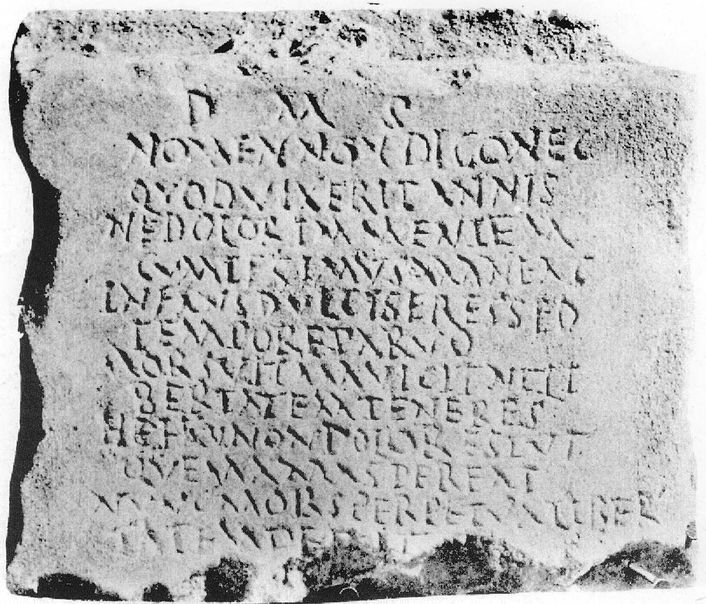
An inscription from Carthago (Carthage) in Tunisia, commemorating the burial of someone who chose to remain anonymous, addresses the same issue (CIL VIII 25006 = CLE 1331 = ILTun 1001):

D(is) M(anibus) s(acrum).
nomen non dico nec
quod (!) uixerit annis
ne dolor im (!) mentem (!)
cum legimus maneat (!).
infans dulcis eres (!) sed
tempore paruo
mors uitam uicit ne li-
bertatem teneres.
heh[e]u (?) non dolor es ut
quem amas pereat.
nunc mors perpetua liber-
tatem dedit.

Sacred to the Spirits of the Departed.

I do not state the name nor how many years s/he lived, lest pain gets to settle in our mind as we read this. As a baby you were sweet, but within a short time death overcame life, lest you obtain freedom. Woe is me, there is no pain equal to that when one loses whom one loves. Now death bestowed eternal freedom.

Similar to the example from Venafrum, above, this text, too, operates with a double concept of freedom – personal freedom (from slavery), potentially in reach within one’s life, and spiritual freedom, which ultimately can only be achieved through death – an ultimate reward, that comes at the cost of great pain for everyone else involved with the person who achieves it.

A third example of this attitude can be found in a text from Ravenna, which commemorates the death of two foster-children in a shipwreck (CIL XI 188 = CLE 1210 – contextualised here):

Duo Iuvan(ensium?) Lupi et Apri.
una Iuuaniae domus
hos produxit alumnos.
libertatis opus contulit una dies
naufraga mors pariter rapuit
quos iunxerat ante
et duplices luctus
sic periniqua dedit.

[This is the monument of] two from Iuvanum (?), Lupus and Aper.

One house in Iuvanum brought forth these two as its foster-children, a single day bestowed the gift of liberty upon them. [The fate of] death in shipwreck snatched away alike those whom it had united before, and thus, most unfairly, brought about double grief.

A most remarkable poem from the city of Rome pushes the idea further still (CIL VI 9632 cf. p. 3470 = VI 33813 = V *334 = CLE 89):

L(ucius) Valerius Zabdae mercatoris venalici l(ibertus) Aries.
Seu stupor est huic studio siue est insania nomen
omnis ab hac cura cura leuata mea est.
monumentum apsolui et impensa mea, amica
tellus ut det ho(s)pitium ossibus, quod omnes
rogant sed felices impetrant. nam quid
egregium quidue cupiendum est magis quam
ube (!) lucem libertatis acceperis lassam (!) senectae
spiritum ibi deponere. quod innocentis signum
est maximum.

Lucius Valerius Aries, freedman of Zabda, the slave-trader.

Whether numbness of madness is the name of such endeavour, all my trouble was lifted by this trouble. I paid for the monument, too, at my own expense, so that a welcoming earth provides shelter to my bones, what everyone hopes, but only the lucky ones achieve. For what is more egregious and more to desirable than to deposit one’s spirit of one’s weary old age as one receives the light of freedom? This is the greatest sign of an innocent man.

Following a quote from Ovid’s Tristia (Ov trist 1.11.11-12) to set the scene – a final trouble to end all troubles –, the deceased is introduced as speaker of his own epitaph: everyone, he claims, has the same hope in life: to find a hospitium, a safe shelter, for one’s mortal remains (ossa); only the lucky ones, the felices, achieve this, though – and Valerius Aries, freedman of a slave-trader, regards himself as someone whose hopes had come true, and he managed to achieve this without being a financial burden to anyone else.

Valerius Aries, who had known slavery and achieved the status of freedman, and/or his patron Zabda (possibly a Jew, if the name is anything to go by), who made a living from other humans’ lack of freedom, describe the ultimate freedom in life – death, that is – as lux libertatis, the (shining) light of freedom, that one acquires at long last, at least if innocent.

But not everyone finds it possible to see consolation in the promise of freedom after death. Being free, as free as one can be, in this world remains a hope (and as such also a constant source of disappointment), as the following piece from Narona (Vid, in Dalmatia) implies:

– – – – – –
C(ai) l(iberta) Fortu[nata]
an(norum) h(ic) s(ita) e(st) XIIX.
si pietas prodest
cuiquam uixisse
modeste, uos precor
o Mane[s, sit] mihi
terra leu[i]s.
libertas [cui] olim fuerat
promissa ,[s]et ante Ditis sub
fatum venit [i]n arbitrium.
uiuite felices quibu[s]
est Fortuna superste[s]:
spenque (!) meam oppress[i]t
fatus in Hiluricum (!).

[- – -] Fortunata, freedwoman of Gaius, lies here aged 18.

If dutifulness makes it useful to anyone to have led a life in modesty, I beseech you, divine Manes, may earth rest lightly on me. I was once promised freedom, but fate skipped ahead for me under Pluto’s judgement. Live happy, those of you, who have fortune by their side: fate has crushed my hope in Illyria.

This last piece speaks of disappointment – the disappointment that promised freedom never came to be. The previous texts spoke of pain and the inability to fight against the necessities of nature’s and human laws.

All of these texts emerge from social contexts in which wealth, independence, and all other manifestations that upper-class freedoms may take, were fundamentally out of reach.

Are they expressions of hopelessness or even fear?

I don’t think so.

To me, they are testament to the unbreakable human spirit, that, in the face of great adversity, one may still harbour hope and entertain one’s dreams: dreams of freedom in this life, freedom before that ultimate freedom in a death that may make us independent from all constraints – a freedom, libertas, that we may struggle to achieve or even be denied (negata), but one that we all – being human! – are owed, debita, as the first inscription beautifully suggested.

Posted in Carmina Epigraphica, Uncategorized | Tagged , , , , , , , | 3 Comments

False Etymologies

fry.jpgWith a little (and really only just a little) too much time on my hands, I recently thought: why not enter terms that are on my mind a lot as search strings into the Packhum Latin database and see what happens.
People as smart as the Romans – surely they must have held their views on important affairs such as Brexit and President-elect Donald Trump…?

Sometimes serendipity strikes (or so it feels).

illos ut caeco recubans in limine sensit
Cerberus, atque omnes capitum suBREXIT hiatus;
saeuus et intranti populo, iam nigra tumebat
colla minax, iam sparsa solo turbauerat ossa,
ni deus horrentem Lethaeo uimine mulcens
ferrea tergemino domuisset lumina somno.

(…) Cerberus saw them, too,
Where he lay on the dark threshold, and reared his
Snarling heads. Fierce to the crowd that passes in,
His black neck was already swelling with menace,
Already he pawed at the bones littering the ground,
But the god soothed his bristling with Lethe’s wand,
And closed his adamantine eyes in triple slumber.

(Statius, Thebaid 2.26-31; transl. from here)

Verso deinde <in> Italiam pectore Alpium Latini iuris Euganeae gentes, quarum oppida XXXIIII enumerat Cato. ex iis TRUMPlini, uenalis cum agris suis populus, dein Camunni conpluresque similes finitimis adtributi municipis.

Then, on the side of the Alps towards Italy, are the Euganean races having the Latin rights, whose towns listed by Cato number 34. Among these are the Trumplini, a people that sold themselves together with their lands, and then the Camunni and a number of similar peoples, assigned to the jurisdiction of the neighbouring municipal towns.

(Pliny, Natural History 3.133-4)

Make of that what you will.

Posted in Poetry, Prose | Tagged , , , , | 6 Comments

Lesser Known Ballads (and Other Art Work) of Reading Gaol

Built in 1844, HM Prison Reading (also known as Reading Gaol and famous through Oscar Wilde‘s poem The Ballad of Reading Gaol) was decommissioned in 2013. Since September 2016 the prison has opened its doors to the public for the rather splendid Artangel project ‘Inside: Artists and Writers in Reading Prison‘ (running until December 2016).

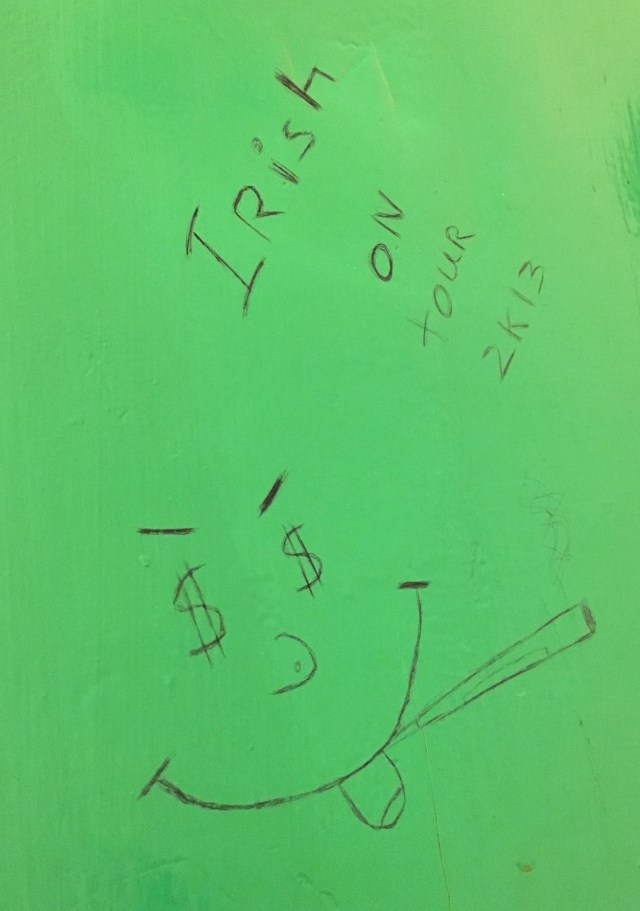
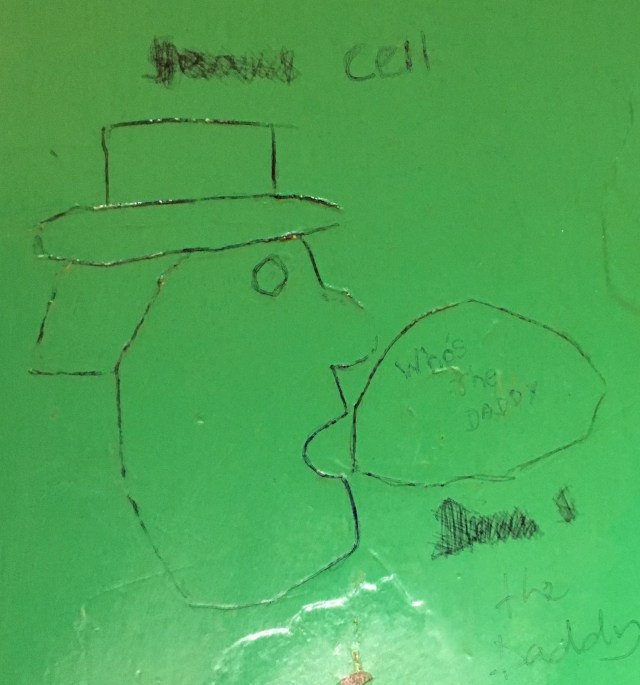
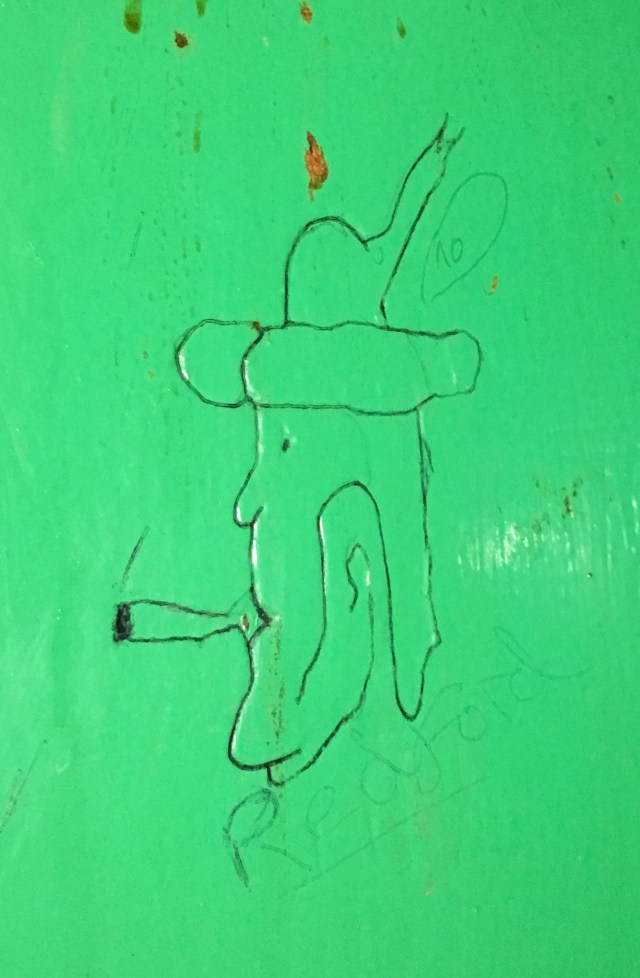
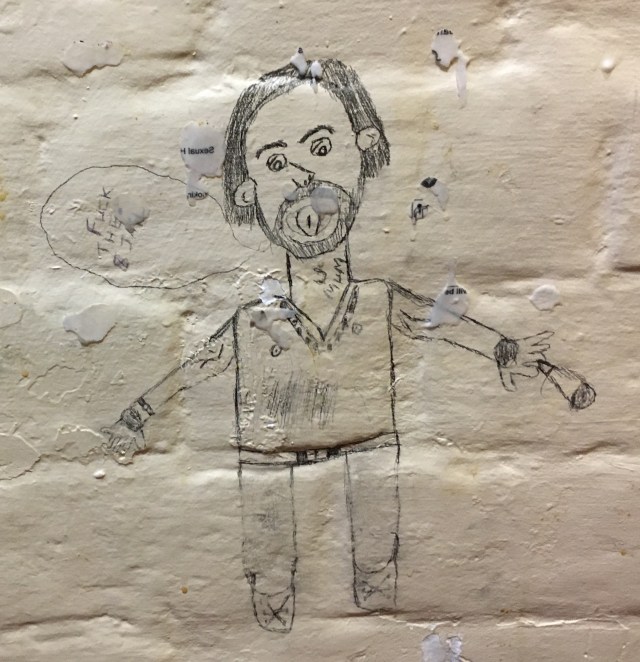
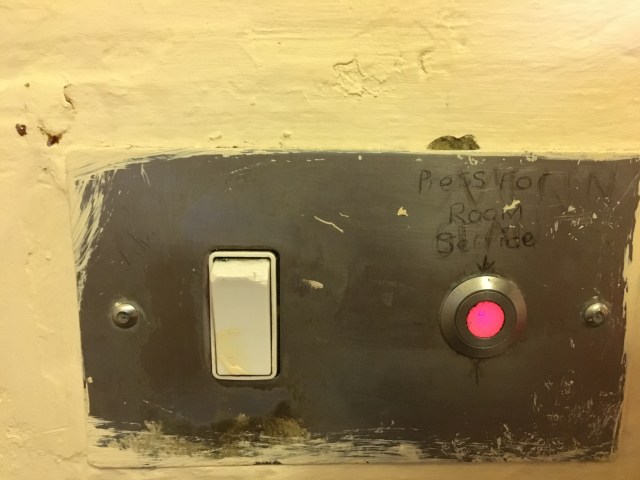
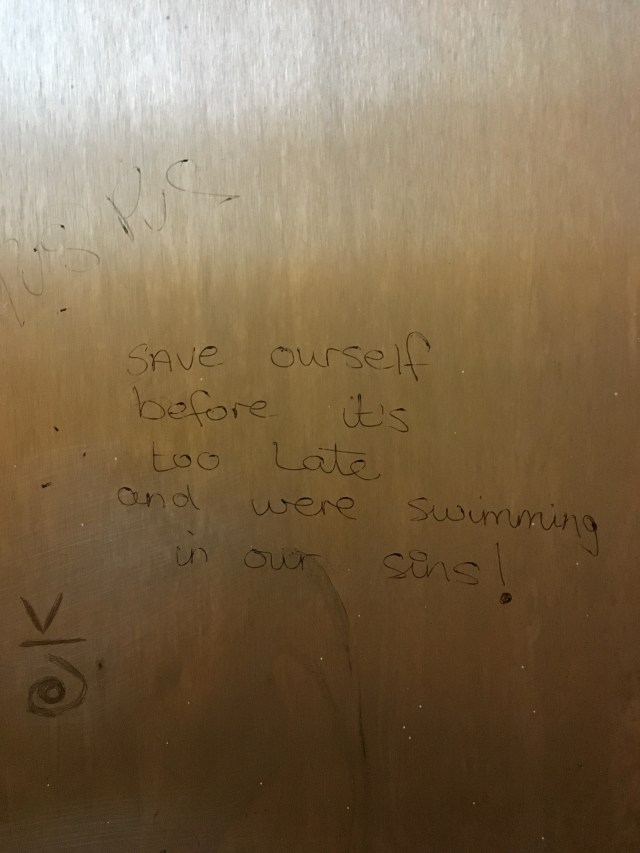
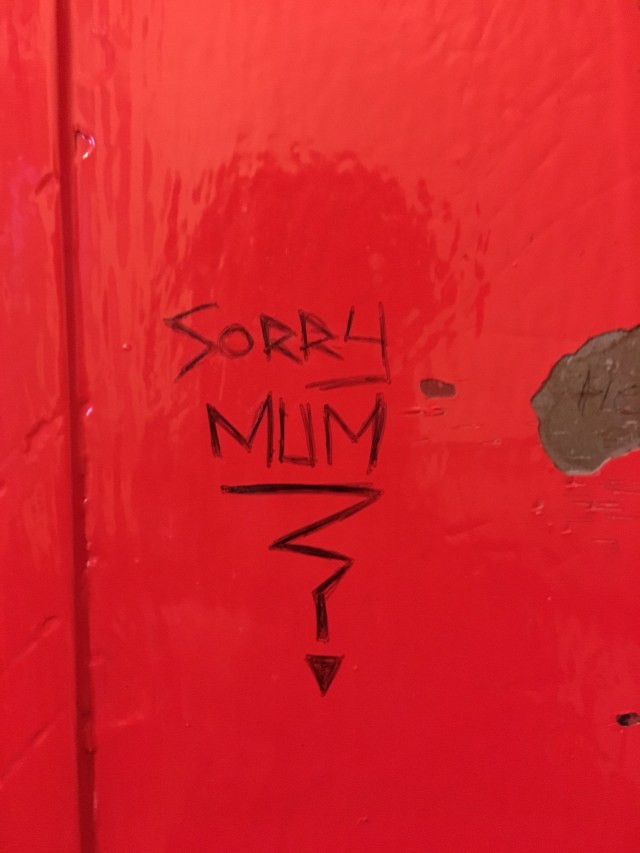
The Artangel exhibition features many striking pieces of artwork and installation. But more than that still, I was struck by art on display that had not been commissioned – and art that has not received much attention as of yet: the creatively destructive art (partly verbal, partly visual) left behind by the inmates of the prison.

Please note: if you are easily offended by gratuitous strong language, obscenity, and nudity, please stop reading now.

As a scholar who has studied ancient Roman graffiti and inscribed poetry, I cannot help but feel the urge to document some of the particularly remarkable pieces here. So, without further ado, here is a short, selective gallery of Lesser Known Ballads of Reading Gaol – as well as some other forms of verbal and non-verbal installations.


Poems

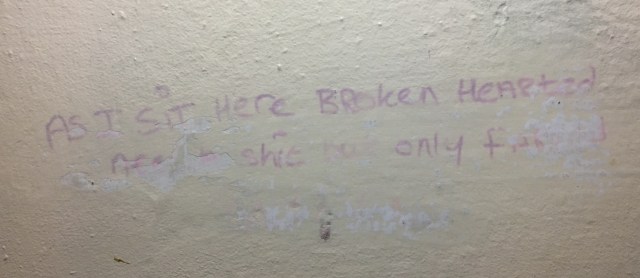
IMG_5946.jpg

As I sit here broken hearted
need to shit but only farted.

IMG_5963.jpg

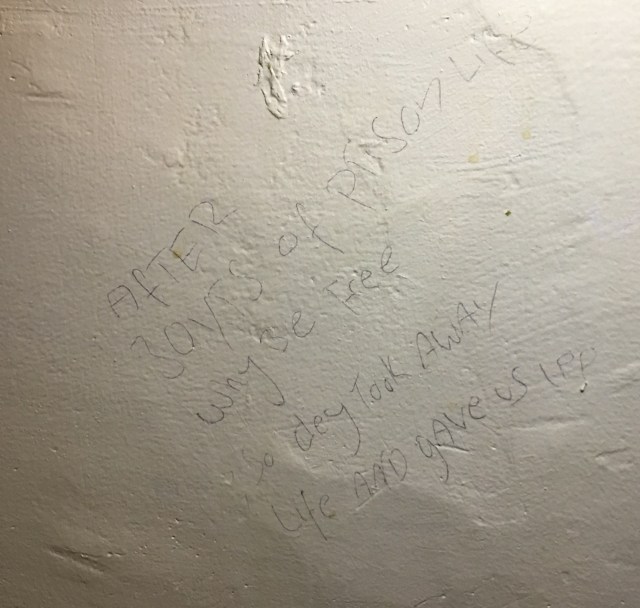
After
30 y(ea)rs of prison
why be free
so dey took away
life and gave us IPP.

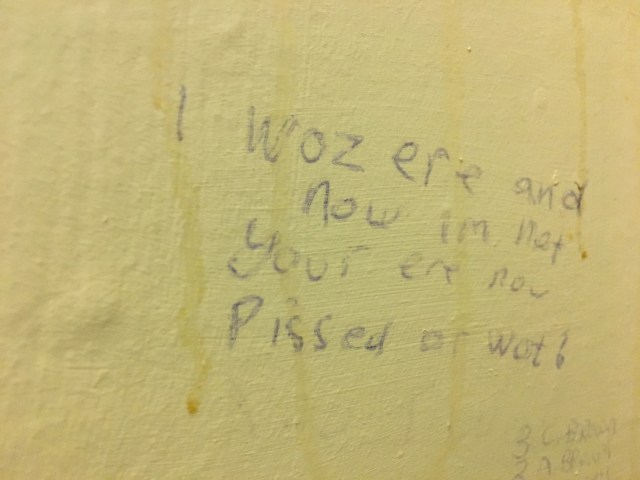
IMG_5967.jpgI woz ere and
now im not
your ere now
pissed or wot?

IMG_5978.jpg

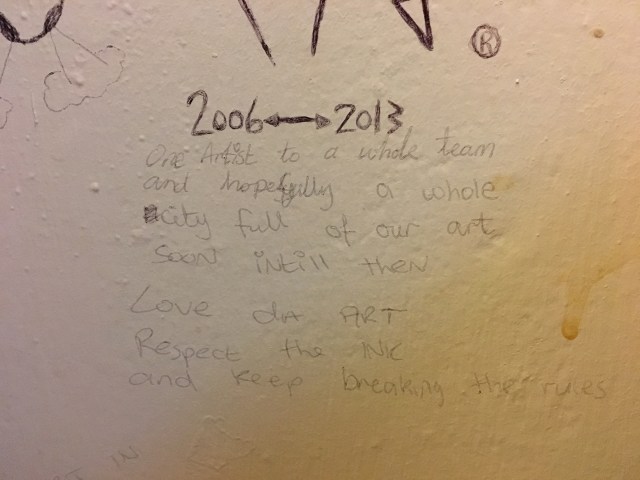
One Artist to a whole team
and hopefully a whole
city full of our art
soon intill then
Love da ART
Respect the INK
and keep breaking the rules.

IMG_5988.jpg

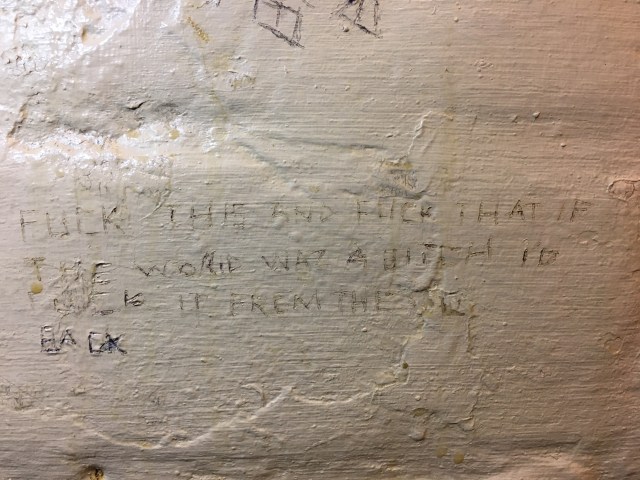
Fuck this and fuck that if
the world waz a bitch I’d
fuck it from the
back.

IMG_6007.jpg

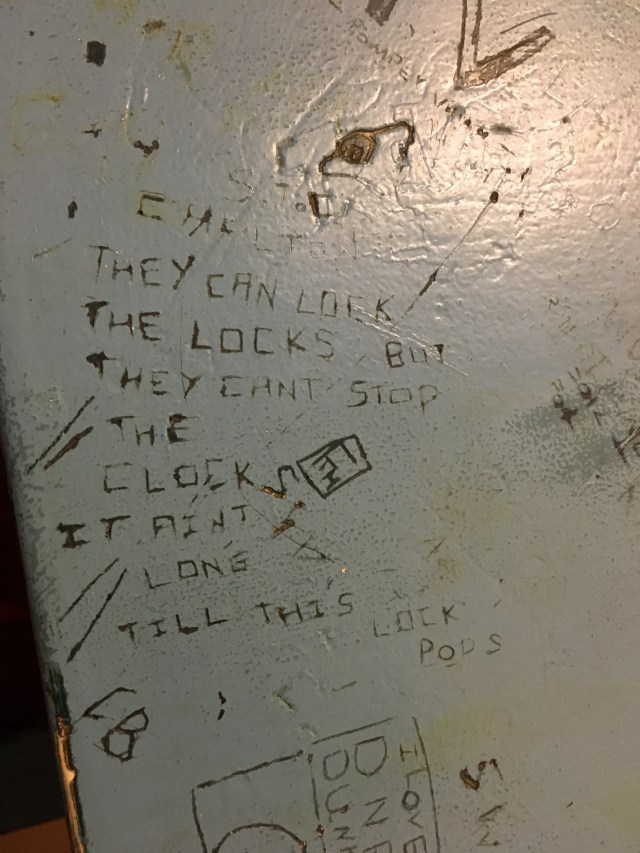
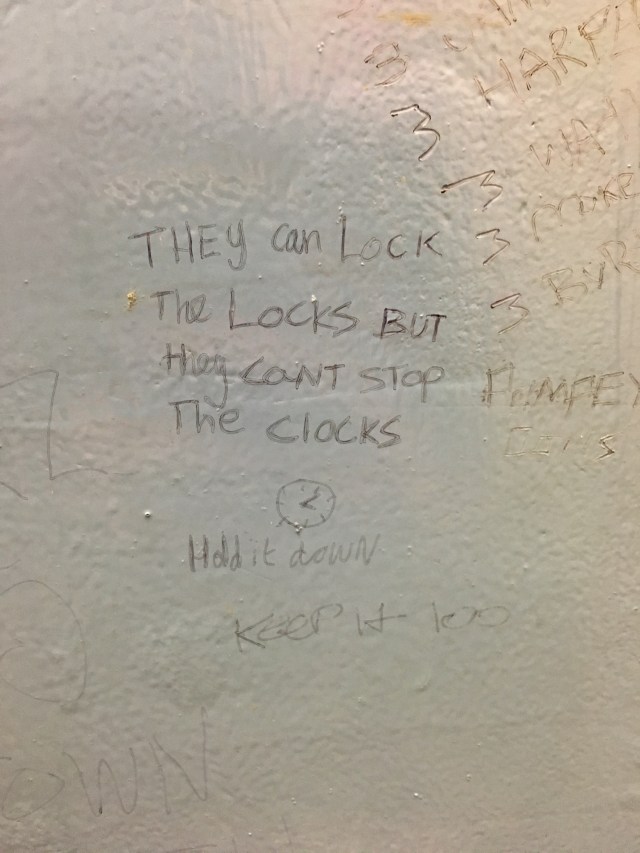
They can lock
the locks, but
they can’t stop
the
clocks.
It ain’t
long
till this
lock
pops.

IMG_6009.jpg

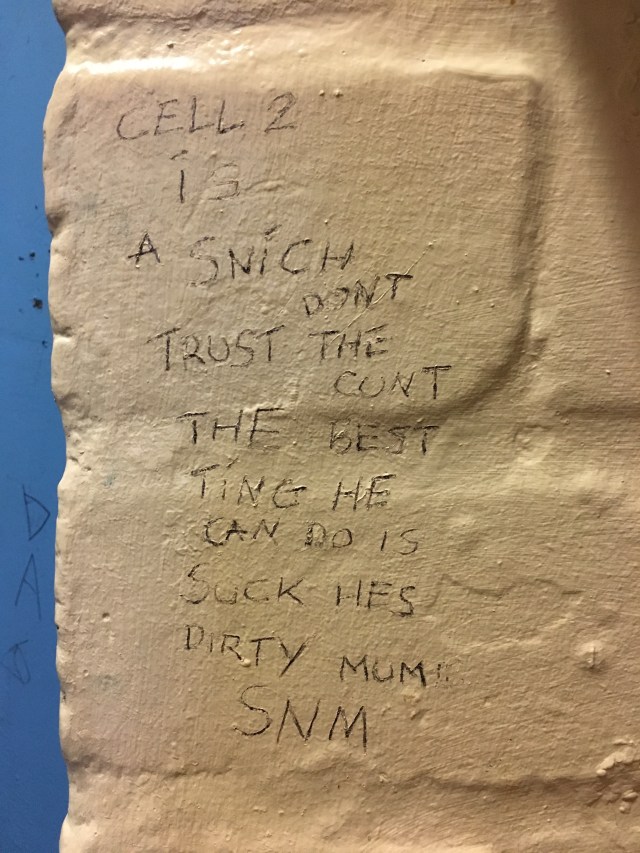
Cell 2
is a snich
don’t
trust the
cunt
the best
ting he
can do is
suck hes
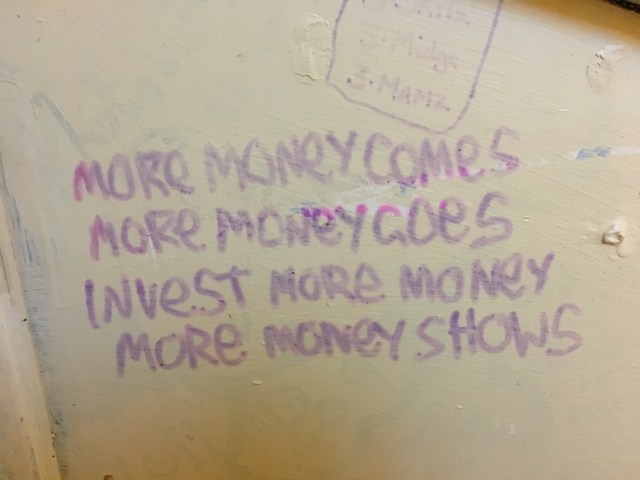
dirty mum.IMG_6012.jpgMore money comes
more money goes
invest more money
more money shows.

IMG_6019.jpgThey can lock
the locks but
they can’t stop
the clocks.


Drawings

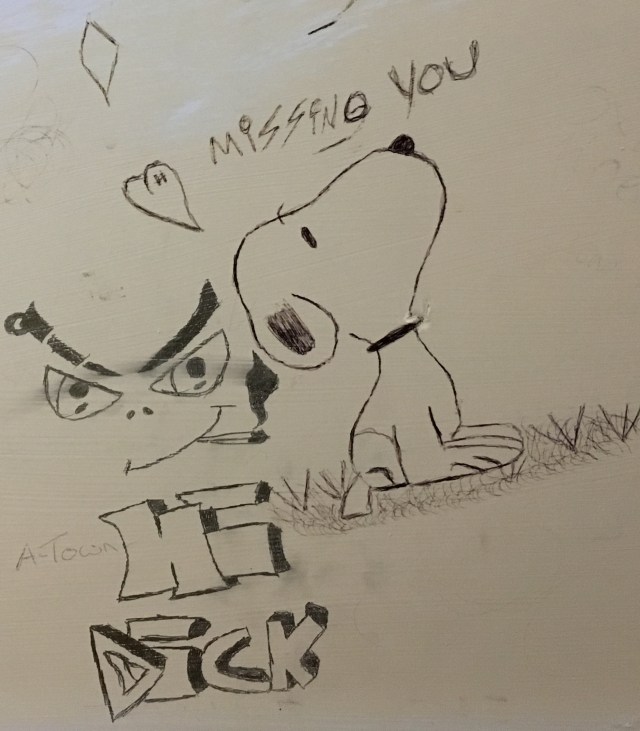
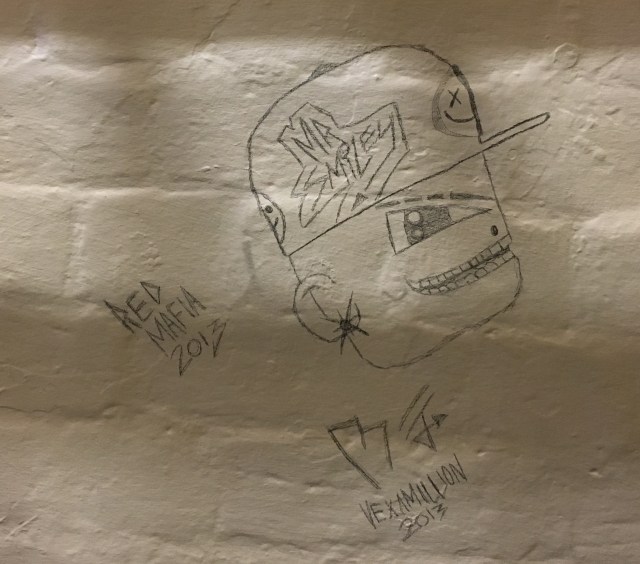
IMG_5954.jpgIMG_5936.jpgIMG_5984.jpgIMG_5922.jpgIMG_5917.jpgIMG_5916.jpgIMG_5994.jpgWitticisms

IMG_5955.jpg

IMG_5960.jpgIMG_5976.jpg

IMG_5981.jpg


The other side

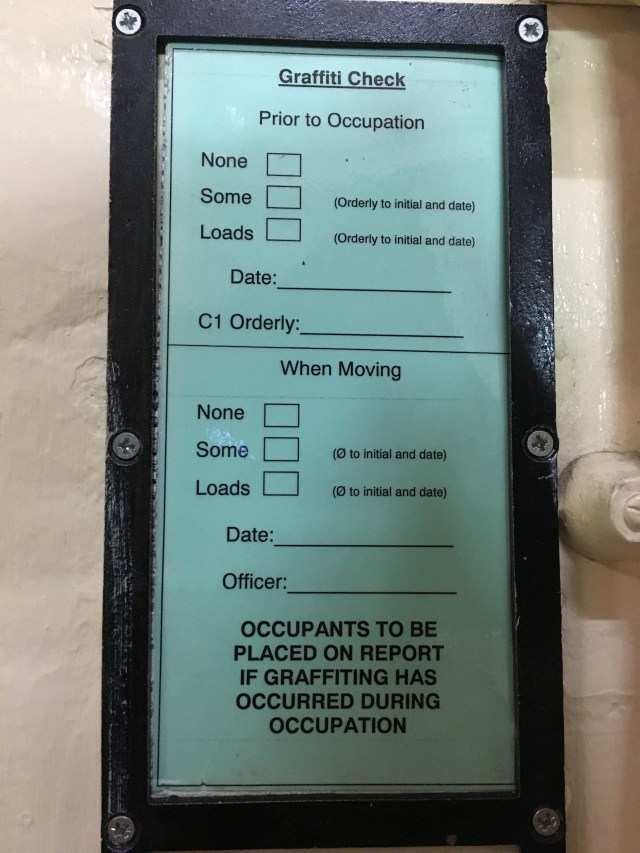
By the doors of some cells, check lists for graffiti and vandalism are still on display:

IMG_5950.jpg

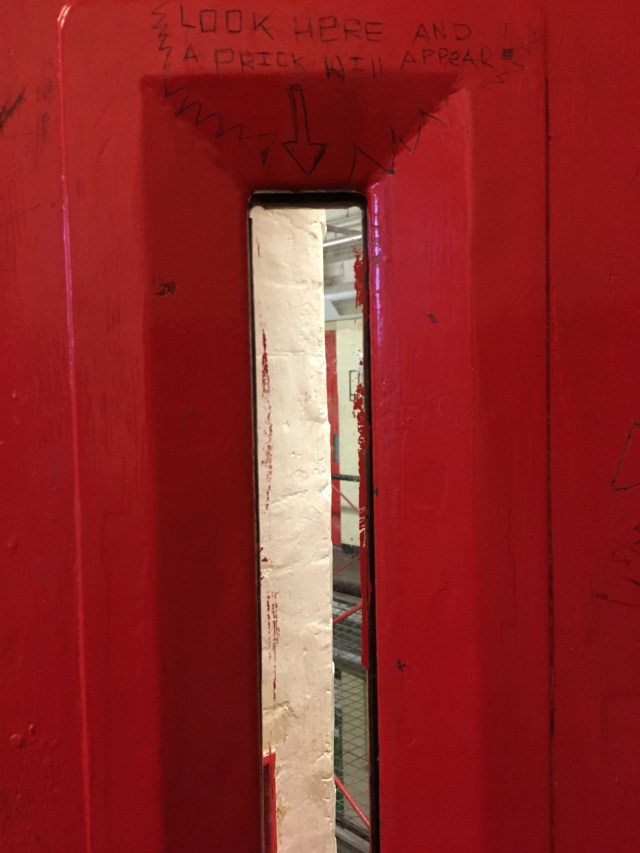
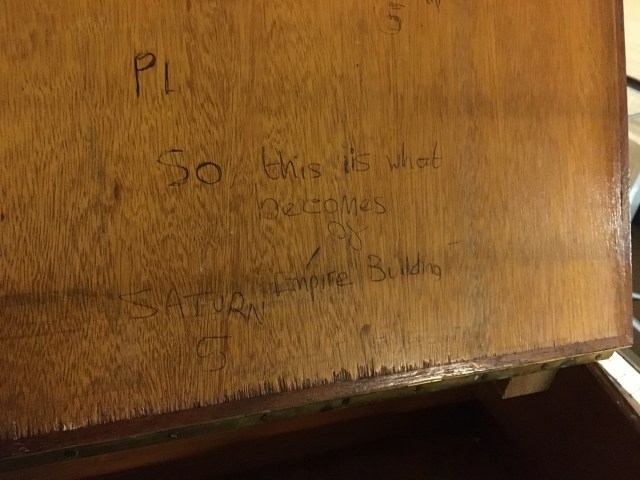
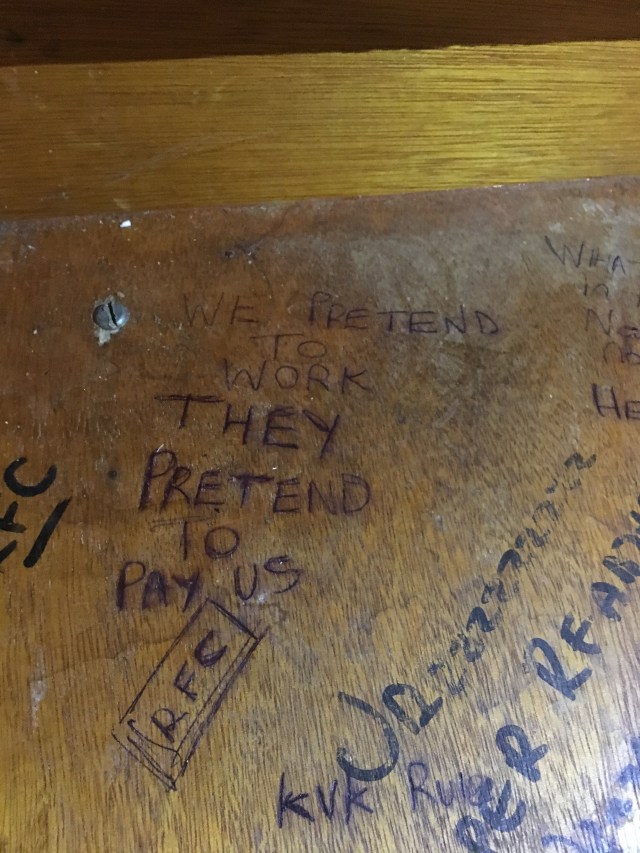
But, rather unsurprisingly, the inmates were not the only ones with too much time on their hands and a desire to leave their mark. Here are just a couple of scribblings from the inside (!) of wooden boxes for guards overseeing prison tracts:

IMG_6022.jpgIMG_6023.jpg


A final comment

On 27th of May I wrote to Rob Wilson, MP for Reading East, requesting permission to document the graffiti of Reading Prison and to collect them (potentially) for a small publication.

On 1st of June, Rob Wilson’s office confirmed receipt and stated:

‘You will be pleased to know that I have raised your request with Andrew Selous MP, Parliamentary Under-Secretary of State (Minister for Prisons, Probation and Rehabilitation) at the Ministry of Justice.

‘I will contact you again as soon as I receive a substantive response.’

As I had not received a substantive (or, in fact, any) response after a month, I followed up on this (on 8th of July) and was eventually told (on 12th of July), if in somewhat kinder words, not to bother any further.

Of course, what do I know about the inscriptions of Reading (Latin and otherwise) . . .

Posted in Carmina Epigraphica, History of Reading, Poetry | Tagged , , , , , , | 2 Comments

Hello Stranger, or: Pompeian Greetings from Beyond the Grave!

The Roman town of Pompeii has provided us with many a remarkable piece of evidence for virtually all aspects of Roman life and civilisation. Yet there are a number of things which are conspicuously lacking (and not for all of them is there an obvious reason for their absence).

Today, I will take one item off that list (well, my list, anyway), though not necessarily in the way I expected it to happen.

Followers of my blog will know that, among my various hobbies, inscribed Latin poems – poetry on tombstones and the like – rule supreme.

Even though extensive cemeteries outside the city gates of Pompeii have been excavated, documented, and studied (see here for a recent, excellent comprehensive study), not a single monumental funerary poem has emerged from the graveyards of Pompeii thus far.

The closest one gets to a monumental poetic text from Pompeii’s cemeteries is a stunning, intriguing curse from a tomb at the Via delle Tombe outside the Porta Nocera (near the amphitheatre; AE 1960.64). The text is not a poem stricto sensu, even though it contains phrases that are certainly reminiscent of inscribed Latin verse:

Hospes paullisper morare | si non est molestum et quid euites | cognosce. amicum hunc quem | speraueram, mi esse ab eo mihi accusato|res subiecti et iudicia instaurata. deis | gratias ago et meae innocentiae, omni | molestia liberatus sum. qui nostrum mentitur | eum nec Di Penates nec inferi recipiant.

Visitor, sojourn a little, if it is no bother, and learn what to avoid: this friend, whom I had hoped to be my friend – by him were accusers brought forth and legal proceedings initiated against me. I thank the gods and my innocence, I was freed from all bother. He who lies about us: may he never be welcomed by the household gods and the gods of the underworld.

I have talked about this piece a couple of times before (see here and here). While it is a most astonishing document indeed for all sorts of reasons, I was never particularly intrigued by the way it interacted with the audience.

This may have been a mistake, for two reasons.

First, what occurred to me the last time I saw this inscription (on occasion of a summer course on which I had the good fortune and absolute pleasure to teach for the École Francaise de Rome) was just how peculiar its opening really is.

To be sure: Roman tombstones address the wayfarer (uiator) or stranger/visitor (hospes) all the time, and there is nothing unusual about it here. Unless, of course, one is not already standing in front of the text . . . !

The way in which we tend to study Latin inscriptions is static and often on the basis of transcriptions, not in the field and with a genuine understanding of how they would have been encountered by the Romans themselves, in time and space.

So I had this idea.

I decided to produce a piece of amateur-ish applied epigraphical science – epigraphy in 4D, using the camera of my mobile phone at eye level while going on a little walk.

The following video is the result of that: it takes you from the cippus of Titus Suedius Clemens in a westbound direction along the Via delle Tombe to the tomb of Vesonius Phileros, at an idling pace, and with a readiness actually to look at the monuments (no sound included – but imagine the sound of birds and crickets to accompany it, as well as almost unbearable heat, as additional features that shape the actual experience):

Having gone through this sequence again and again, immersing myself into the four-dimensional world of Roman graveyards, I now feel safe in the assumption that a phrase like hospes paullisper morare, ‘visitor, sojourn a little’, is not an attempt to reach out to an audience that is in a hurry (as often implied in the texts that use related phrases).

In fact, unless one is already idling and ready to read these texts, it is virtually impossible to read these words (and thus to get drawn into the text) at all.

Much rather, they would appear to be an invitation to sojourn extended to those who are already idling – a polite form of address, like that of an inn-keeper outside their restaurants, trying to draw a paying crowd (which, incidentally, makes good sense with regard to the word hospes – a hospes is a ‘guest’: hence the English word ‘hospitality’!).

And then there is that second reason.

The phrase hospes paullisper morare, ‘visitor, sojourn a little’, made me think of something else as well – and that is where my considerations regarding (the lack of) funerary poetry from Pompeii come full circle.

One of the reasons that have been adduced by scholars for the absence of monumental poems from the graveyards of Pompeii is the date of Pompeii’s destruction. While there are a lot of poetic graffiti and dipinti from Pompeii (even  in the context of the burial areas), the practice of funerary Latin verse inscriptions had not fully developed yet around Pompeii at A. D. 79, some colleagues have argued.

I was inclined to believe that, to an extent, until I searched for further uses of the term hospes at Pompeii. Much to my surprise (I knew the text that I found, in fact I have talked about it here before, but I simply had not made the connection), there IS a funerary poem that has emerged from Pompeii after all!

Why did I not notice it before?

The reason is simple: the poem was not discovered on a graveyard, and it is not monumental.

And yet it is irrefutable evidence for an awareness of the practice of inscribed Latin verse in funerary contexts at Pompeii. It reads (CIL IV 8899 = Zarker 124, discovered at III 5.4, along the Via dell’Abbondanza):

Hospes adhuc tumuli ni meias ossa prec[antur],
nam si uis (h)uic gratior esse caca.
Urticae monumenta vides discede cacator
non est hic tutum culu(m) aperire tibi.

Stranger, my bones beg you not to pee at my tomb: if you want to do the deceased an even bigger favour: take a dump! You see the tomb of Urtica [= ‘Stinging Nettle’]: go away, shitter! It is not safe for you to open your buttocks here.

It seemed only too fitting: a commemorative, funerary poem about bodily functions in honour of a deceased stinging nettle!

Only Pompeii would provide us with a subversive, heavily scatological parody of an established genre for which there is no actual evidence at Pompeii itself (so far) rather than the real thing . . . !

Posted in Carmina Epigraphica, Uncategorized | Tagged , , , , , | Comments Off on Hello Stranger, or: Pompeian Greetings from Beyond the Grave!

A Chilling Letter from Ancient Rome

It has been a couple of years since I last posted a chilling Halloween story from the ancient world, and it has also been quite some time now since I last blogged: I blame a spooky-scary workload!

At any rate, time to resume blogging, time for a story worthy of the occasion. So … here it comes: a translation of the younger Pliny‘s most famous spooky letter (Plin. epist. 7.27):

Gaius Plinius to his Sura: greetings!

Leisure grants opportunity – for me to learn and for you to teach me something. For I should eagerly like to know whether you believe that ghosts exist and have a proper appearance and a spirit, or whether you think that they are a humbug and absurdities that spring from our imagination.

I do believe they exist, and I come to that conclusion primarily from what I head had happened to Curtius Rufus. When he was still insignificant and a non-entity, he had been assigned to the governor of Africa as an attaché. As the day was leaning towards its end, he took a walk in the colonnade. A woman’s shape appears to him, exceeding a human in size and beauty. He was terrified, and she tells him that she was Africa, who had come to tell him of things to come: he was to go to Rome and to hold office, and even to return to this very same province with supreme command: and there he was to die. All this became true. And there is even talk that, when he arrived at Carthage and left the boat, he encountered the same apparition on the shore. Certainly, when he had fallen ill, he provided explanations for the present on the basis of the past as well as such for future on the basis of the present, and he let go of all hope for his health – even when no one in his company was concerned for him.

But isn’t this next story, which I will tell just the way I heard it, even more dire and hardly less astonishing? There was a house in Athens, spacious and sizeable, but also with a horrendous reputation and a bringer of destruction. Through the silence of the night the clangour of iron, and if you listened more carefully, the rattling of chains resounded, at first from a distance, then coming closer. Soon after that, there was an apparition, an old man, emaciated and squalid, with a long beard and dishevelled hair. There were fetters around his feet, in his hands he held chains and shook them. This caused the inhabitants upsetting, horrifying nights through which they stayed awake in horror. Sickness followed their lack of sleep, and eventually death, as fear grew further. For even during daytime, even though the apparition had vanished, the memory of what they had seen remained in front of their eyes, and thus their dread outlasted the dread’s causes. Thus the house had become deserted and condemned to being abandoned, being left to this monstrosity altogether. Yet it was advertised, be it that someone, unaware of such evil, had any desire to buy or rent it.

The philosopher Athenodorus came to Athens. He read the advertisement, and, when he had heard about the price, he began to inquire, as the cheap price sounded suspicious to him. He found out about everything and still he was no less keen – in fact: he was rather more – to rent the place. When the evening came, he ordered for a resting place to be placed in the front part of the house. He demanded his notebooks, a stylus, and a lamp, and then sends all his servants off into the inner rooms. He himself focused his mind, eyes, and hand on writing, lest an unoccupied mind were to make up phantom noises and baseless fears. At first, as normal, there was the silence of night. Then shaking of iron, fetters being moved. He did not lift his eyes, did not let go of the stylus, but strengthened his mind and blocked his ears. Then the eerie sound grew bigger, came nearer, it already was on his doorstep, and then it was heard in his room. He turns around and sees and recognises the apparition that he was told of. It stood there and gave him a sign with its finger, as though he was summoning him. He, however, gives it a sign with its hand to wait a little and returns to his wax tablets and his stylus. The apparition sounds off its chains over the head of the man as he was writing. He turns around again and sees it summoning him as before, and without further delay he takes his lamp and follows it. It walks with slow steps, as if weighed down by chains. As it enters the house’s courtyard, it suddenly disappears and leaves its companion alone. Left alone, he plucks some weeds and leaves and places them on that very spot, as a mark. The next day, he goes to the magistrates, asks them to command for that spot to be dug up. Bones are discovered, caught and tangled up in chains, which had emerged in decay from a body, rotted away through age and soil, and been left to the chains. They pick them up and bury them publicly. Once the spirits of the departed had been buried properly, the house then was free of them.

I trust those who vouch for these stories. I can guarantee others for the next one. I have a freedman, not at all uneducated. His younger brother used to sleep with him in the same bed. That man saw that someone sat on him, on the blanket, applying scissors to his head, already cutting off some hair from the top of his head. When it dawned, he was shorn around the top of his head, and hair was discovered lying around him. Only very little time elapsed, and something similar did the same again, confirming the truth in the former. A slave-boy used to sleep in the dorm with many others. Through the windows came, thus he tells, two men in white tunics and shore him as he was asleep, then they disappeared again the same way they had come. The next day revealed the boy shorn and hair strewn around him. Nothing worth noting followed, except that I was not indicted after all perhaps, which I was to be, if Domitian, under whom these things happened, had lived longer. For in his desk there was a pamphlet about me, given to him by Carus. Whence one may surmise, as people who are indicted customarily let their hair grow long, that the shorn-off hair of my folk had been a sign that the danger that was looming had been averted.

Now, apply your learnedness to these matters, I beg you. It is a worthy cause for you to study extensively and in detail, and I myself am not unworthy, surely, to receive the benefit of your learnedness. Of course, consider the positives as well as the negatives, as you always do, but do indicate your inclination, lest you keep me in suspense and indecision, as the whole point of my inquiry was to resolve my doubts.

Farewell.

Posted in Prose | Tagged , , , | 1 Comment